


基于神经网络的未来3天Kp指数预报建模与可解释AI应用
doi: 10.11728/cjss2024.03.2023-0107
-
 王听雨 男, 1996年7月出生于湖南省, 现为中国科学院空间科学中心特别研究助理, 主要研究方向为空间天气预报建模、人工智能与空间天气预报交叉. E-mail: wangtingyu@nssc.ac.cn
 -
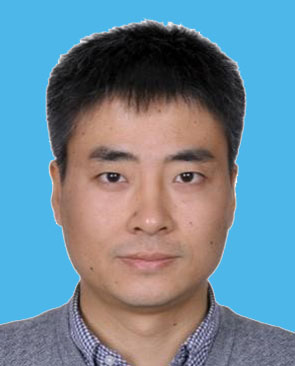 罗冰显 男, 1981年11月出生, 现为中国科学院国家空间科学中心研究员、博士生导师, 国家“万人计划”青年拔尖人才获得者, 中国科学院大学岗位教授, 长期从事空间天气和空间环境预报和应用研究. E-mail: luobx@nssc.ac.cn
作者简介:
通讯作者:
Modeling Next 3-day Kp Index Forecasting with Neural Networks and Exploring the Application of Explainable AI
-
摘要: 当前业务中对未来3天Kp指数预报需求强烈. 但地磁暴中多参数耦合导致难以量化各预报因子对Kp值的贡献, 制约了预报精度提升. 本文构建了神经网络3天Kp指数预报模型, 并使用人工智能(AI)可解释性算法定量化各因子贡献. 结果显示, 行星际磁场南向分量在提前3 h对Kp指数的贡献为37.15%, 为主要因子, 说明模型能捕捉符合物理特征的主要预报因子. Kp指数历史特征贡献随提前量逐渐增加, 提前3天总体贡献占68.06%, 验证了对冕洞高速流引起的地磁暴事件的预报能力. 对2015和2017年特大地磁暴进行贡献分析, 模型准确捕捉了地磁暴多参数耦合的复杂特性. 研究表明, 可解释AI算法在一定程度上能定量化各预报因子对Kp指数的预报贡献, 有助于改进未来3天Kp指数AI预报模型.
-
关键词:
- 地磁暴 /
- 未来3天Kp指数预报 /
- 神经网络 /
- 可解释性AI算法
Abstract: The current operational needs of space weather forecasting strongly require accurate predictions of the future 3-day Kp index. Such forecasts involve a multitude of predictors, including physical parameters observed at the Earth-Sun L1 point and historical characteristics of the Kp index. Therefore, previous research primarily relied on statistical or empirical methods for prediction. However, the complex coupling of multiple parameters during geomagnetic storm events has made it challenging to quantify the contributions of various predictors to Kp index forecasting over a 3-day timescale, hindering further improvements in forecast accuracy. This study builds a 3-day Kp index forecasting model based on neural network modeling and utilizes explainable AI (Artificial Intelligence) algorithm, specifically the integrated gradient algorithm, to quantify the contributions of individual predictor. The research results indicate that the southward interplanetary magnetic field contributes significantly to Kp index prediction, accounting for 37.15% of all factors, making it the primary contributor. Following this, solar wind speed contributes 15.73%, underscoring the model's ability to capture parameters aligned with physical characteristics as the primary predictive factors during training. The contribution of historical characteristics of Kp index (recurrence characteristics) gradually increases with the forecasting horizon and reaches 68.06% at a lead time of 3-day. This substantiates the strong predictive capabilities of the AI model in forecasting geomagnetic storm events induced by high-speed solar wind streams originating from coronal holes. Furthermore, this study conducts contribution analysis on two significant geomagnetic storm events that occurred in 2015 and 2017. It reveals that the predominant predictors contributing to each event differ. This underscores the model's capability to accurately capture the complex coupling of multiple parameters in geomagnetic storm forecasting. In conclusion, this research demonstrates that employing explainable AI algorithms can help quantify the contributions of various predictive factors to Kp index forecasting to some extent. This has the potential to enhance further research and improvements in 3-day Kp index AI forecasting models. -

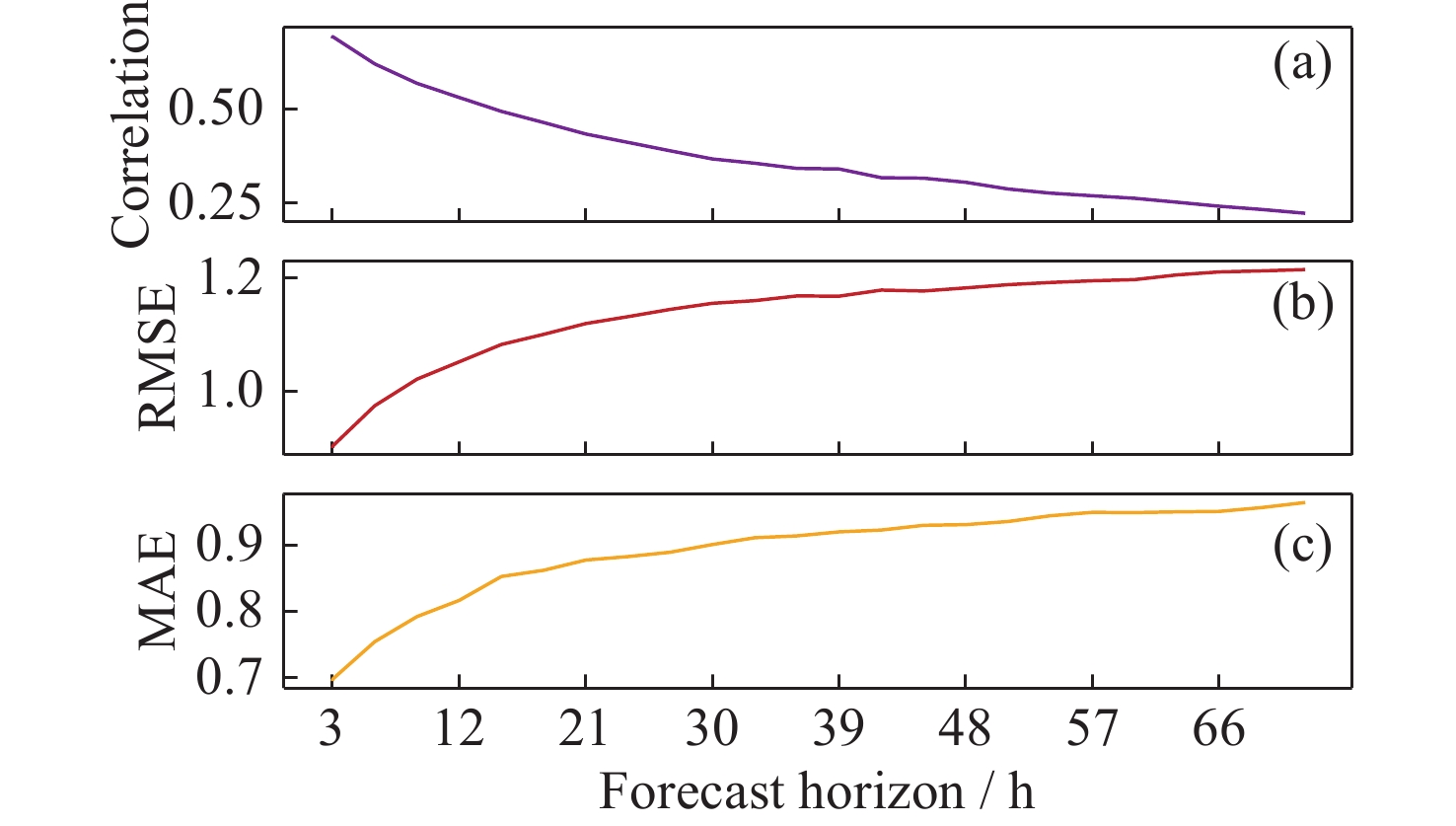
图 1 未来3天Kp指数预报模型评估结果(2011年4月至2022年6月). 曲线为评估指标随预报时长(3 h分辨率)变化的函数
Figure 1. Evaluation results (April 2011 to June 2022) of the future 3 day Kp index forecast. Model depict as a function of the forecast horizon (at a 3 h resolution)
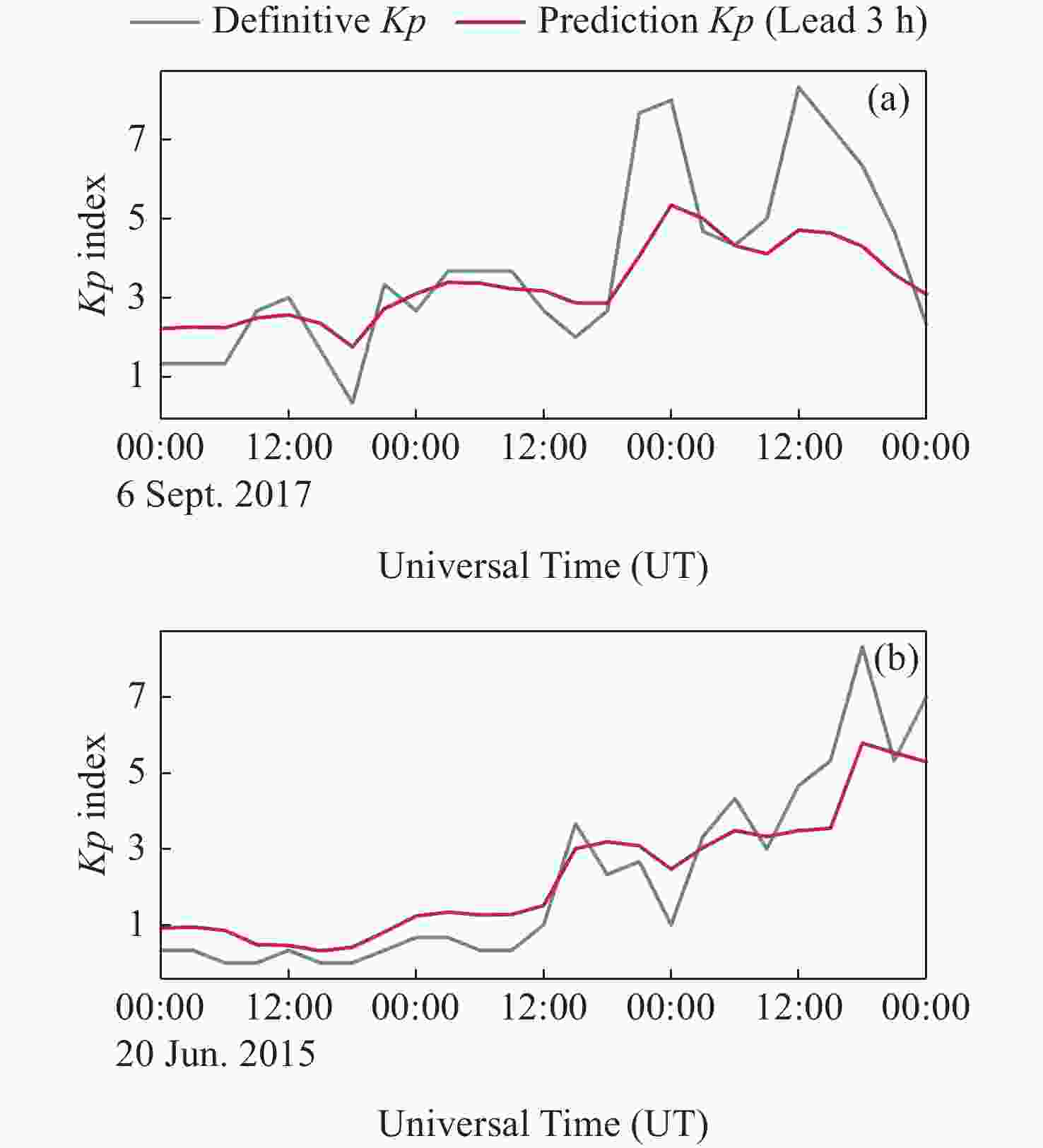
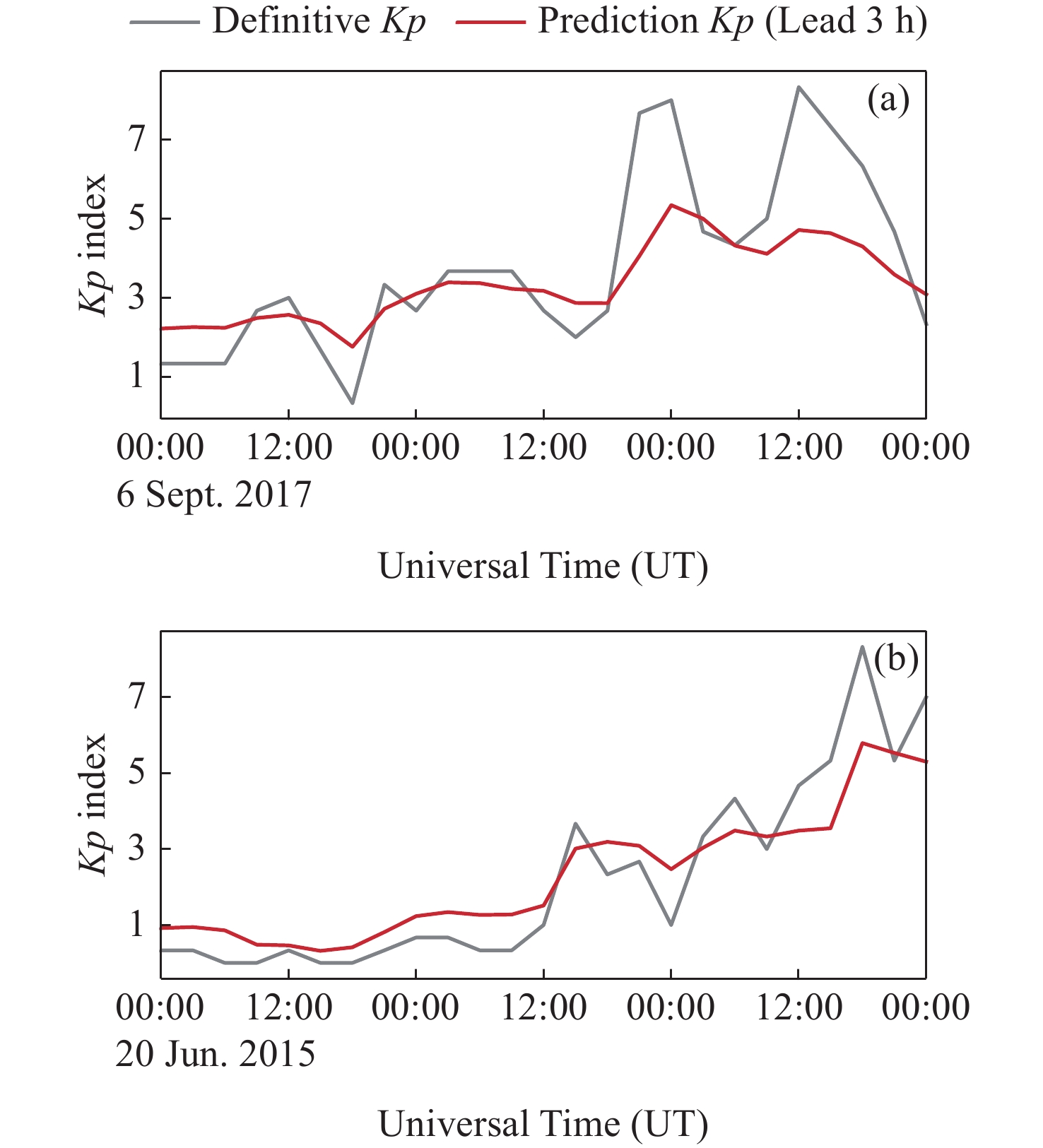
图 2 2017 年与2015 年两次特大地磁暴时实际结果与预报结果对比
Figure 2. Comparison between actual and forecasted Kp index for two extreme geomagnetic storms in 2017 and 2015
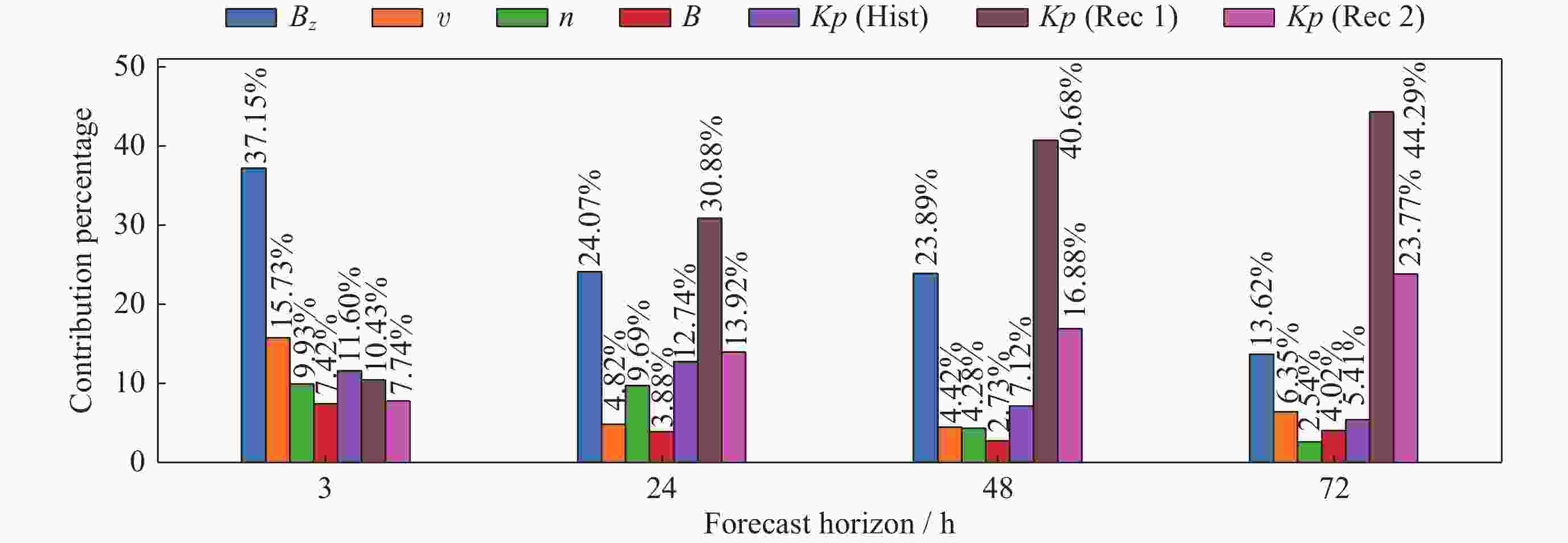
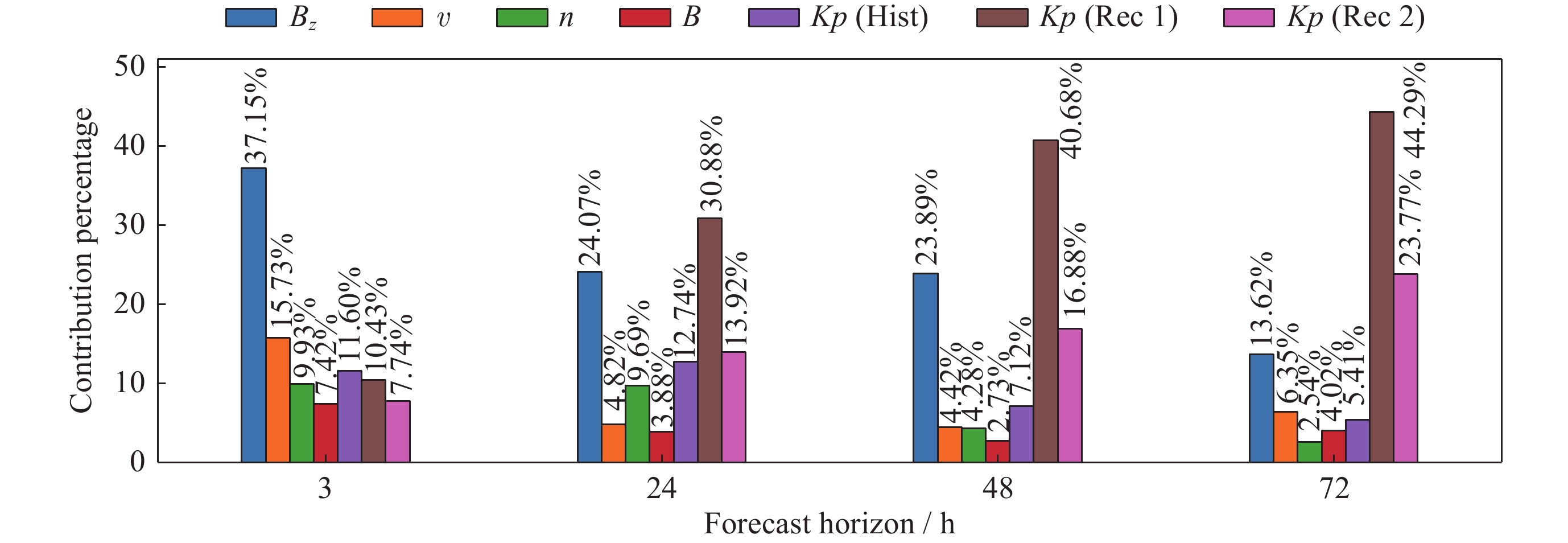
图 3 提前3, 24, 48, 72 h预报Kp指数时7类特征贡献值占比
Figure 3. Contribution percentages of the 7 categories of features forecasting the Kp index 3, 24, 48, 72 h in advance
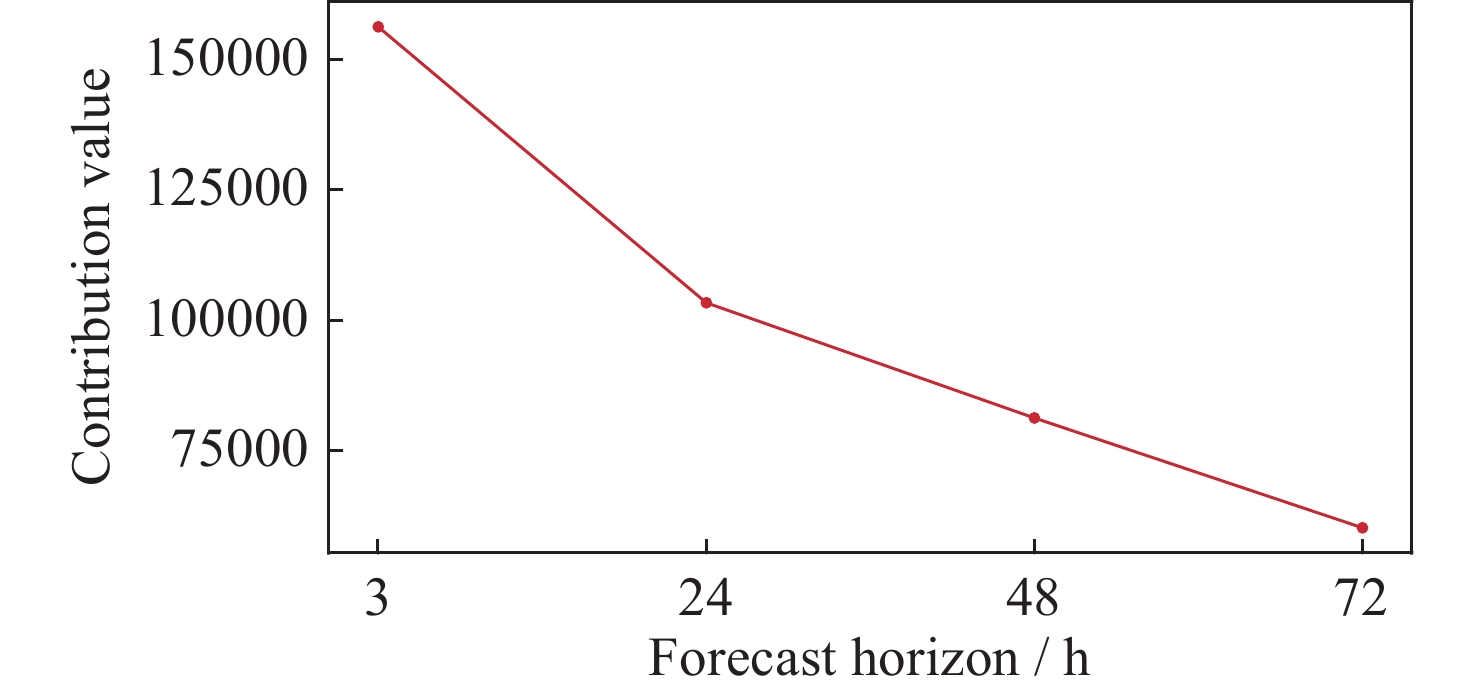
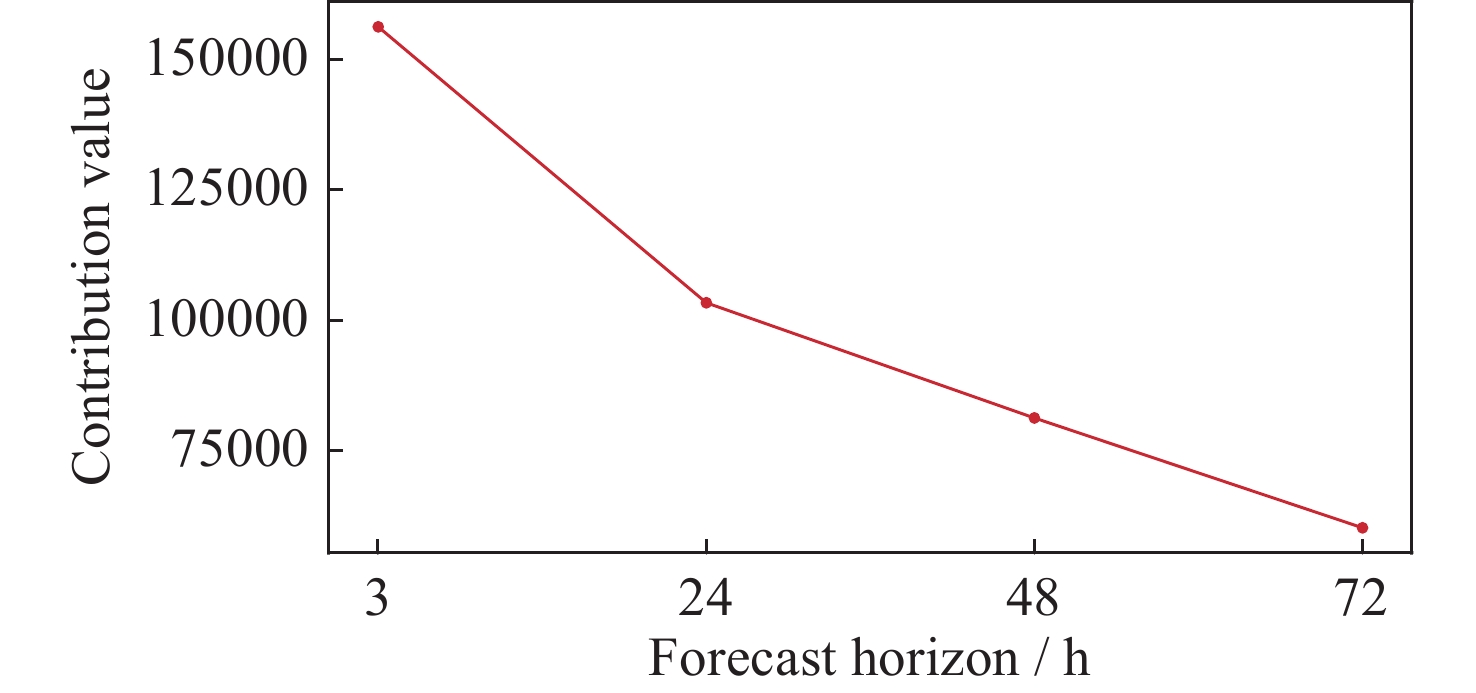
图 4 93个特征贡献度之和随预报时间的变化(提前3, 24, 48, 72 h)
Figure 4. Sum of contributions from 93 features as a function of the forecast horizon (3, 24, 48, 72 h ahead)
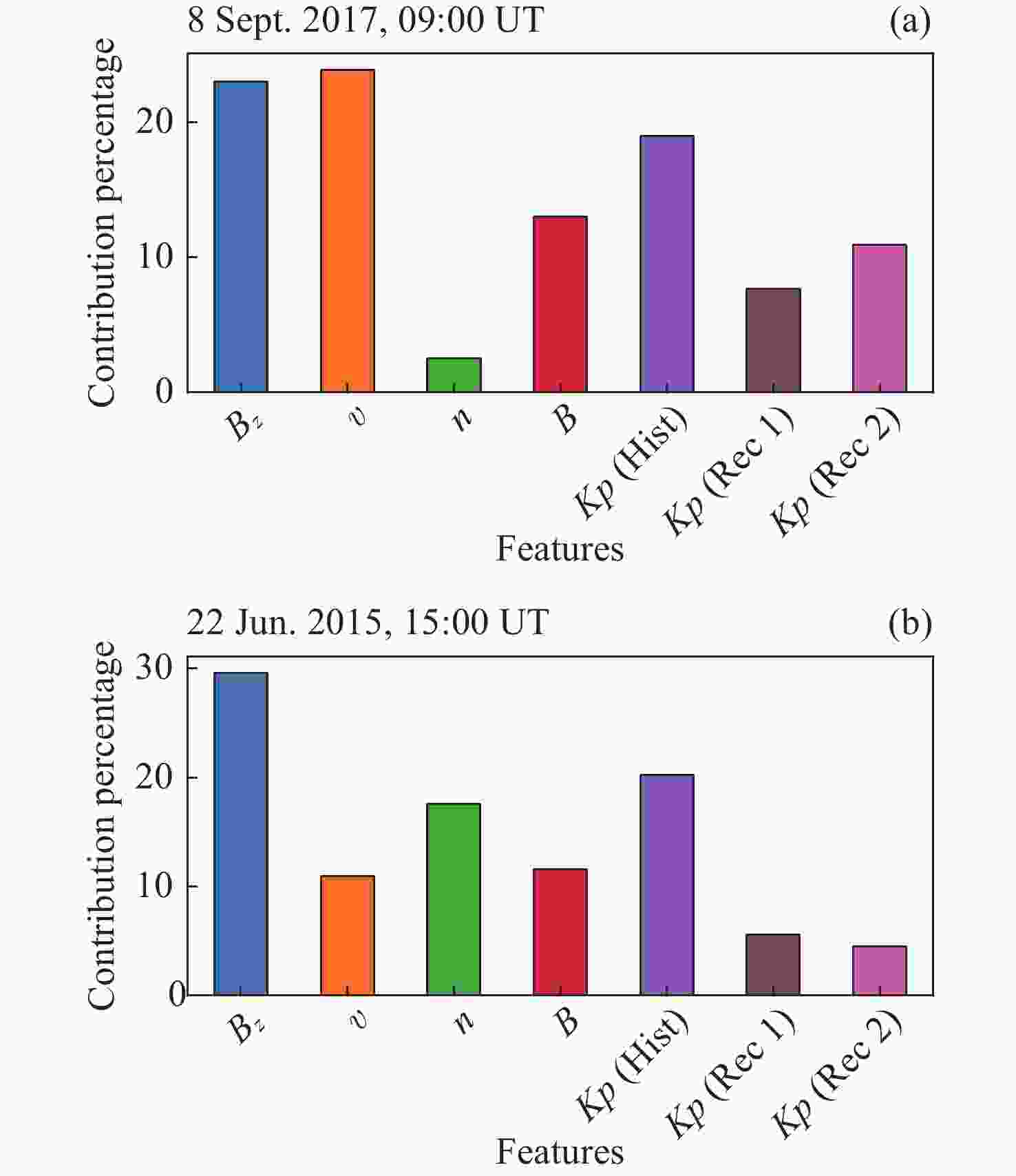
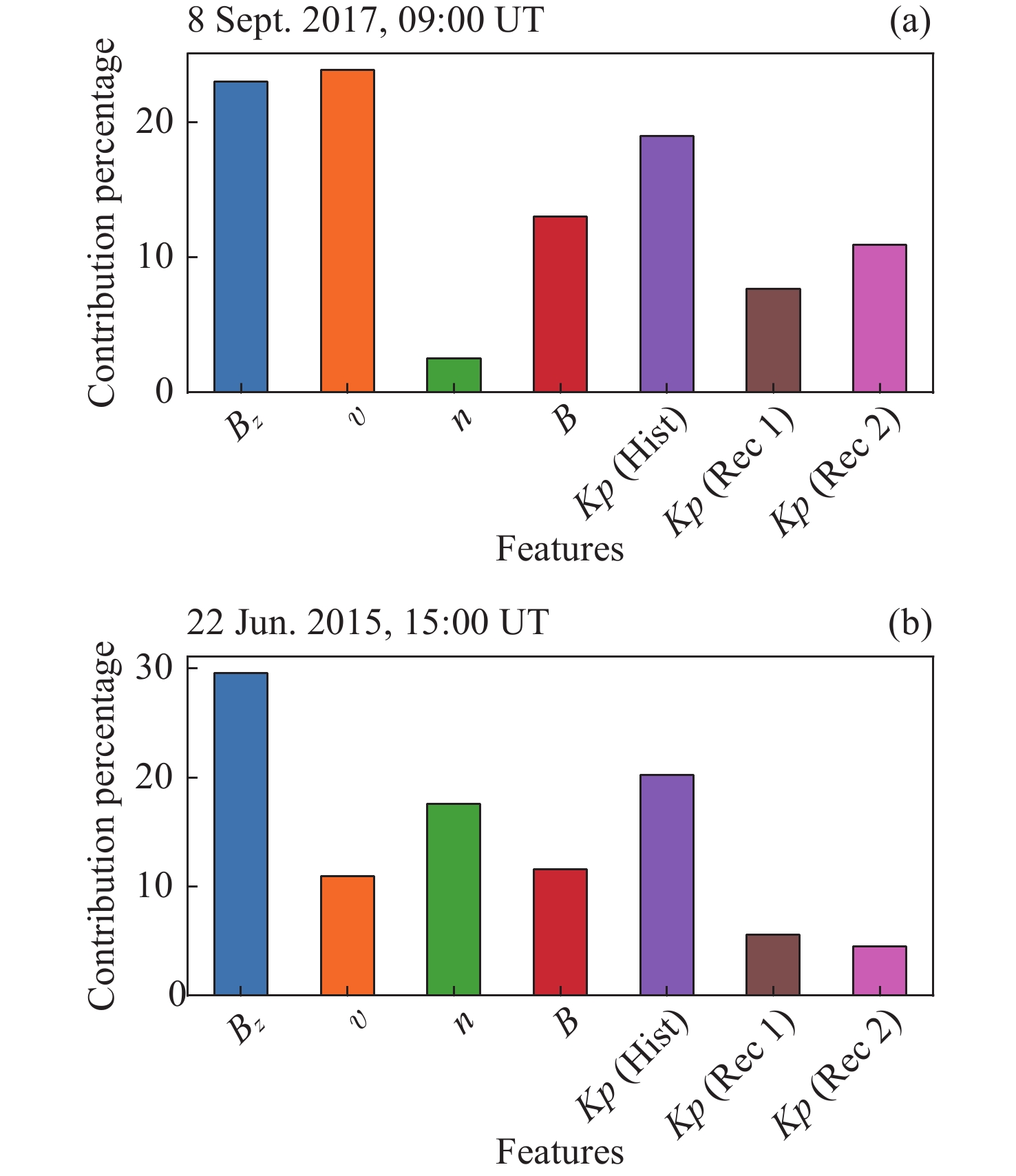
图 5 2017年与2015年两次特大地磁暴时7类特征对预报的贡献占比(提前3 h预报)
Figure 5. Contribution percentages of the 7 feature categories to the forecast during the two extreme geomagnetic storms in 2017 and 2015 (3 h lead time)
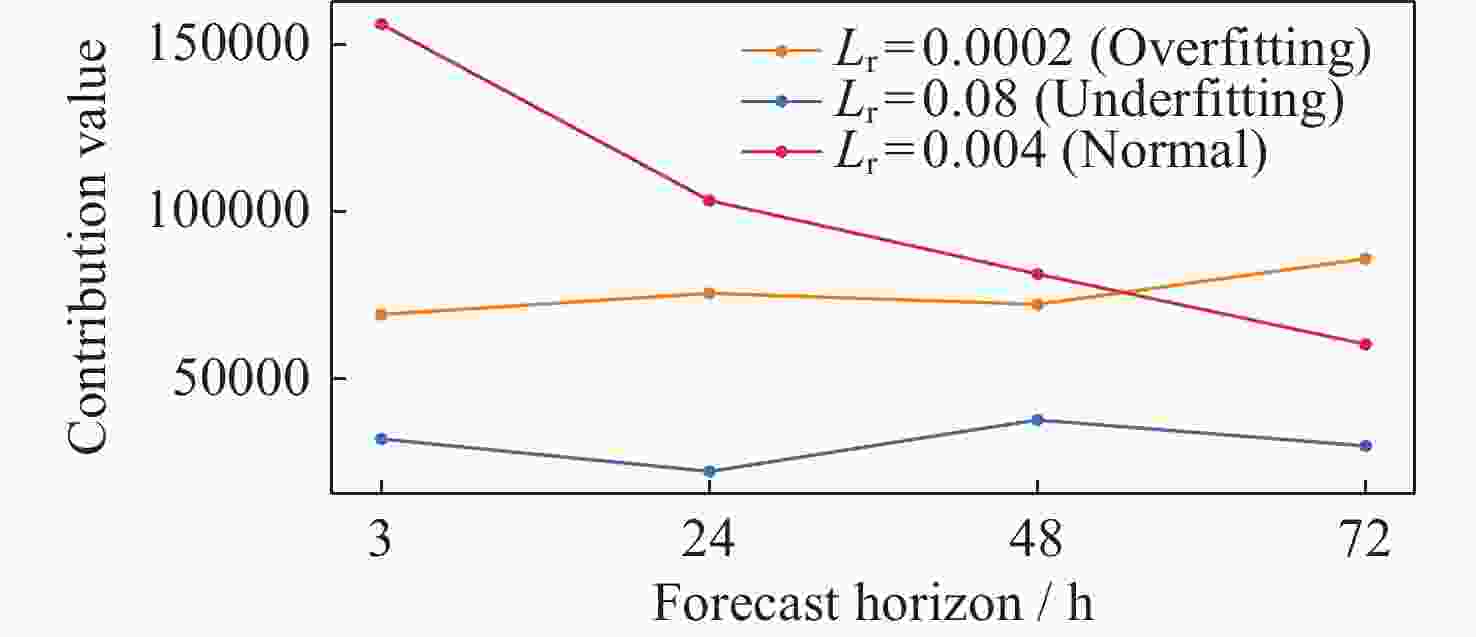
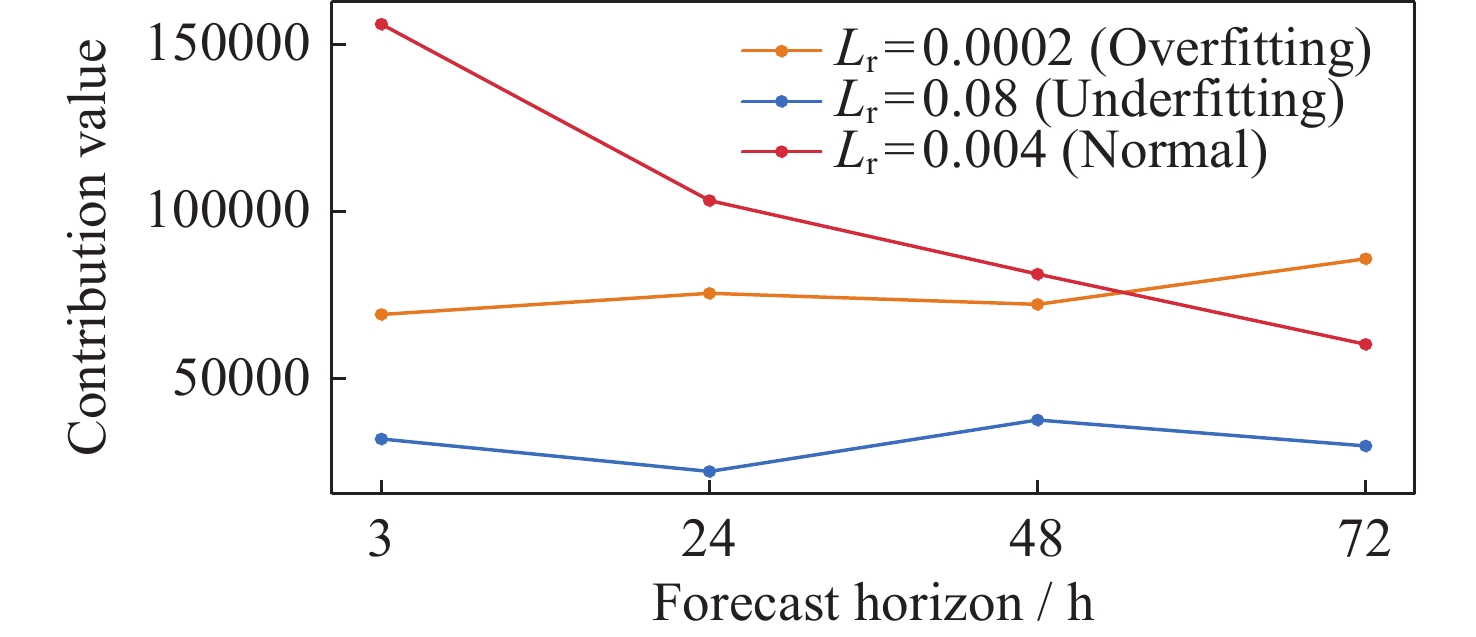
图 6 三种拟合能力不同的模型度量的总贡献度随预报时间的变化(提前3, 24, 48, 72 h)
Figure 6. Total contribution measured by three models with different fitting abilities varies over forecast horizon (3, 24, 48, 72 h in advance)

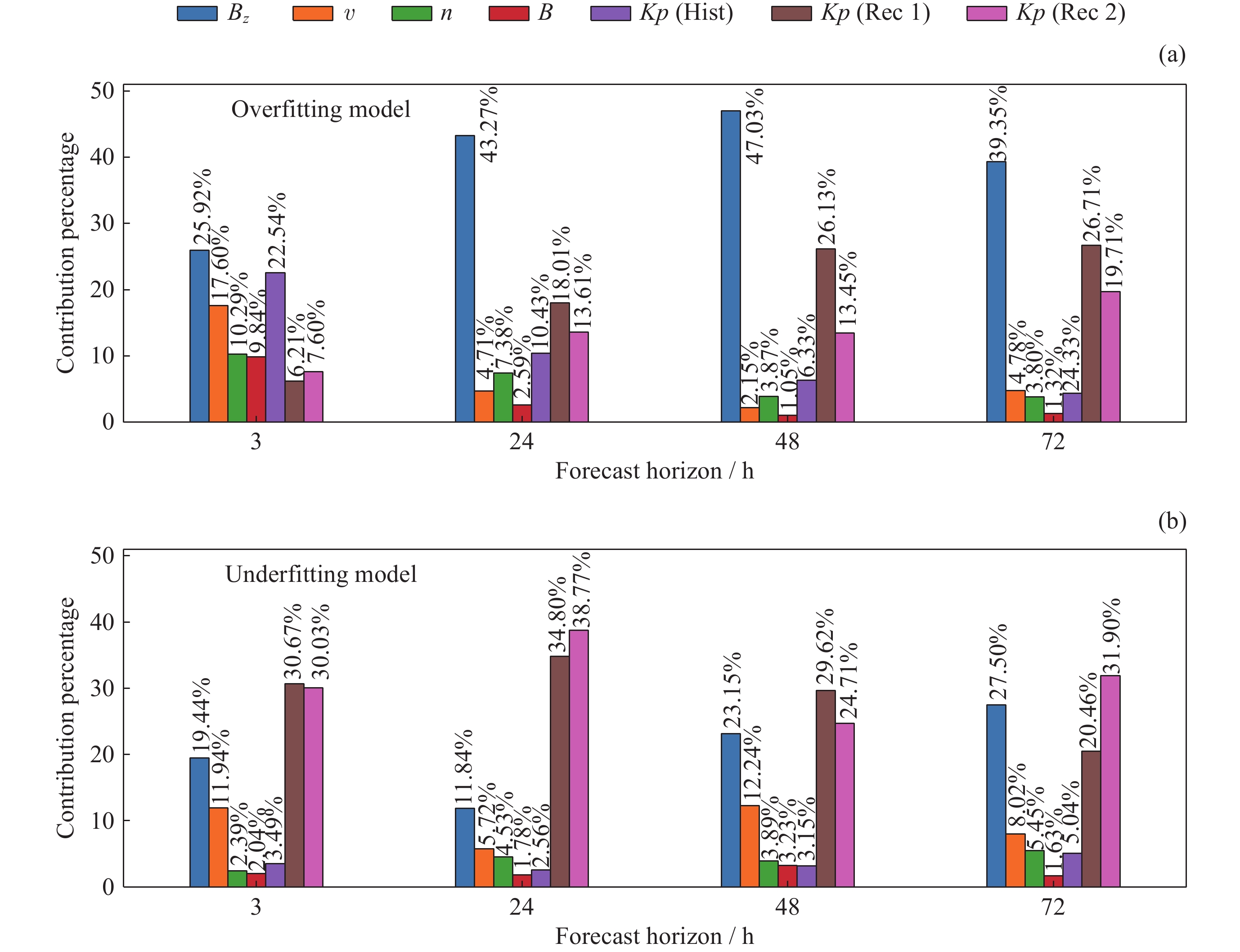
图 7 提前3, 24, 48, 72 h 预报Kp指数时7类特征贡献值占比
Figure 7. Contribution percentages of the 7 categories of features forecasting the Kp index 3, 24, 48, 72 h in advance
表 1 训练模型所用到的超参数以及训练策略
Table 1. Hyperparameters and training strategies used for training the model in this study
参数名 参数值/名称 Mini batch 1 Epoch 10 Optimizer AdamW Loss function MSE Learning rate 0.004 Momentum 0.6 Scheduler StepLR  下载: 导出CSV
表 2 用于输入模型的93个特征分类(按照物理参数或者物理特征进行归类)
Table 2. Classification of 93 features inputting into model (categorized by physical parameters or characteristics)
特征类型 特征因子 特征数 $ {{B}}_{{z}} $ 行星际磁场南向分量($ {B}_{z} $)在$ {T}_{0} $时刻之前的 0~3 h, 3~6 h 和 6~9 h内观测到的平均值、
最大值和最小值9 $ {B} $ 总磁场($ B $)在$ {T}_{0} $时刻之前的 0~3 h, 3~6 h和 6~9 h内观测到的平均值、最大值和最小值 9 $ {v} $ 太阳风速度($ v $)在$ {T}_{0} $时刻之前的 0~3 h, 3~6 h和 6~9 h内观测到的平均值、最大值和最小值 9 $ {n} $ 质子密度($ n $)在$ {T}_{0} $时刻之前的 0~3 h, 3~6 h和 6~9 h内观测到的平均值、最大值和最小值 9 H [Kp (Hist)] $ {T}_{0} $时刻之前的 3, 6和 9 h的Kp指数 3 R1 [Kp (Rec 1)] $ {T}_{0} $时刻之前的 26, 27, 28天(前一个太阳自转周期)的Kp指数在 6, 12, 24 h内的平均值、
最大值和最小值27 R2 [Kp (Rec 2)] $ {T}_{0} $时刻之前的 53, 54, 55天(前两个太阳自转周期)的Kp指数在 6, 12, 24 h内的平均值、
最大值和最小值27
下载: 导出CSV
-
[1] FANG T W, KUBARYK A, GOLDSTEIN D, et al. Space weather environment during the SpaceX starlink satellite loss in February 2022[J]. Space Weather, 2022, 20(11): e2022SW003193 doi: 10.1029/2022SW003193 [2] 罗冰显, 王荣兰, 刘卫, 等. “星链”卫星毁于地磁暴事件空间环境分析[J]. 国际太空, 2022(5): 35-39 doi: 10.3969/j.issn.1009-2366.2022.05.009LUO Bingxian, WANG Ronglan, LIU Wei, et al. Analysis of the space environment in the event of the destruction of the Starlink satellite by a geomagnetic storm[J]. Space International, 2022(5): 35-39 doi: 10.3969/j.issn.1009-2366.2022.05.009 [3] MATZKA J, STOLLE C, YAMAZAKI Y, et al. The geomagnetic Kp index and derived indices of geomagnetic activity[J]. Space Weather, 2021, 19(5): e2020SW002641 doi: 10.1029/2020SW002641 [4] WING S, JOHNSON J R, JEN J, et al. Kp forecast models[J]. Journal of Geophysical Research: Space Physics, 2005, 110(A4): A04203. DOI: 10.1029/2004JA010500 [5] WINTOFT P, WIK M, MATZKA J, et al. Forecasting Kp from solar wind data: input parameter study using 3-hour averages and 3-hour range values[J]. Journal of Space Weather and Space Climate, 2017, 7: A29 doi: 10.1051/swsc/2017027 [6] TAN Y, HU Q H, WANG Z, et al. Geomagnetic index Kp forecasting with LSTM[J]. Space Weather, 2018, 16(4): 406-416 doi: 10.1002/2017SW001764 [7] 肖建军, 龚建村. 国外空间天气保障能力建设及对我国的启示[J]. 航天器环境工程, 2015, 32(1): 9-13 doi: 10.3969/j.issn.1673-1379.2015.01.002XIAO Jianjun, GONG Jiancun. Foreign space weather support capability building and the enlightenments to our country[J]. Spacecraft Environment Engineering, 2015, 32(1): 9-13 doi: 10.3969/j.issn.1673-1379.2015.01.002 [8] LI Rong, QUAN Lin, LI Ling, et al. Review on status and development of space weather services[J/OL]. Progress in Geophysics, (2023-06-27)[2023-09-15]. https://kns.cnki.net/kcms2/article/abstract?v=3uoqIhG8C45S0n9fL2suRadTyEVl2pW9UrhTDCdPD66mi5bQfuHu-RxLnEeZBXUV7crkn5fWLWA2JP2zYD9YfcusDT2ApoMe&uniplatform=NZKPT [9] WANG J J, LUO B X, LIU S Q, et al. A machine learning-based model for the next 3-day geomagnetic index (Kp) forecast[J]. Frontiers in Astronomy and Space Sciences, 2023, 10: 1082737 doi: 10.3389/fspas.2023.1082737 [10] SHPRITS Y Y, VASILE R, ZHELAVSKAYA I S. Nowcasting and predicting the Kp index using historical values and real-time observations[J]. Space Weather, 2019, 17(8): 1219-1229 doi: 10.1029/2018SW002141 [11] BERNOUX G, BRUNET A, BUCHLIN É, et al. Forecasting the geomagnetic activity several days in advance using neural networks driven by solar EUV imaging[J]. Journal of Geophysical Research: Space Physics, 2022, 127(10): e2022JA030868 doi: 10.1029/2022JA030868 [12] 3-Day forecast | NOAA / NWS Space Weather Prediction Center[EB/OL]. [2023-09-15]. https://www.swpc.noaa.gov/products/3-day-forecast [13] Forecast Kp index–space weather[EB/OL]. [2023-09-15]. https://spaceweather.gfz-potsdam.de/products-data/forecasts/Kp-index-forecast [14] 胡晓彦, 徐寄遥, 邹自明. “大数据&人工智能”驱动的空间天气科研范式变革初步探索[J]. 数据与计算发展前沿, 2023, 5(2): 24-36HU Xiaoyan, XU Jiyao, ZOU Ziming. Preliminary study on paradigm shift in space weather research driven by big data and artificial intelligence[J]. Frontiers of Data & Computing, 2023, 5(2): 24-36 [15] HAM Y G, KIM J H, LUO J J. Deep learning for multi-year ENSO forecasts[J]. Nature, 2019, 573(7775): 568-572 doi: 10.1038/s41586-019-1559-7 [16] ZHANG A X, FU T M, FENG X, et al. Deep learning-based ensemble forecasts and predictability assessments for surface ozone pollution[J]. Geophysical Research Letters, 2023, 50(8): e2022GL102611 doi: 10.1029/2022GL102611 [17] WANG T Y, HUANG P. Superiority of a convolutional neural network model over dynamical models in predicting central pacific ENSO[J]. Advances in Atmospheric Sciences, 2024, 41(1): 141-154 doi: 10.1007/s00376-023-3001-1 [18] SUNDARARAJAN M, TALY A, YAN Q Q. Axiomatic attribution for deep networks[C]//Proceedings of the 34th International Conference on Machine Learning. Sydney: JMLR. org, 2017: 3319-3328 [19] DAS A, RAD P. Opportunities and challenges in explainable artificial intelligence (XAI): a survey[OL]. arXiv preprint arXiv: 2006.11371, 2020 [20] LU Z, PU H M, WANG F C, et al. The expressive power of neural networks: a view from the width[OL]. arXiv preprint arXiv: 1709.02540, 2017 [21] PAPITASHVILI N E, KING J H. OMNI 1-min data set[DS/OL]. NASA Space Physics Data Facility, 2020[2023-09-25]. https://hpde.io/NASA/NumericalData/OMNI/HighResolutionObservations/Version1/PT1M [22] KNIPP D J, GROSS N A. Understanding space weather and the physics behind it[C]//Proceedings of the American Geophysical Union, Fall Meeting 2011. Washington D C: AGU, 2011 [23] AUGUSTO C R A, NAVIA C E, DE OLIVEIRA M N, et al. The 2015 summer solstice storm: one of the major geomagnetic storms of solar cycle 24 observed at ground level[J]. Solar Physics, 2018, 293(5): 84 doi: 10.1007/s11207-018-1303-8 [24] HAJRA R, TSURUTANI B T, LAKHINA G S. The complex space weather events of 2017 September[J]. The Astrophysical Journal, 2020, 899(1): 3 doi: 10.3847/1538-4357/aba2c5 [25] BADRUDDIN B, ASLAM O P M, DEROUICH M, et al. Forbush decreases and geomagnetic storms during a highly disturbed solar and interplanetary period, 4–10 September 2017[J]. Space Weather, 2019, 17(3): 487-496 doi: 10.1029/2018SW001941 [26] HAM Y G, KIM J H, MIN S K, et al. Anthropogenic fingerprints in daily precipitation revealed by deep learning[J]. Nature, 2023, 622(7982): 301-307 doi: 10.1038/s41586-023-06474-x -
-

 下载:
下载:

计量
- 文章访问数: 1694
- HTML全文浏览量: 627
- PDF下载量: 102
-
被引次数:
0(来源:Crossref)
0(来源:其他)

