


F10.7指数与Ap指数短期预报检验
doi: 10.11728/cjss2024.03.2023-0121
-
 陈安芹 女, 1980年1月出生于山东省昌乐县, 现为国家卫星气象中心(国家空间天气监测预警中心)高级工程师、首席预报员, 主要研究方向为太阳活动区特征、空间天气预报等. E-mail: chenanqin@cma.gov.cn
 -
 赵海娟 女, 1977年4月出生于河北省滦南县, 现为国家卫星气象中心(国家空间天气监测预警中心)高级工程师, 主要从事太阳活动预报研究及空间天气预报工作. E-mail: zhaohj@cma.gov.cn
作者简介:
通讯作者:
Verification of Short-term Forecast for F10.7 Index and Ap Index
-
摘要: 国家空间天气监测预警中心(NCSW)从2004年7月1日开始对用户提供空间天气预报服务, 其中包括未来24 h, 48 h和72 h的F10.7指数和Ap指数预报. 本文对2005-2022年NCSW的F10.7指数和Ap指数的预报结果进行了检验. 通过检验发现, NCSW预报的未来24 h, 48 h和72 h的F10.7指数平均比实测值偏小; 未来24 h的Ap指数平均比实测值偏大, 未来48 h和72 h的Ap指数平均比实测值偏小. 太阳活动水平越高, F10.7指数的预报误差越大; 但是Ap指数预报误差最大值反而出现在太阳活动下降段. 此外, 通过与跟报模型、14天回归模型、14天回归修正模型、27天回归模型和27天回归修正模型等简单的统计预报模型对比发现, NCSW的预报性能整体优于简单的统计预报模型. 对于F10.7指数, NCSW的预报性能略好于跟报模型, 明显好于4个回归模型, 但是当太阳活动水平较高时, 跟报模型未来72 h的F10.7指数预报性能优于NCSW; 对于Ap指数, 多数情况下, NCSW的预报性能明显优于统计预报模型, 但是地磁扰动剧烈时, 27天回归模型预报的Ap指数反而比NCSW的预报更准确.Abstract: The National Center for Space Weather (NCSW) has been providing space weather forecasts for the next 24 h, 48 h and 72 h since 1 July 2004. In this paper, the average error, the average absolute error, the skill score, the median error and the interquartile range of error are used to verify the F10.7 index and Ap index forecasted by NCSW from 2005 to 2022. It was found that the F10.7 index forecasted by NCSW for the next 24 h, 48 h, and 72 h are usually smaller than the observed F10.7 index; the Ap index for the next 24 h is usually higher than the observed Ap index, while Ap index forecasted for the next 48 h and 72 h are usually lower than the observed Ap index. The higher the level of solar activity, the greater the forecast error of the F10.7 index is. However, the maximum forecast error of the Ap index occurs in the declining period of solar activity. In addition, we compared the forecasts of NCSW with the simple statistical models such as the persistence model, 14 days recurrence model, 14 days corrected recurrence model, 27 days recurrence model, and 27 days corrected recurrence model, and found that the forecast performance of NCSW is usually better than that of five simple statistical models. For the F10.7 index, the forecast performance of NCSW is slightly better than that of the persistence model, and significantly better than that of the four recurrence models. However, when the solar activity level is high, the persistence model's performance of the F10.7 index for the next 72 h is better than that of NCSW. For the Ap index, in most cases, the performance of NCSW is significantly better than that of statistical models. However, when geomagnetic disturbances are severe, the Ap index forecasted by the 27 days recurrence model is more accurate than that forecasted by NCSW.
-
Key words:
- Space weather /
- Forecast verification /
- F10.7 index /
- Ap index
-
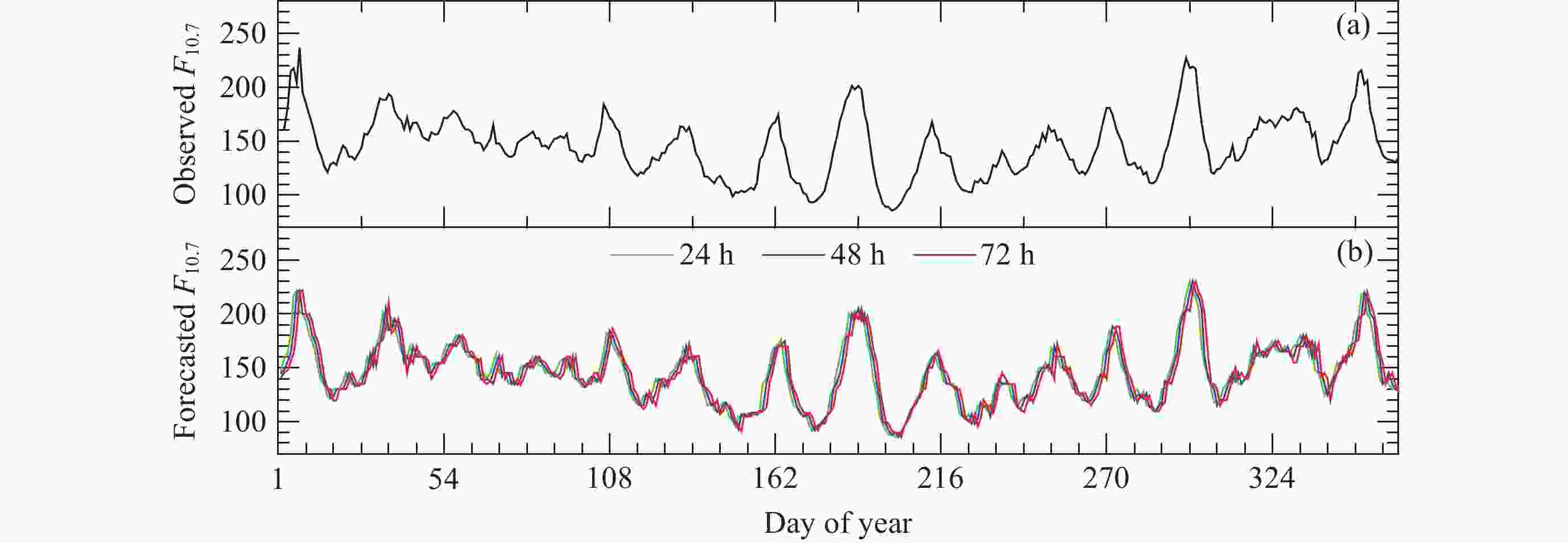
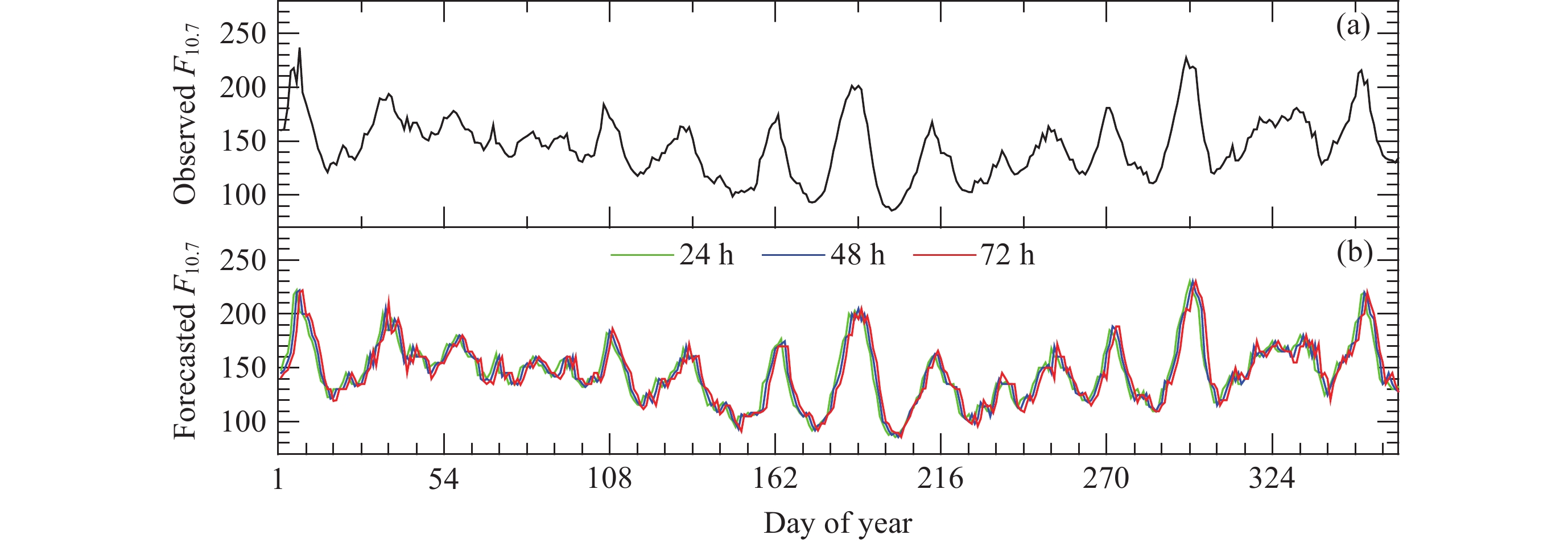
图 1 2014年F10.7指数的观测值和NCSW预报的未来24 h, 48 h和72 h的F10.7指数分布
Figure 1. Distribution of the observed F10.7 index and the F10.7 index forecasted by NCSW for the next 24 h, 48 h and 72 h during 2014
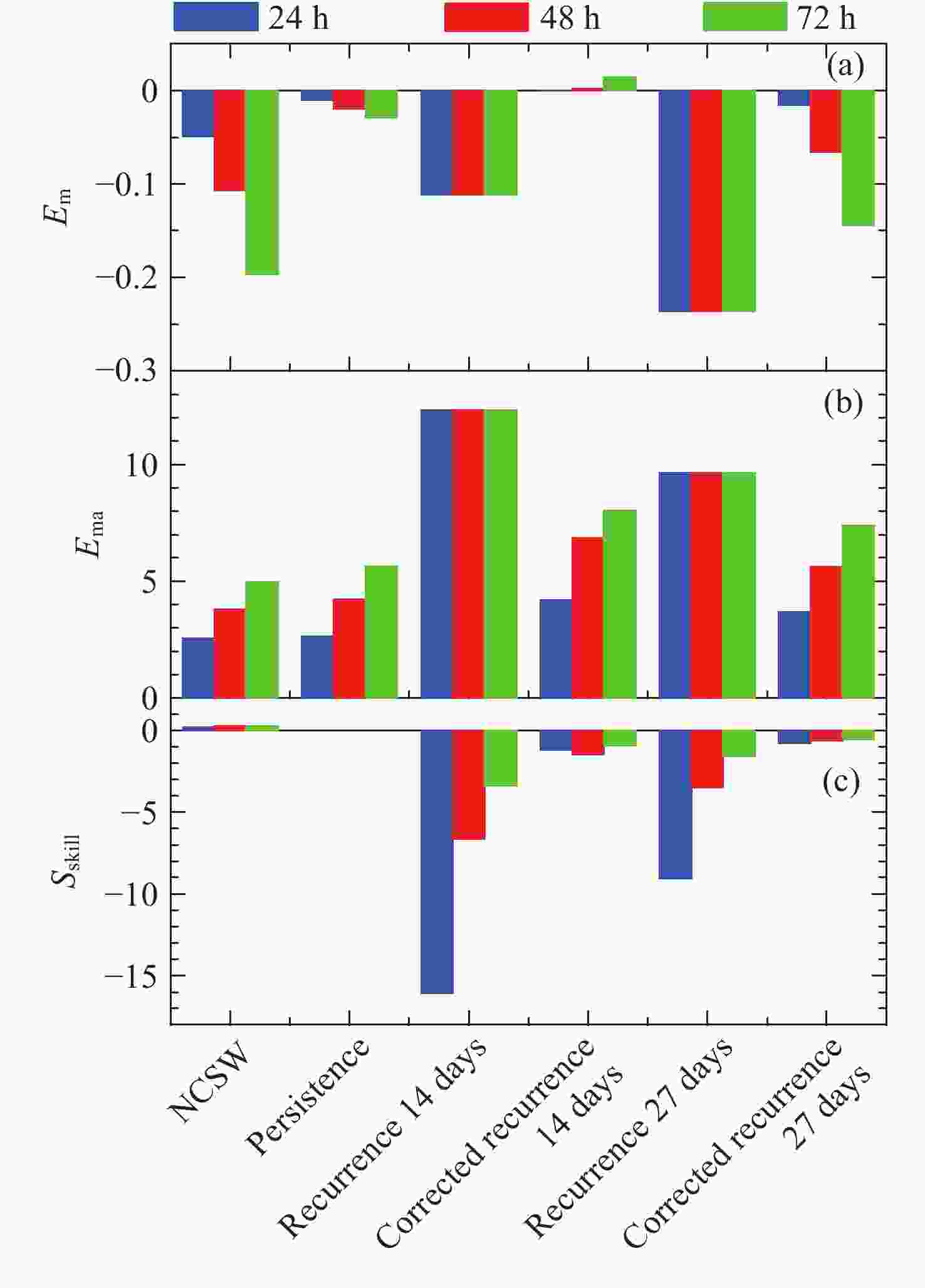
图 2 NCSW和不同统计预报模型预报的F10.7指数的平均误差、平均绝对误差和技术评分
Figure 2. Mean errors, absolute errors and skill scores of F10.7 index forecasted by NCSW and different statistical models
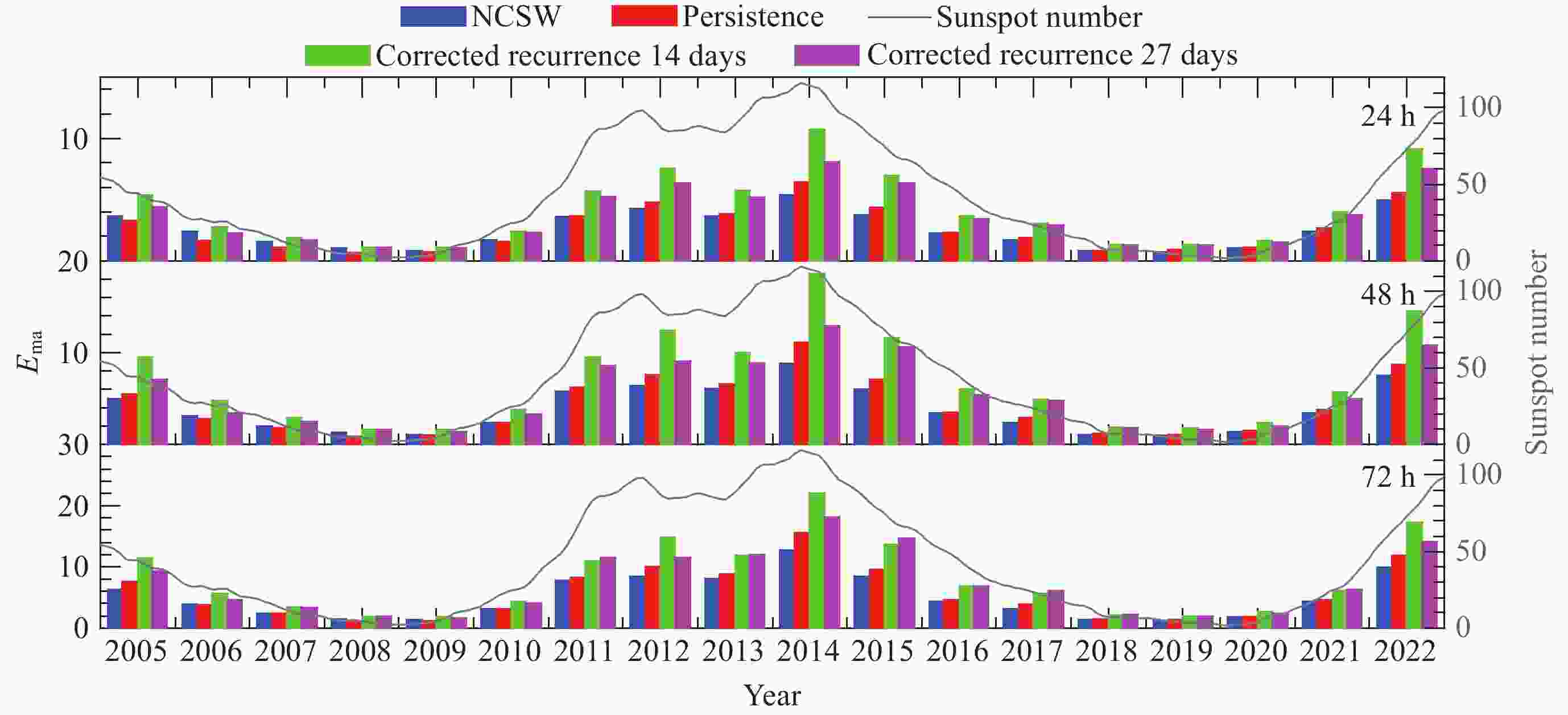
图 3 2005-2022年F10.7指数预报值的平均绝对误差分布
Figure 3. Distribution of the mean absolute errors for the forecast of F10.7 index from 2005 to 2022
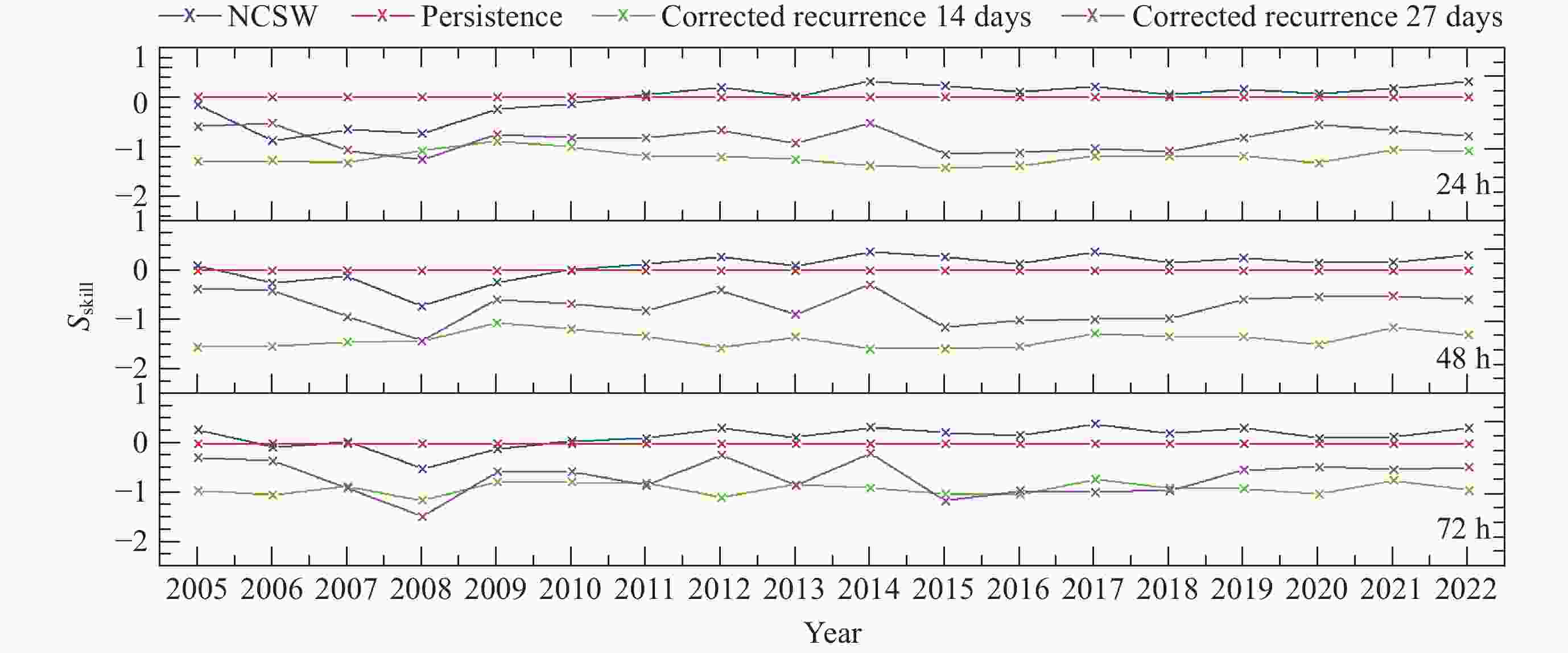
图 4 2005-2022年F10.7指数预报值的技术评分分布
Figure 4. Distribution of the skill scores of forecasted F10.7 index from 2005 to 2022
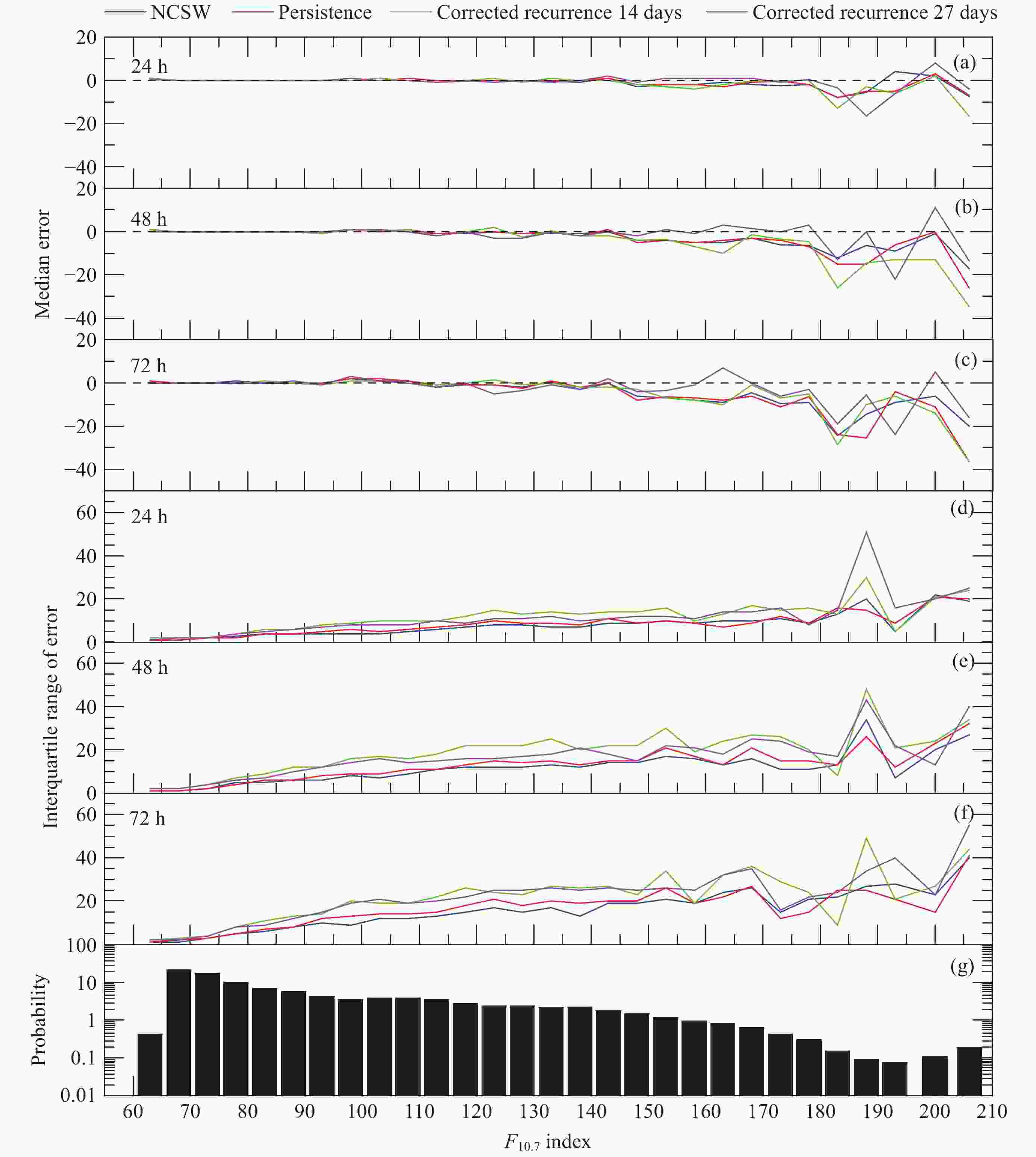
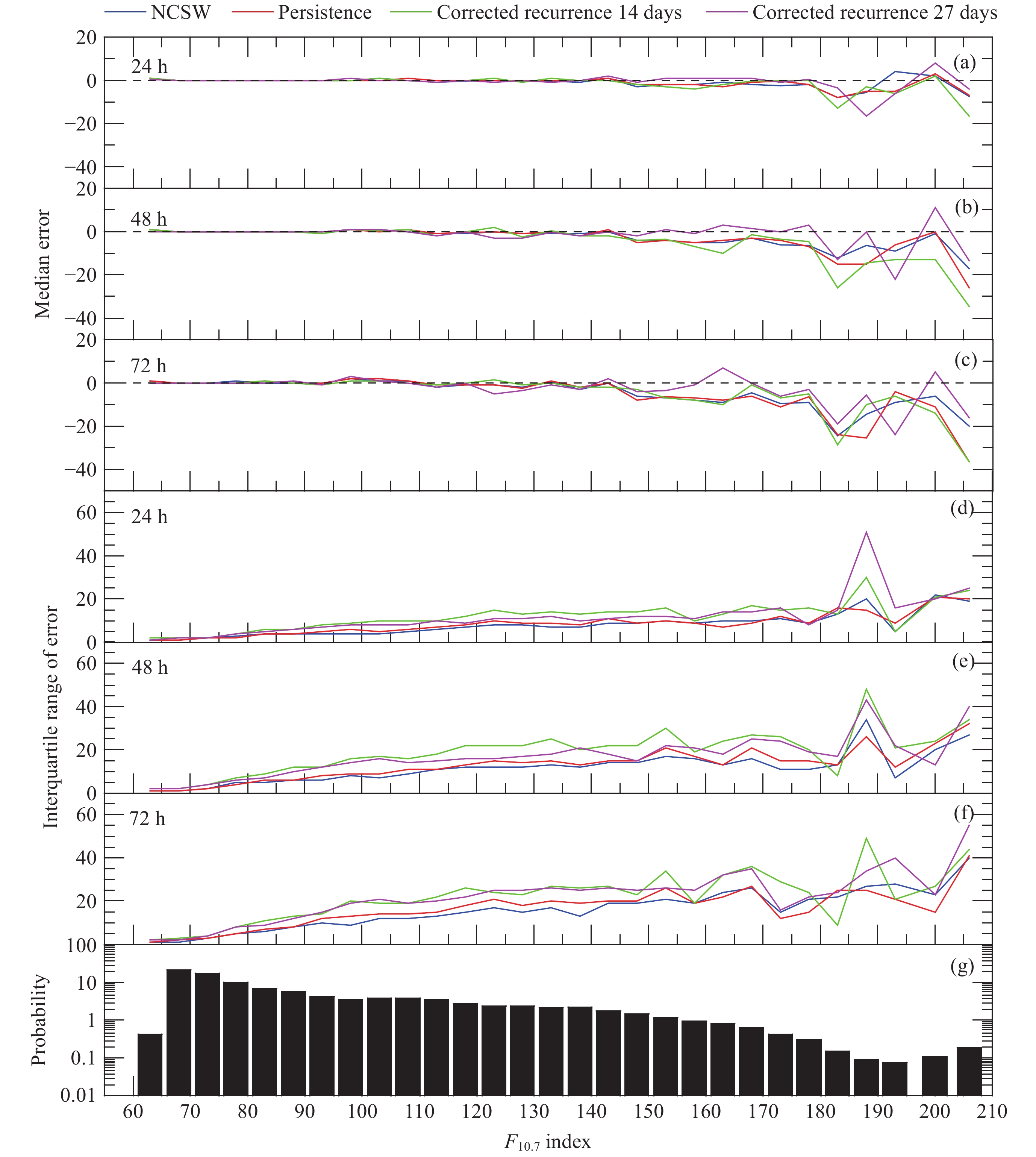
图 5 2005-2022年不同F10.7指数观测值对应的预报误差分布
Figure 5. Errors conditional on the observed F10.7 index from 2005 to 2022
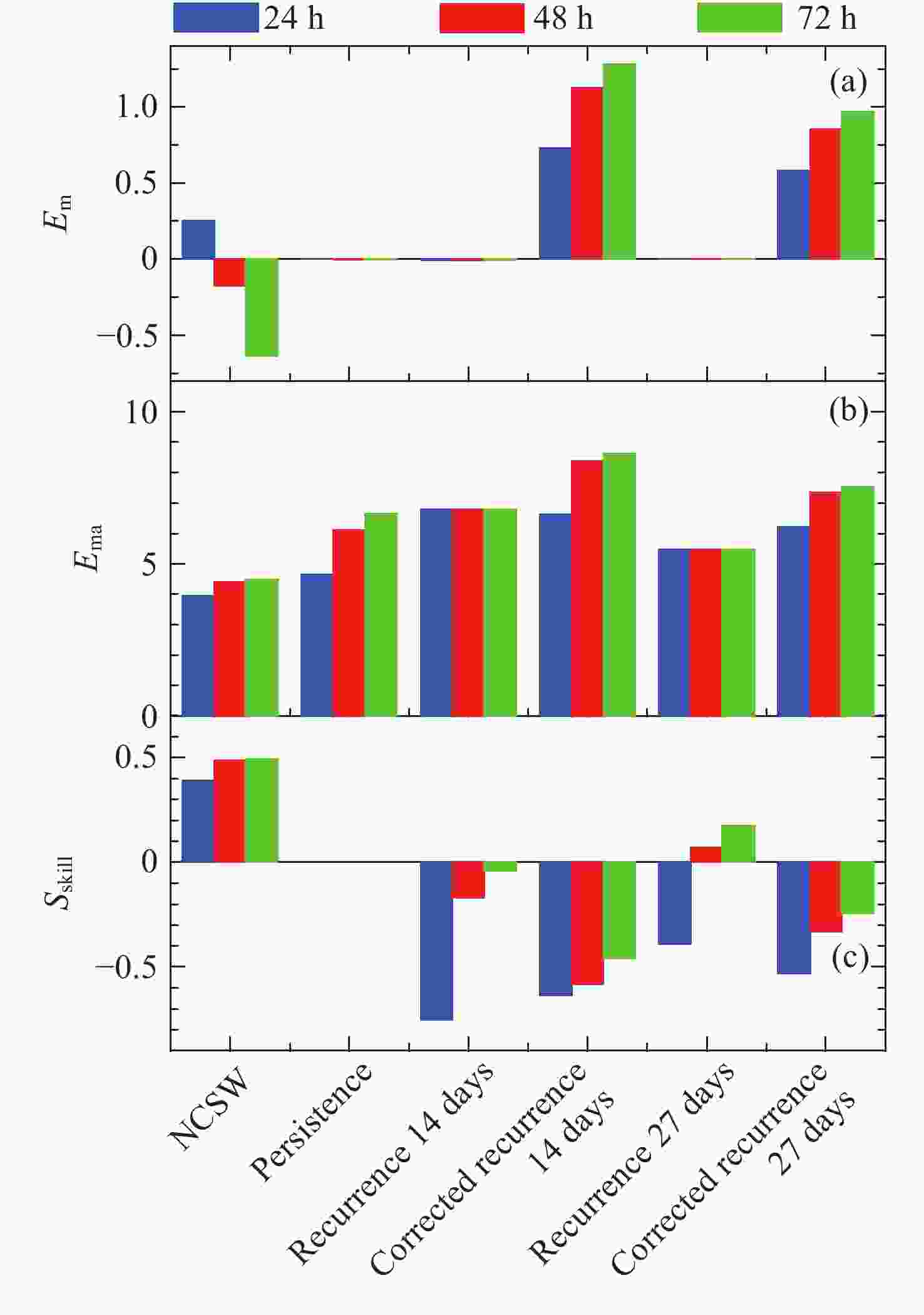
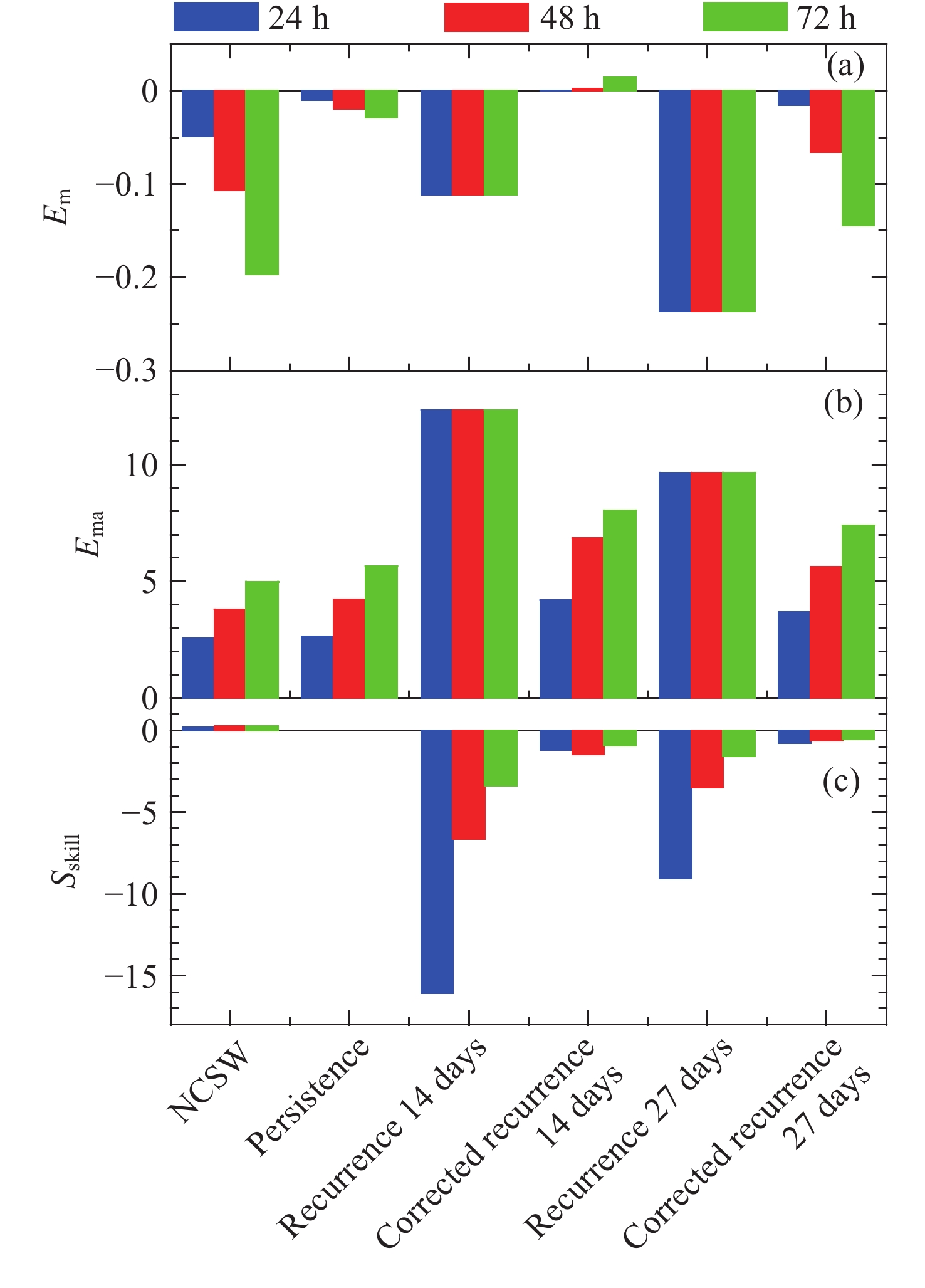
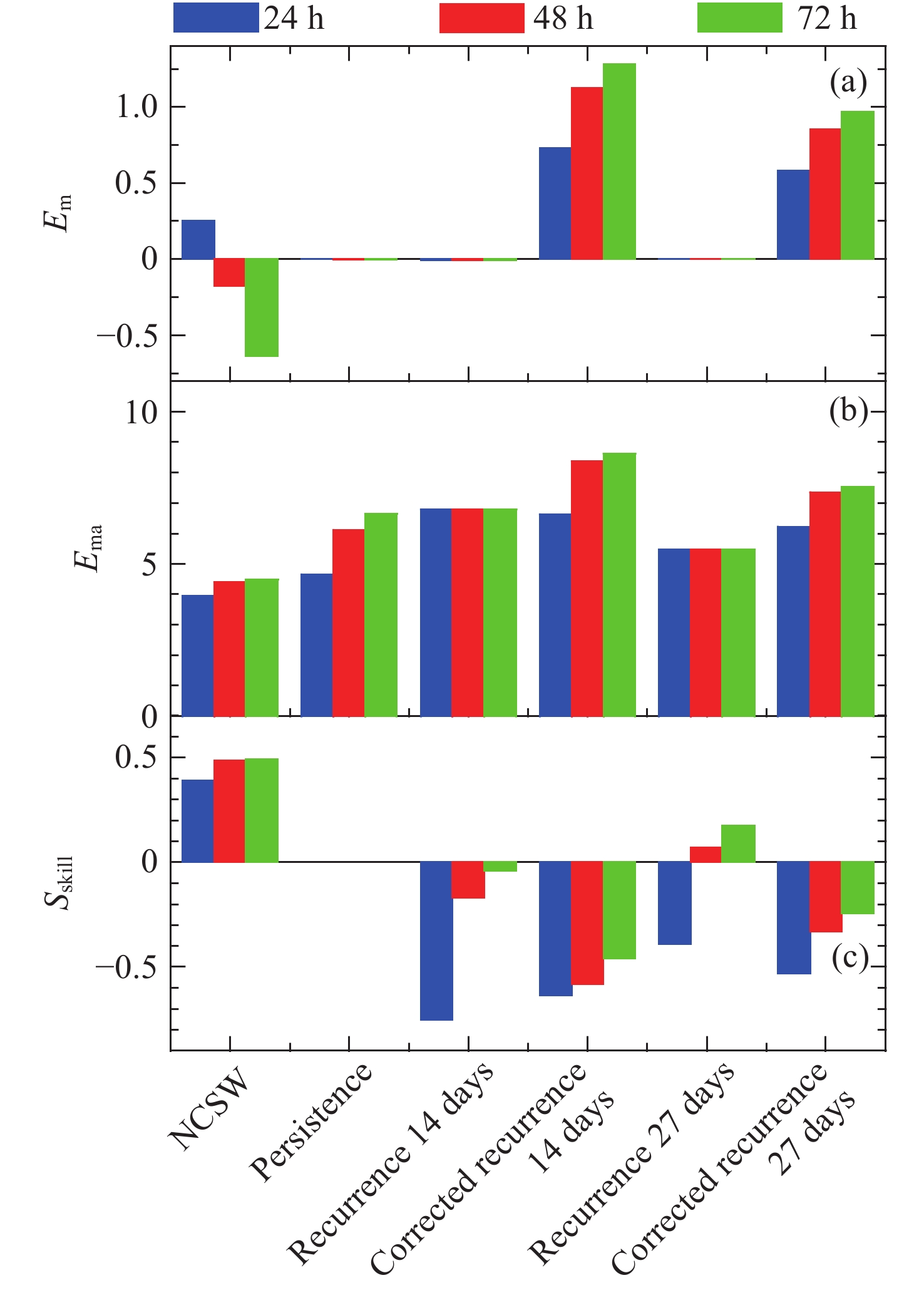
图 6 NCSW和不同统计预报模型预报的Ap指数的平均误差、平均绝对误差和技术评分
Figure 6. Mean errors, mean absolute errors and skill scores of Ap index forecasted by NCSW and different statistical models
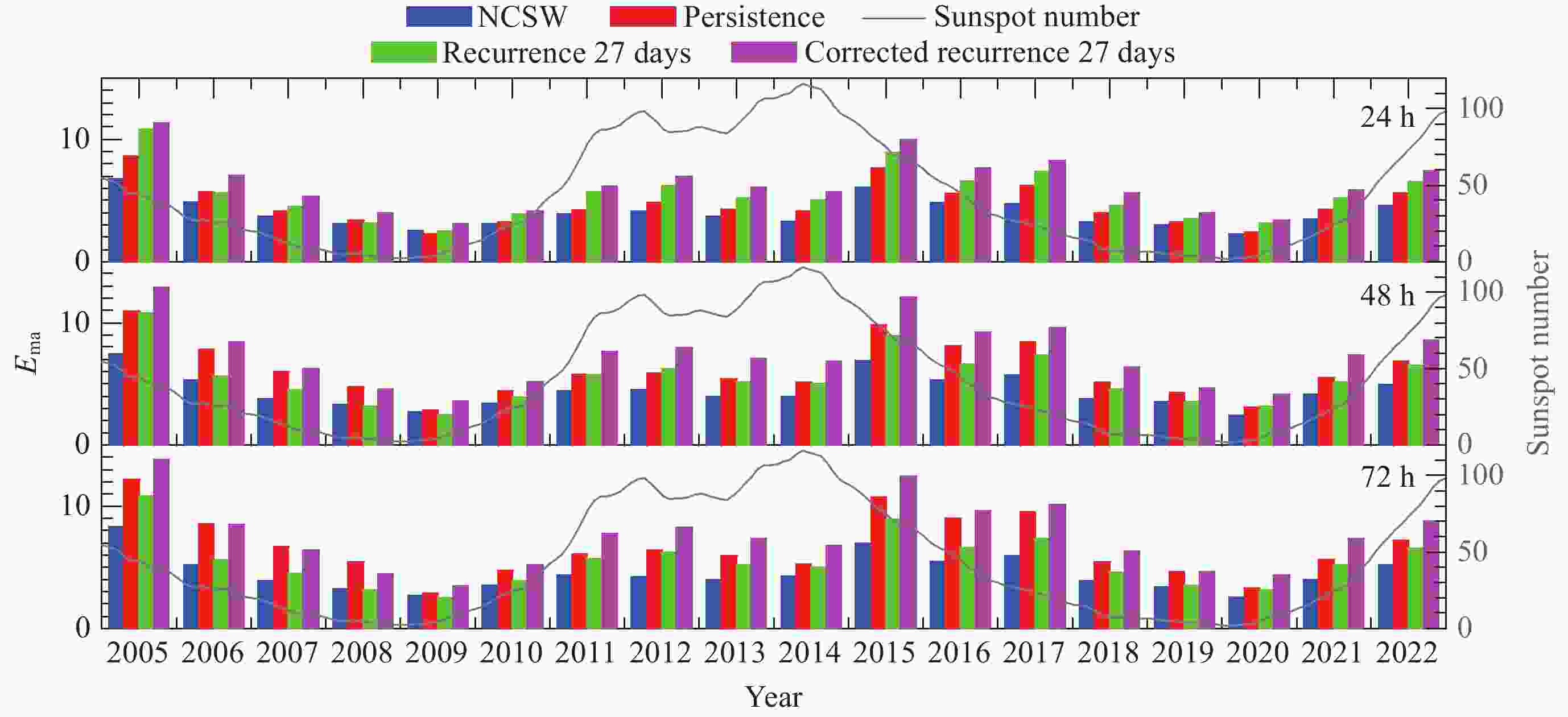
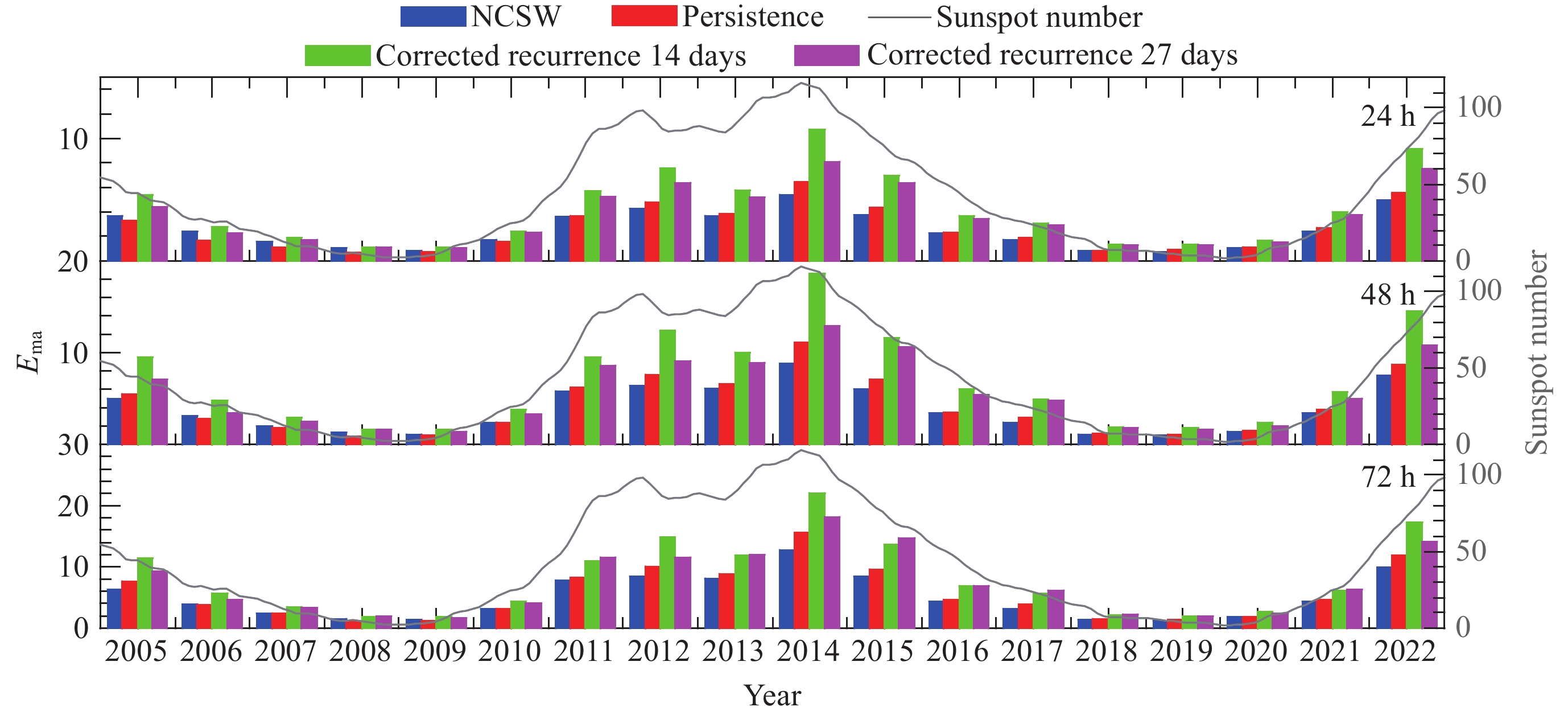
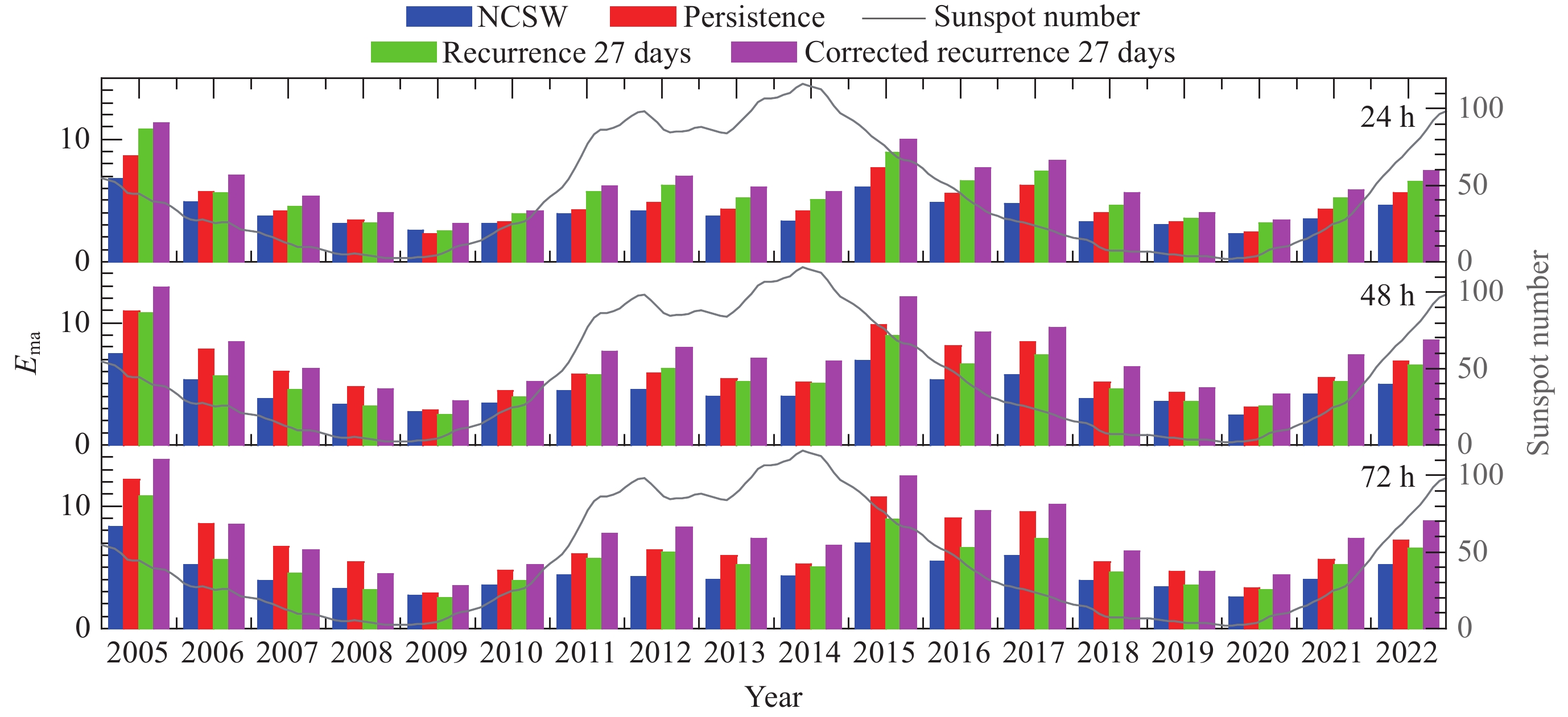
图 7 2005-2022年Ap指数预报值的平均绝对误差分布
Figure 7. Distribution of the mean absolute errors for the forecast of Ap index from 2005 to 2022
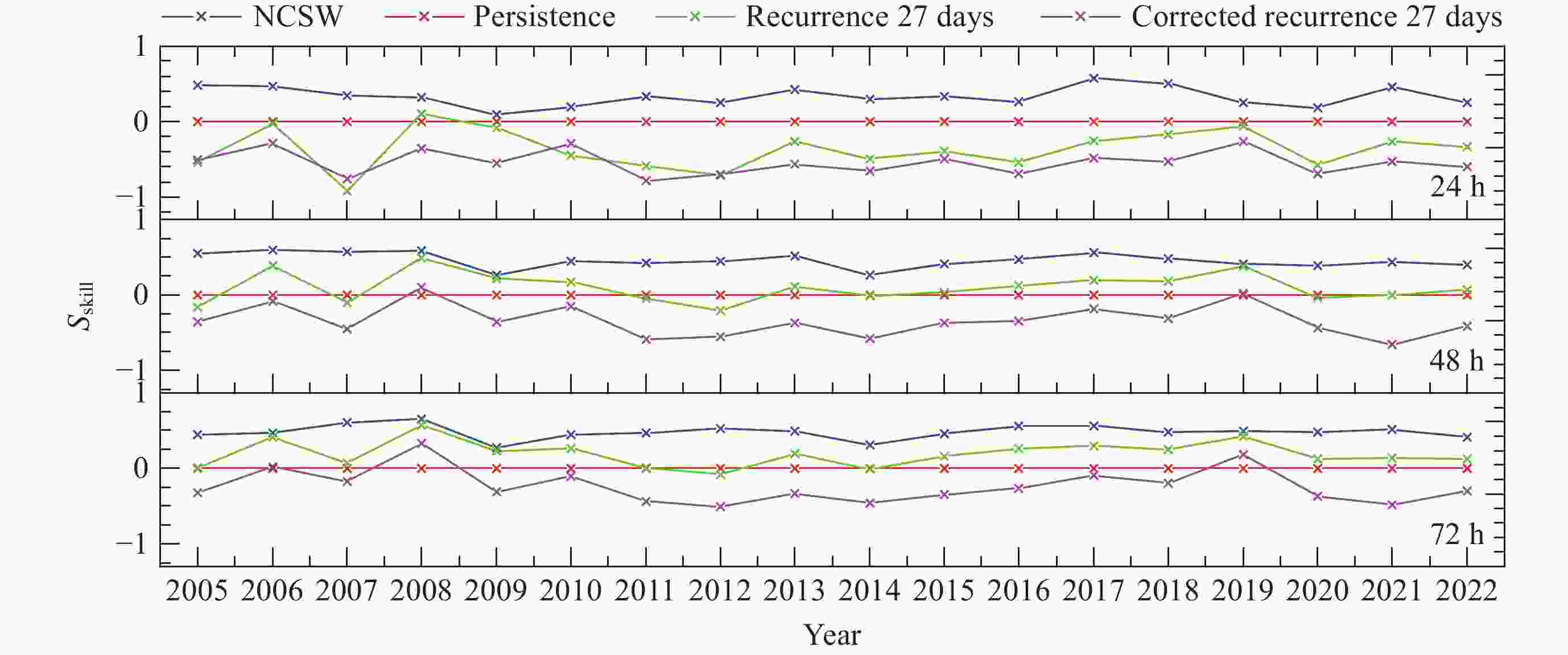
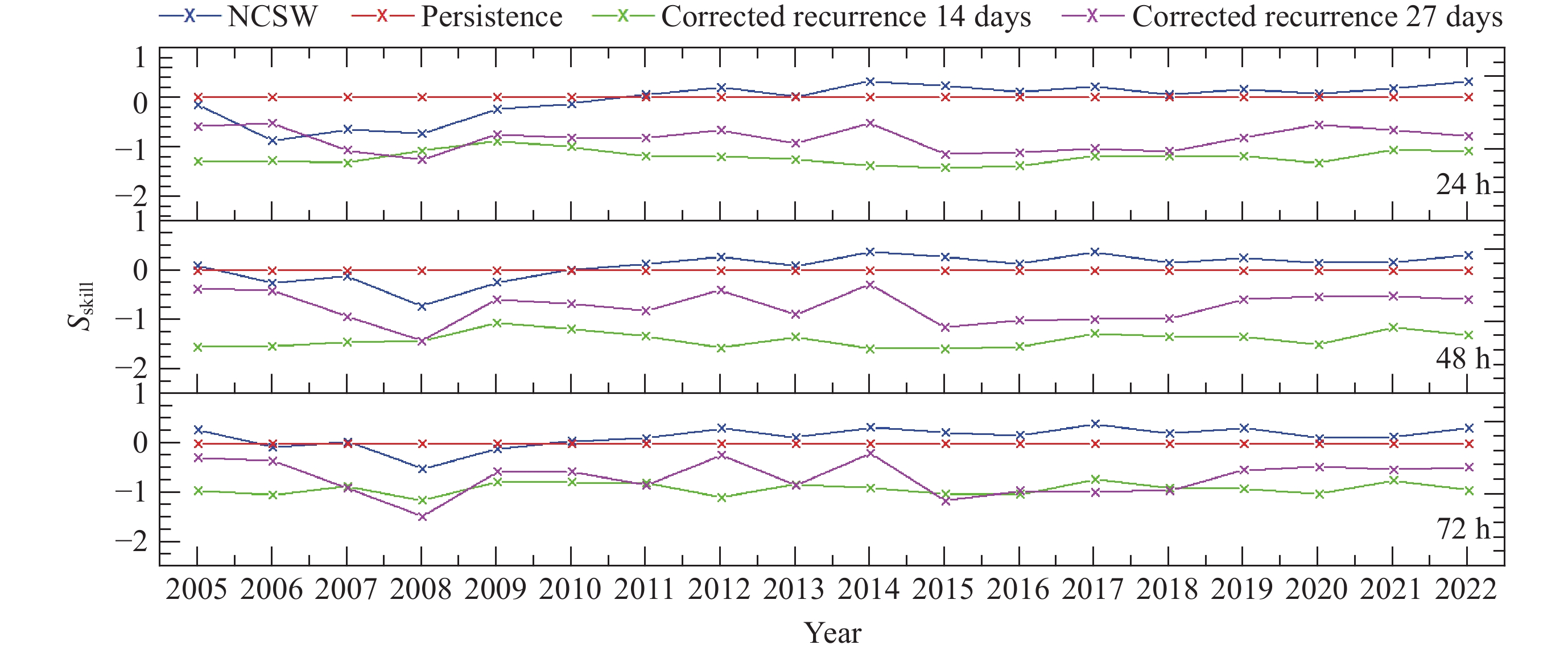
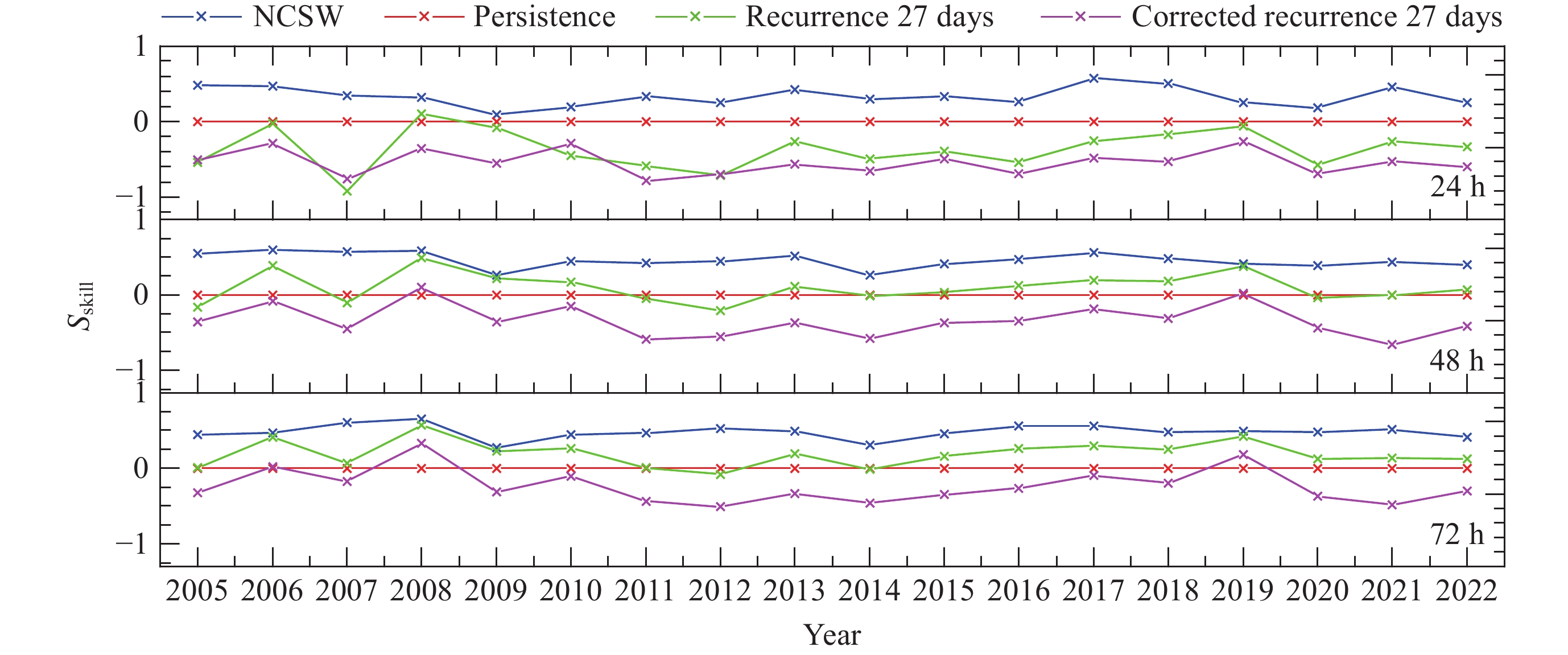
图 8 2005-2022年Ap指数预报值的技术评分分布
Figure 8. Distribution of the skill scores of forecasted Ap index from 2005 to 2022
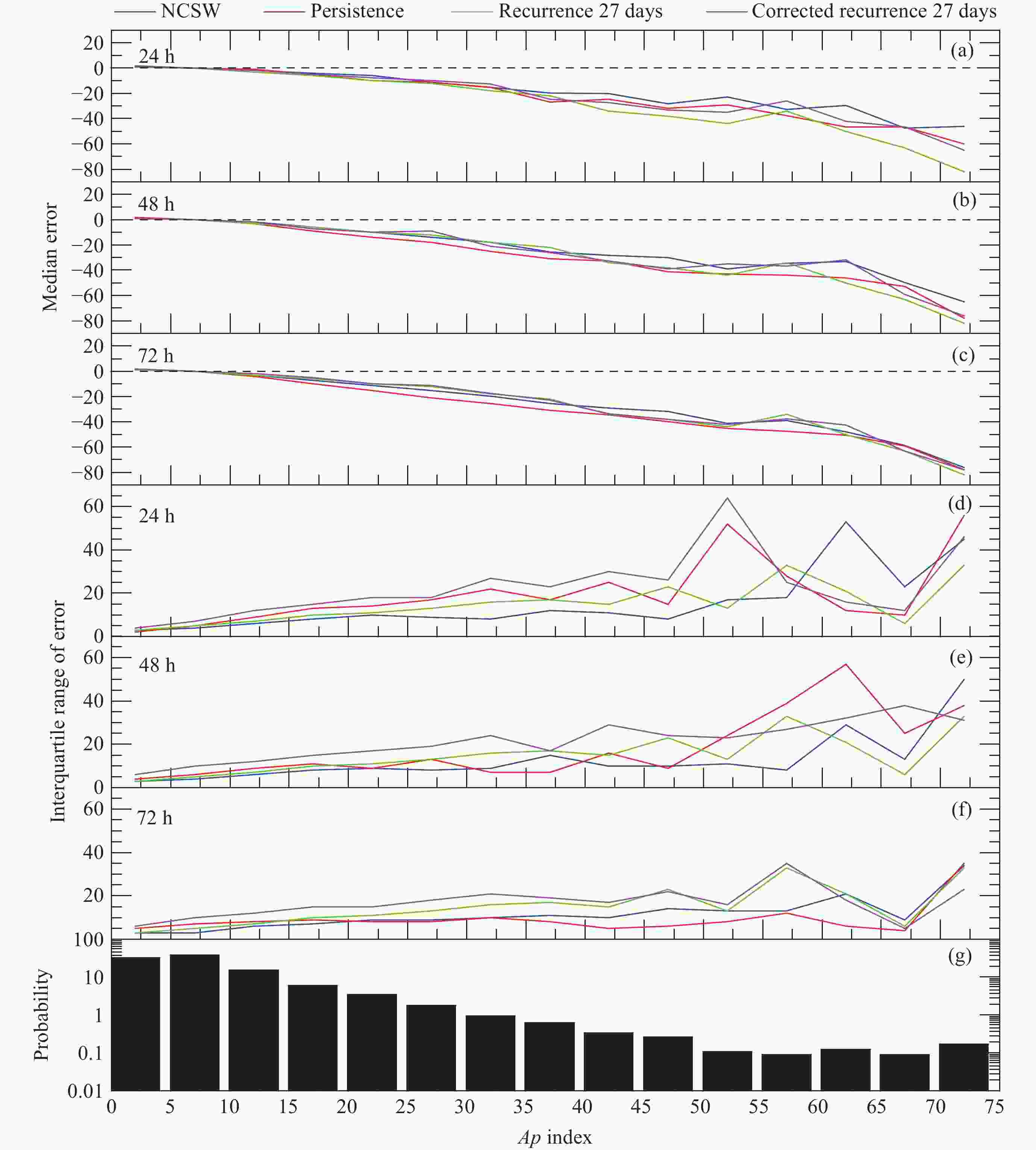
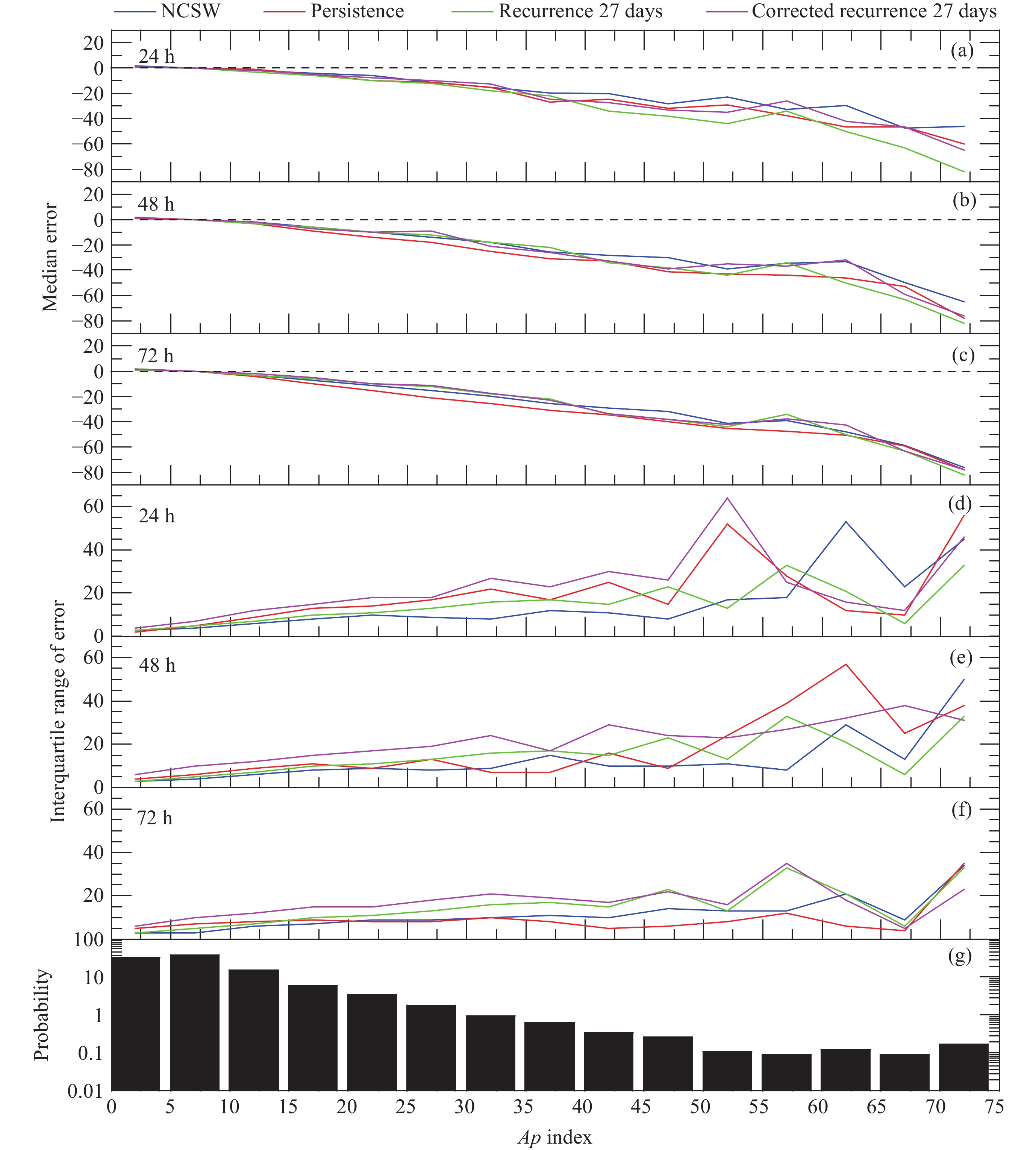
图 9 2005-2022年不同Ap指数观测值对应的预报误差分布
Figure 9. Errors conditional on the observed Ap index from 2005 to 2022
-
[1] ROEMER M, FRAMKE W, SCHUCHARDT K G H. Solar EUV and decimetric indices and thermospheric models[J]. Advances in Space Research, 1983, 3(1): 75-82 doi: 10.1016/0273-1177(83)90208-9 [2] HEDIN A E. Correlations between thermospheric density and temperature, solar EUV flux, and 10.7-cm flux variations[J]. Journal of Geophysical Research: Space Physics, 1984, 89(A11): 9828-9834 doi: 10.1029/JA089iA11p09828 [3] 刘芳, 蔡立锋, 孙先伟, 等. 空间环境参数预报数据在轨控策略中的融合应用[J]. 无线电工程, 2019, 49(4): 314-318 doi: 10.3969/j.issn.1003-3106.2019.04.10LIU Fang, CAI Lifeng, SUN Xianwei, et al. Fusion application of prediction data for space environmental parameters in orbit control strategy[J]. Radio Engineering, 2019, 49(4): 314-318 doi: 10.3969/j.issn.1003-3106.2019.04.10 [4] 张育林, 陈小前, 闫野, 译. 空间环境及其对航天器的影响[M]. 北京: 中国宇航出版社, 2011PISACANE V L. The Space Environment and its Effects on Space Systems[M]. Virginia: American Institute of Aeronautics and Astronautics, 2008 [5] 林元章. 太阳物理导论[M]. 北京: 科学出版社, 2000LIN Yuanzhang. Introduction of Solar Physics[M]. Beijing: China Science Press, 2000 [6] 王劲松, 吕建永. 空间天气[M]. 北京: 气象出版社, 2009WANG Jingsong, LÜ Jianyong. Space Weather[M]. Beiing: China Meteorological Press, 2009 [7] 张效信, 杜丹, 郭建广. 空间天气定量预报模式[M]. 北京: 气象出版社, 2016ZHANG Xiaoxin, DU Dan, GUO Jianguang. Quantitative Forecasting Model of Space Weather[M]. Beijng: China Meteorological Press, 2016 [8] 雷久侯, 李若曦, 任德馨, 等. 热层大气密度反演与建模研究进展[J]. 地球与行星物理论评, 2023, 54(4): 434-454LEI Jiuhou, LI Ruoxi, REN Dexin, et al. Recent progress on the retrieval and modeling of thermosphere mass density[J]. Reviews of Geophysics and Planetary Physics, 2023, 54(4): 434-454 [9] BRUINSMA S, FORBES J M, NEREM R S, et al. Thermosphere density response to the 20–21 November 2003 solar and geomagnetic storm from CHAMP and GRACE accelerometer data[J]. Journal of Geophysical Research: Space Physics, 2006, 111(A6): A06303 [10] LEI J H, THAYER J P, LU G, et al. Rapid recovery of thermosphere density during the October 2003 geomagnetic storms[J]. Journal of Geophysical Research: Space Physics, 2011, 116(A3): A03306 [11] LEI J H, BURNS A G, THAYER J P, et al. Overcooling in the upper thermosphere during the recovery phase of the 2003 October storms[J]. Journal of Geophysical Research: Space Physics, 2012, 117(A3): A03314 [12] LIU R, LÜHR H, DOORNBOS E, et al. Thermospheric mass density variations during geomagnetic storms and a prediction model based on the merging electric field[J]. Annales Geophysicae, 2010, 28(9): 1633-1645 doi: 10.5194/angeo-28-1633-2010 [13] LIU R, MA S Y, LÜHR H. Predicting storm-time thermospheric mass density variations at CHAMP and GRACE altitudes[J]. Annales Geophysicae, 2011, 29(3): 443-453 doi: 10.5194/angeo-29-443-2011 [14] LÜHR H, ROTHER M, KÖHLER W, et al. Thermospheric up-welling in the cusp region: evidence from CHAMP observations[J]. Geophysical Research Letters, 2004, 31(6): L06805 [15] SUTTON E K, FORBES J M, NEREM R S. Global thermospheric neutral density and wind response to the severe 2003 geomagnetic storms from CHAMP accelerometer data[J]. Journal of Geophysical Research: Space Physics, 2005, 110(A9): A09S40 [16] 刘振兴. 太空物理学[M]. 哈尔滨: 哈尔滨工业大学出版社, 2005LIU Zhenxing. Space Physics[M]. Harbin: Harbin Institute of Technology Press, 2005 [17] 张桂清, 王家龙. 北京天文台太阳活动预报新方案的检验和与旧方案及WWA预报效果的比对[J]. 地球物理学报, 1994, 9: 42-47ZHANG Guiqing, WANG Jialong. Verification on new scheme of predicting x-ray flares in BAO and comparison with predicting effectiveness of old scheme and WWA[J]. Chinese Journal of Geophysics, 1994, 9: 42-47 [18] CROWN M D. Validation of the NOAA space weather prediction center’s solar flare forecasting look-up table and forecaster-issued probabilities[J]. Space Weather, 2012, 10(6): S06006 [19] DEVOS A, VERBEECK C, ROBBRECHT E. Verification of space weather forecasting at the regional warning center in Belgium[J]. Journal of Space Weather and Space Climate, 2014, 4: A29 doi: 10.1051/swsc/2014025 [20] SHARPE M A, MURRAY S A. Verification of space weather forecasts issued by the met office space weather operations centre[J]. Space Weather, 2017, 15(10): 1383-1395 doi: 10.1002/2017SW001683 [21] ZHONG Q Z, WANG J J, MENG X J, et al. Prediction model for solar energetic proton events: analysis and verification[J]. Space Weather, 2017, 17(5): 709-726 [22] 中国气象局. QX/T 295-2015 空间天气短期预报检验方法[S]. 北京: 中国气象出版社, 2015China Meteorological Administration. QX/T 295-2015 Verification methods for short-term space weather forecast[S]. Beijing: China Meteorological Press, 2015 [23] The conceptual approach). New York: USA Springer, 1997 (吴喜之, 程博, 柳林旭, 等译. 统计学(基本概念和方法). 北京: 高等教育出版社, 2000GUDMUND R I, MARY G. Statistics [24] BERDYUGINA S V, USOSKIN I G. Active longitudes in sunspot activity: century scale persistence[J]. Astronomy & Astrophysics, 2003, 405(3): 1121-1128 [25] USOSKIN I G, BERDYUGINA S V, POUTANEN J. Preferred sunspot longitudes: non-axisymmetry and differential rotation[J]. Astronomy & Astrophysics, 2005, 441(1): 347-352 [26] ZHANG L Y, CUI Y M, HE H, et al. Longitudinal distribution of major solar flares during 1975-2005[J]. Advances in Space Research, 2007, 40(7): 970-975 doi: 10.1016/j.asr.2006.12.052 [27] ZHANG L Y, WANG H N, DU Z L, et al. Long-term behavior of active longitudes for solar X-ray flares[J]. Astronomy & Astrophysics, 2007, 471(2): 711-716 [28] ZHANG L Y, WANG H N, DU Z L. Prediction of solar active longitudes[J]. Astronomy & Astrophysics, 2008, 484(2): 523-527 [29] ZHANG L, MURSULA K, USOSKIN I, et al. Global analysis of active longitudes of solar X-ray flares[J]. Journal of Atmospheric and Solar-Terrestrial Physics, 2011, 73(2/3): 258-263 [30] CHEN A Q, WANG J X, LI J W, et al. Statistical properties of superactive regions during solar cycles 19-23[J]. Astronomy & Astrophysics, 2011, 534: A47 [31] BIESECKER D A, WEBB D F, ST CYR O C. STEREO space weather and the space weather beacon[J]. Space Science Reviews, 2008, 136(1/2/3/4): 45-65 [32] PESNELL W D, THOMPSON B J, CHAMBERLIN P C. The solar dynamics observatory (SDO)[J]. Solar Physics, 2012, 275(1/2): 3-15 [33] SCHOU J, SCHERRER P H, BUSH R I, et al. Design and ground calibration of the Helioseismic and Magnetic ima-ger (HMI) instrument on the Solar dynamics observatory (SDO)[J]. Solar Physics, 2012, 275(1/2): 229-259 [34] 罗冰显, 刘四清, 钟秋珍, 等. 冕洞特征参数与重现型地磁暴关系的统计研究[J]. 空间科学学报, 2007, 27(2): 117-124 doi: 10.3969/j.issn.0254-6124.2007.02.005LUO Bingxian, LIU Siqing, ZHONG Qiuzhen, et al. Primary study about the relationships between coronal holes’ parameters and the correlative geomagnetic disturbances[J]. Chinese Journal of Space Science, 2007, 27(2): 117-124 doi: 10.3969/j.issn.0254-6124.2007.02.005 [35] 卜萱, 罗冰显, 刘四清, 等. 冕洞特征参数与地磁暴强度及发生时间统计[J]. 空间科学学报, 2020, 40(1): 9-19 doi: 10.11728/cjss2020.01.009BU Xuan, LUO Bingxian, LIU Siqing, et al. Statistical study between characteristic parameters of coronal holes and intensity/time of geomagnetic storms[J]. Chinese Journal of Space Science, 2020, 40(1): 9-19 doi: 10.11728/cjss2020.01.009 [36] 高扬, 吕建永, 王明, 等. 基于深度学习的太阳F10.7辐射通量的短期预报研究[J]. 天文学报, 2022, 63(1): 104-114GAO Yang, LÜ Jianyong, WANG Ming, et al. Short-term prediction of solar F10.7 radiation flux based on deep learning[J]. Acta Astronomica Sinica, 2022, 63(1): 104-114 [37] HUANG X, WANG H N, XU L, et al. Deep learning based solar flare forecasting model. I. Results for line-of-sight magnetograms[J]. The Astrophysical Journal, 2018, 856(1): 7 doi: 10.3847/1538-4357/aaae00 [38] ZHENG Y F, LI X B, WANG X S. Solar flare prediction with the hybrid deep convolutional neural network[J]. The Astrophysical Journal, 2019, 885(1): 73 doi: 10.3847/1538-4357/ab46bd [39] LI X B, ZHENG Y F, WANG X S, et al. Predicting solar flares using a novel deep convolutional neural network[J]. The Astrophysical Journal, 2020, 891(1): 10 doi: 10.3847/1538-4357/ab6d04 [40] BHATTACHARJEE S, ALSHEHHI R, DHURI D B, et al. Supervised convolutional neural networks for classification of flaring and nonflaring active regions using line-of-sight magnetograms[J]. The Astrophysical Journal, 2020, 898(2): 98 doi: 10.3847/1538-4357/ab9c29 [41] CHEN A Q, YE Q, WANG J X. Flare index prediction with machine learning algorithms[J]. Solar Physics, 2021, 296(10): 150 doi: 10.1007/s11207-021-01895-1 [42] LIU S X, XU L, ZHAO Z R, et al. Deep learning based solar flare forecasting model. II. Influence of image resolution[J]. The Astrophysical Journal, 2022, 941(1): 20 doi: 10.3847/1538-4357/ac99dc [43] LI M, CUI Y M, LUO B X, et al. Deep neural networks of solar flare forecasting for complex active regions[J]. Frontiers in Astronomy and Space Sciences, 2023, 10: 1177550 doi: 10.3389/fspas.2023.1177550 [44] 温靖, 钟秋珍, 刘四清. 太阳10.7 cm射电流量中期预报模型研究(II)[J]. 空间科学学报, 2010, 30(3): 198-204 doi: 10.11728/cjss2010.03.198WEN Jing, ZHONG Qiuzhen, LIU Siqing. Model research of 10.7 cm solar radio flux 27-day forecast (II)[J]. Chinese Journal of Space Science, 2010, 30(3): 198-204 doi: 10.11728/cjss2010.03.198 [45] LEI L, ZHONG Q, WANG J, et al. The mid-term forecast method of F10.7 based on extreme ultraviolet images[J]. Advances in Astronomy, 2019, 2019: 5604092 [46] HENNEY C J, TOUSSAIN W A, WHITE S M, et al. Forecasting F10.7 with solar magnetic flux transport modeling[J]. Space Weather, 2012, 10(2): S02011 -
-

 下载:
下载:

计量
- 文章访问数: 1273
- HTML全文浏览量: 820
- PDF下载量: 59
-
被引次数:
0(来源:Crossref)
0(来源:其他)

