


基于深度学习的太阳黑子群磁类型分类
doi: 10.11728/cjss2025.02.2024-0100 cstr: 32142.14.cjss.2024-0100
-
 尹耀 男, 1999年1月出生于湖北省潜江市, 现为武汉大学地球与空间科学技术学院硕士研究生, 主要研究方向为机器学习识别磁重联和空间天气预报建模. E-mail: yaoyin@whu.edu.cn
 -
 黄狮勇 男, 1986年1月出生于江西省赣州市, 现为武汉大学地球与空间科学技术学院教授, 主要研究方向为磁层物理、磁重联、等离子体湍流、地磁尾动力学过程、卫星数据处理算法、行星物理和机器学习在空间天气中的应用. E-mail: shiyonghuang@whu.edu.cn
作者简介:
通讯作者:
Magnetic Type Classification of Sunspot Groups Based on Deep Learning
-
摘要: 太阳活动作为太阳大气层中能量释放和物质运动的显著表现形式, 是空间天气的主要扰动源, 以太阳黑子为代表的剧烈太阳活动可能导致近地空间环境的剧烈变化, 进而对人类的生产生活产生深远影响. 准确、高效地预报空间天气有助于减少其对人类生产生活的影响. 本文利用2010-2017年太阳动力学天文台(Solar Dynamics Observatory, SDO)搭载的HMI仪器观测的连续谱图和磁图数据, 建立了基于压缩激励模块和深度残差网络的太阳黑子威尔逊山磁类型分类模型. 为了有效避免因时间序列连续性导致的模型过拟合问题, 采用时序分割法划分数据集, 并结合太阳黑子图像的特点应用了数据增强策略, 以提高模型的泛化能力. 结果表明, 提出的模型能够较准确地完成太阳黑子磁分类任务, 尤其是在复杂类型黑子的识别方面, 相较于传统方法其识别能力得到了显著的提升. 此外, 使用类激活映射方法对测试集样本进行了可视化研究, 分析了模型提取到的特征图像和分类依据, 从而提高模型的可解释性.Abstract: Solar activity, as a significant manifestation of energy release and material movement in the solar atmosphere, is the main disturbance source of space weather. The violent solar activity represented by sunspots may lead to drastic changes in the near-earth space environment, and then have a profound impact on human production and life. Accurate and efficient prediction of space weather is helpful to reduce its impact on human production. In this paper, a magnetic type classification model of sunspot Mount Wilson based on squeeze-and-excitation module and deep residual network is established by using the continuum map and magnetogram map data observed by the HMI instrument on the Solar Dynamics Observatory (SDO) from 2010 to 2017. In order to effectively avoid the problem of model overfitting caused by the continuity of time series, this paper uses the time series segmentation method to divide the data set, and applies the data augmentation strategy combined with the characteristics of sunspot images to improve the generalization ability of the model. The experimental results show that the model proposed in this study can perform the task of sunspot classification accurately, especially in the recognition of complex sunspots, and its recognition ability has been significantly improved compared with traditional methods. In addition, this paper uses the class activation mapping method to visualize the test set samples, analyzes the feature images extracted from the model and the classification basis, so as to improve the interpretability of the model.
-
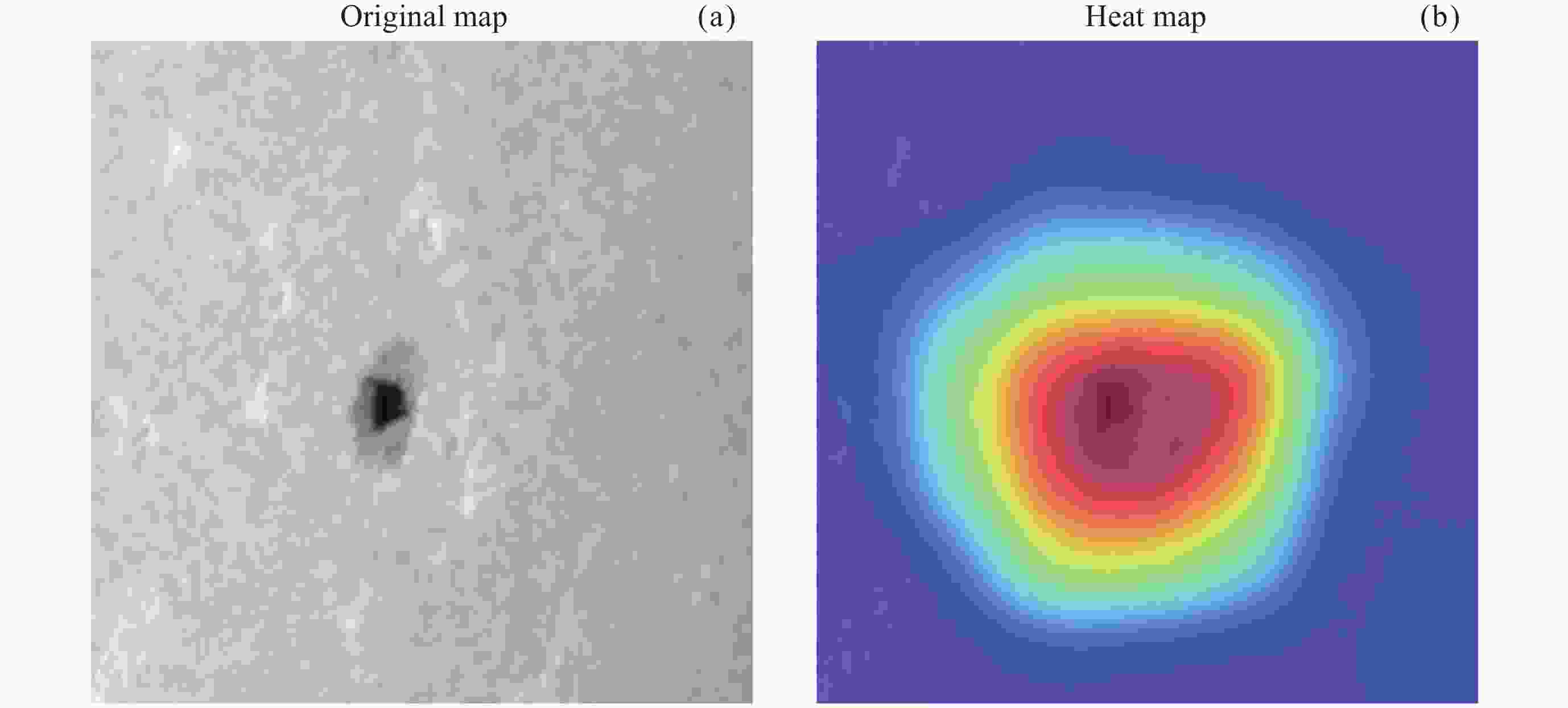
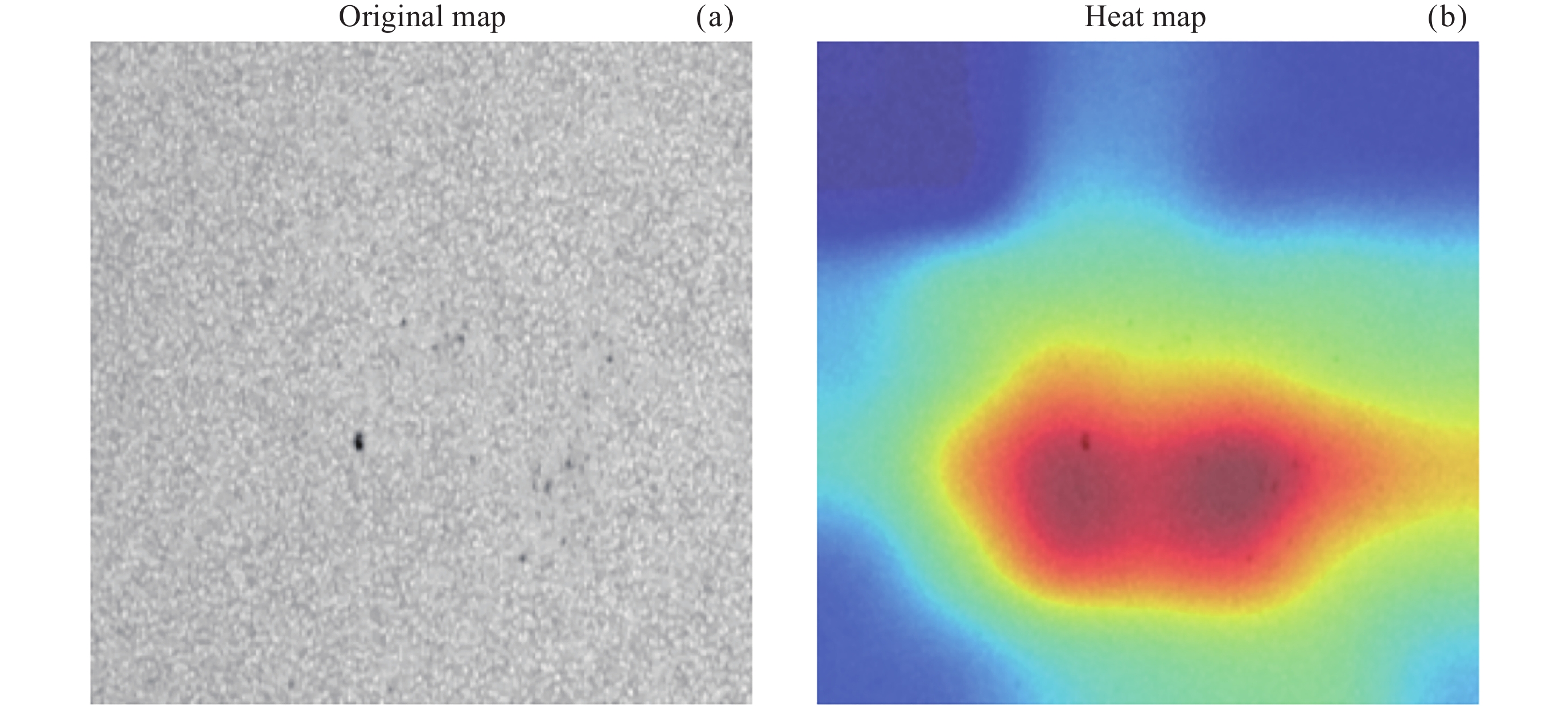
图 3 案例一的黑子群α类型原始图与其类激活热力图
Figure 3. Original map of sunspot group α type, and the heat map of its class activation in Case 1
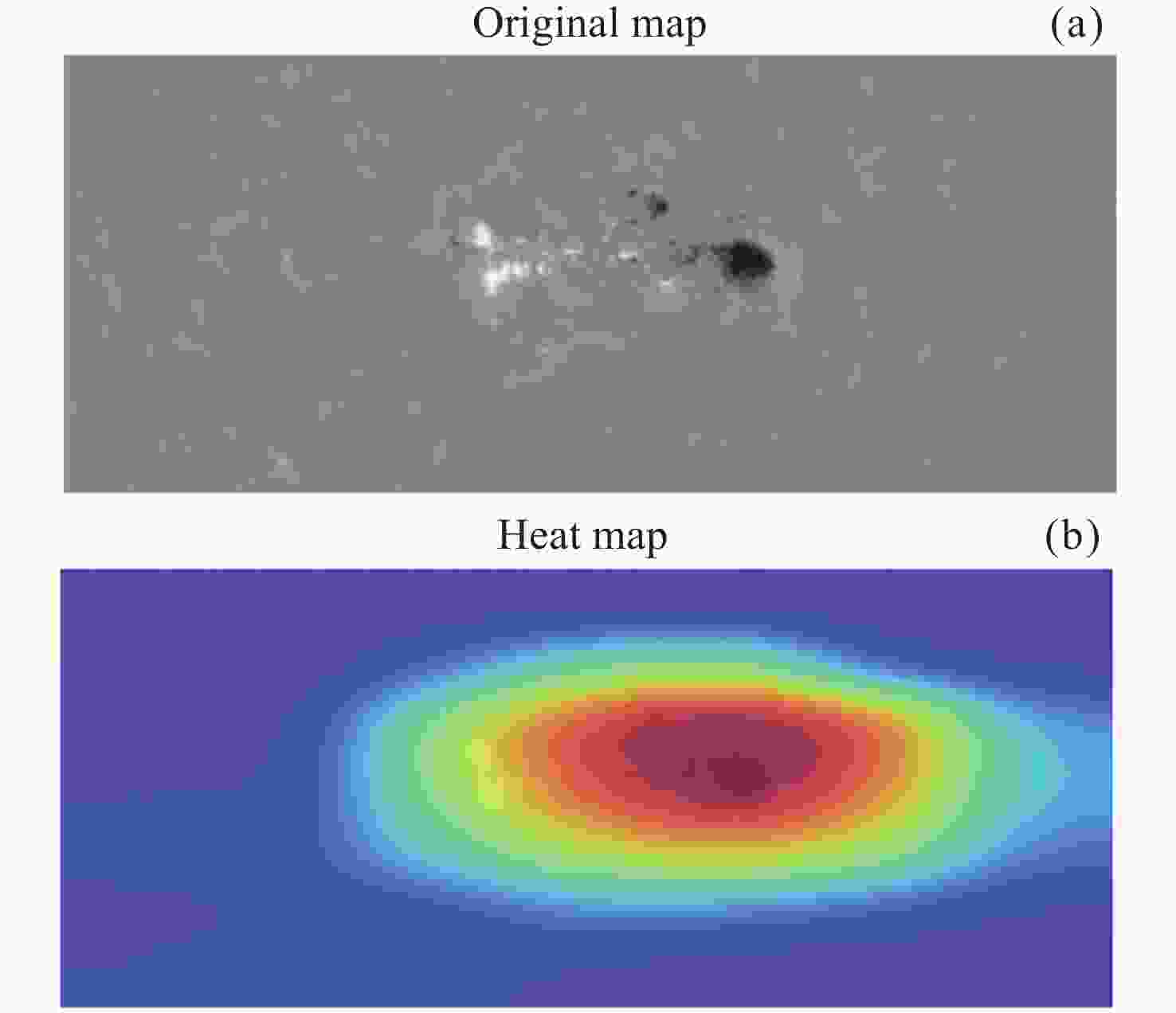
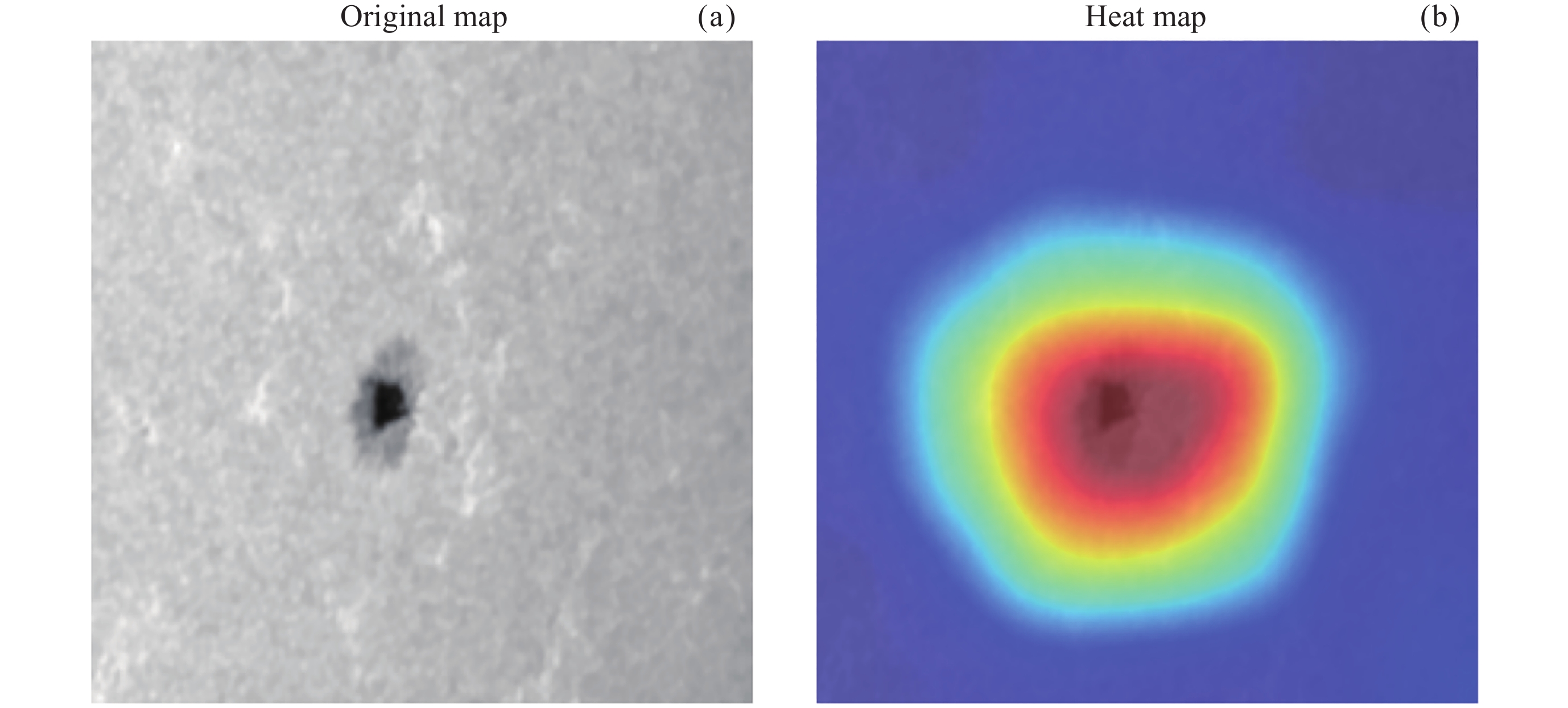
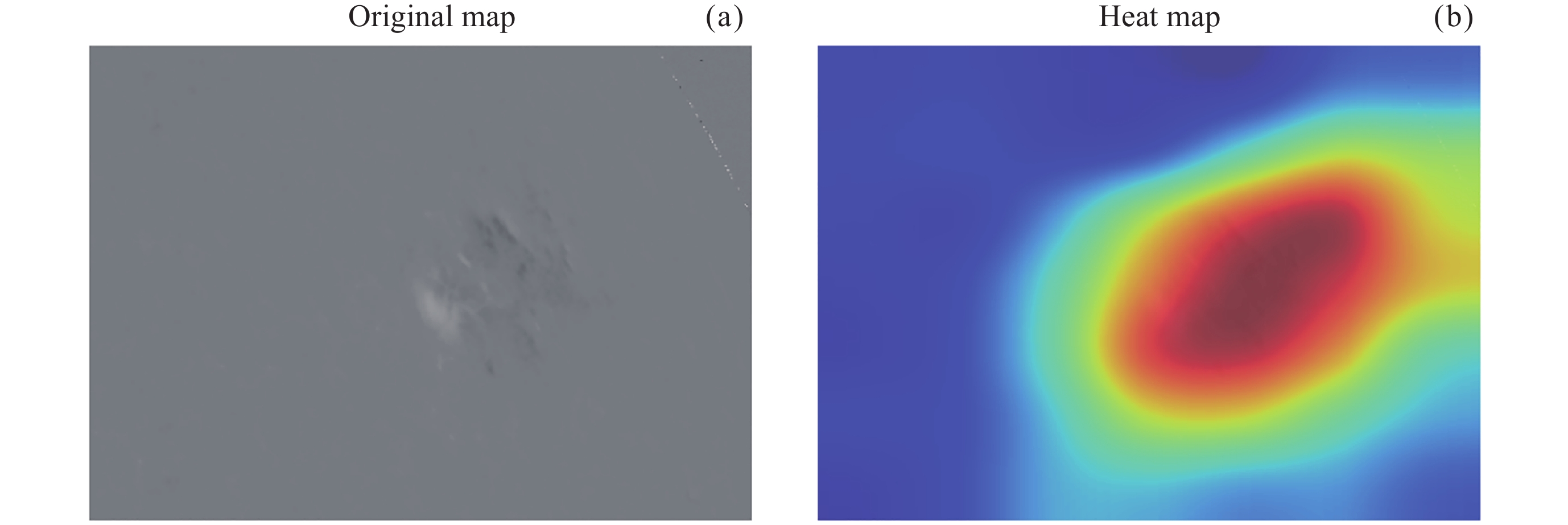
图 4 案例二的黑子群α类型原始图与其类激活热力图
Figure 4. Original map of sunspot group α type, and the heat map of its class activation in Case 2
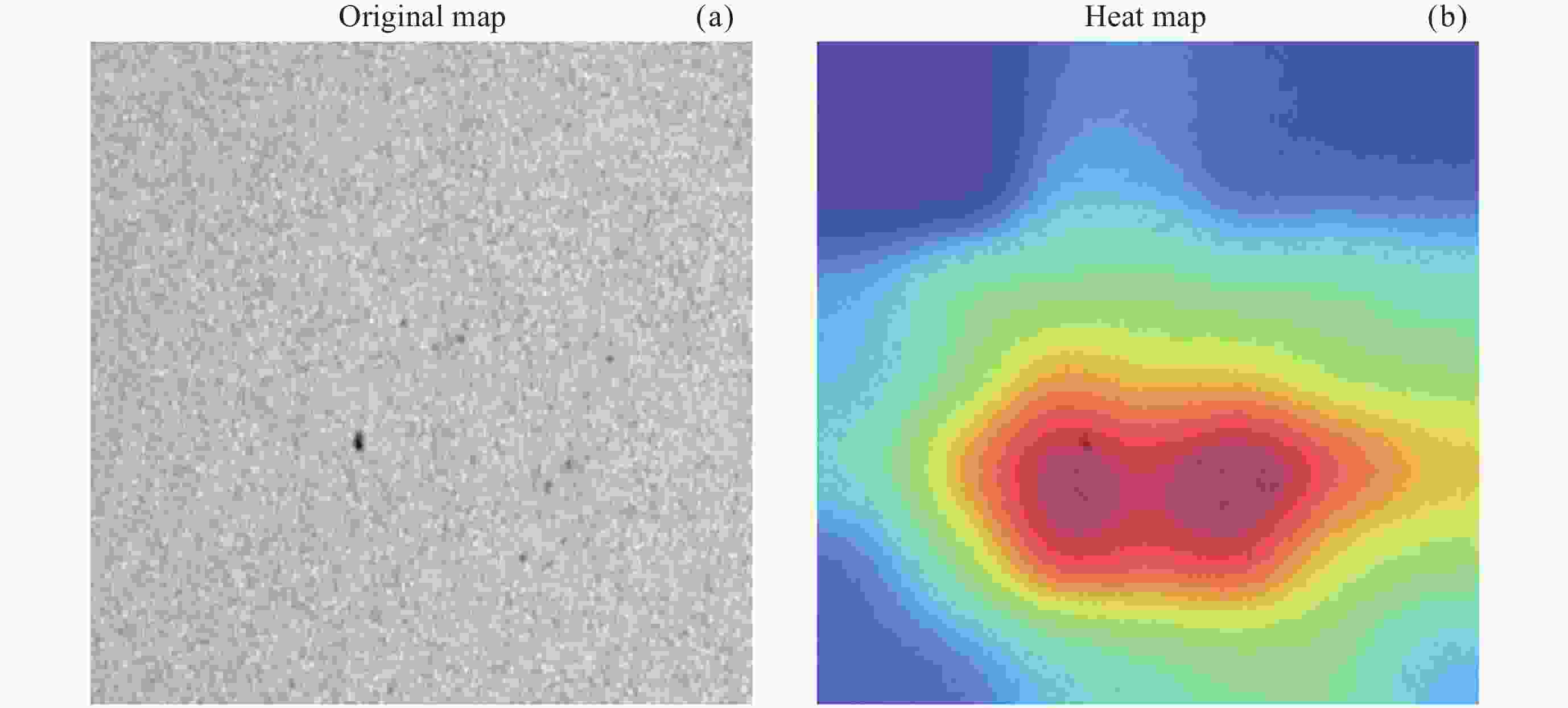
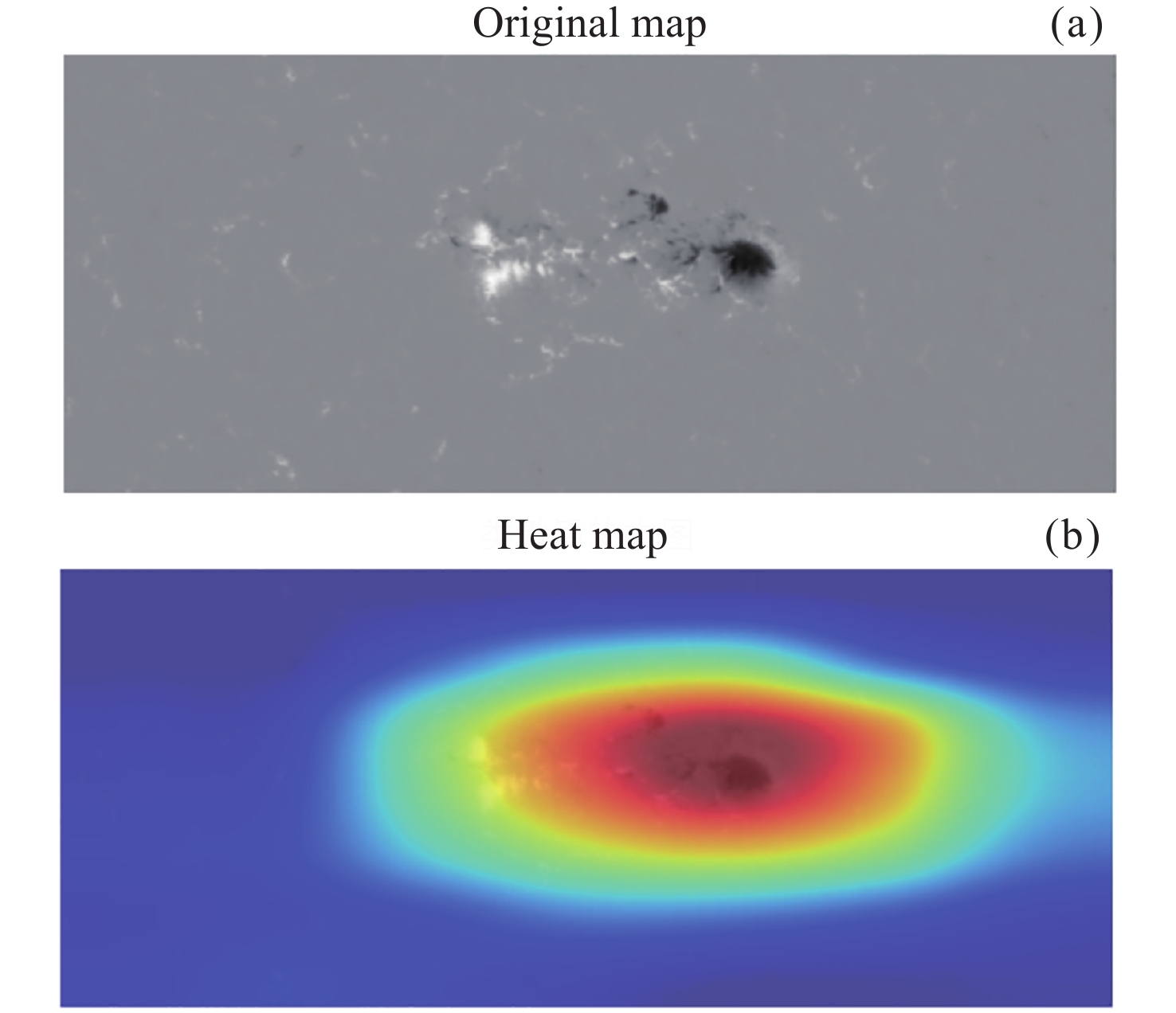
图 5 案例三的黑子群α类型原始图与类激活热力图
Figure 5. Original map of sunspot group α type, and the heat map of its class activation in Case 3
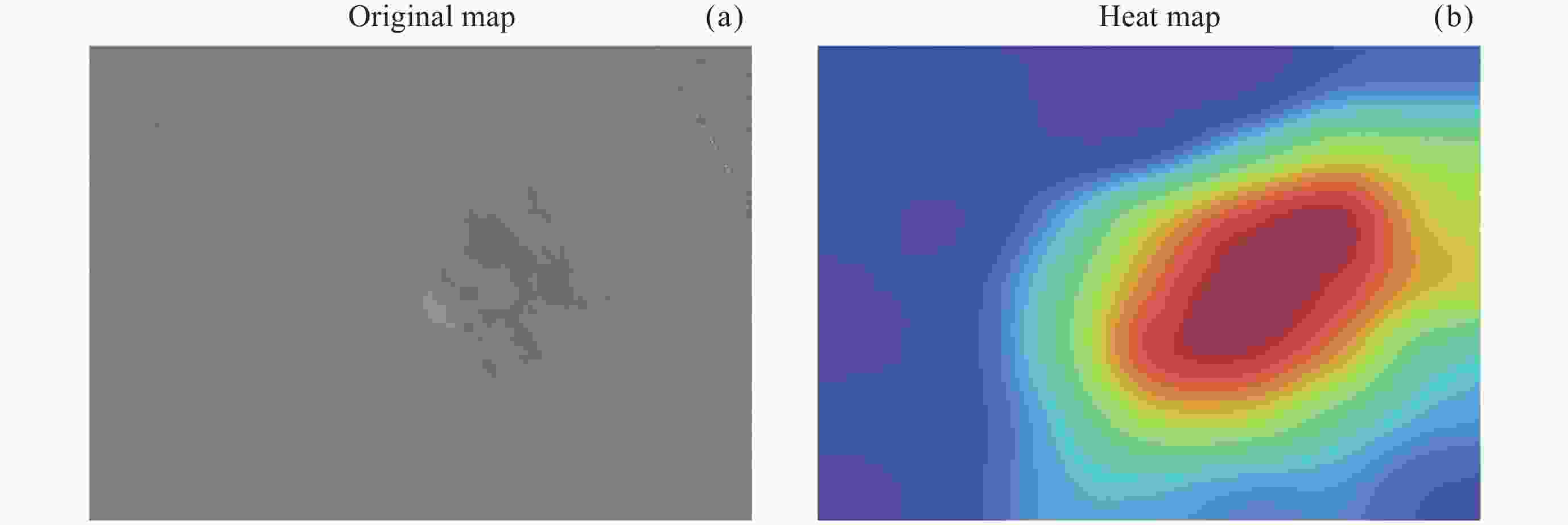
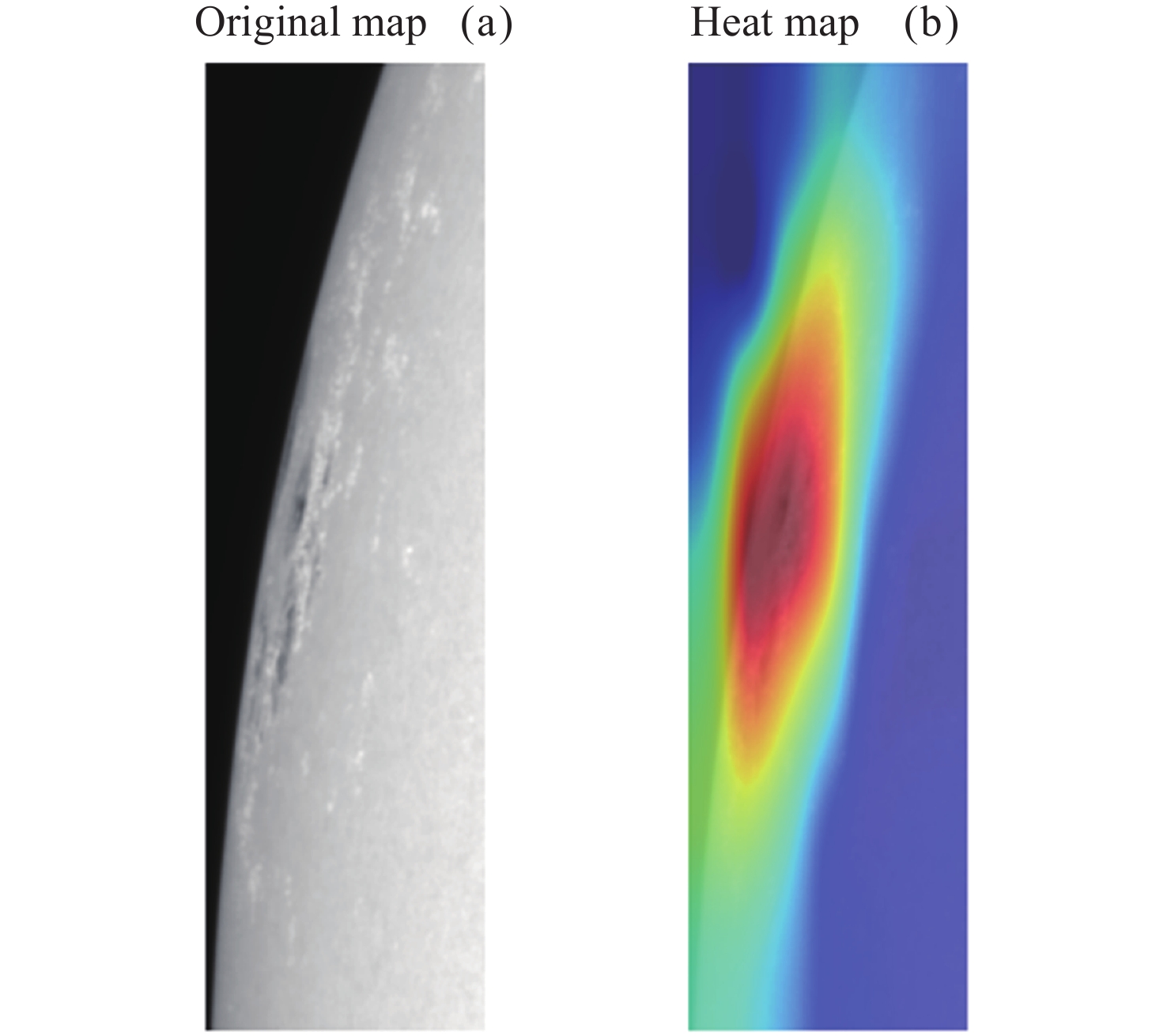
图 6 案例四的黑子群α类型原始图与其类激活热力图
Figure 6. Original map of sunspot group α type, and the heat map of its class activation in Case 4
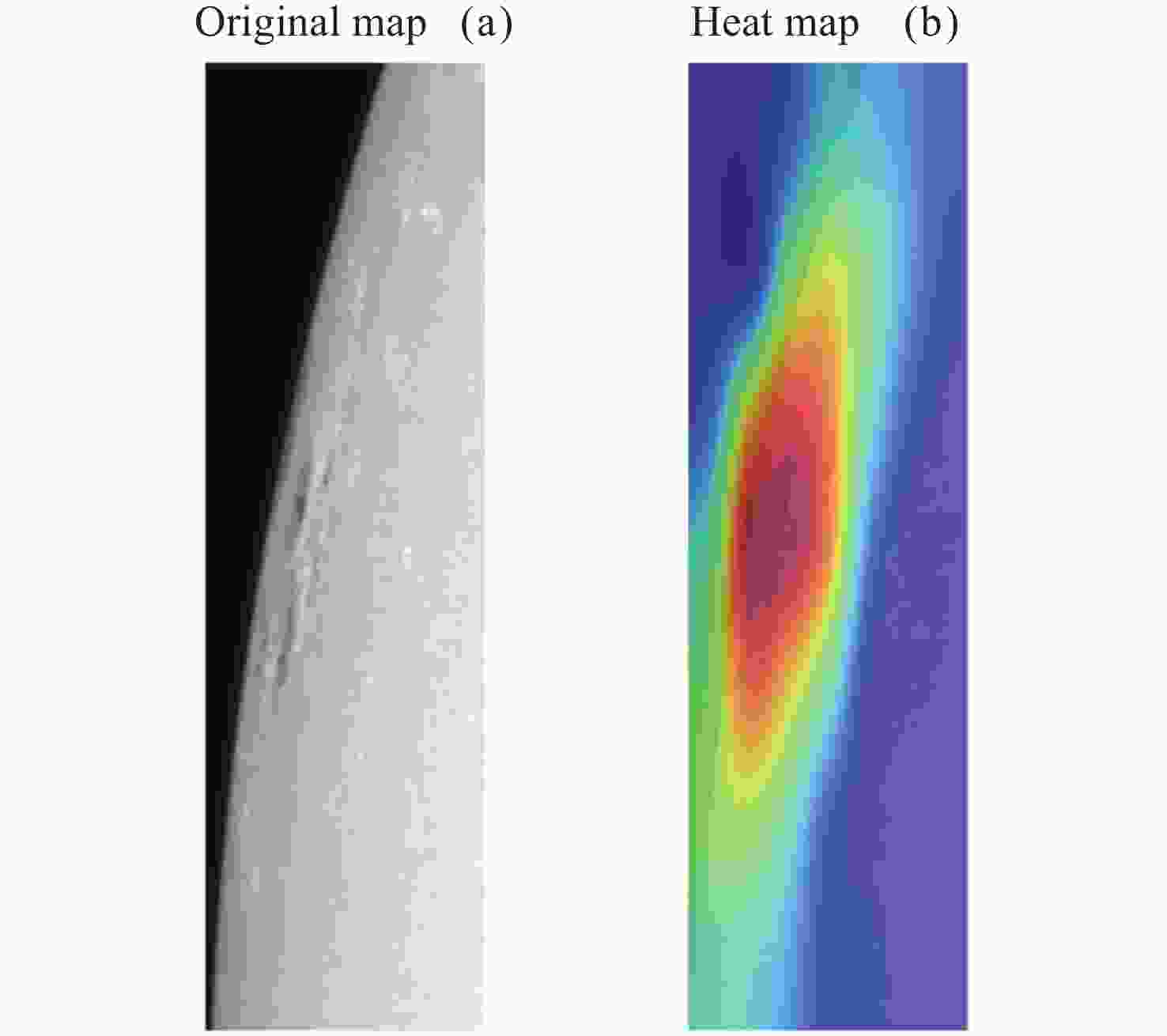
图 7 案例五的黑子群α类型原始图与其类激活热力图
Figure 7. Original map of sunspot group α type, and the heat map of its class activation in Case 5
表 1 威尔逊山分类方案
Table 1. Mount Wilson classification scheme
类型 分类依据 α 都具有相同的磁极性, 包含单颗太阳黑子或一组太阳黑子的活跃区域. 相反的极性对应物仍然存在, 但强度微弱或浓度不足以形成太阳黑子 β 至少具有两个相反磁极性的太阳黑子或太阳黑子群的活跃区域. 两种极性之间存在一条简单的中性线 γ 具有磁极性完全混合的太阳黑子的活跃区域 β-γ 至少具有两个相反磁极性的太阳黑子或太阳黑子群, 但没有明确定义的中性线划分相反极性的活动区域 δ 极性相反的双极性太阳黑子群, 且半影的跨度小于日面2° β-δ 具有β磁场的活跃区域, 并且在单颗半影内至少有一对极性相反的本影 β-γ-δ 具有β-γ磁场的活跃区域, 并且在单颗本影内至少有一对极性相反的本影 γ-δ 具有γ磁场的活跃区域, 并且在单颗半影内至少有一对极性相反的本影  下载: 导出CSV
表 2 数据分布
Table 2. Data distribution
类型 总数据集
2010年5月1日至2017年12月12日训练集
2010年5月1日至2015年7月27日测试集
2015年7月28日至2017年12月12日α 5276 3989 1287 β 7849 6580 1269 β-X 2516 1941 575
下载: 导出CSV
表 3 混淆矩阵
Table 3. Confusion matrix
预测为正类 预测为负类 观测为正类 True Positive (TP) False Negative (FN) 观测为负类 False Positive (FP) True Negative (TN)
下载: 导出CSV
表 4 连续谱图预测结果
Table 4. Prediction results of continuum map
α β β-X α 5916 377 37 β 323 8566 525 β-X 138 179 2701
下载: 导出CSV
表 5 连续谱图性能指标的模型对比
Table 5. Comparison of performance metrics of continuum map by different models
下载: 导出CSV
表 6 磁图预测结果
Table 6. Predicted results of magnetogram map
α β β-X α 6123 199 8 β 423 8684 307 β-X 76 221 2721
下载: 导出CSV
-
[1] 程术, 石耀霖, 张怀. 基于神经网络预测太阳黑子变化[J]. 中国科学院大学学报, 2022, 39(5): 615-626CHENG Shu, SHI Yaolin, ZHANG Huai. Predicting sunspot variations through neural network[J]. Journal of University of Chinese Academy of Sciences, 2022, 39(5): 615-626 [2] CHEN Z, LIAO W T, LI H M, et al. Prediction of global ionospheric TEC based on deep learning[J]. Space Weather, 2022, 20(4): e2021SW002854 doi: 10.1029/2021SW002854 [3] CHEN Z, ZHOU K C, LI H M, et al. Global TEC map fusion through a hybrid deep learning model: RFGAN[J]. Space Weather, 2023, 21(1): e2022SW003341 doi: 10.1029/2022SW003341 [4] YANG Q L, CHEN Z, TANG R X, et al. Image super-resolution methods for FY-3E X-EUVI 195 Å solar images[J]. The Astrophysical Journal Supplement Series, 2023, 265(2): 36 doi: 10.3847/1538-4365/acb3b9 [5] NGUYEN T T, WILLIS C P, PADDON D J, et al. Learning sunspot classification[J]. Fundamenta Informaticae, 2006, 72(1/2/3): 295-309 [6] ABD M A, MAJED S F, ZHARKOVA V. Automated classification of sunspot groups with support vector machines[M]//Elleithy K, Sobh T, Iskander M, et al. Technological Developments in Networking, Education and Automation. Dordrecht: Springer, 2010: 321-325 [7] FANG Y H, CUI Y M, AO X Z. Deep learning for automatic recognition of magnetic type in sunspot groups[J]. Advances in Astronomy, 2019(1): 9196234 [8] 王雅妮. 利用卷积神经网络自动归类太阳黑子[D]. 哈尔滨: 哈尔滨工业大学, 2020WANG Yani. Automatic Classification of Sunspots Using Convolutional Neural Networks[D]. Harbin: Harbin Institute of Technology, 2020 [9] He Y B, Yang Y F, Bai X Y, et al. Research on Mount Wilson magnetic classification based on deep learning[J]. Advances in Astronomy, 2021, 2021(1): 5529383 [10] TANG R X, ZENG X W, CHEN Z, et al. Multiple CNN variants and ensemble learning for sunspot group classification by magnetic type[J]. The Astrophysical Journal Supplement Series, 2021, 257(2): 38 doi: 10.3847/1538-4365/ac249f [11] 李书馨, 赵学斌, 陈君, 等. 基于深度学习的太阳黑子Wilson山磁类型识别方法[J]. 空间科学学报, 2022, 42(3): 333-339 doi: 10.11728/cjss2022.03.210107004LI Shuxin, ZHAO Xuebin, CHEN Jun, et al. Recognition method for mount Wilson magnetic type of sunspots based on deep learning[J]. Chinese Journal of Space Science, 2022, 42(3): 333-339 doi: 10.11728/cjss2022.03.210107004 [12] 樊石鸣. 基于改进ResNet算法的太阳黑子分类方法研究[J]. 现代电子技术, 2024, 47(5): 80-84FAN Shiming. Research on sunspot classification method based on improved ResNet algorithm[J]. Modern Electronics Technique, 2024, 47(5): 80-84 [13] HALE G E, ELLERMAN F, NICHOLSON S B, et al. The magnetic polarity of sun-spots[J]. Astrophysical Journal, 1919, 49: 153 doi: 10.1086/142452 [14] SUN C, SHRIVASTAVA A, SINGH S, et al. Revisiting unreasonable effectiveness of data in deep learning era[C]//Proceedings of the 2017 IEEE International Conference on Computer Vision (ICCV). Venice: IEEE, 2017: 843-852 [15] ZHONG Z, ZHENG L, KANG G L, et al. Random erasing data augmentation[C]//Proceedings of the AAAI Conference on Artificial Intelligence. Washington: AAAI Press, 2020: 13001-13008 [16] HU J, SHEN L, SUN G. Squeeze-and-excitation networks[C]//Proceedings of the 2018 IEEE/CVF Conference on Computer Vision and Pattern Recognition. Salt Lake City: IEEE, 2018: 7132-7141 [17] HE K M, ZHANG X Y, REN S Q, et al. Deep residual learning for image recognition[C]//Proceedings of the 2016 IEEE Conference on Computer Vision and Pattern Recognition (CVPR). Las Vegas: IEEE, 2016: 770-778 [18] ZHOU B L, KHOSLA A, LAPEDRIZA A, et al. Learning deep features for discriminative localization[C]//Proceedings of the 2016 IEEE Conference on Computer Vision and Pattern Recognition (CVPR). Las Vegas: IEEE, 2016: 2921-2929 [19] AMIN F, MAHMOUD M. Confusion matrix in binary classification problems: A step-by-step tutorial[J]. Journal of Engineering Research, 2022, 6: T1-T12 [20] 张开放, 苏华友, 窦勇. 一种基于混淆矩阵的多分类任务准确率评估新方法[J]. 计算机工程与科学, 2021, 43(11): 1910-1919 doi: 10.3969/j.issn.1007-130X.2021.11.002ZHANG Kaifang, SU Huayou, DOU Yong. A new multi-classification task accuracy evaluation method based on confusion matrix[J]. Computer Engineering :Times New Roman;">& Science, 2021, 43(11): 1910-1919 doi: 10.3969/j.issn.1007-130X.2021.11.002 [21] LIU S X, XU L, ZHAO Z R, et al. Deep learning based solar flare forecasting model. II. influence of image resolution[J]. The Astrophysical Journal, 2022, 941(1): 20 doi: 10.3847/1538-4357/ac99dc -
-

 下载:
下载:

计量
- 文章访问数: 1426
- HTML全文浏览量: 700
- PDF下载量: 185
-
被引次数:
0(来源:Crossref)
0(来源:其他)

