


FY-3E卫星高能粒子探测器监测结果
doi: 10.11728/cjss2025.05.2024-0121 cstr: 32142.14.cjss.2024-0121
-
 王春琴 女, 1978年生, 现为中国科学院国家空间科学中心副研究员, 主要从事星载空间带电粒子及辐射效应探测数据分析研究工作. E-mail: wcq@nssc.ac.cn
作者简介:
Monitoring Results of FY-3E Satellite High-energy Particle Detector
-
摘要: FY-3E卫星高能粒子探测器开展轨道空间高能电子和高能质子监测, 可获取卫星本体三个方向(–z朝天向、–x飞行反方向和+y垂直轨道面方向) 0.15~5.7 MeV的高能电子和 3~300 MeV的高能质子数据. 通过分析高能粒子探测器2021年7月至2024年5月高能质子、高能电子探测数据, 得到卫星本体三个方向高能质子和高能电子空间分布区域及长时间演化结果. 研究表明, 能量越低, 分布范围越大, 结构越复杂, 其中较低能量的电子在南北高纬度上呈现出多条带结构; 电子通量强度+y方向的最高, 动态变化最为显著, –z方向反之. 质子则在三个方向上的差异相对较小; 2024年5月的极强地磁暴显著影响到电子和质子的空间分布和通量强度. 数据结果表明, FY-3E高能粒子探测器能够对卫星轨道空间高能粒子动态做出灵敏响应, 探测数据不仅可以支持开展轨道环境评估、航天器辐射防护设计以及星上设备安全布局等, 还有助于辐射带的动态及极端事件研究的深入开展.Abstract: FY-3E satellite is one of the Fengyun-3 polar orbit meteorological satellite series and also the first morning dusk orbit meteorological satellite in China. The satellite orbits at an altitude of about 830 kilometers with an inclination angle of 98.75°. The high-energy particle detector mounted on the satellite is used to monitor the charged particle radiation environment, which can provide 0.15 MeV to 5.7 MeV high-energy electron and 3 MeV to 300 MeV proton flux data in three directions of the satellite body (–z skyward direction, –x flight reverse direction, and +y vertical orbital plane direction). The data of high-energy protons and electrons monitored by the detector from July 2021 to May 2024 are analyzed, and the spatial distribution and long-term evolution results are obtained in the three directions as follows. The lower the energy, the larger the distribution range, and the more complex the structure, especially for energy electrons, which exhibit multiple stripes at both high latitudes of north and south. Among the three directions, the flux intensity of electrons in the +y direction is the highest, and the –z direction is the smallest. The difference of protons in the three directions is relatively small. The +y direction electrons are most significantly affected by environmental disturbances. The extremely strong geomagnetic storm in May 2024 significantly affects the spatial distribution and flux intensity of both electrons and protons. The data results indicate that the high-energy particle detector can respond sensitively to the dynamics of high-energy particles in space. The measured data can not only support the assessment of orbital environment, serve for the design of spacecraft radiation protection and the secure layout of satellite equipment, but also can help to further understand the dynamic physics process of charged particles in radiation belts during disturbances, especially under the influence of extreme events.
-
Key words:
- FY-3E satellite /
- High energy proton /
- High energy electron /
- Earth radiation belt
-

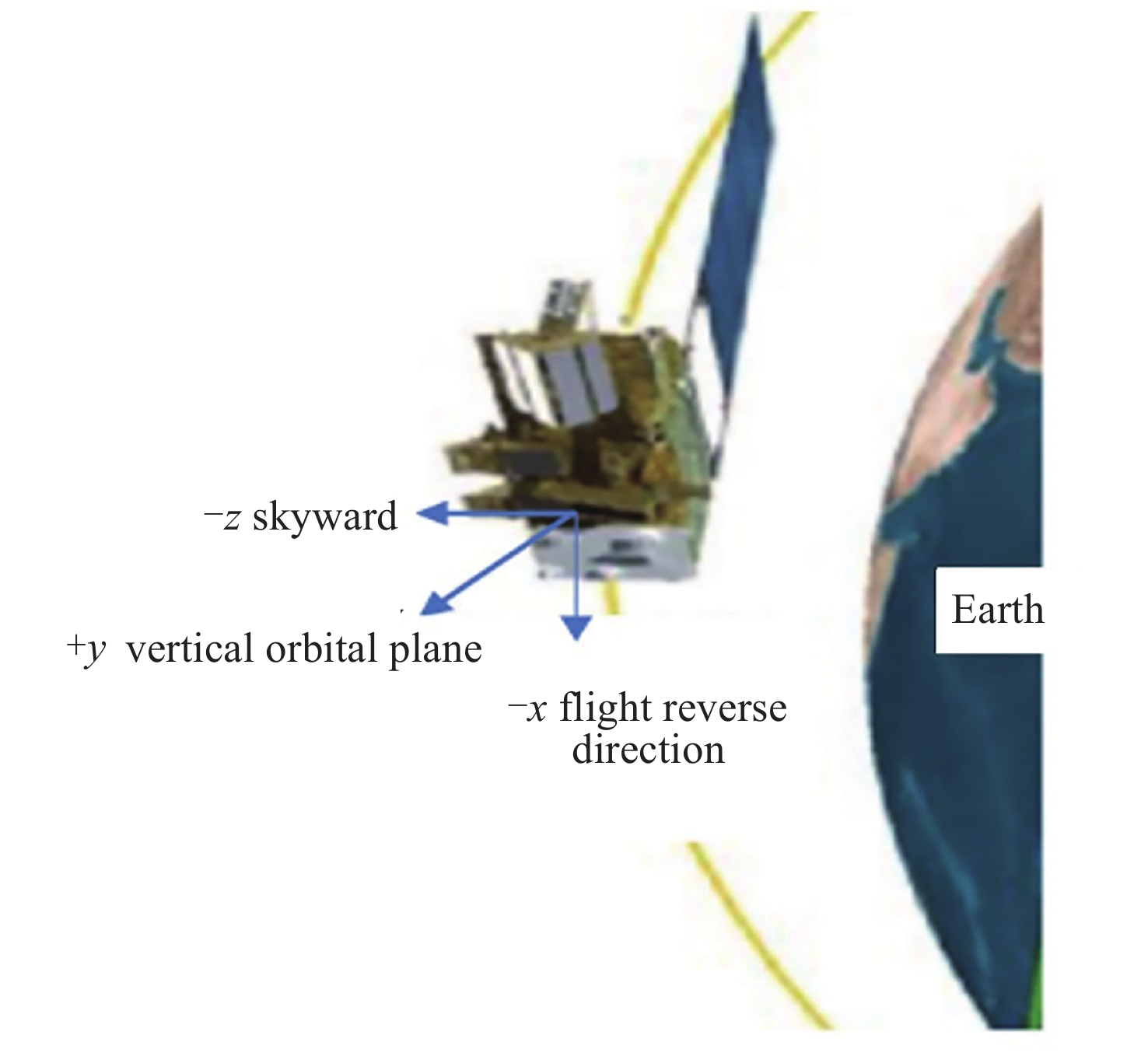
图 1 仪器相对卫星的安装方向
Figure 1. Schematic diagram of the installation direction of the instrument on the satellite
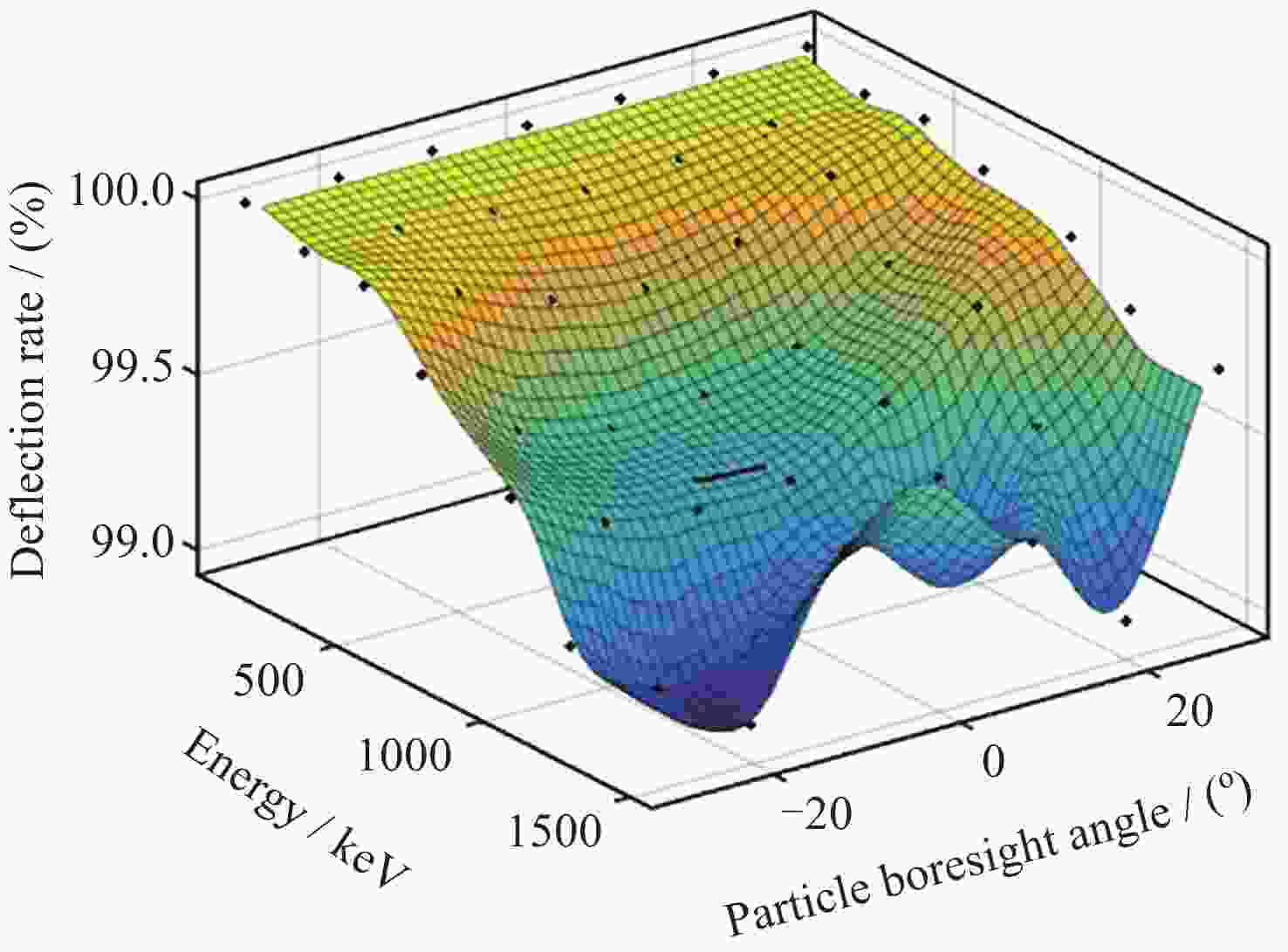
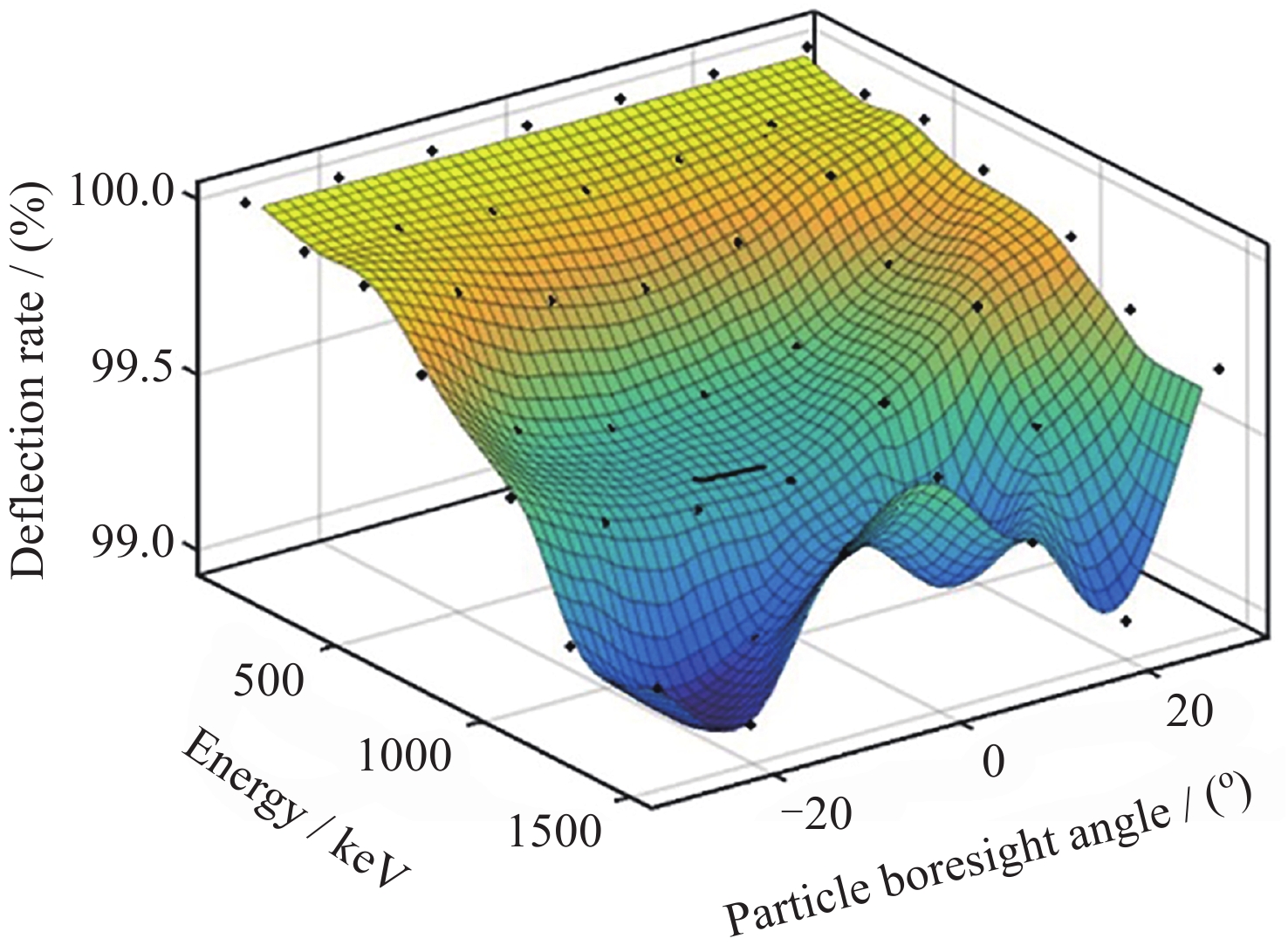
图 3 0.42 T磁铁偏转电子地面试验结果
Figure 3. Ground test results of deflection of high-energy electrons by a 0.42 T magnet
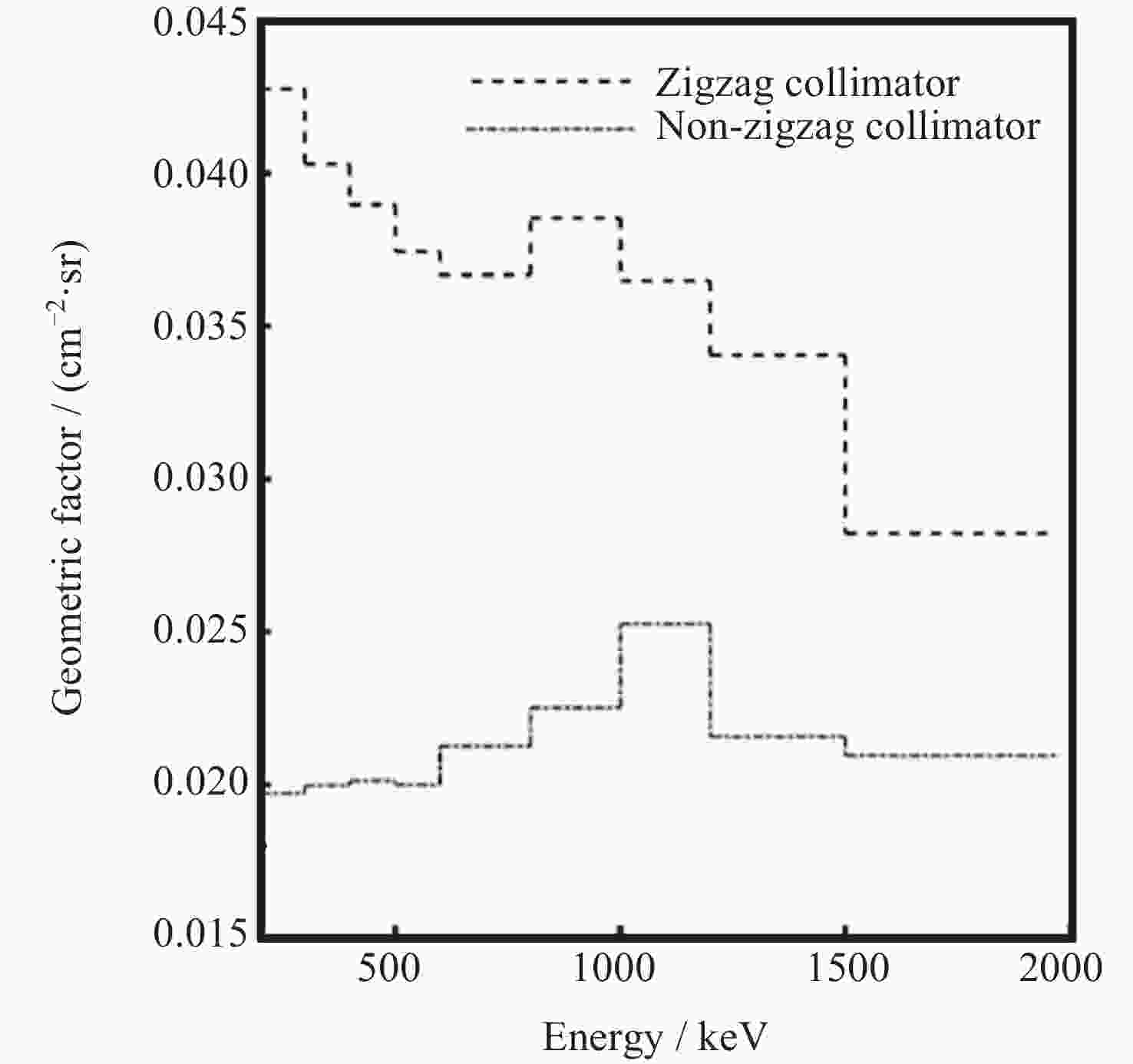
图 5 锯齿结构和非锯齿结构准直器探测效率仿真结果
Figure 5. Simulation results of zigzag and non-zigzag collimator detection efficiency
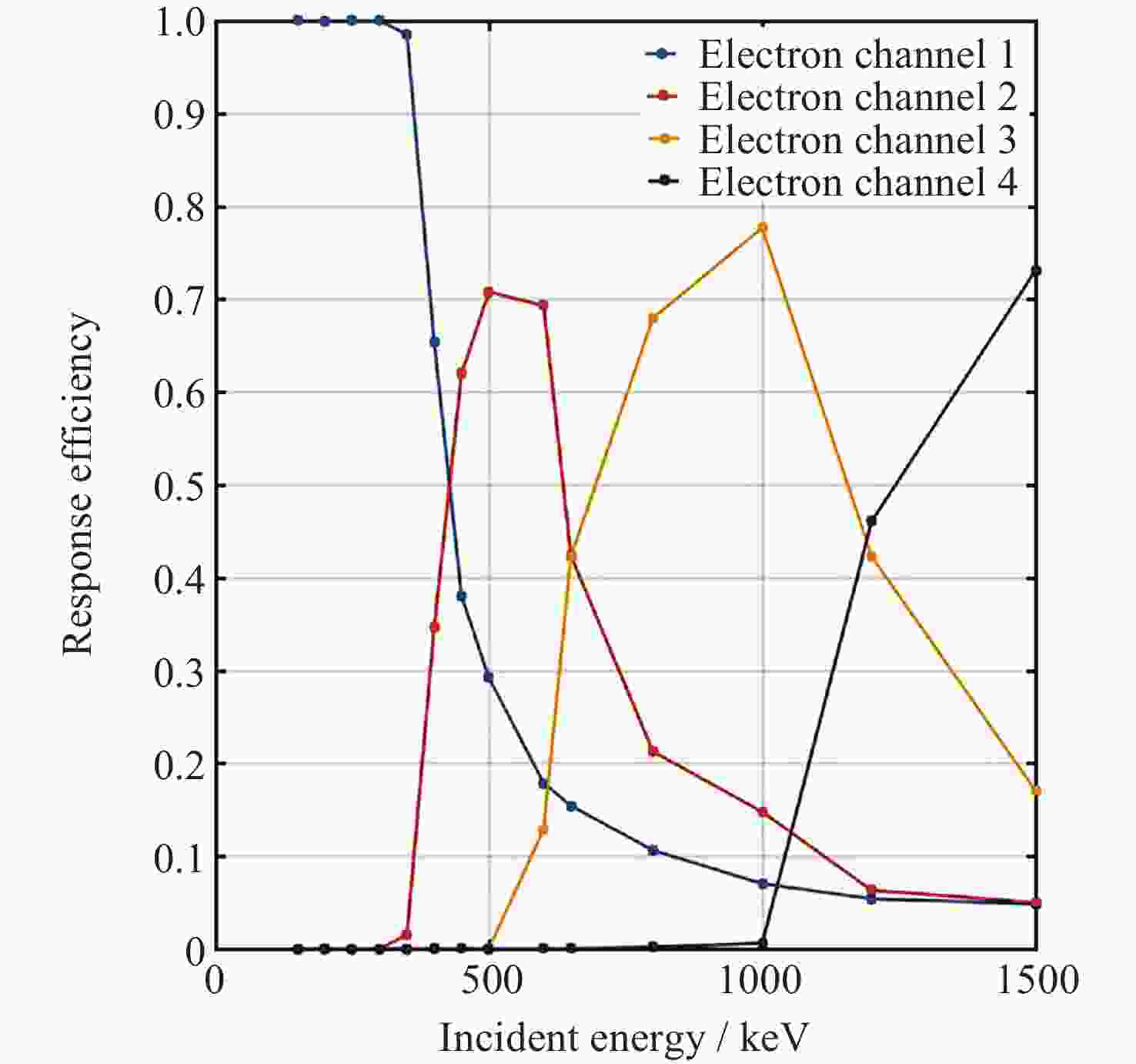
图 6 电子各道响应效率曲线加速器定标结果
Figure 6. Calibration results of the response efficiency of electron channels
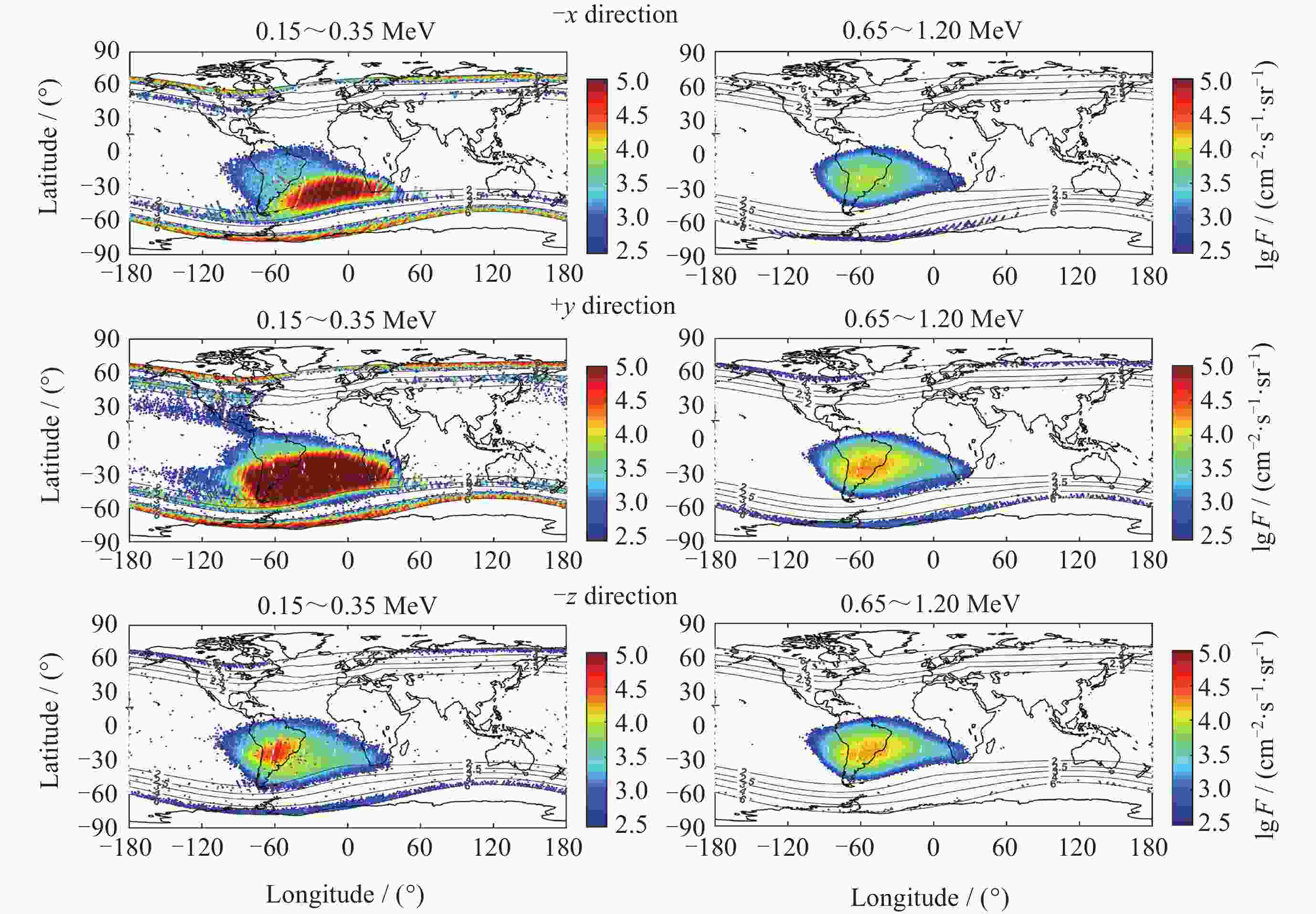
图 7 FY-3E卫星 2024年2月1日探测的地磁平静期间(Dst最小值为–21 nT)三个方向高能电子辐射全球分布
Figure 7. Global distribution of high-energy electron radiation in three directions during quiet period (minimum value of Dst is –21 nT)
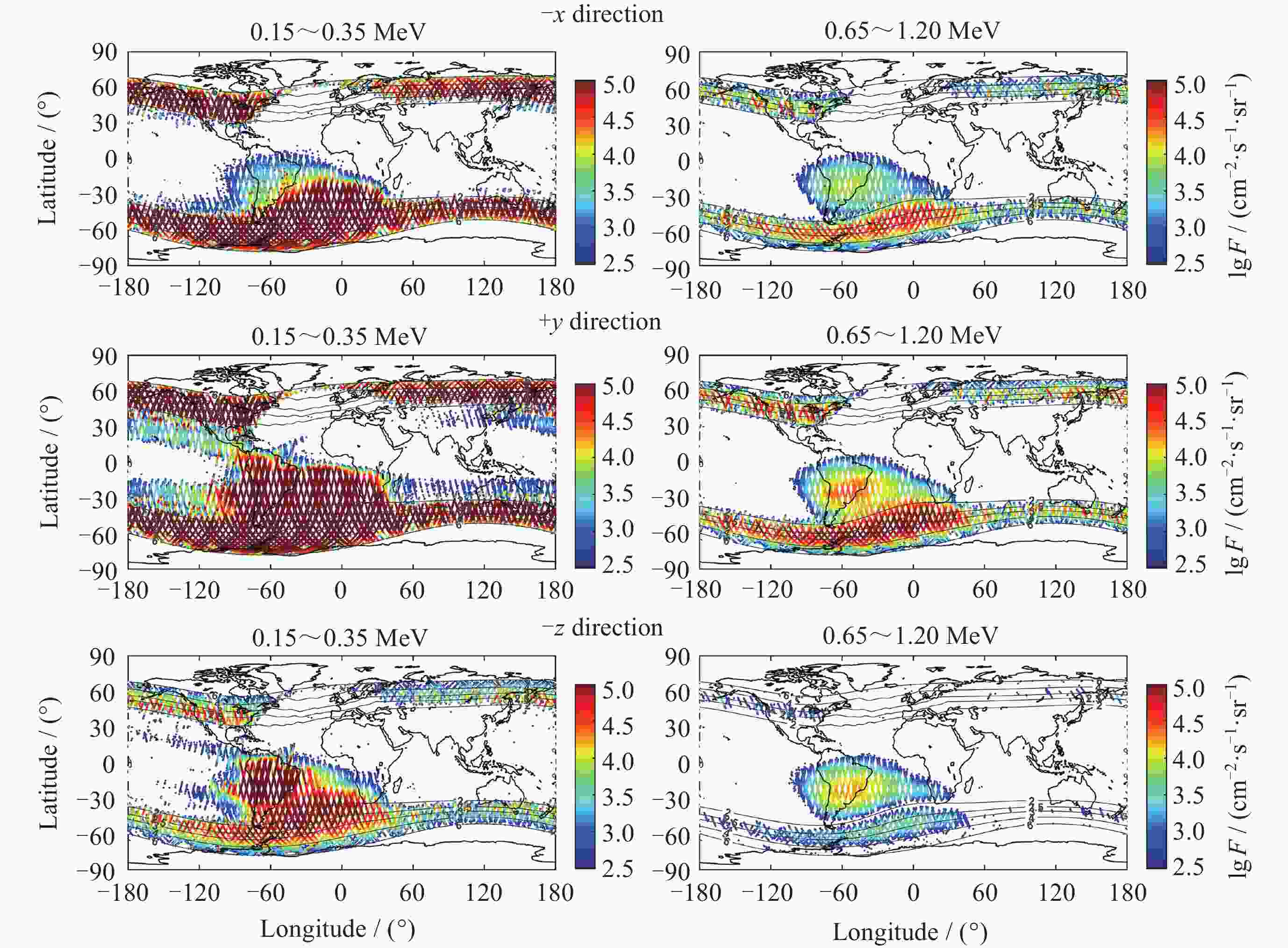
图 9 强磁暴期间(Dst最小值为–412 nT)三个方向高能电子辐射全球分布
Figure 9. Global distribution of high-energy electron radiation in three directions during a strong geomagnetic storm (minimum value of Dst is –412 nT)
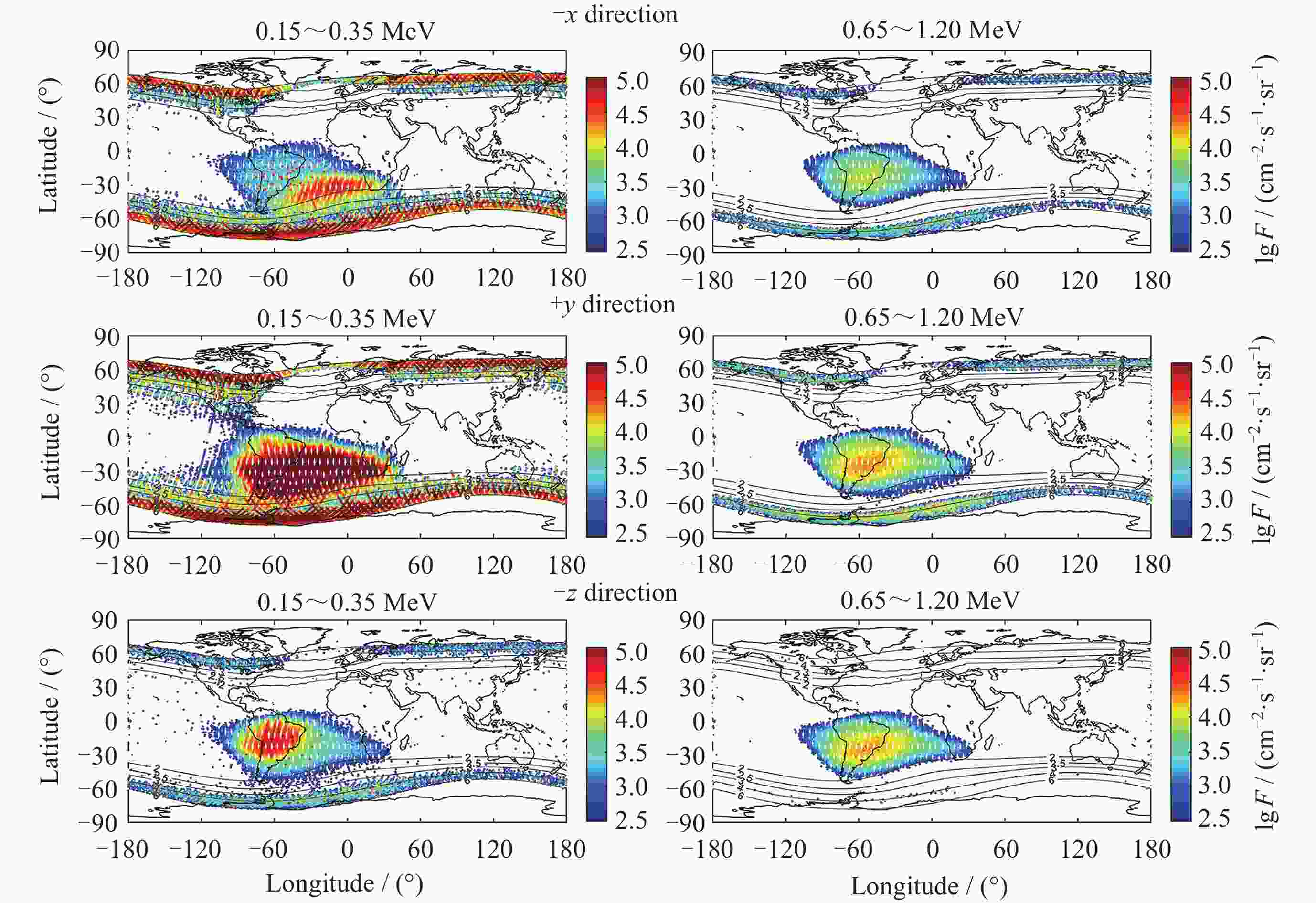
图 8 中等磁暴期间(Dst最小值为–65 nT)三个方向高能电子辐射全球分布
Figure 8. Global distribution of high-energy electron radiation in three directions during moderate geomagnetic storm (minimum value of Dst is –65 nT)
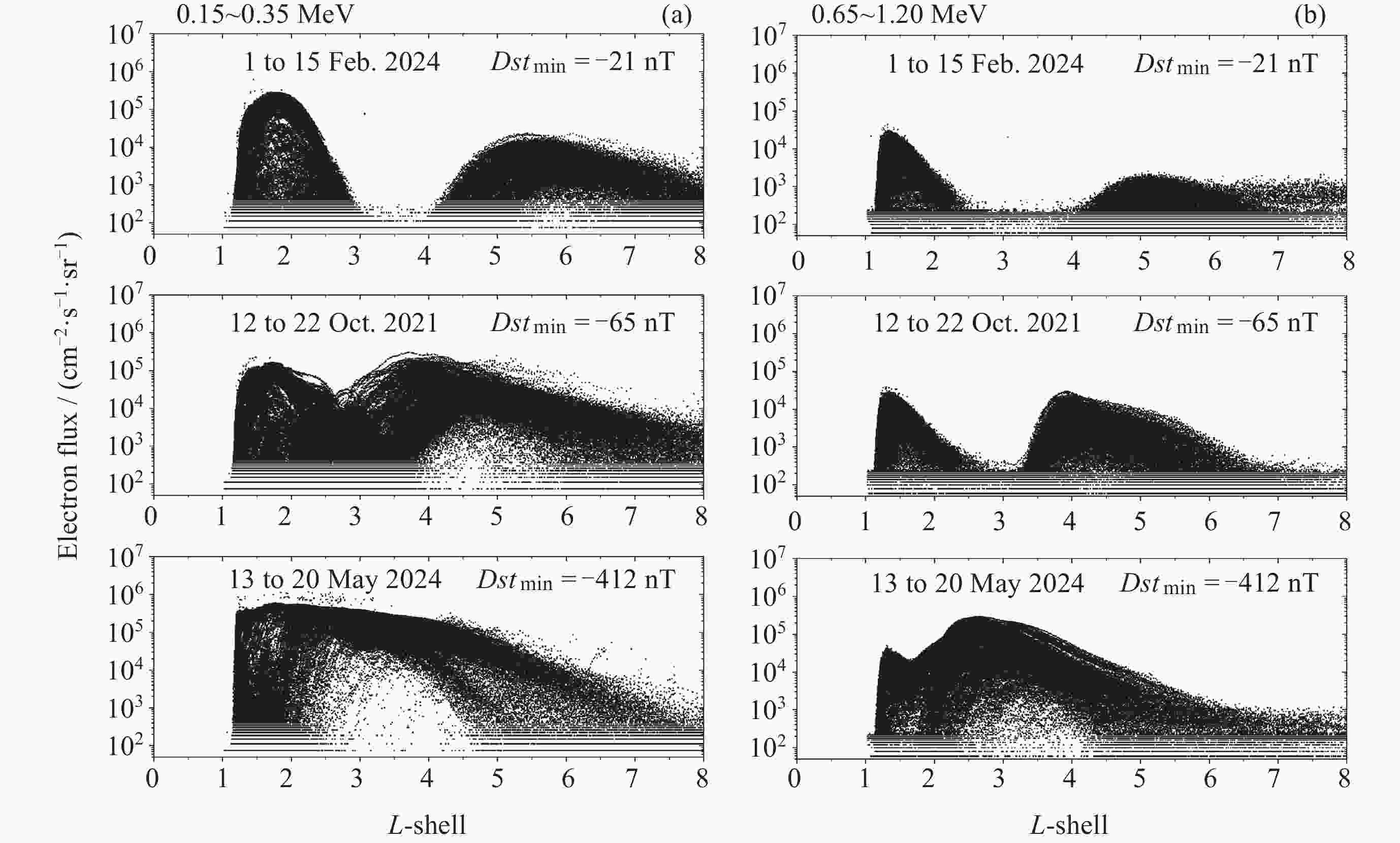
图 10 不同环境扰动时段0.15~0.35 MeV (a)和0.65~1.2 MeV (b)高能电子通量辐射带位置变化
Figure 10. Variation of 0.15~0.35 MeV (a) and 0.65~1.2 MeV (b) electron flux in radiation belt during different disturbance periods
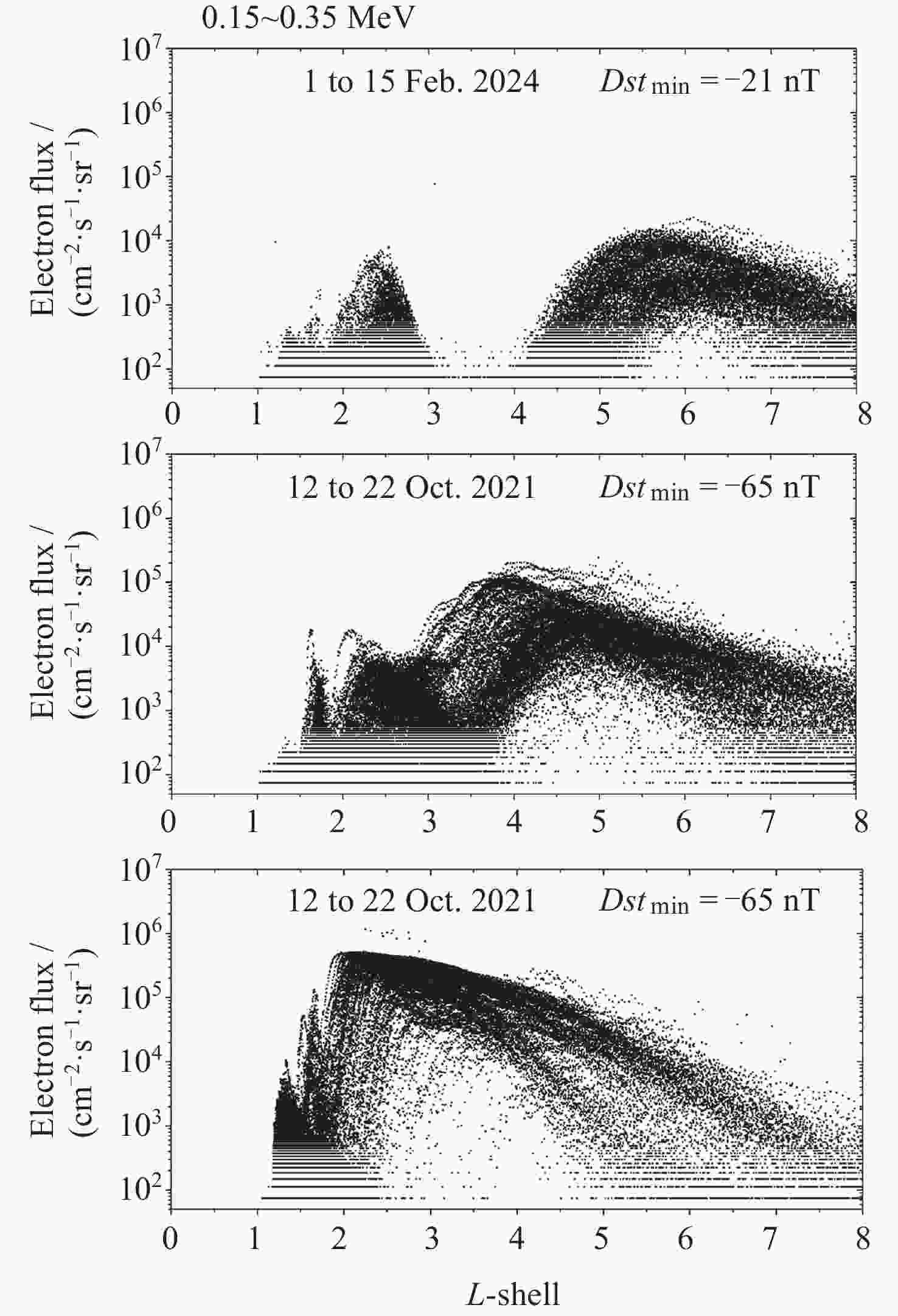
图 11 不同环境扰动时段0.15~0.35 MeV高能电子通量辐射带位置变化(筛选纬度 > 0°的数据获得)
Figure 11. Variation of 0.15~0.35 MeV electron flux in radiation belt during different disturbance periods (obtained data with latitude > 0°)
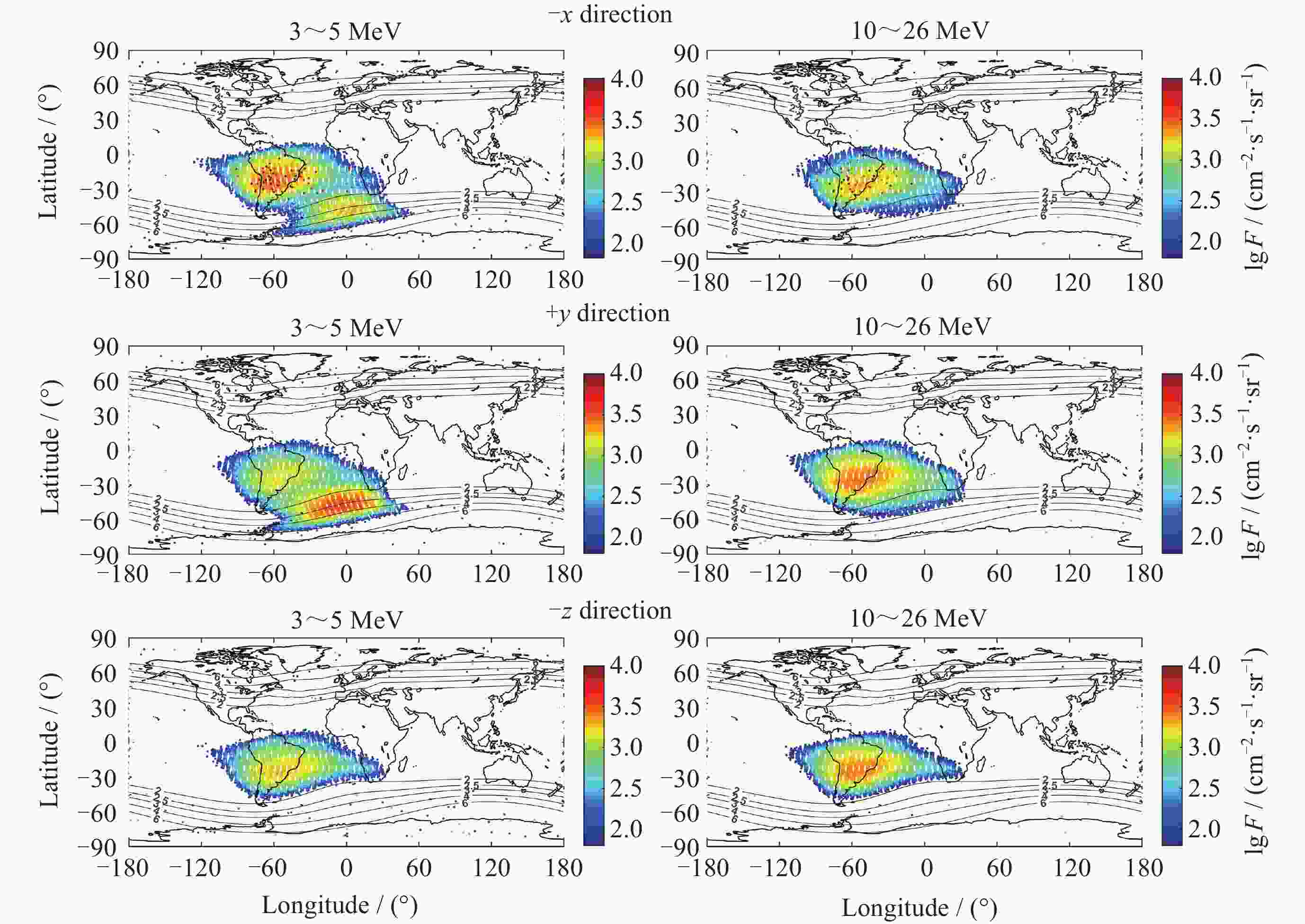
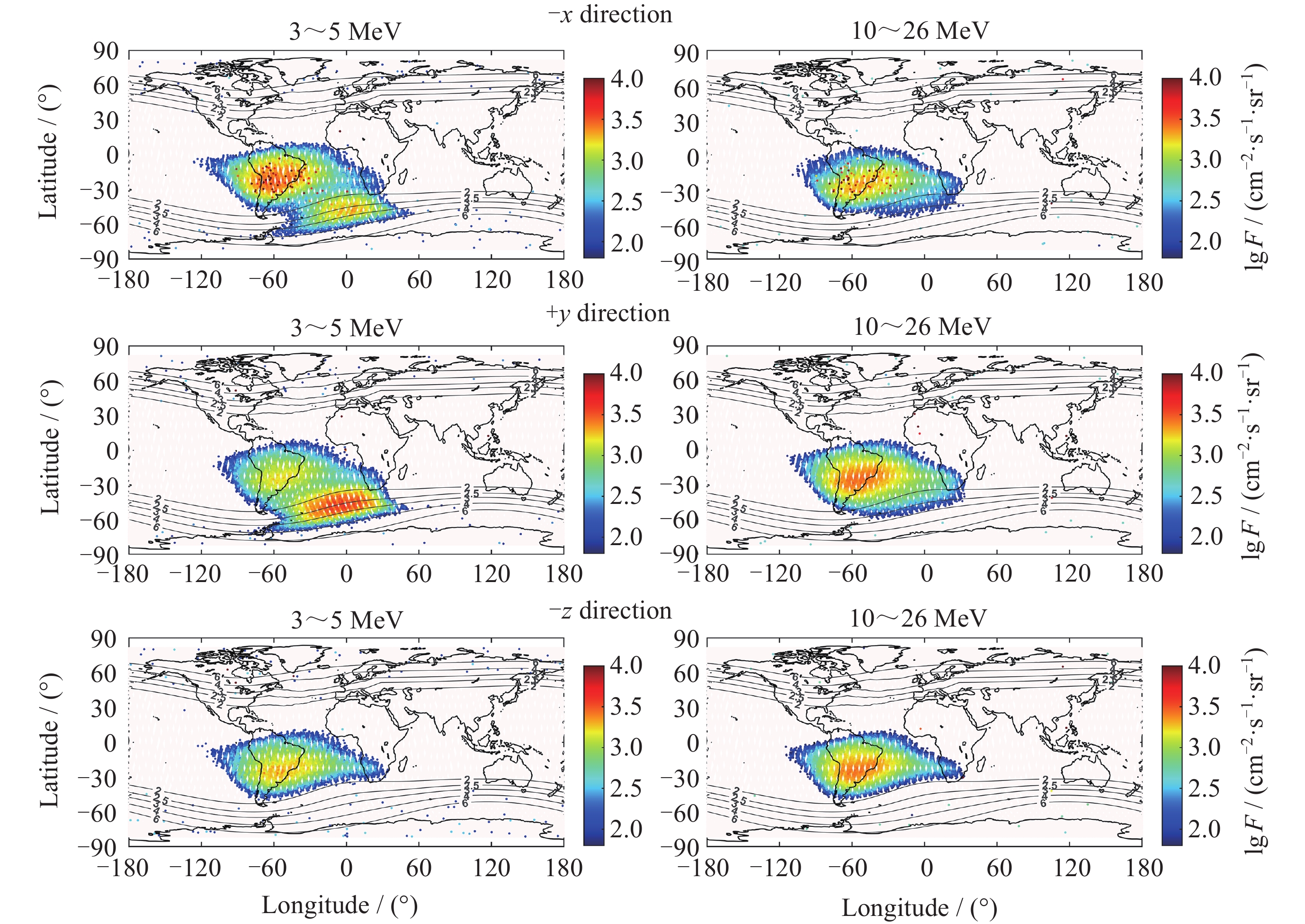
图 12 无太阳质子事件期间三个方向高能质子全球分布
Figure 12. Global distribution of high-energy protons in three directions during none solar proton events
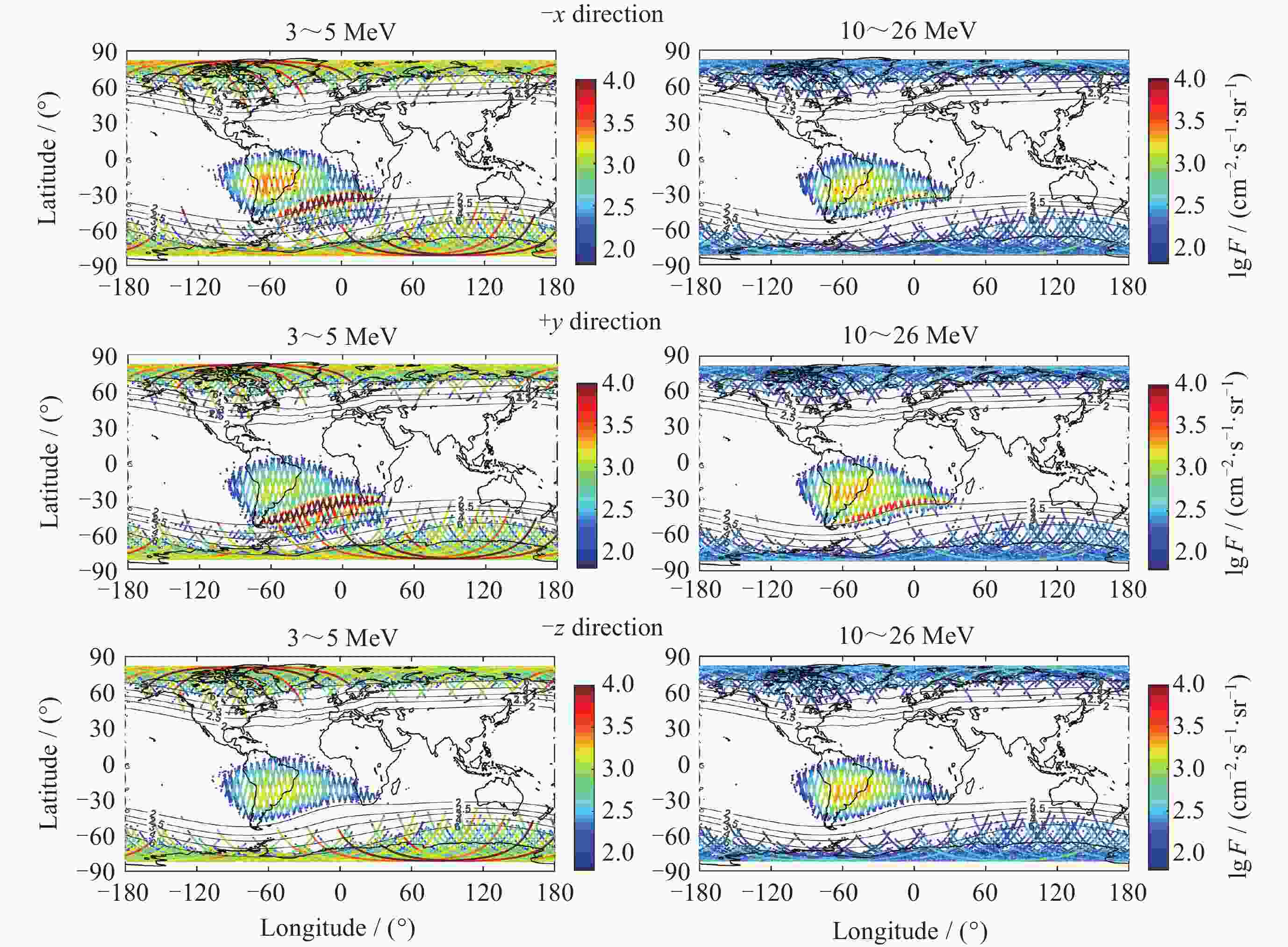
图 14 太阳质子事件伴随强磁暴(Dst指数最小为–412 nT)三个方向高能质子全球分布
Figure 14. Global distribution of high-energy protons in three directions accompanied by strong geomagnetic storm (minimum value of Dst is –412 nT) during solar proton events
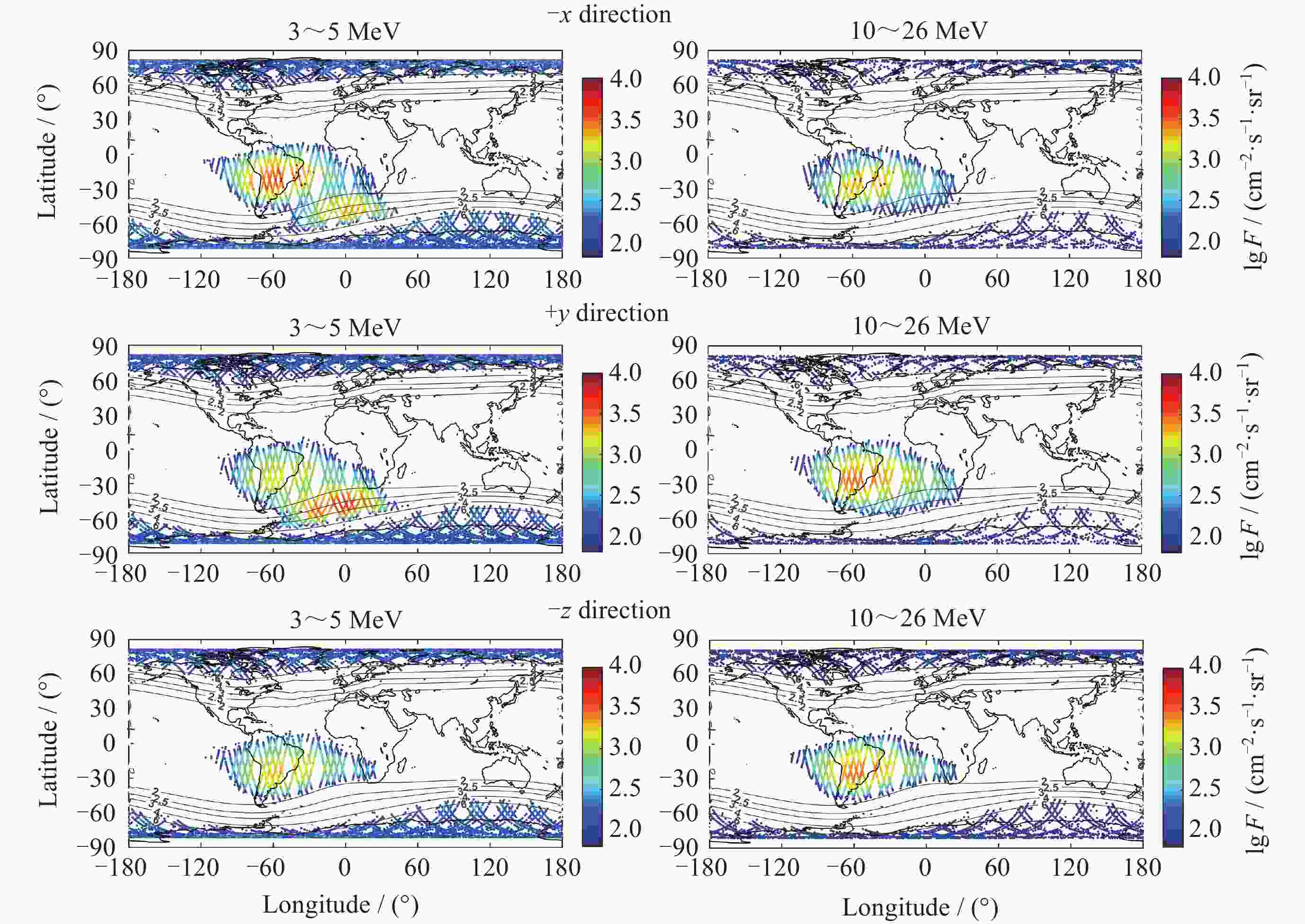
图 13 太阳质子事件伴随小磁暴(Dst指数最小为–33 nT)三个方向高能质子全球分布
Figure 13. Global distribution of high-energy protons in three directions accompanied by small geomagnetic storm (minimum value of Dst is –33 nT) during solar proton events
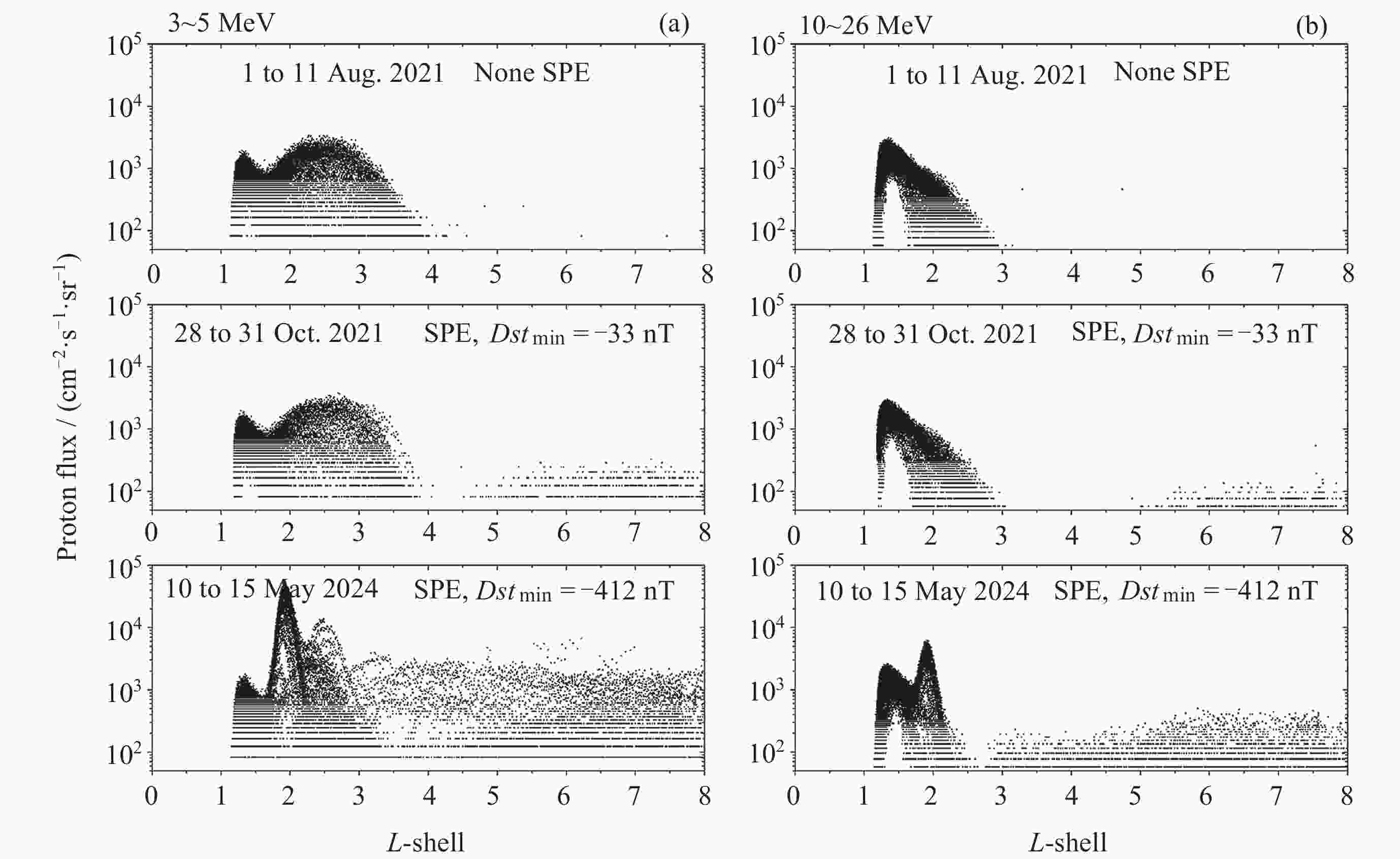
图 15 不同环境扰动时段 3~5 MeV (a)和10~26 MeV (b)高能质子通量辐射带位置变化
Figure 15. Variation of 3~5 MeV (a) and 10~26 MeV (b) proton flux in radiation belt during different disturbance periods
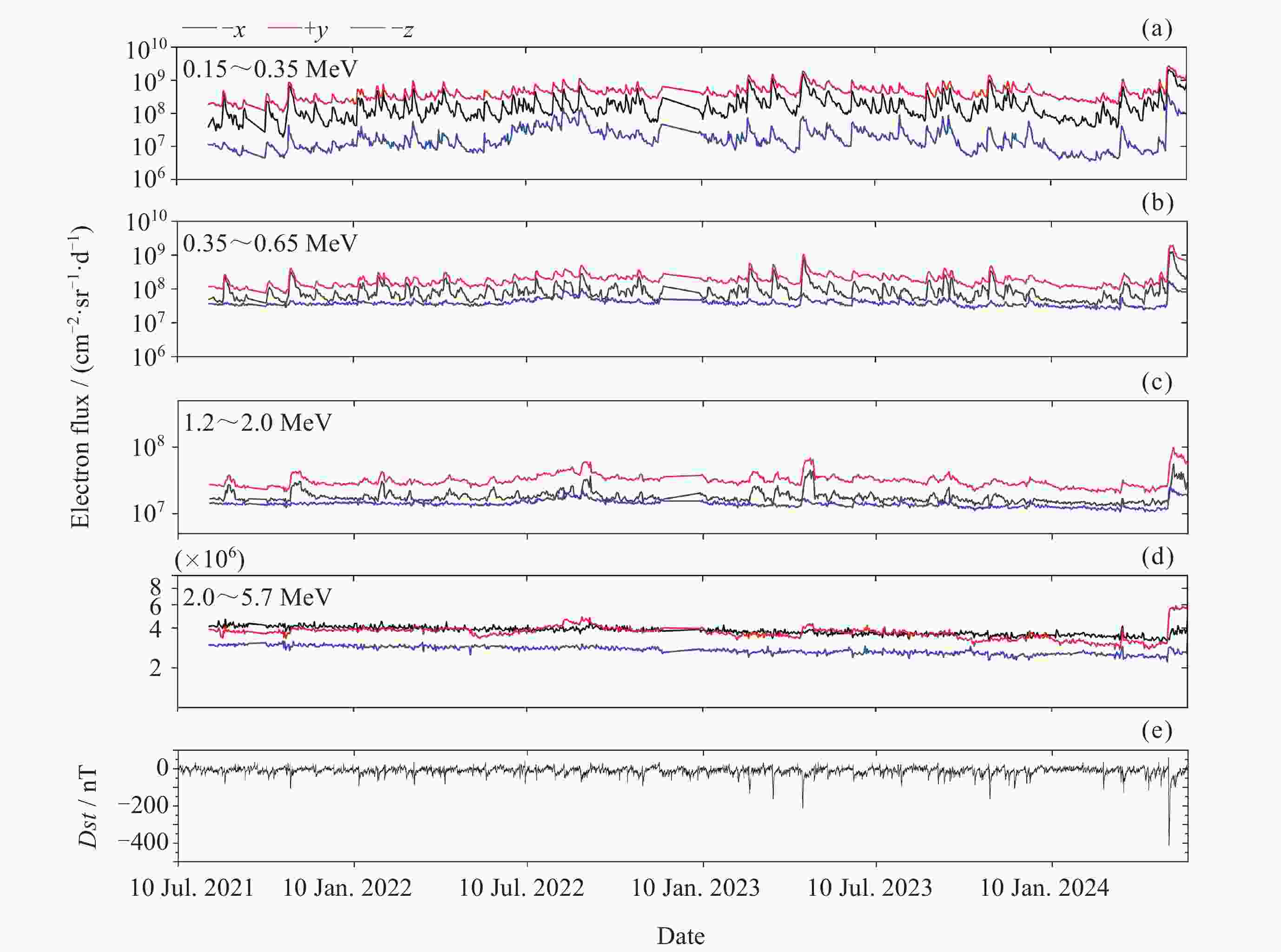
图 16 FY-3E卫星轨道空间高能电子日累积通量时序变化
Figure 16. Variations of daily cumulative flux of high-energy electrons in FY-3E satellite orbit
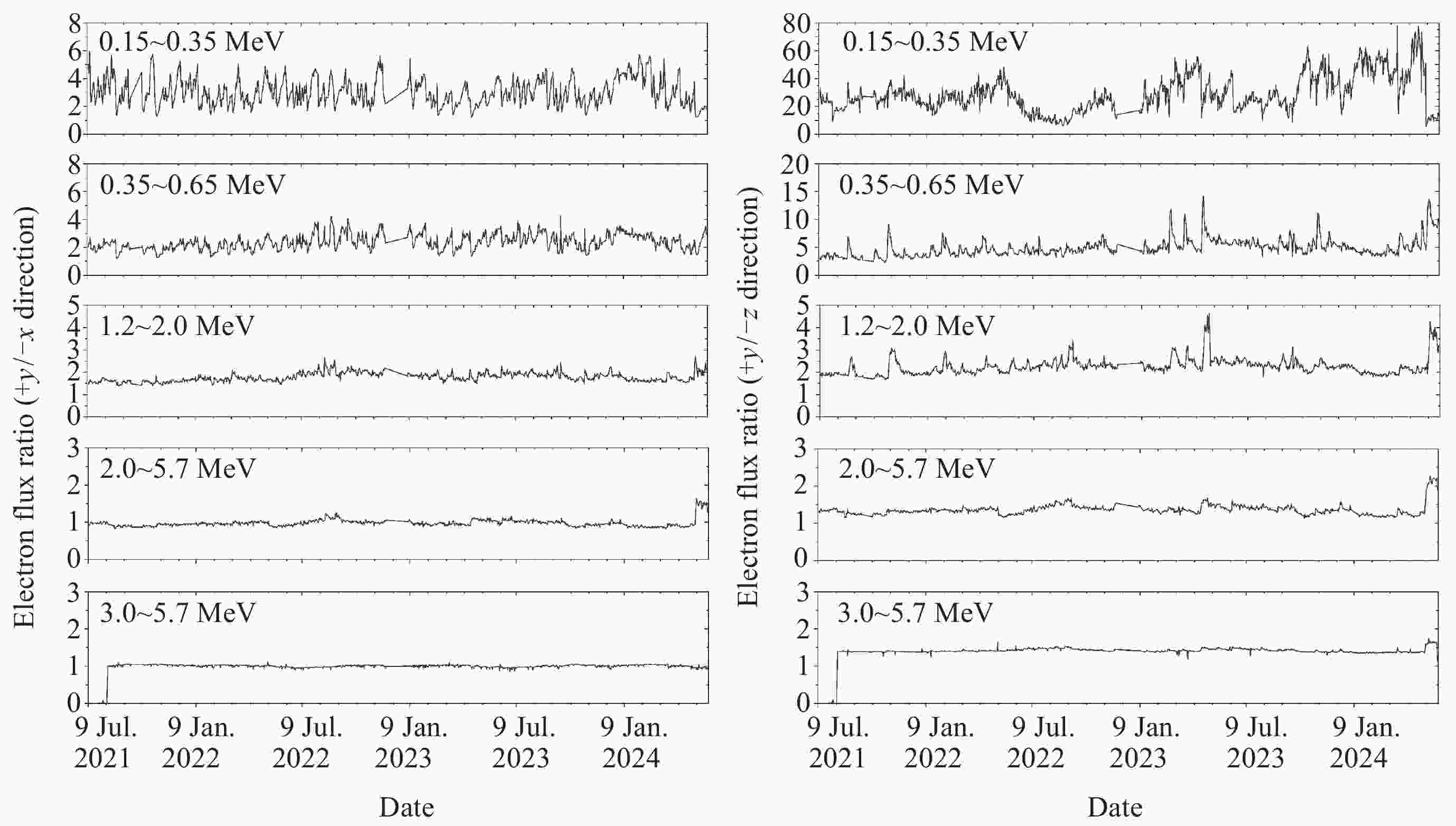
图 17 FY-3E卫星轨道空间三个方向高能电子日累积通量比率时序变化
Figure 17. Variations of daily cumulative flux ratio of high-energy electrons in three directions of FY-3E satellite orbit
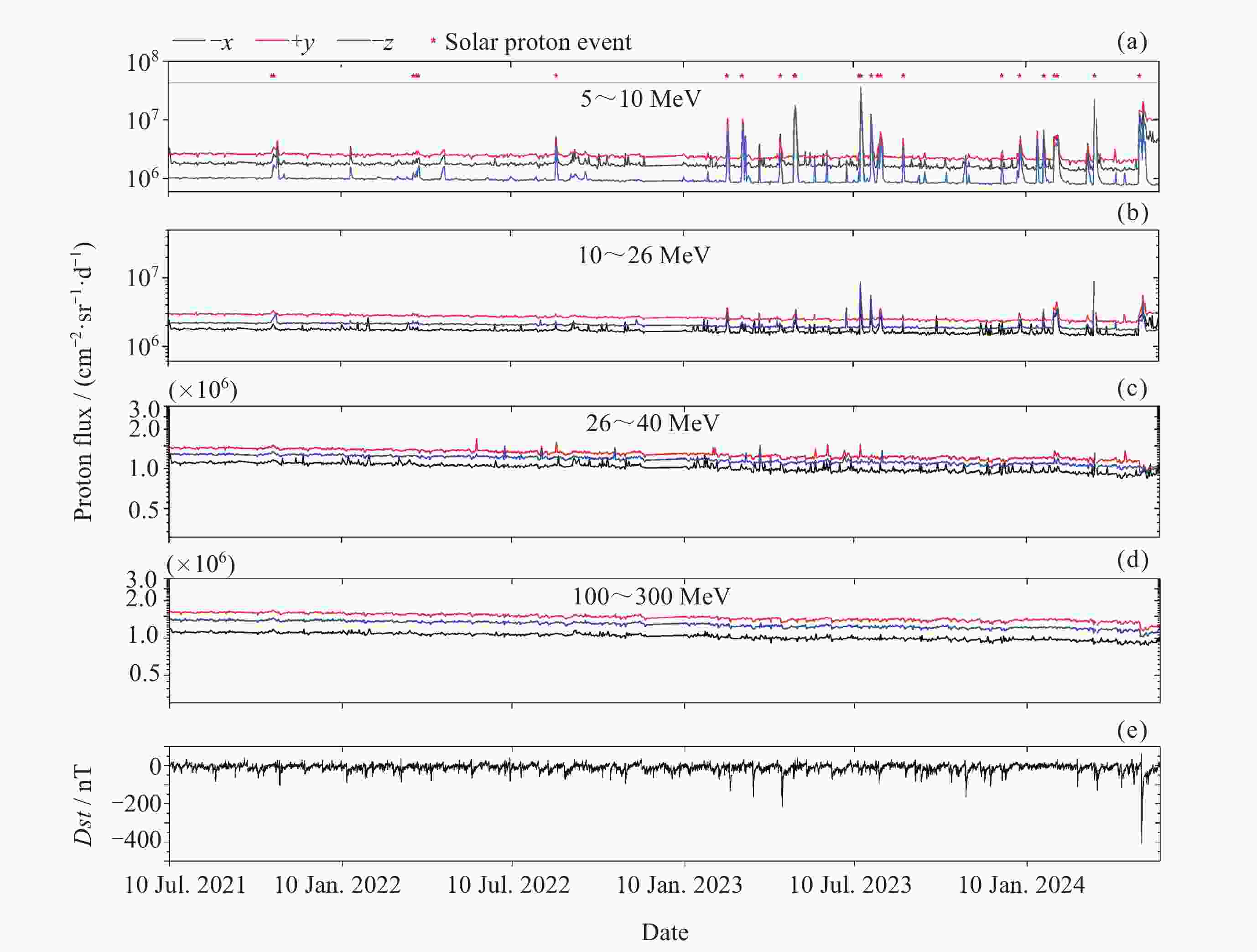
图 18 FY-3E卫星轨道空间高能质子日累积通量时序变化
Figure 18. Variations of daily cumulative flux of high-energy protons in FY-3E satellite orbit
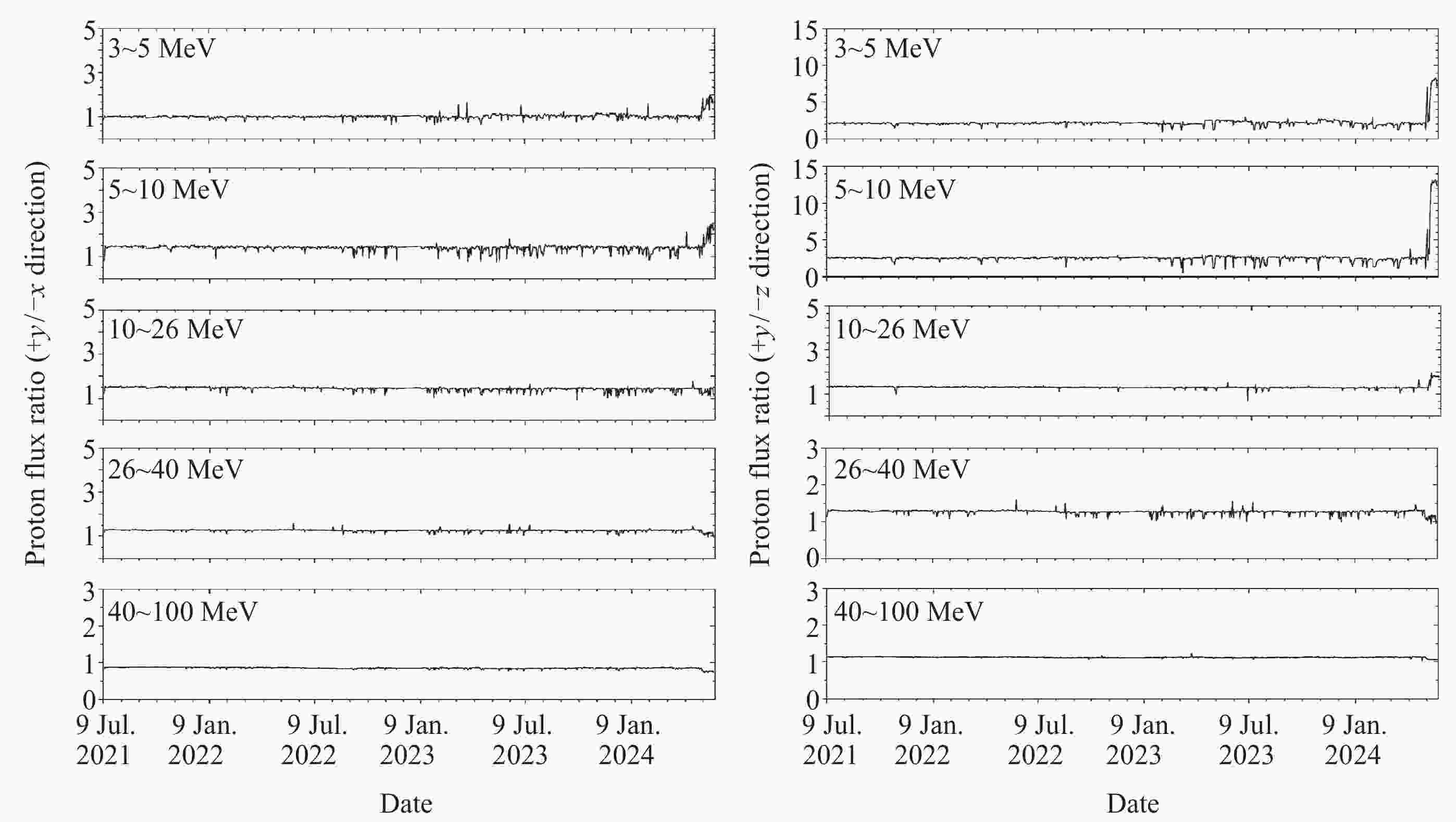
图 19 FY-3E卫星轨道空间三个方向高能质子日累积通量比率时序变化
Figure 19. Variations of daily cumulative flux ratio of high-energy protons in three directions of FY-3E satellite orbit
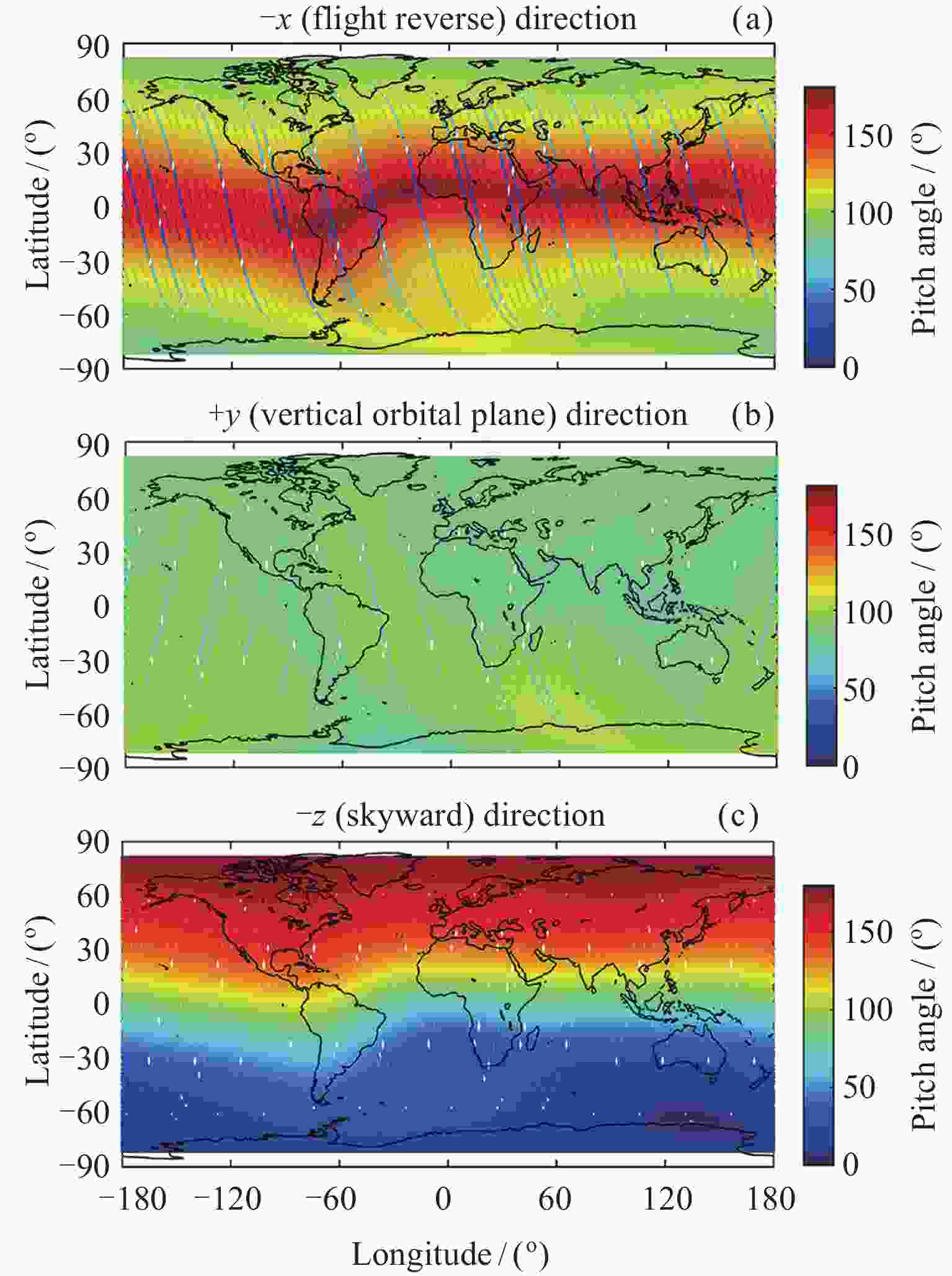
图 20 FY-3E卫星三个方向粒子投掷角分布
Figure 20. Distribution of particle pitch angles in three directions of FY-3E satellite
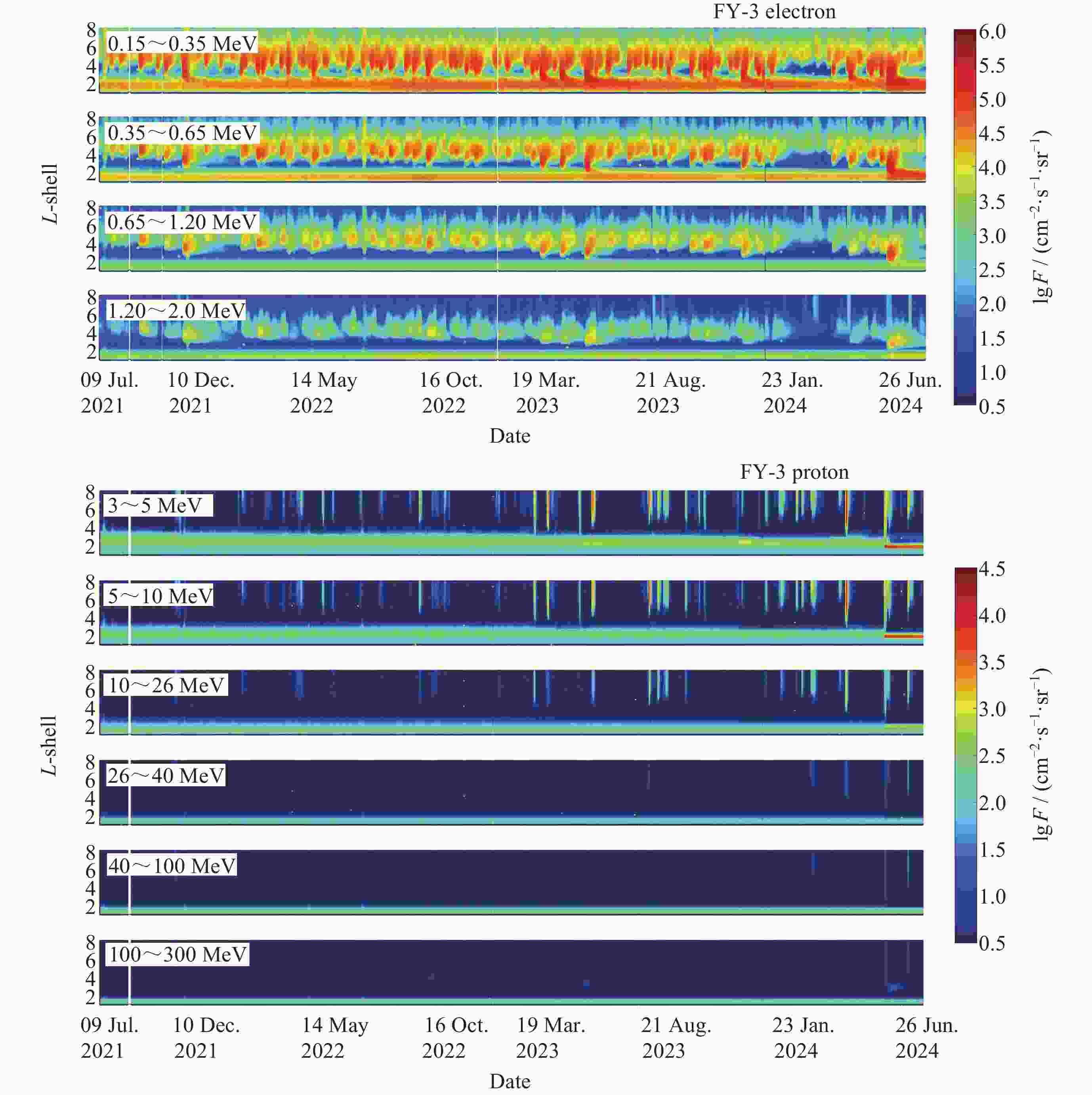
图 21 辐射带高能电子、高能质子通量强度时序变化
Figure 21. Evolution of high energy electron and proton flux in radiation belt
表 1 高能粒子探测器探测技术指标
Table 1. Technical specifications for high-energy particle detector
指标名称 高能质子 高能电子 探测能道/MeV 3~5, 5~10, 10~26, 26~40, 40~100,
100~3000.15~0.35, 0.35~0.65, 0.65~1.2, 1.2~2.0,
2.0~5.7仪器张角/(°) 40 30 几何因子/(cm2·sr) 0.30 0.05 时间分辨率/s 2 2 地面定标精度 优于10% 优于8.7%  下载: 导出CSV
表 2 高能质子传感器逻辑工作方式
Table 2. Logic working mode of high-energy proton sensors
能谱 能量范围/MeV 逻辑工作方式 P1 3~5 $ {\mathrm{D}1}_{2.64}\cdot {\overline{\mathrm{D}1}_{4.76}}\cdot {\overline{(\mathrm{D}2+\mathrm{D}3+\mathrm{D}4)}_{2.0}}\cdot {\overline{\mathrm{D}5}}_{0.7} $ P2 5~10 $ {\mathrm{D}1}_{4.76}\cdot {\overline{\mathrm{D}1}_{8.30}}\cdot {\overline{(\mathrm{D}2+\mathrm{D}3+\mathrm{D}4)}_{4.51}}\cdot {\overline{\mathrm{D}5}}_{0.7} $ P3 10~26 $ {{\mathrm{D}1}_{2.00}\cdot (\mathrm{D}2+\mathrm{D}3+\mathrm{D}4)}_{4.51}\cdot {\overline{(\mathrm{D}2+\mathrm{D}3+\mathrm{D}4)}_{25.0}}\cdot {\overline{\mathrm{D}5}}_{0.7} $ P4 26~40 $ {(\mathrm{D}2+\mathrm{D}3+\mathrm{D}4)}_{9.76}\cdot {\overline{(\mathrm{D}2+\mathrm{D}3+\mathrm{D}4)}_{25.0}}\cdot {\mathrm{D}5}_{0.7} $ P5 40~100 $ {(\mathrm{D}2+\mathrm{D}3+\mathrm{D}4)}_{4.33}\cdot {\overline{(\mathrm{D}2+\mathrm{D}3+\mathrm{D}4)}_{9.77}}\cdot {\mathrm{D}5}_{0.7} $ P6 100~300 $ {(\mathrm{D}2+\mathrm{D}3+\mathrm{D}4)}_{2.08}\cdot {\overline{(\mathrm{D}2+\mathrm{D}3+\mathrm{D}4)}_{4.33}}\cdot {\mathrm{D}5}_{0.7} $
下载: 导出CSV
表 3 电子探头逻辑工作方式
Table 3. Logic working mode of electronic probes
能道 能量 逻辑工作方式 E1 0.15~0.35 MeV $ {\mathrm{A}1}_{0.14}\cdot {\overline{\mathrm{A}1}}_{0.35}\cdot {\overline{\mathrm{A}2}}_{0.2}\cdot {\overline{\mathrm{A}3}}_{0.2} $ E2 0.35~0.65 MeV $ {{\overline{\mathrm{A}1}}_{0.65}\cdot \mathrm{A}2}_{0.2}\cdot {\overline{\mathrm{A}2}}_{0.56}\cdot {\overline{\mathrm{A}3}}_{0.2} $ E3 0.65~1.20 MeV $ {\overline{\mathrm{A}1}}_{1.2}\cdot {\mathrm{A}2}_{0.56}\cdot {\overline{\mathrm{A}2}}_{1.14}\cdot {\overline{\mathrm{A}3}}_{0.2} $ E4 1.2~2.0 MeV $ {{\overline{\mathrm{A}1}}_{1.2}\cdot (\mathrm{A}2+\mathrm{A}3)}_{1.14}\cdot {\overline{(\mathrm{A}2+\mathrm{A}3)}}_{1.94} $ E5 2.0~5.7 MeV $ {{\overline{\mathrm{A}1}}_{1.2}\cdot (\mathrm{A}2+\mathrm{A}3)}_{1.94}\cdot {\overline{(\mathrm{A}2+\mathrm{A}3)}}_{3.0} $ 注 A1即为传感器D1, A2代表传感器D2+D3, A3代表传感器D4+D5+D6.
下载: 导出CSV
-
[1] BAKER D N, ERICKSON P J, FENNELL J F, et al. Space weather effects in the earth’s radiation belts[J]. Space Science Reviews, 2018, 214(1): 17 doi: 10.1007/s11214-017-0452-7 [2] DMITRIEV A V. On the radiation belt location during the 23rd and 24th solar cycles[J]. Annales Geophysicae, 2019, 37(4): 719-732 doi: 10.5194/angeo-37-719-2019 [3] HEYNDERICKX D. Radiation belt modelling in the framework of space weather effects and forecasting[J]. Journal of Atmospheric and Solar-Terrestrial Physics, 2002, 64(16): 1687-1700 doi: 10.1016/S1364-6826(02)00119-0 [4] ZHANG P, HU X Q, LU Q F, et al. FY-3E: the first operational meteorological satellite mission in an early morning orbit[J]. Advances in Atmospheric Sciences, 2022, 39(1): 1-8 doi: 10.1007/s00376-021-1304-7 [5] SHEN G H, ZHANG X X, WANG J H, et al. Development and calibration of a three-directional high-energy particle detector for FY-3E satellite[J]. Aerospace, 2023, 10(2): 173 doi: 10.3390/aerospace10020173 [6] HOU D H, ZHANG X X, WANG J H, et al. Calibration of the FY-3E particle sensors: high-energy particle detector (HEPD)[J]. Journal of Instrumentation, 2023, 18(7): P07050 doi: 10.1088/1748-0221/18/07/P07050 [7] VLASOVA N A, KALEGAEV V V, NAZARKOV I S. Dynamics of relativistic electron fluxes of the outer radiation belt during geomagnetic disturbances of different intensity[J]. Geomagnetism and Aeronomy, 2021, 61(3): 331-340 doi: 10.1134/S0016793221030178 [8] PIERRARD V, BOTEK E, RIPOLL J F, et al. Electron dropout events and flux enhancements associated with geomagnetic storms observed by PROBA-V/Energetic Particle Telescope from 2013 to 2019[J]. Journal of Geophysical Research: Space Physics, 2020, 125(12): e2020JA028487 doi: 10.1029/2020JA028487 [9] CHEN H W T, KALEGAEV V V, PANASYUK M I, et al. Long‐term dropout of relativistic electrons in the outer radiation belt during two sequential geomagnetic storms[J]. Journal of Geophysical Research: Space Physics, 2020, 125(10): e2020JA028098 doi: 10.1029/2020JA028098 [10] ZHENG Y H, LUI A T Y, LI X L, et al. Characteristics of 2-6 MeV electrons in the slot region and inner radiation belt[J]. Journal of Geophysical Research: Space Physics, 2006, 111(A10): A10204 doi: 10.1029/2006JA011748 [11] WANG Chunqin, ZHANG Xianguo, SHEN Guohong, et al. Dynamic results of electron flux in radiation belt from 2011 to 2015 based on FY-3B satellite observation[J]. Chinese Journal of Geophysics, 2021, 64(6): 1831-1841 (王春琴, 张贤国, 沈国红, 等. 2011-2015年辐射带电子动态FY-3B卫星实测结果[J]. 地球物理学报, 2021, 64(6): 1831-1841 doi: 10.6038/cjg2021O0341WANG Chunqin, ZHANG Xianguo, SHEN Guohong, et al. Dynamic results of electron flux in radiation belt from 2011 to 2015 based on FY-3B satellite observation[J]. Chinese Journal of Geophysics, 2021, 64(6): 1831-1841 doi: 10.6038/cjg2021O0341 [12] WANG C Q, CHANG Z, ZHANG X X, et al. Proton belt variations traced back to Fengyun-1C satellite observations[J]. Earth and Planetary Physics, 2020, 4(6): 611-618 doi: 10.26464/epp2020069 [13] LOOPER M D, BLAKE J B, MEWALDT R A. Response of the inner radiation belt to the violent Sun-Earth connection events of October-November 2003[J]. Geophysical Research Letters, 2005, 32(3): L03S06 doi: 10.1029/2004GL021502 [14] LORENTZEN K R, MAZUR J E, LOOPER M D, et al. Multisatellite observations of MeV ion injections during storms[J]. Journal of Geophysical Research: Space Physics, 2002, 107(A9): 1231 [15] YUAN C J, ZONG Q G. Dynamic variations of the outer radiation belt during magnetic storms for 1.5-6.0 MeV electrons[J]. Science China Technological Sciences, 2011, 54(2): 431-440 doi: 10.1007/s11431-010-4269-9 [16] GOYAL R, ZHAO H, CALIF S, et al. Role of subauroral polarization streams in deep injections of energetic electrons into the inner magnetosphere[J]. Geophysical Research Letters, 2024, 51(11): e2024GL108863 doi: 10.1029/2024GL108863 [17] SUMMERS D, THORNE R M, XIAO F L. Relativistic theory of wave-particle resonant diffusion with application to electron acceleration in the magnetosphere[J]. Journal of Geophysical Research: Space Physics, 1998, 103(A9): 20487-20500 doi: 10.1029/98JA01740 [18] HORNE R B, THORNE R M. PotenTial waves for relativistic electron scattering and stochastic acceleration during magnetic storms[J]. Geophysical Research Letters, 1998, 25(15): 3011-3014 doi: 10.1029/98GL01002 [19] NI B B, HUA M, GU X D, et al. Artificial modification of Earth’s radiation belts by ground-based Very-Low-Frequency (VLF) transmitters[J]. Science China Earth Sciences, 2022, 65(3): 391-413 doi: 10.1007/s11430-021-9850-7 [20] SAUVAUD J A, WALT M, DELCOURT D, et al. Inner radiation belt particle acceleration and energy structuring by drift resonance with ULF waves during geomagnetic storms[J]. Journal of Geophysical Research: Space Physics, 2013, 118(4): 1723-1736 doi: 10.1002/jgra.50125 [21] LI X L, BARKER A B, BAKER D N, et al. Modeling the deep penetration of outer belt electrons during the ‘‘Halloween’’ magnetic storm in 2003[J]. Space Weather, 2009, 7(2): S02004 doi: 10.1029/2008SW000418 [22] SELESNICK R S, HUDSON M K, KRESS B T. Injection and loss of inner radiation belt protons during solar proton evenTs and magnetic storms[J]. Journal of Geophysical Research: Space Physics, 2010, 115(A8): A08211 doi: 10.1029/2010JA015247 [23] LI W, HUDSON M K. Earth’s Van Allen radiation belts: from discovery to the Van Allen Probes era[J]. Journal of Geophysical Research: Space Physics, 2019, 124(11): 8319-8351 doi: 10.1029/2018JA025940 [24] SMIRNOV A, SHPRITS Y, ALLISON H, et al. Storm-time evolution of the equatorial electron pitch angle distributions in earth’s outer radiation belt[J]. FronTiers in Astronomy and Space Sciences, 2022, 9: 836811 doi: 10.3389/fspas.2022.836811 -
-

 下载:
下载:




计量
- 文章访问数: 1317
- HTML全文浏览量: 485
- PDF下载量: 152
-
被引次数:
0(来源:Crossref)
0(来源:其他)

