


基于文献计量学的中国探月工程国际科研影响力评估
doi: 10.11728/cjss2026.01.2025-0029 cstr: 32142.14.cjss.2025-0029
-
 张腾飞 男, 1988年4月出生于山西省晋城市, 硕士, 现为中国科学院地质与地球物理研究所馆员, 主要从事文献情报研究工作. E-mail: zhangtf@mail.iggcas.ac.cn
 -
 徐琳 女, 1972年出生, 博士, 正高级工程师, 就职于中国科学院月球与深空探测总体部/国家空间科学中心, 研究方向为陨石学、月球与行星科学, 以及月球与深空探测方面的战略研究. E-mail: xulin@nssc.ac.cn
-
 杨蔚 男, 1981年出生, 博士, 现为中国科学院地质与地球物理研究所研究员, 研究方向为行星化学和离子探针分析技术等. E-mail: yangw@mail.iggcas.ac.cn
-
 王燕海 女, 1969年8月出生于北京市, 现为中国科学院地质与地球物理研究所科技平台处副研究馆员, 主要从事所图书馆日常管理工作, 为科研一线人员提供支撑服务. E-mail: yanhai_wang@mail.iggcas.ac.cn
作者简介:
通讯作者:
Bibliometrics-based Evaluation of International Scientific Research Impact of China’s Lunar Exploration Program
-
摘要: 基于Web of Science核心合集数据库, 采用文献计量学方法对中国探月工程(2003-2024)的科研产出进行系统分析. 通过量化评估1023篇SCI论文的时空分布特征、国际合作态势及学术影响力, 揭示了中国探月工程对全球月球科学研究的贡献. 研究表明, 中国探月工程的实施使中国月球科学领域发文量占比提升至32.6% (2024年), 工程产出论文的CNCI值(1.03)超越全球均值; 科研突破集中于嫦娥四号(月球背面着陆巡视探测)与嫦娥五号(月球样品分析)任务, 产出181篇高影响力论文; 国际引用情况中, 非中国机构占比显著增长, 显示工程成果获得广泛国际认可. 研究成果为评估中国深空探测计划的科学效益提供了定量依据.
-
关键词:
- 文献计量 /
- 月球科学 /
- 中国探月工程(嫦娥工程) /
- 月球样品 /
- 有效载荷(科学载荷) /
- 国际影响力
Abstract: As human exploration of the Moon continues to advance, the Chinese Lunar Exploration Program (later referred to as the Chang’E Project) has emerged as a key component of China’s deep space exploration strategy, garnering widespread attention within the international academic community and driving the development of China’s lunar science research community. Since the launch of the Chang’E Project in 2004, related research has yielded a series of remarkable achievements. These findings have provided new evidence for understanding the formation and evolutionary history of the moon, while also laying the groundwork and accumulating experience for future deep space exploration activities. Based on the Web of Science Core Collection Database, this study uses bibliometric methods to systematically analyze the scientific output of the Chinese Lunar Exploration Program (2003-2024). By quantitatively evaluating the spatial and temporal distribution characteristics, international cooperation dynamics, and academic influence of 1023 SCI papers, the study reveals the contribution of Chinese Lunar Exploration Program to the global lunar scientific research. The study shows that: the implementation of Chinese Lunar Exploration Program has increased China’s share of publications in the field of lunar science to 32.6% (2024), and the CNCI value of the project’s output papers (1.03) exceeds the global average; scientific breakthroughs are concentrated in the Chang’E-4 (lunar backside landing and roving exploration) and Chang’E-5 (lunar sample analysis) missions, and the project outputs 181 high-impact papers; the proportion of international citations from non-Chinese institutions has increased significantly, indicating that the engineering results have gained wide international recognition. This study provides quantitative evidence for evaluating the scientific benefits of China’s deep space exploration program, and will also serve as an important reference for China’s future deep space exploration strategic planning and planetary science development. -
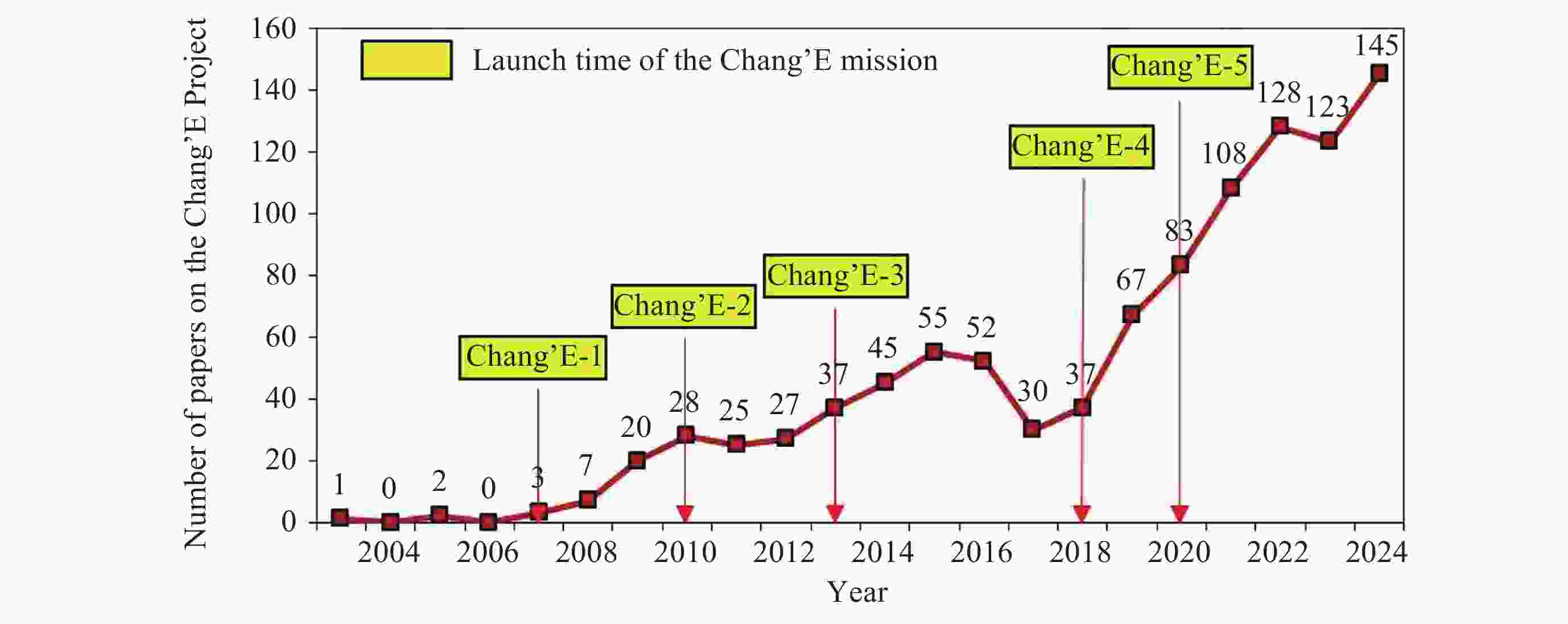
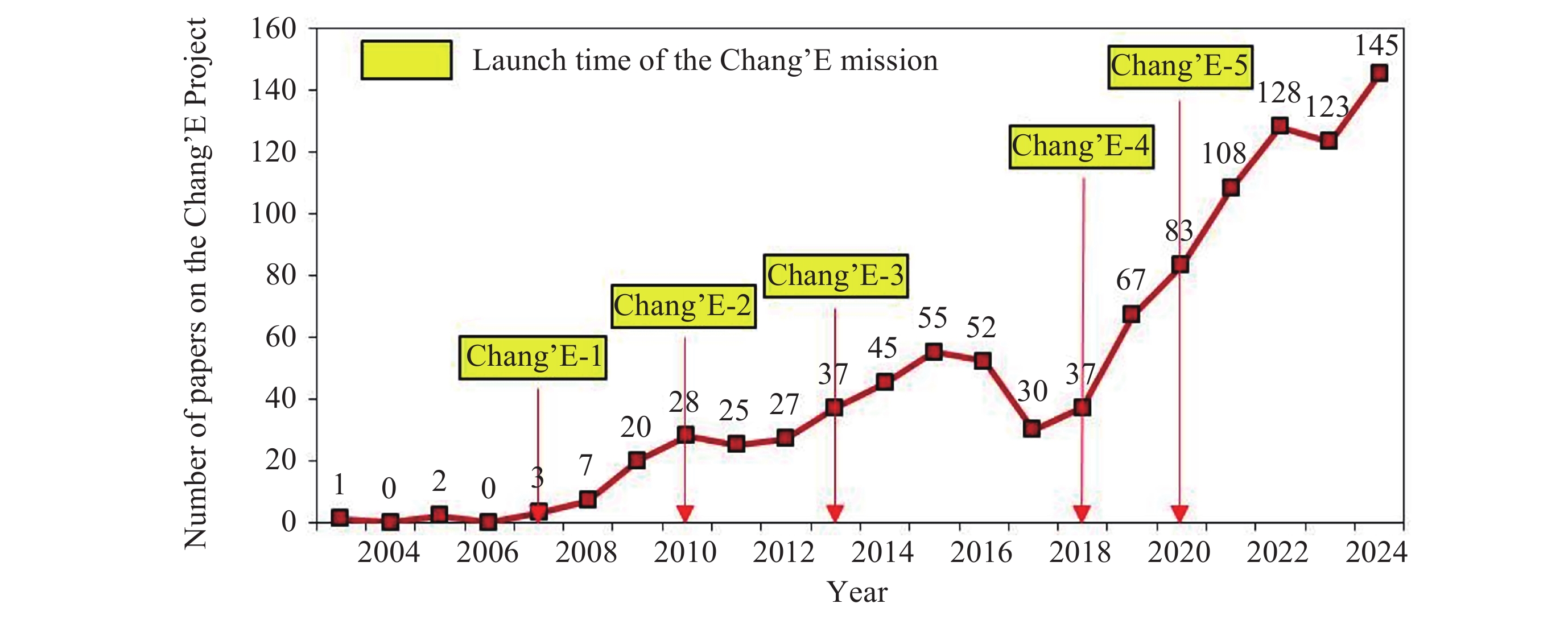
图 1 2003-2024年嫦娥工程发文数量演变趋势
Figure 1. Evolutionary trend of publication quantity of the Chang’E Project from 2003 to 2024
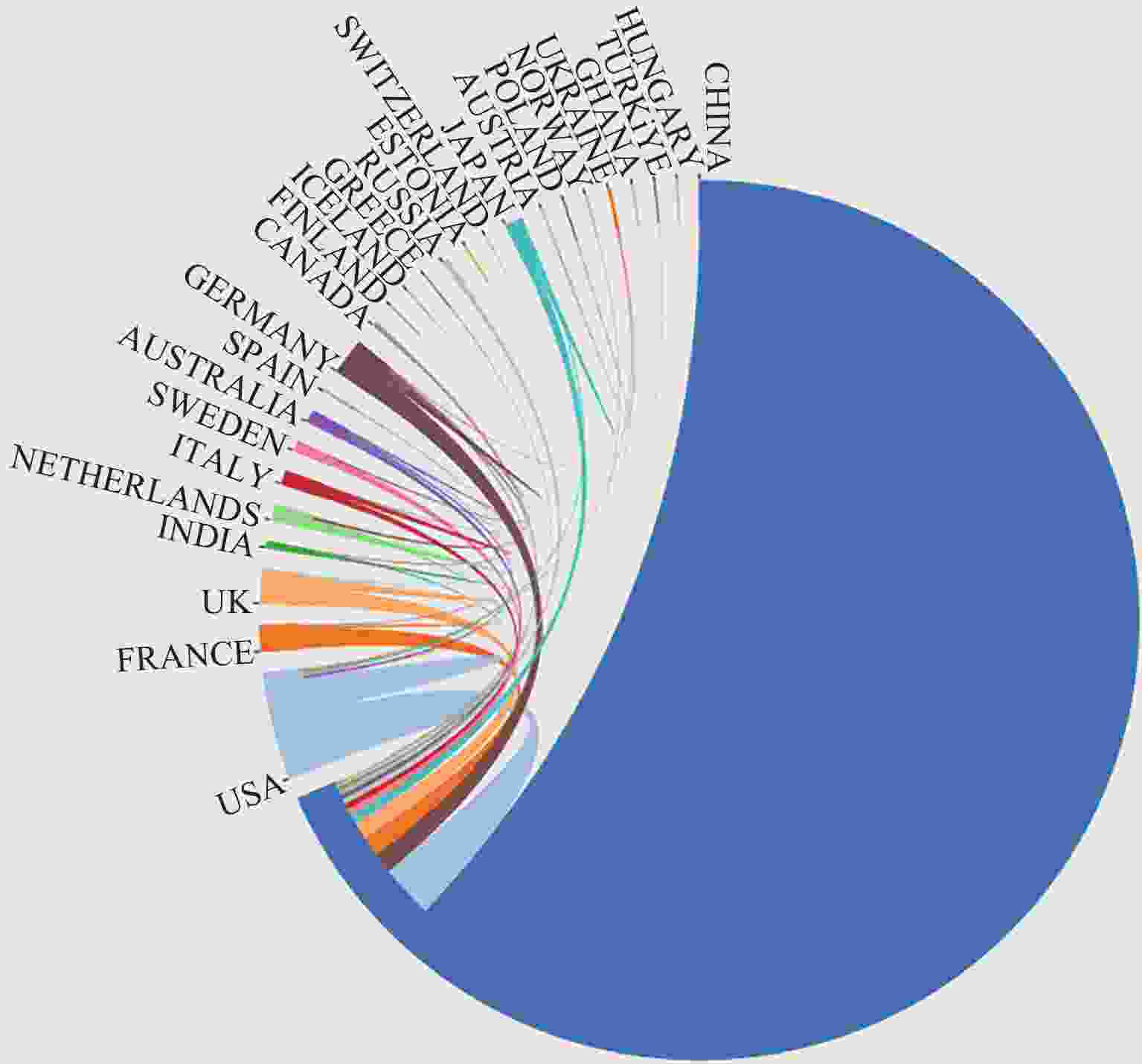
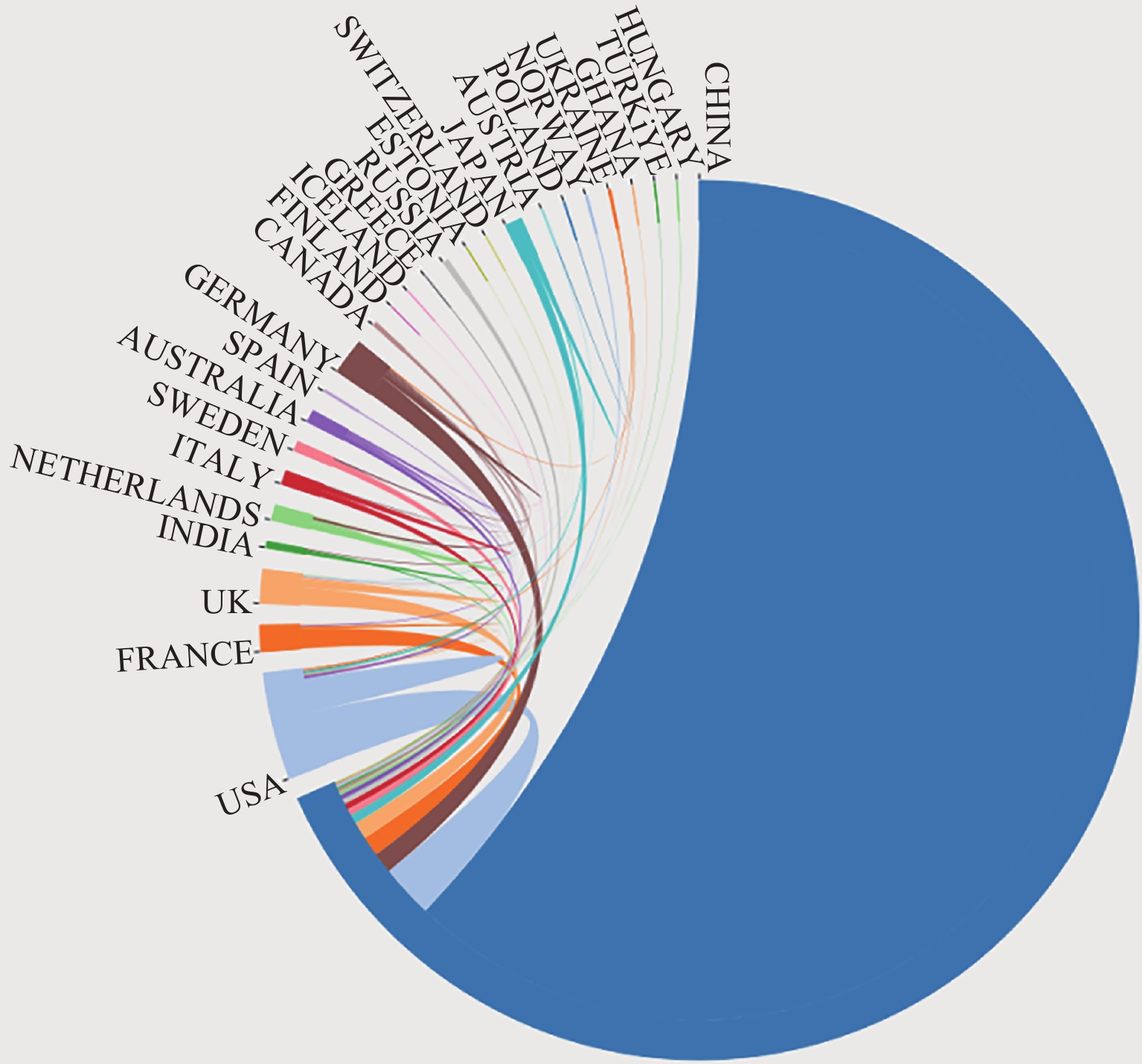
图 2 嫦娥工程产出论文国际合作图谱
Figure 2. International co-operation atlas of papers output by the Chang’E Project
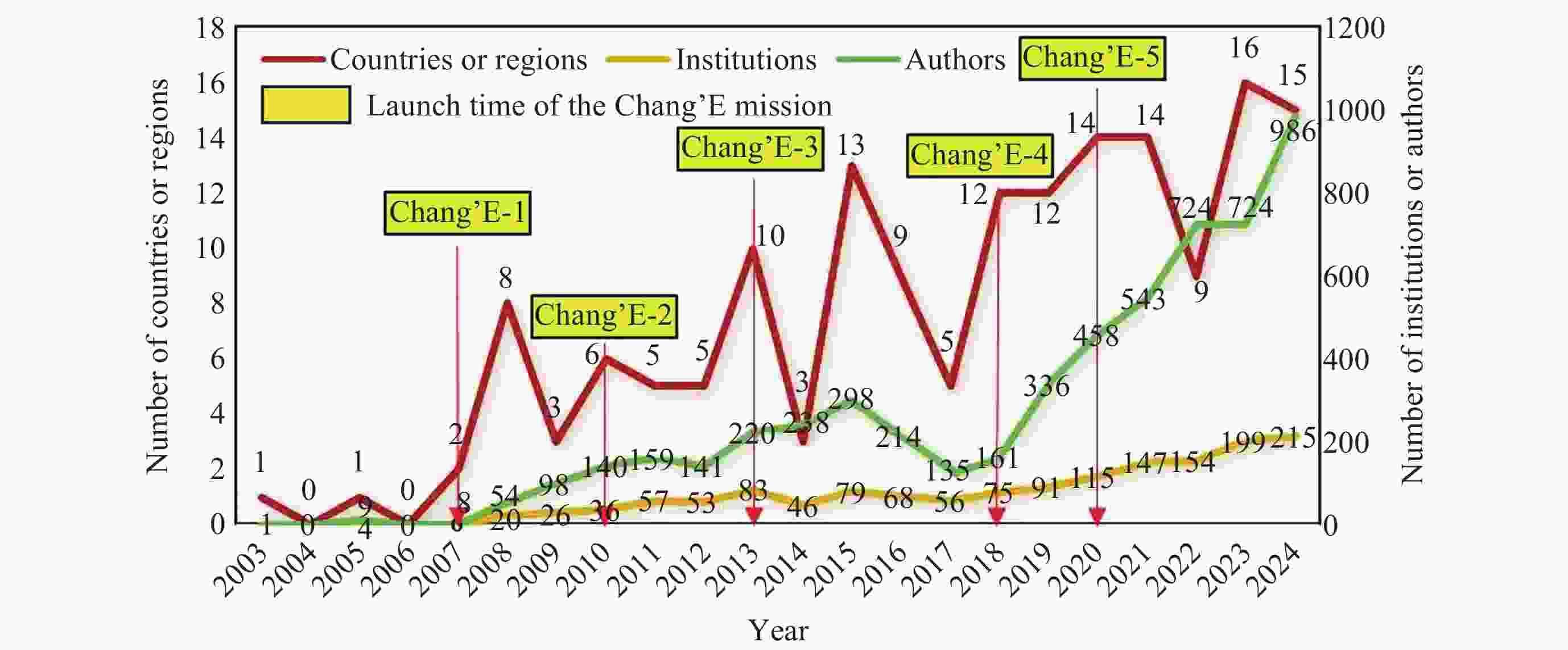
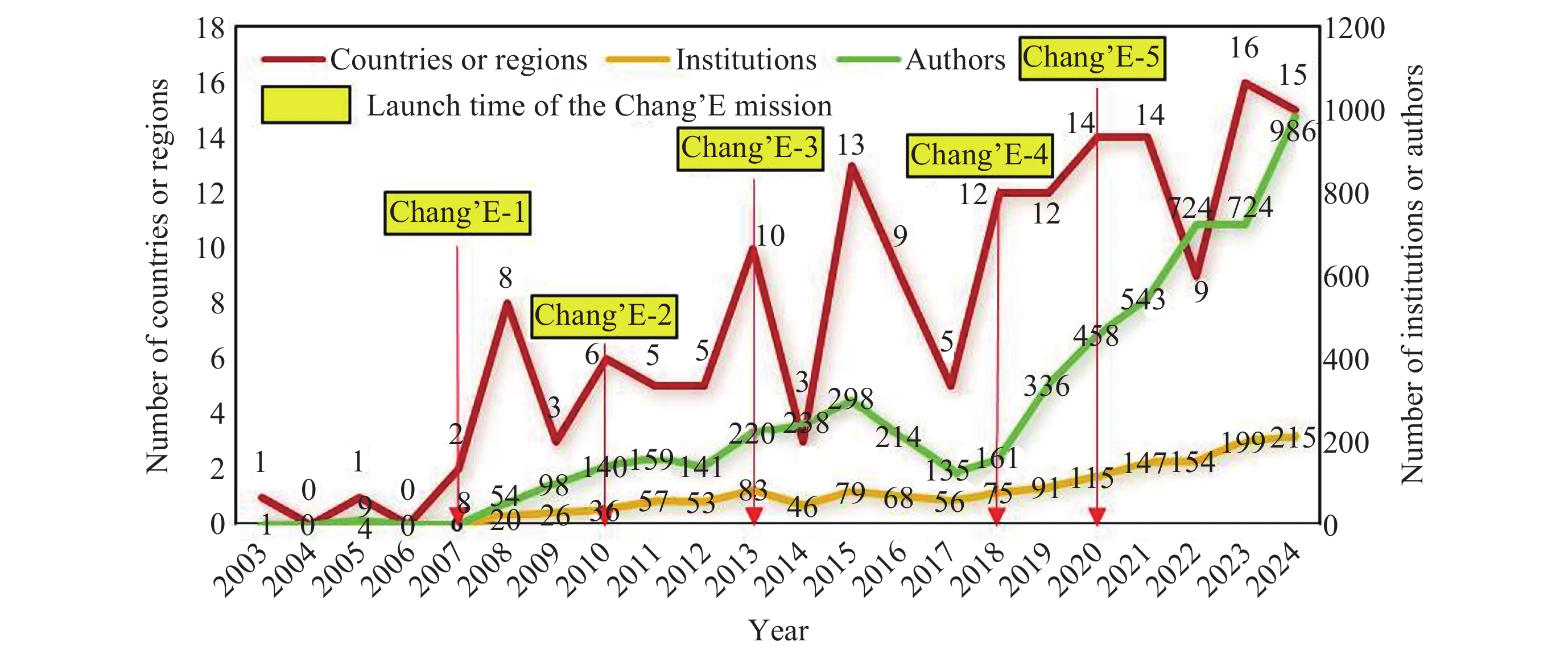
图 3 2003-2024年嫦娥工程发文涉及国家或地区、机构、作者数量随年份演变趋势
Figure 3. Annual evolutionary trends in the number of countries or regions, organizations and authors involved in the Chang’E Project’s published papers from 2003 to 2024
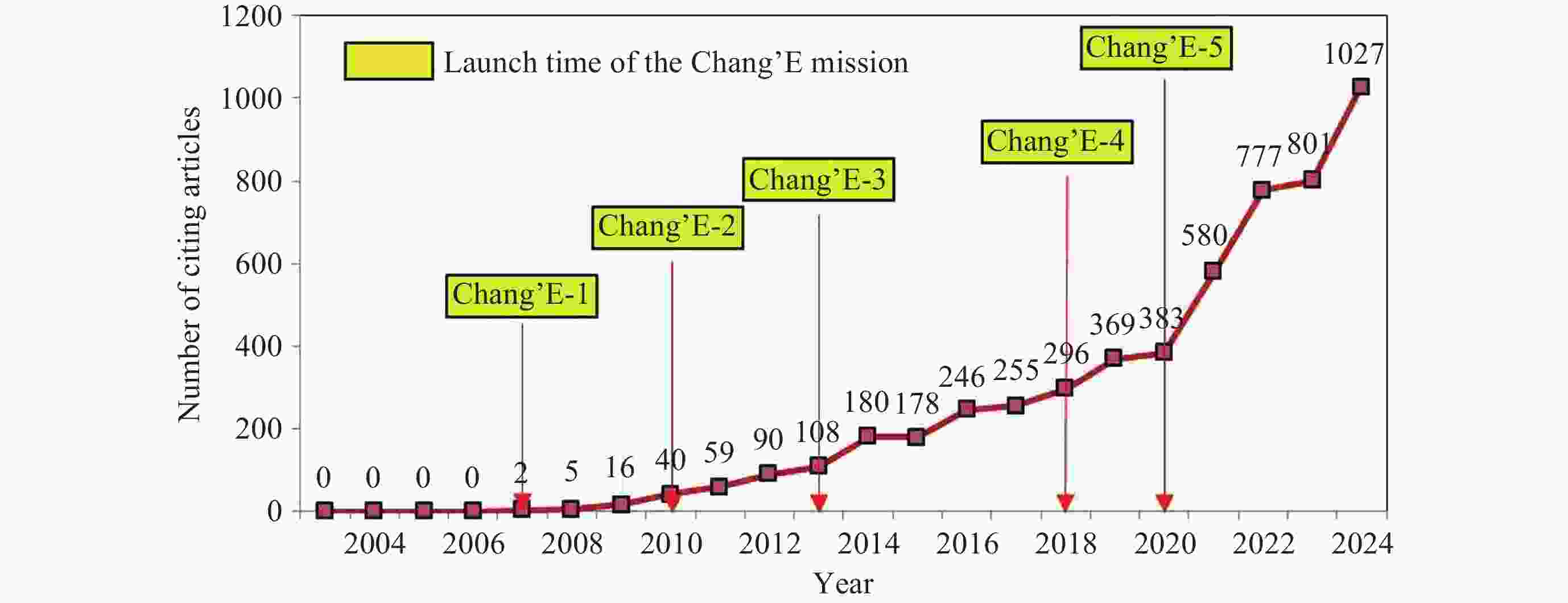
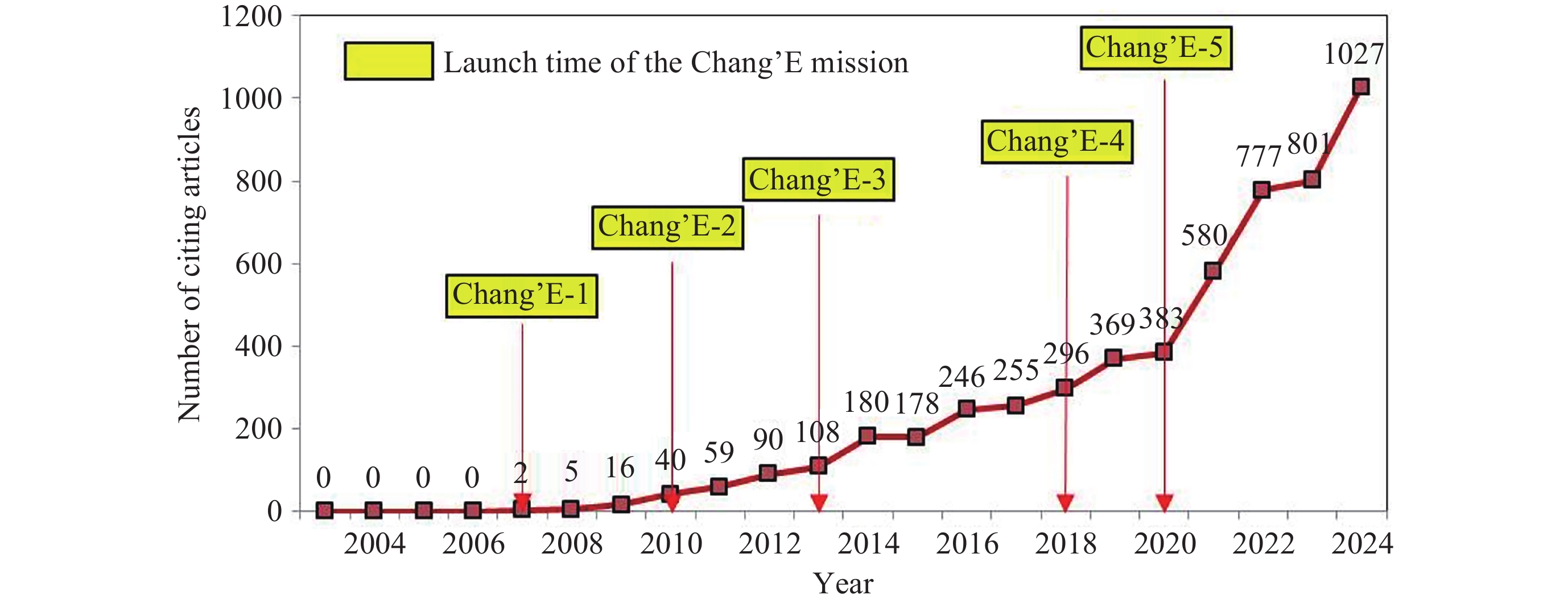
图 4 2003-2024年施引论文数量随年份变化趋势
Figure 4. Trends in the number of citing articles from 2003 to 2024
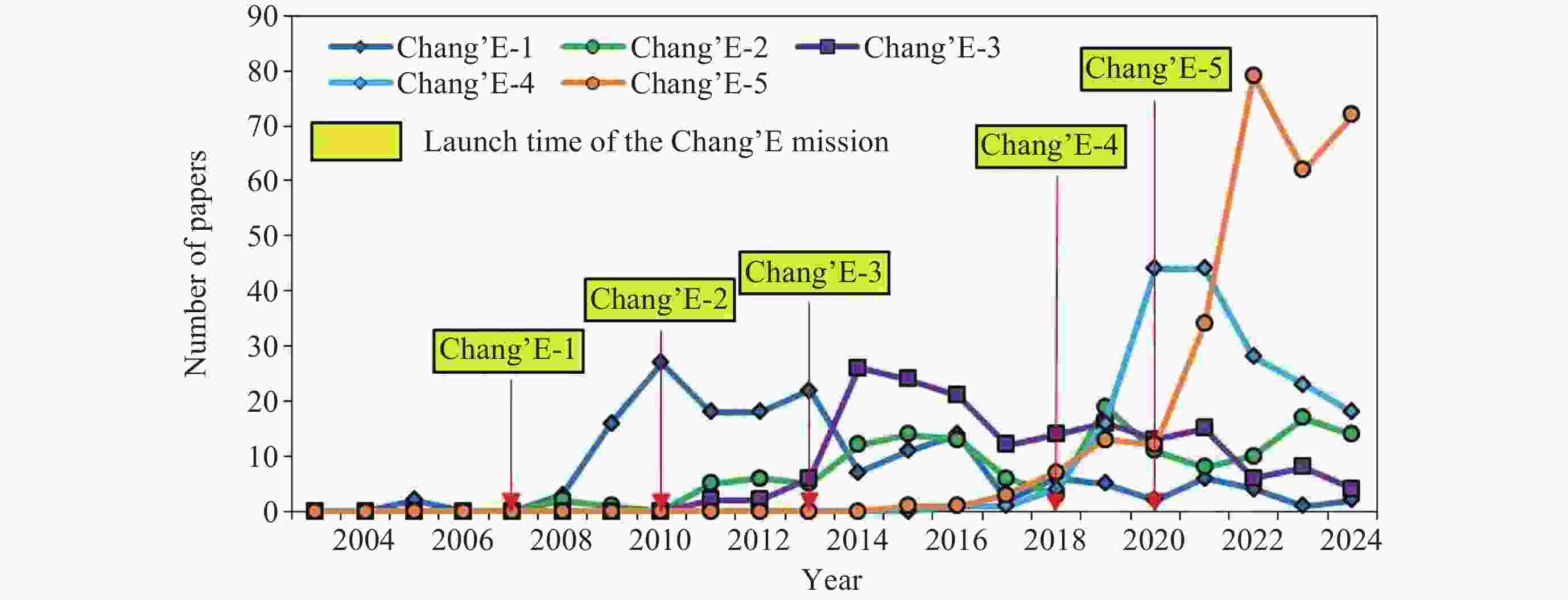
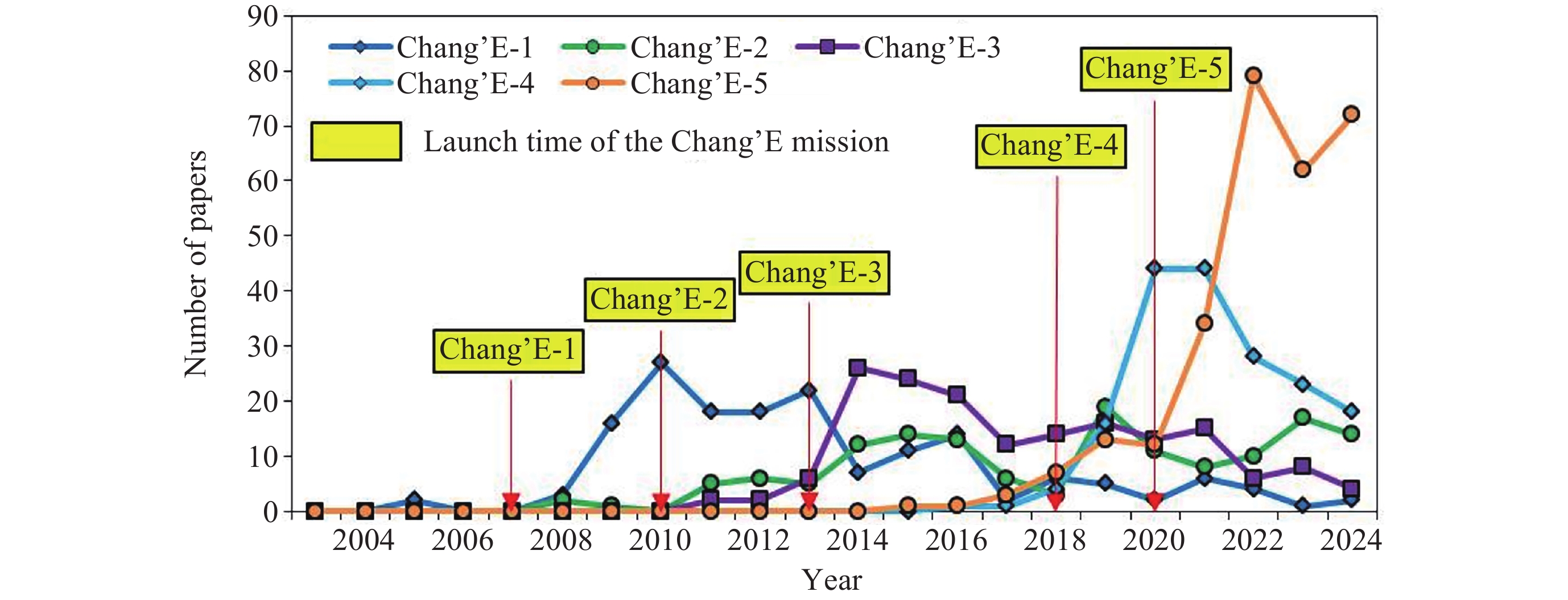
图 5 2003-2024年嫦娥工程各任务发文数量逐年演变趋势
Figure 5. Annual evolutionary trends in the number of published papers by each mission of the Chang’E Project from 2003 to 2024
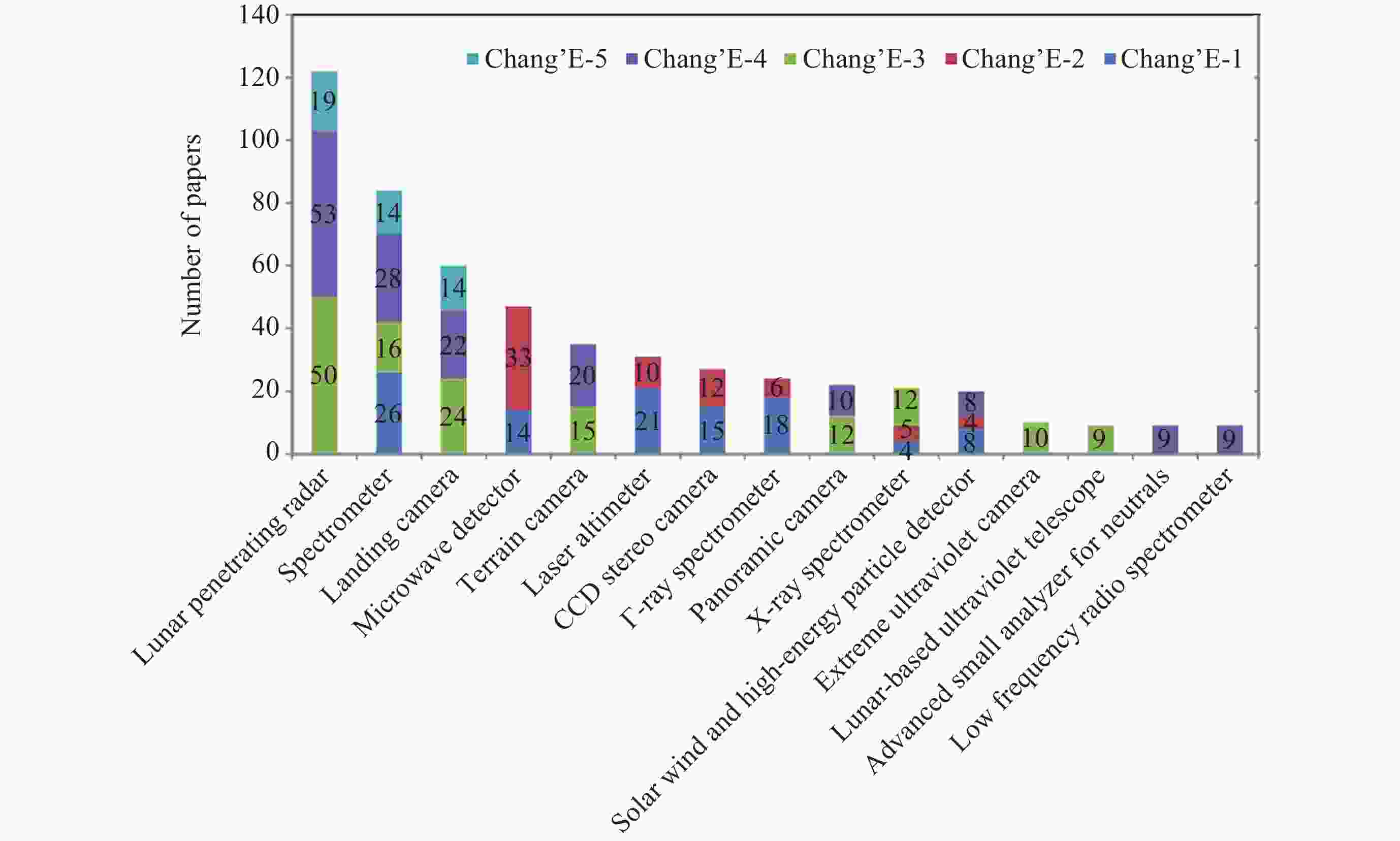
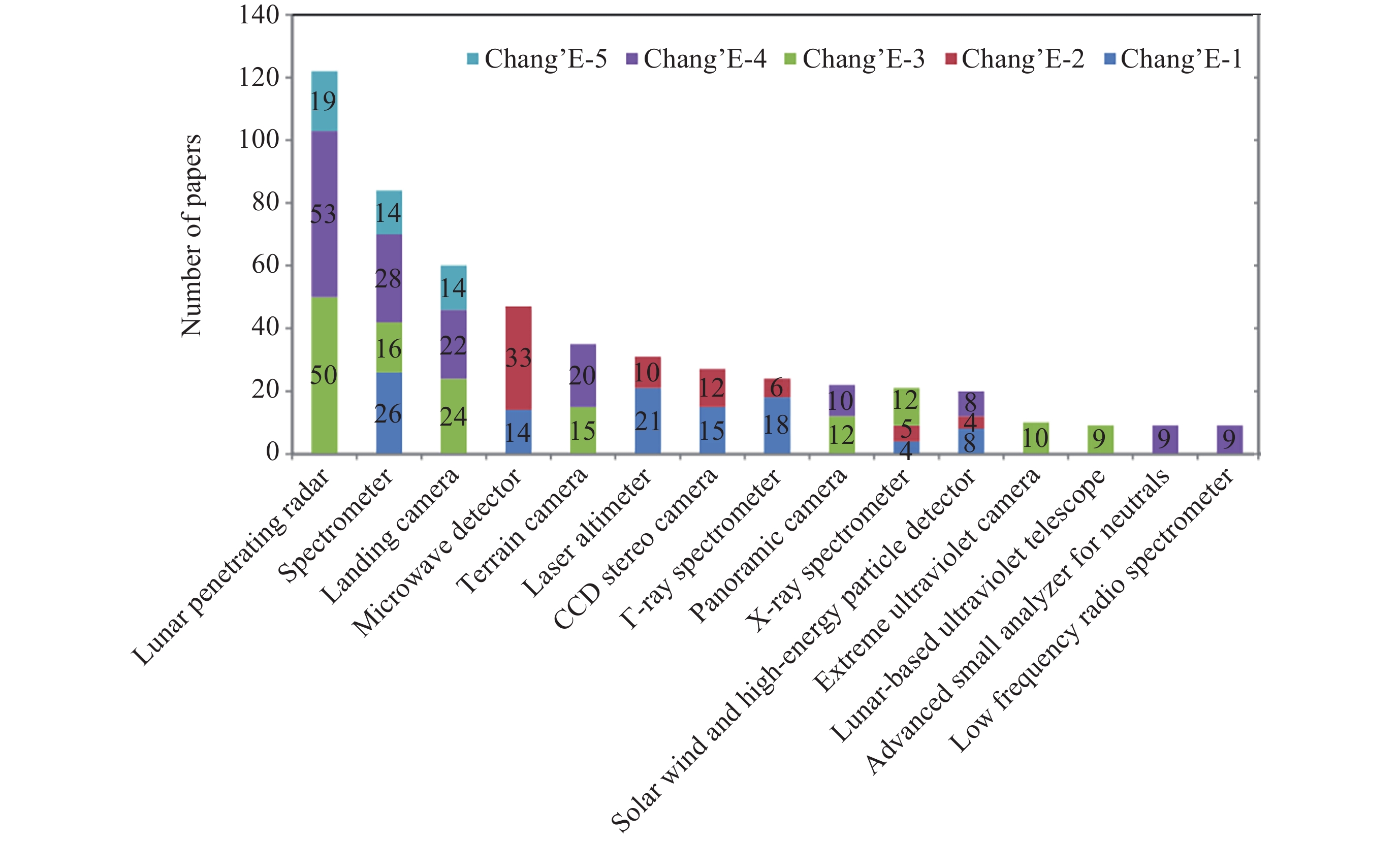
图 6 嫦娥工程各科学载荷产出论文情况
Figure 6. Status of paper outputs of each scientific payload of the Chang’E Project
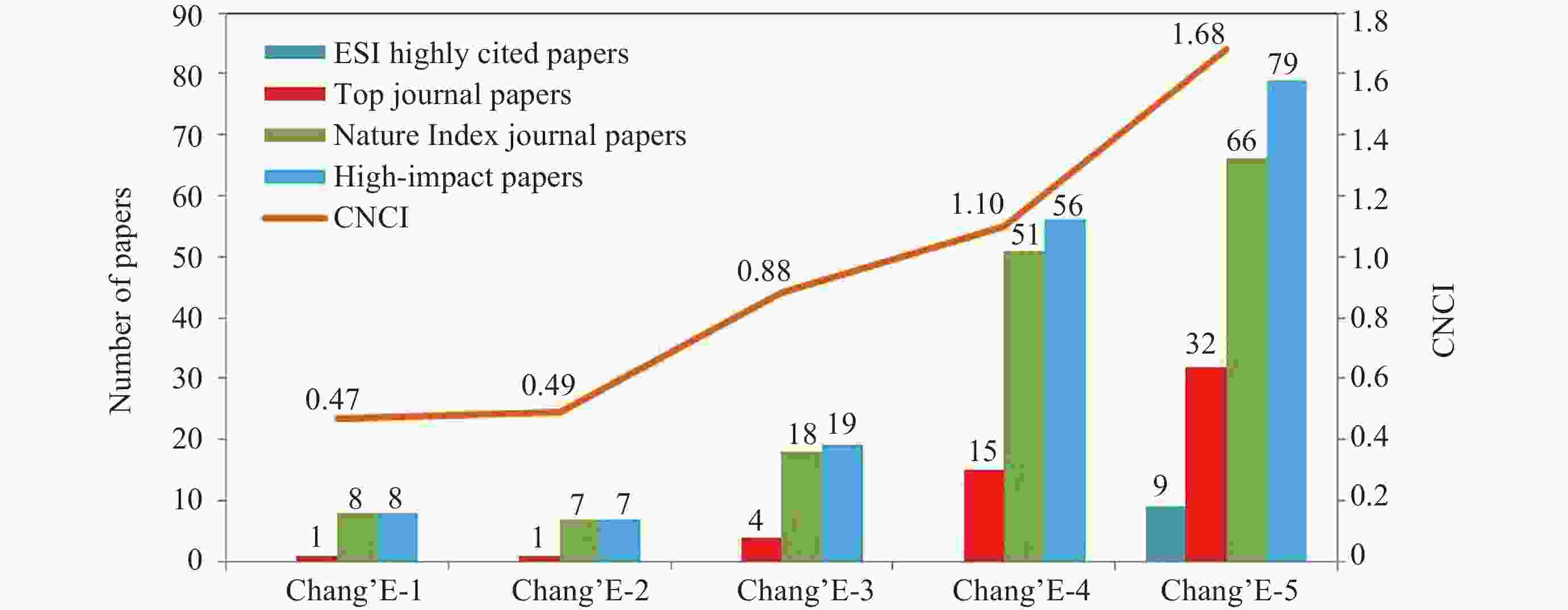
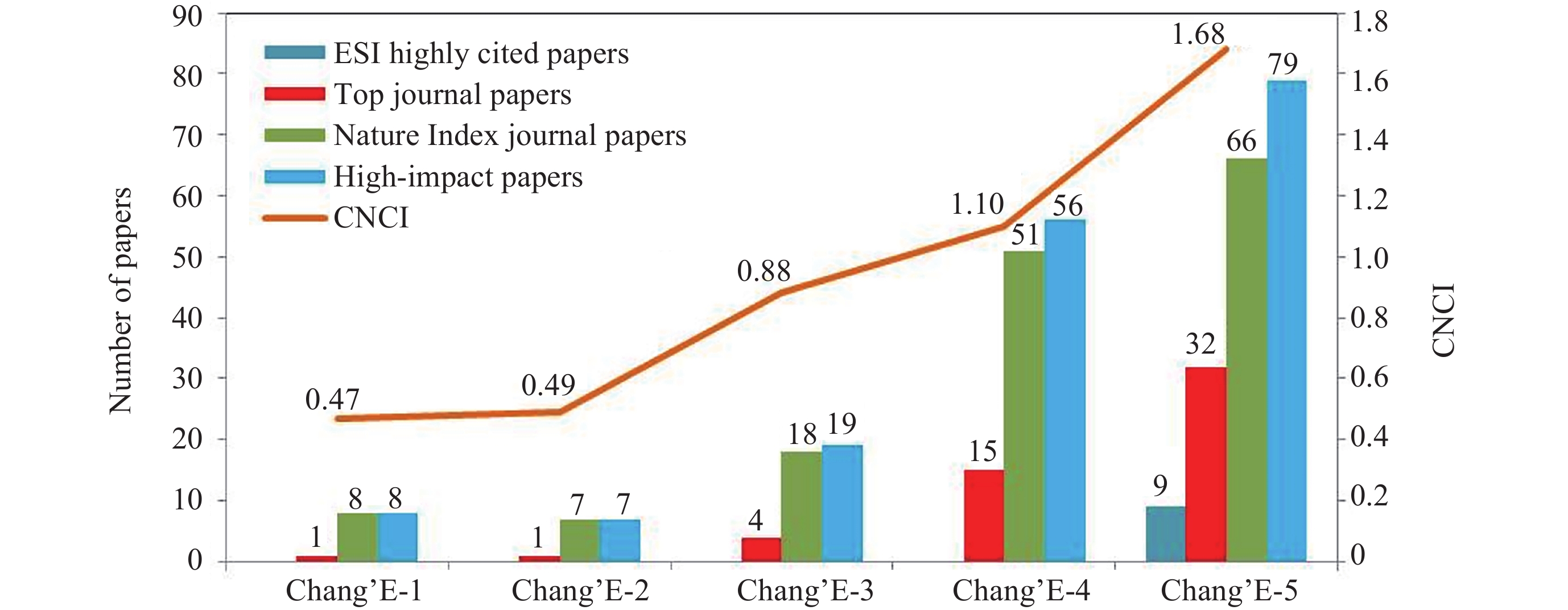
图 7 嫦娥工程各次任务发文情况
Figure 7. Status of published papers by each mission of the Chang’E Project
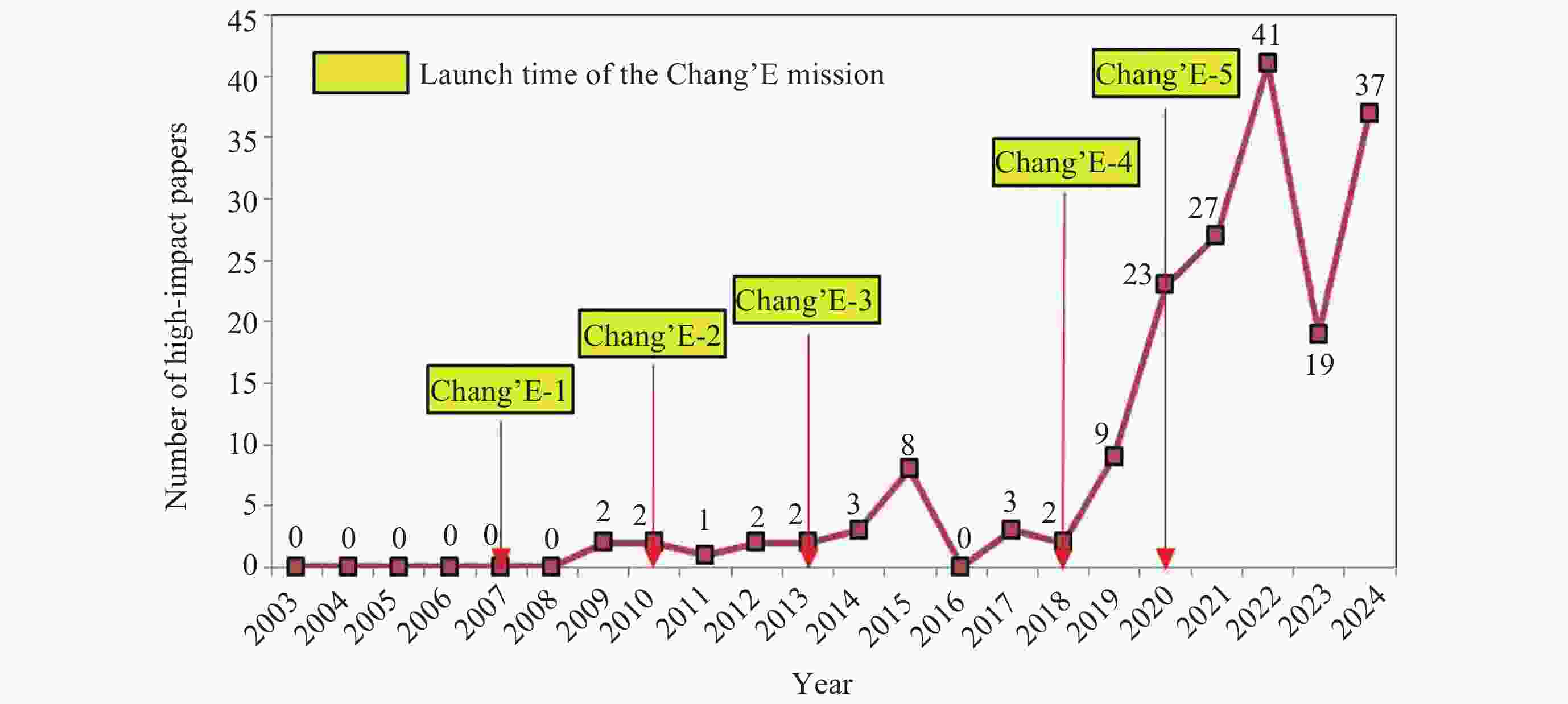
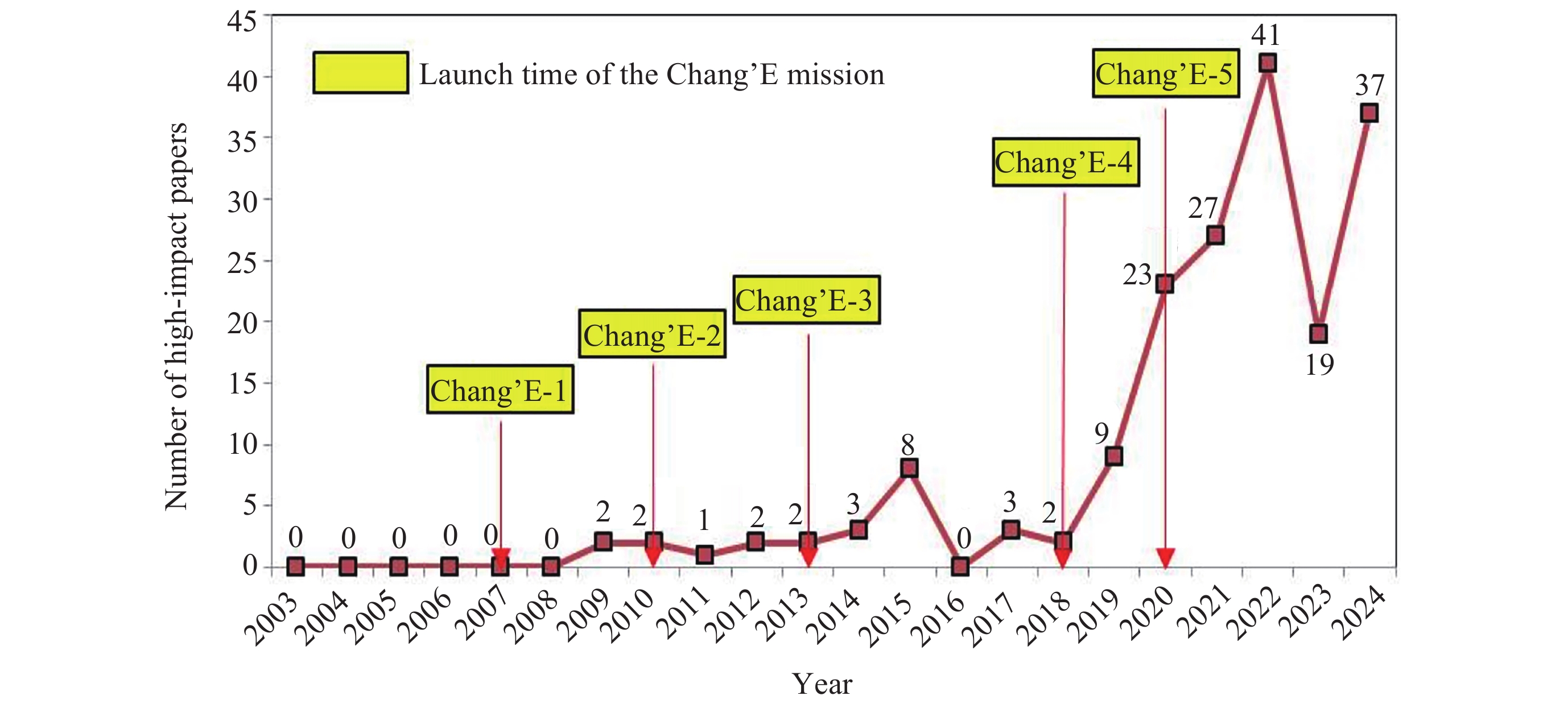
图 8 2003-2024年嫦娥工程产出高影响力论文数量逐年演变趋势
Figure 8. Annual evolutionary trend in the number of high-impact papers produced by the Chang’E Project from 2003 to 2024
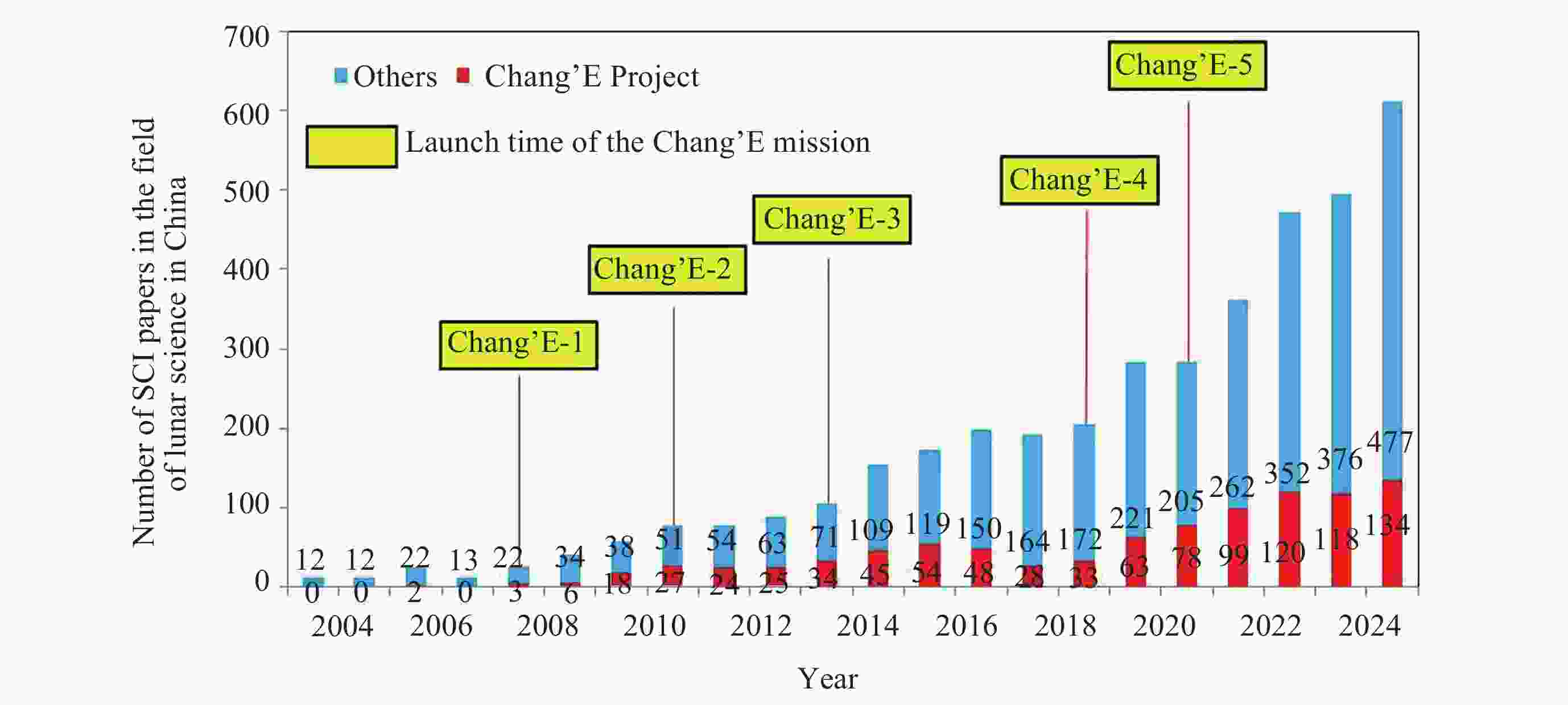
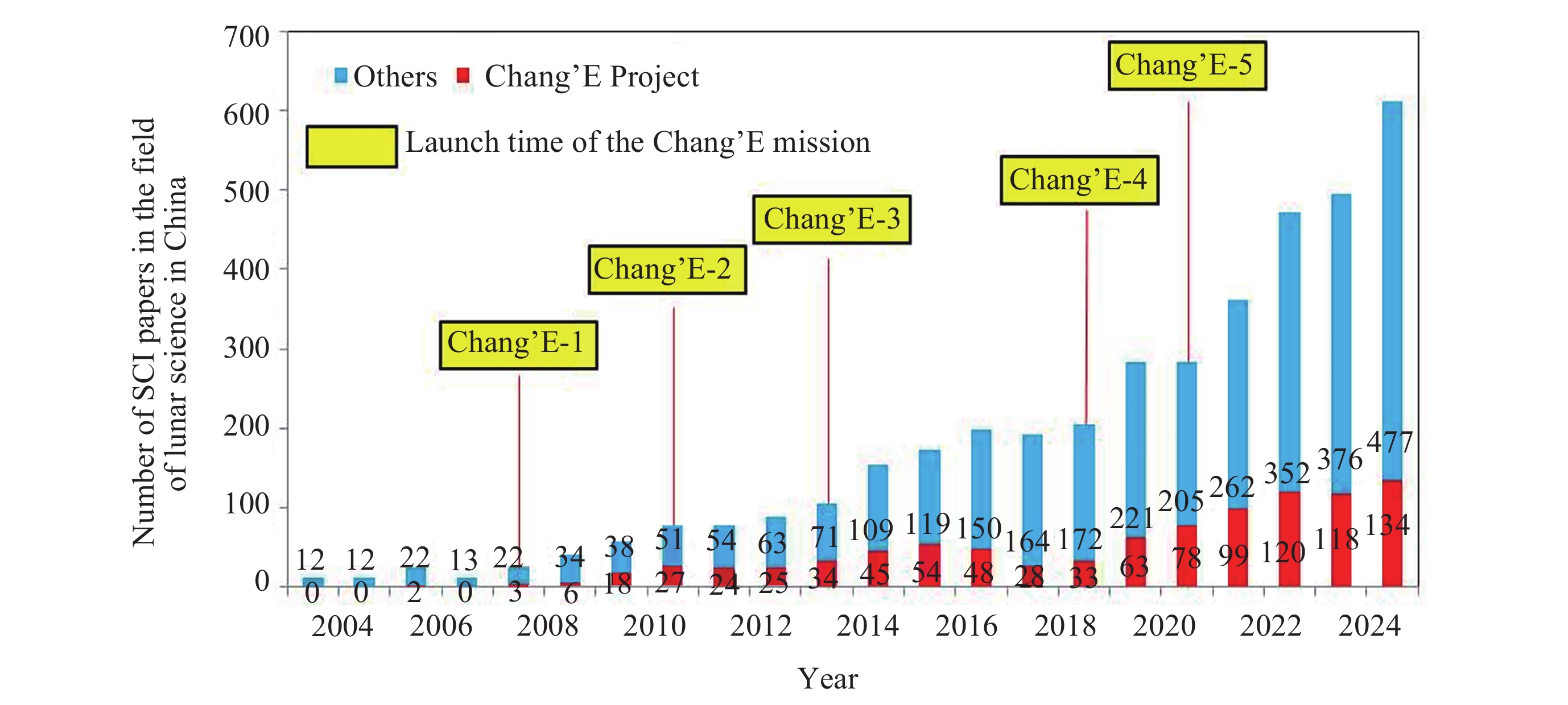
图 9 2003-2024年中国月球科学产出SCI论文数量逐年演变趋势
Figure 9. Annual evolutionary trend in the number of SCI papers in Chinese lunar science from 2003 to 2024
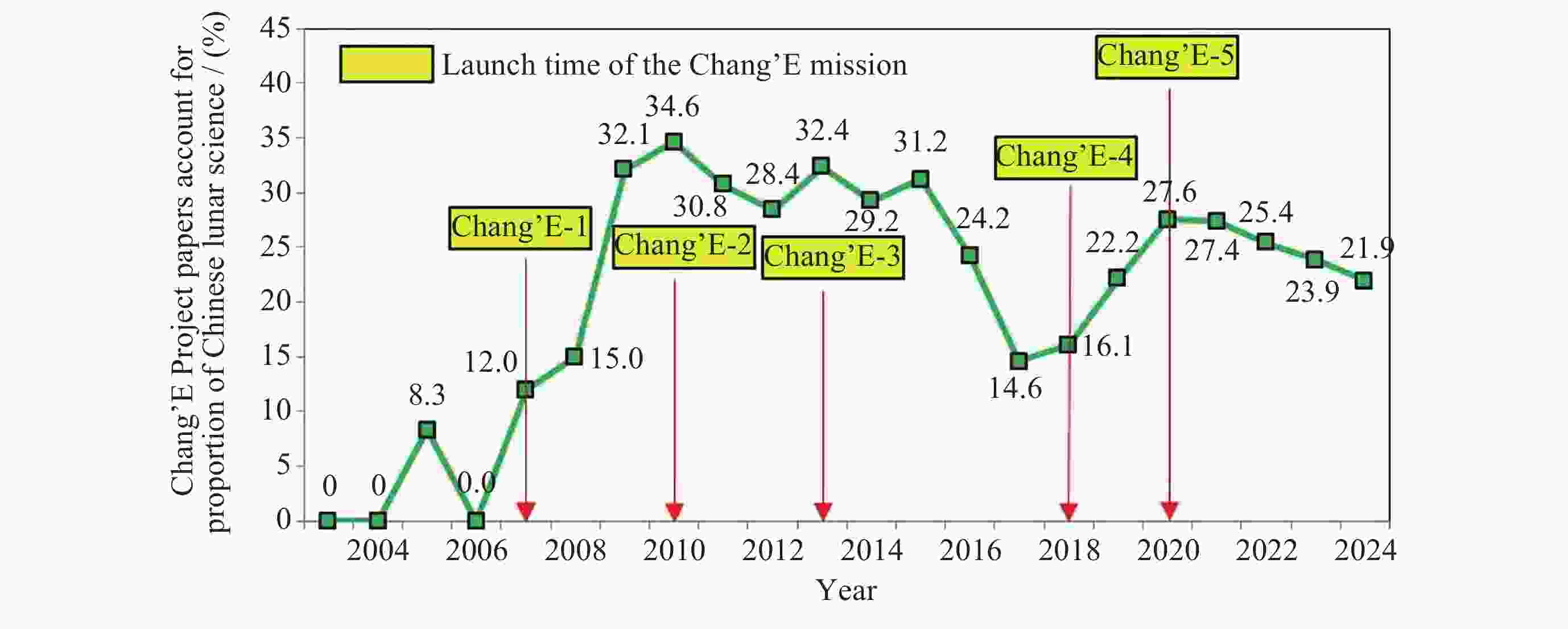
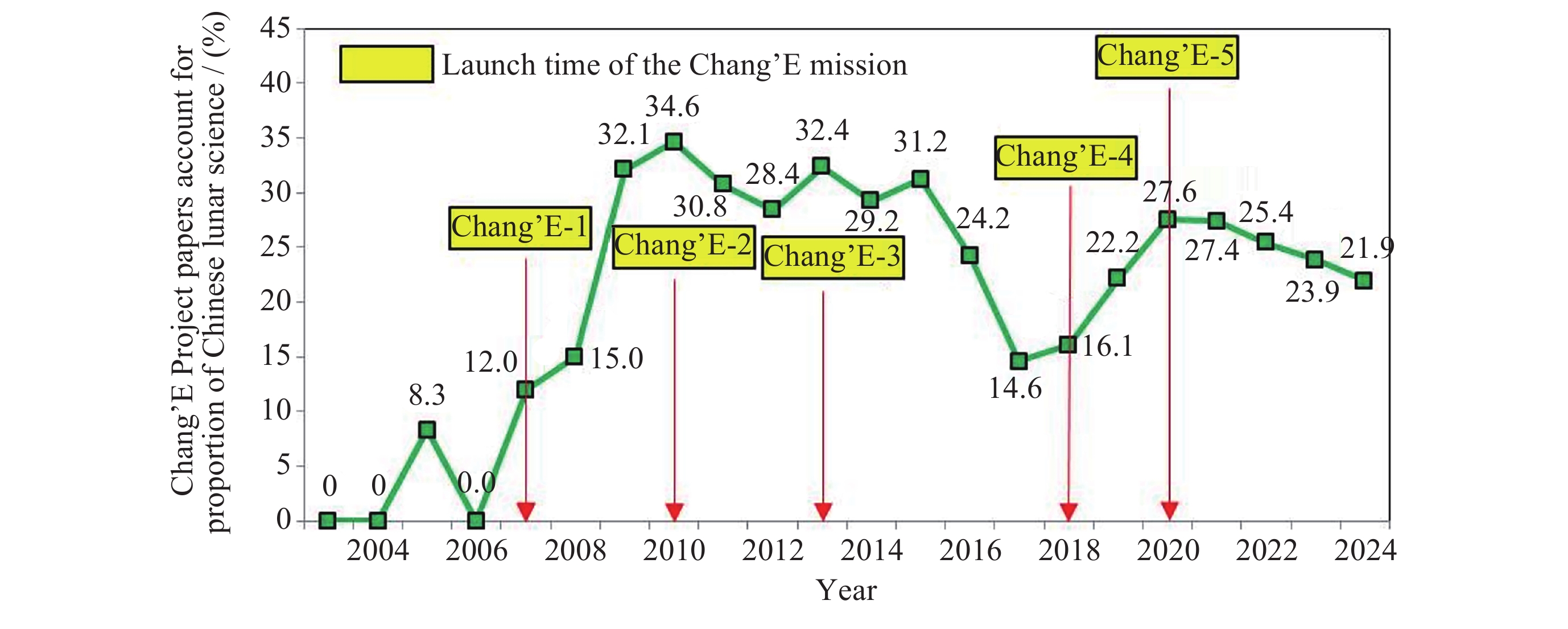
图 10 2003-2024年嫦娥工程发文占中国月球科学论文比例逐年演变趋势
Figure 10. Annual evolutionary trend of the proportion of the Chang’E Project publications in China’s lunar science from 2003 to 2024
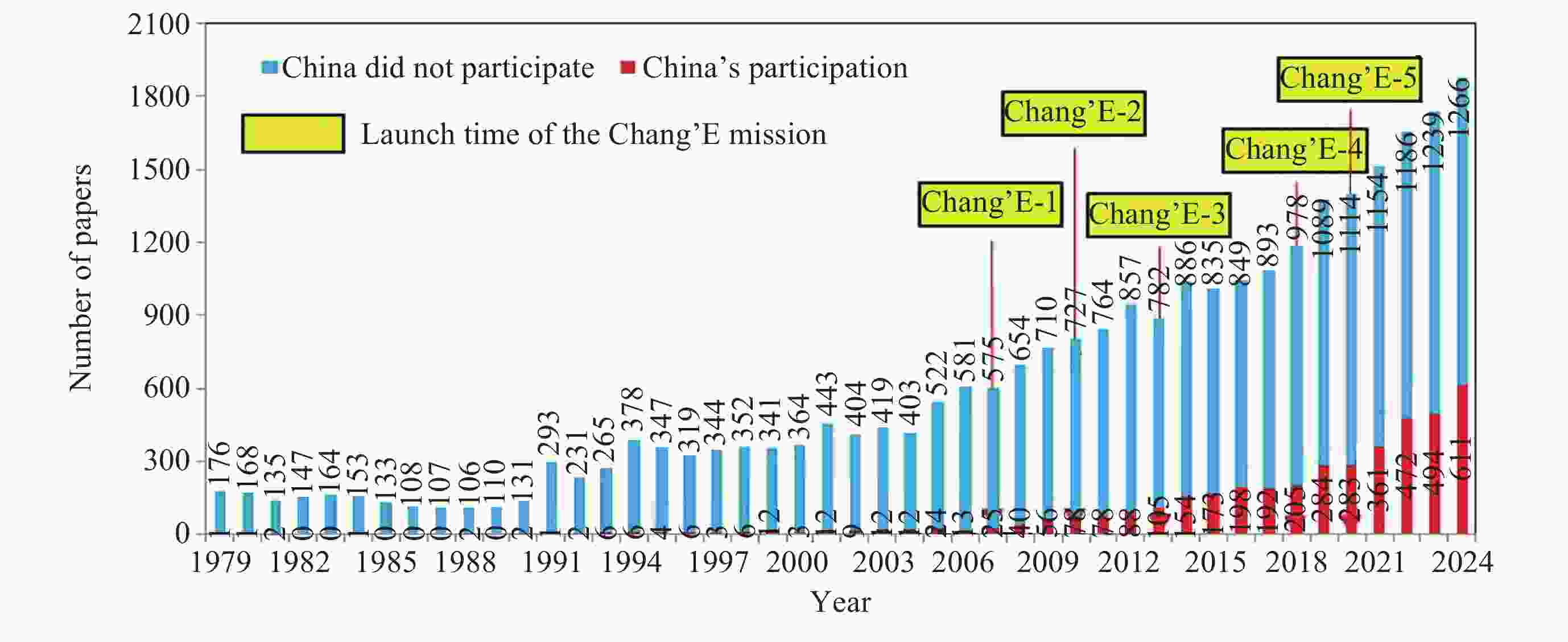
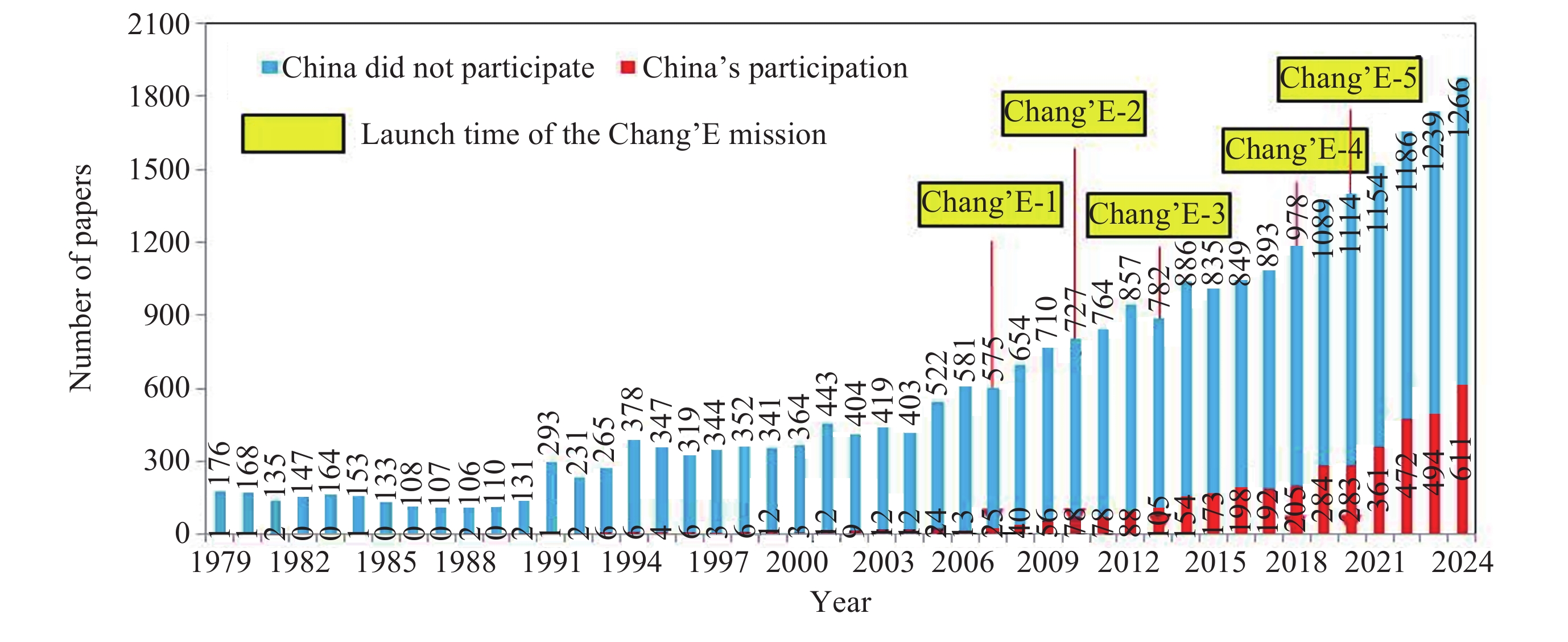
图 11 1979-2024年中国对国际月球科学发文贡献逐年演变趋势
Figure 11. Annual evolutionary trend of China’s contribution to international lunar science publications from 1979 to 2024
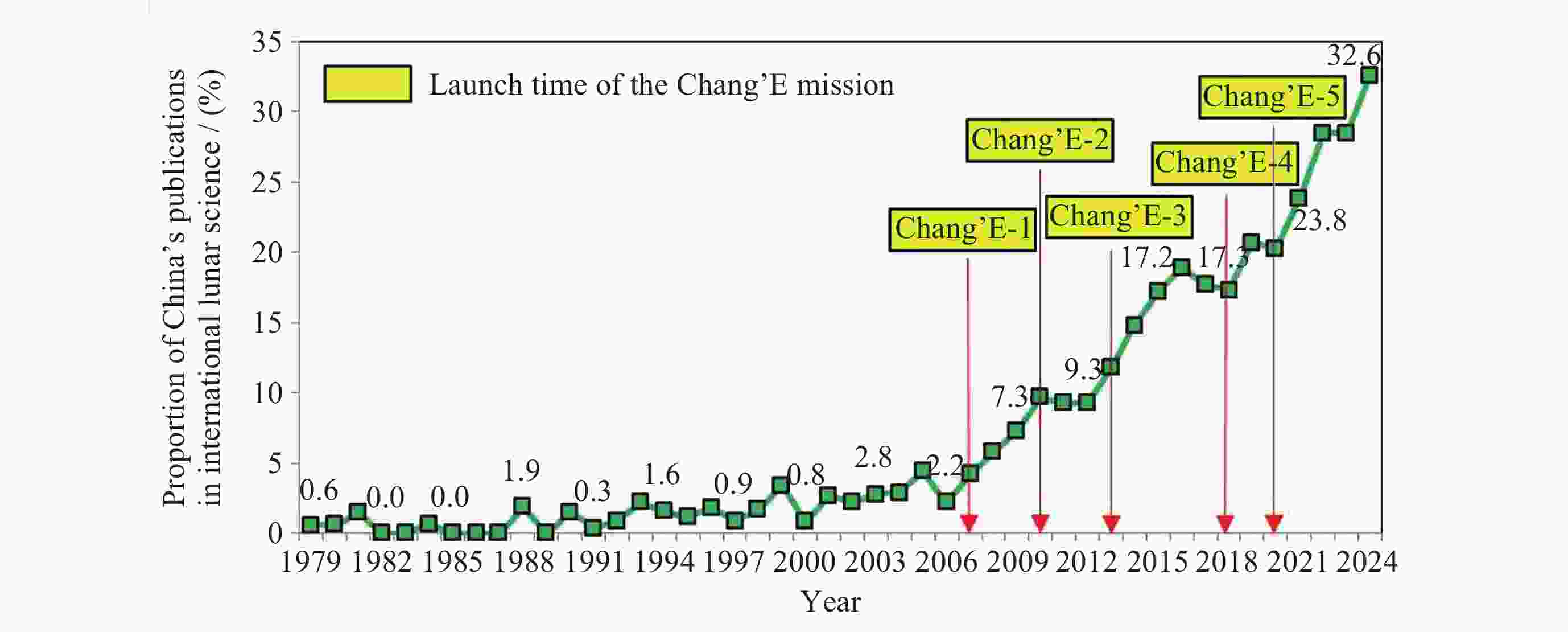
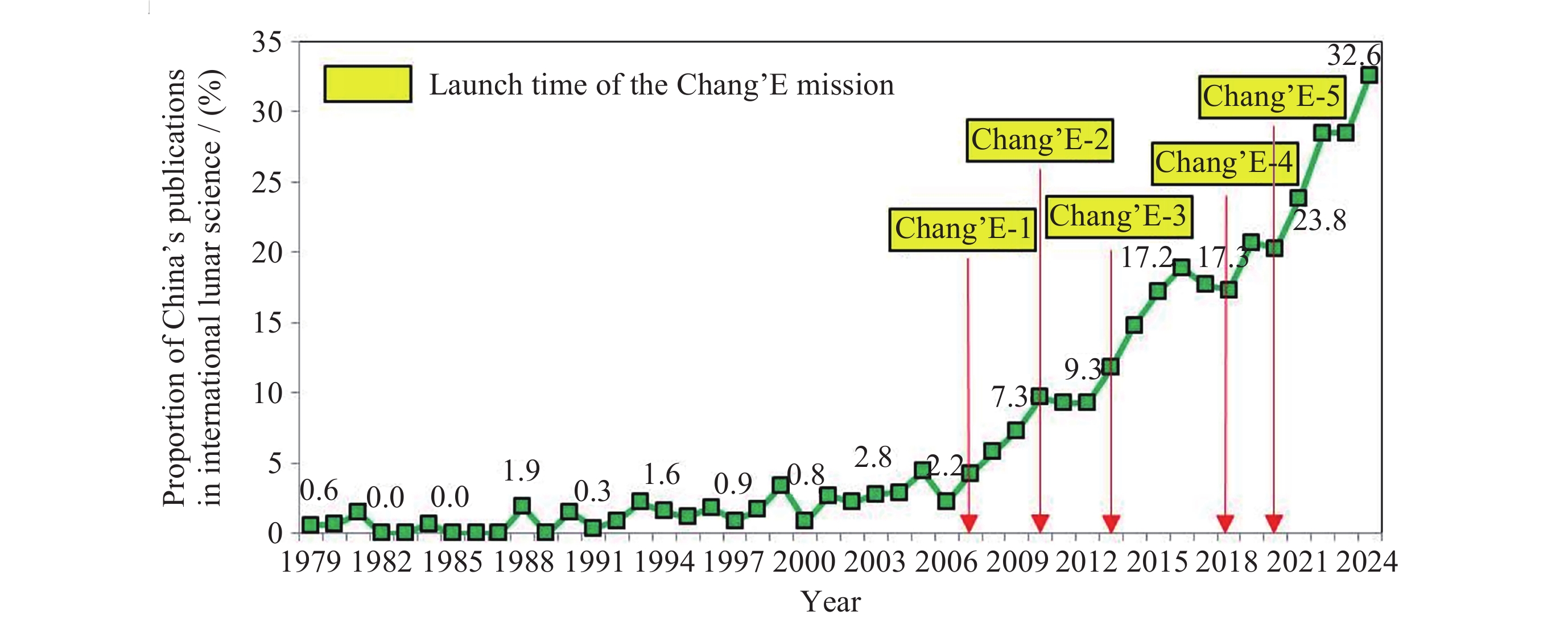
图 12 1979-2024年中国占国际月球科学发文比例逐年演变趋势
Figure 12. Annual evolutionary trend of the proportion of China’s publications in international lunar science from 1979 to 2024
表 1 嫦娥工程与国际月球科学领域论文产出排名前10的学科
Table 1. Top 10 disciplines in terms of paper output in the Chang’E Project and international lunar science field
嫦娥工程 国际月球科学领域 排名 学科 论文篇数 论文占比/(%) CNCI值 排名 学科 论文篇数 论文占比/(%) CNCI值 1 天文学与天体物理学
(Astronomy and Astrophysics)313 30.6 0.75 1 天文学与天体物理学
(Astronomy and Astrophysics)11029 32.4 0.72 2 地球科学综合
(Geosciences Multidisciplinary)238 23.3 0.83 2 地球化学与地球物理学
(Geochemistry and Geophysics)6911 20.3 1.01 3 地球化学与地球物理学
(Geochemistry and Geophysics)195 19.1 1.21 3 地球科学综合
(Geosciences Multidisciplinary)5032 14.8 0.77 4 遥感科学
(Remote Sensing)183 17.9 0.56 4 自然科学综合
(Multidisciplinary Sciences)4388 12.9 1.38 5 影像科学与摄影技术
(Imaging Science and Photographic Technology)170 16.6 0.57 5 航空航天工程学
(Engineering Aerospace)4003 11.8 0.91 6 电子与电气工程学
(Engineering, Electrical
and Electronic)122 11.9 0.79 6 气象与大气科学
(Meteorology and Atmospheric Sciences)1673 4.9 0.52 7 航空航天工程学
(Engineering Aerospace)93 9.1 1.12 7 电子与电气工程学
(Engineering, Electrical
and Electronic)1093 3.2 0.91 8 自然科学综合
(Multidisciplinary Sciences)82 8 3.43 8 物理学综合
(Physics Multidisciplinary)978 2.9 0.55 9 环境科学
(Environmental Sciences)76 7.4 0.46 9 遥感科学
(Remote Sensing)965 2.8 0.63 10 气象与大气科学
(Meteorology and Atmospheric Sciences)61 6 0.48 10 影像科学与摄影技术
(Imaging Science and
Photographic Technology)807 2.4 0.66 注 CNCI值在科睿唯安旗下InCites数据库中检索查询, 该数据库中仅包含1980年以来的数据, 而国际月球科学领域涉及部分1980年之前的数据, 因此其CNCI值可能存在一定误差, 仅供参考.  下载: 导出CSV
表 2 嫦娥工程论文产出排名前10的期刊
Table 2. Top 10 journals by paper outputs of the Chang’E Project
排名 期刊 (国别) 论文篇数 论文占比/(%) 影响因子 JCR分区 1 Icarus (美国) 69 6.7 2.5 Q2 2 Remote Sensing (瑞士) 68 6.6 4.2 Q2 3 Advances in Space Research (英国) 48 4.7 2.8 Q2 4 Journal of Geophysical Research-Planets (美国) 47 4.6 3.9 Q1 5 Research in Astronomy and Astrophysics (中国) 45 4.4 1.8 Q3 6 Geophysical Research Letters (美国) 44 4.3 4.6 Q1 7 IEEE Transactions on Geoscience and Remote Sensing (美国) 44 4.3 7.5 Q1 8 Planetary and Space Science (美国) 33 3.2 1.8 Q3 9 Earth and Planetary Science Letters (荷兰) 28 2.7 4.8 Q1 10 IEEE Journal of Selected Topics in Applied Earth
Observations and Remote Sensing (美国)24 2.3 4.7 Q1
下载: 导出CSV
表 3 嫦娥工程论文产出排名前10的国家
Table 3. Top 10 countries in terms of the Chang’E Project paper outputs
排名 国家 论文篇数 论文占比/(%) CNCI值 1 中国 959 93.7 1.11 2 美国 129 12.6 1.69 3 德国 44 4.3 2.2 4 英国 38 3.7 2.02 5 法国 35 3.4 1.16 6 日本 18 1.8 0.76 7 澳大利亚 14 1.4 1.82 8 瑞典 14 1.4 1.95 9 意大利 13 1.3 1.66 10 俄罗斯 13 1.3 0.44
下载: 导出CSV
表 4 中国合作前10国家
Table 4. Top 10 countries for China’s co-operation
排名 国家 合作论文
篇数合作论文占
中国发文比例/(%)合作论文
CNCI值1 美国 99 10.3 1.87 2 英国 37 3.9 2.16 3 德国 35 3.7 2.53 4 法国 33 3.4 1.13 5 日本 14 1.5 0.83 6 瑞典 13 1.4 2.1 7 澳大利亚 10 1.0 2.4 8 意大利 8 0.8 2.1 9 俄罗斯 8 0.8 0.57 10 加拿大 7 0.7 1.56
下载: 导出CSV
表 5 嫦娥工程论文产出排名前10的机构
Table 5. Top 10 institutions by paper output of the Chang’E Project
排名 机构 论文篇数 论文占比/(%) CNCI值 1 中国科学院国家天文台 205 20.0 1.58 2 澳门科技大学 178 17.4 0.97 3 中国科学院地质与地球物理研究所 97 9.5 2.65 4 中国科学院地球化学研究所 94 9.2 2.33 5 中国地质大学 (武汉) 85 8.3 1.73 6 吉林大学 74 7.2 0.63 7 中国科学院国家空间科学中心 70 6.8 1.78 8 中国科学院上海技术物理研究所 59 5.8 1.28 9 南京大学 58 5.7 1.97 10 中国科学院比较行星学卓越创新中心 54 5.3 1.5
下载: 导出CSV
表 6 嫦娥工程论文产出排名前10的机构(根据第一单位或通信单位)
Table 6. Top 10 institutions by paper output of Chang’E Project (According to the first organization or correspondence organization)
排名 机构 (第一单位或通信单位) 论文篇数 论文占比/(%) CNCI值 1 中国科学院国家天文台 108 10.6 1.98 2 澳门科技大学 93 9.1 0.86 3 中国科学院地质与地球物理研究所 71 6.9 2.62 4 吉林大学 63 6.2 0.62 5 中国地质大学 (武汉) 57 5.6 1.89 6 中国科学院地球化学研究所 42 4.1 1.48 7 武汉大学 37 3.6 0.47 8 中国科学院国家空间科学中心 36 3.5 2.27 9 山东大学 33 3.2 1.01 10 中国科学院上海天文台 33 3.2 0.45
下载: 导出CSV
表 7 嫦娥工程产出论文前10机构与其他机构合作情况
Table 7. Cooperation status in paper output between the top 10 institutions and other institutions of the Chang’E Project
排名 机构 论文
篇数CNCI
值占嫦娥
工程发
文比例/
(%)与其他
机构合
作论文
篇数与其他
机构合
作论文
CNCI值与其他
机构合
作论文
百分比/(%)国内合
作论文
篇数国内合
作论文
CNCI值国内合
作百分
比/(%)国际合
作论文
篇数国际合
作论文
CNCI值国际合
作百分
比/(%)1 中国科学院
国家天文台205 1.58 20 185 1.66 90.2 128 1.66 62.4 57 1.67 27.8 2 澳门科技大学 178 0.97 17.4 163 1.03 91.6 98 0.98 55.1 61 1.11 34.3 3 中国科学院
地质与地球
物理研究所97 2.65 9.5 91 2.7 93.8 72 2.76 74.2 19 2.49 19.6 4 中国科学院
地球化学
研究所94 2.33 9.2 90 2.37 95.7 73 2.51 77.7 17 1.79 18.1 5 中国地质
大学(武汉)85 1.73 8.3 71 1.78 83.5 27 1.02 31.8 44 2.24 51.8 6 吉林大学 74 0.63 7.2 70 0.63 94.6 56 0.57 75.7 14 0.9 18.9 7 中国科学院
国家空间
科学中心70 1.78 6.8 66 1.8 94.3 34 2.38 48.6 32 1.18 45.7 8 中国科学院
上海技术
物理研究所59 1.28 5.8 52 1.32 88.1 40 1.24 67.8 12 1.61 20.3 9 南京大学 58 1.97 5.7 54 1.97 93.1 30 1.32 51.7 23 2.87 39.7 10 中国科学院
比较行星学
卓越创新中心54 1.5 5.3 54 1.5 100 34 1.22 63 20 1.97 37
下载: 导出CSV
表 8 嫦娥工程及其施引论文的前10产出国家
Table 8. Top 10 countries in paper output of the Chang’E Project and its citing articles
嫦娥工程 施引论文 排名 国家 论文篇数 比例/(%) 排名 国家 施引论文篇数 比例/(%) 1 中国 959 93.7 1 中国 3441 63.3 2 美国 129 12.6 2 美国 1172 21.6 3 德国 44 4.3 3 德国 362 6.7 4 英国 38 3.7 4 英国 283 5.2 5 法国 35 3.4 5 法国 259 4.8 6 日本 18 1.8 6 日本 243 4.5 7 澳大利亚 14 1.4 7 意大利 201 3.7 8 瑞典 14 1.4 8 印度 168 3.1 9 意大利 13 1.3 9 俄罗斯 143 2.6 10 俄罗斯 13 1.3 10 澳大利亚 140 2.6
下载: 导出CSV
表 9 嫦娥工程及其施引论文的前10产出机构
Table 9. Top 10 institutions in paper outputs of the Chang’E Project and its citing articles
嫦娥工程 施引论文 排名 机构 所属国家 论文
篇数比例/(%) 排名 机构 所属国家 施引论文
篇数比例/(%) 1 中国科学院国家
天文台中国 205 20 1 澳门科技大学 中国 292 5.4 2 澳门科技大学 中国 178 17.4 2 中国科学院国家
天文台中国 272 5 3 中国科学院地质与
地球物理研究所中国 97 9.5 3 美国航空航天局 美国 264 4.9 4 中国科学院地球化学
研究所中国 94 9.2 4 武汉大学 中国 221 4.1 5 中国地质大学 (武汉) 中国 85 8.3 5 中国科学院地质与
地球物理研究所中国 197 3.6 6 吉林大学 中国 74 7.2 6 哈尔滨工业大学 中国 175 3.2 7 中国科学院国家空间
科学中心中国 70 6.8 7 加州大学系统 美国 167 3.1 8 中国科学院上海
技术物理研究所中国 59 5.8 8 吉林大学 中国 163 3 9 南京大学 中国 58 5.7 9 中国地质大学 (武汉) 中国 162 3 10 中国科学院比较行星
学卓越创新中心中国 54 5.3 10 法国国家科学
研究中心法国 157 2.9
下载: 导出CSV
表 10 各嫦娥任务携带科学载荷以及相应论文产出情况
Table 10. Status of scientific payloads carried by each Chang’E mission and corresponding paper outputs
嫦娥工程系列 科学载荷名称 论文数 嫦娥一号 (8台) 干涉成像光谱仪 26 激光高度计 21 γ射线谱仪 18 CCD立体相机 15 微波探测仪 14 太阳风离子探测器 6 X射线谱仪 4 太阳高能粒子探测器 2 嫦娥二号 (7台) 微波探测仪 33 CCD立体相机 12 激光高度计 10 γ射线谱仪 6 X射线谱仪 5 太阳风离子探测器 3 太阳高能粒子探测器 1 嫦娥三号 (8台) 测月雷达 50 降落相机 24 红外成像光谱仪 16 地形地貌相机 15 粒子激发X射线谱仪 12 全景相机 12 极紫外相机 10 月基光学望远镜 9 嫦娥四号 (9台) 测月雷达 53 红外光谱仪 28 降落相机 22 地形地貌相机 20 全景相机 10 中性原子探测仪 9 中子及辐射剂量探测仪 8 低频射电探测仪 6 低频射电频谱仪 3 嫦娥五号 (4台) 月壤结构探测仪
(测月雷达)19 月球矿物光谱分析仪 14 降落相机 14 全景相机 0
下载: 导出CSV
表 11 嫦娥工程各次任务产出论文情况
Table 11. Status of paper outputs by each mission of the Chang’E Project
文献计量评价指标 嫦娥一号 嫦娥二号 嫦娥三号 嫦娥四号 嫦娥五号 嫦娥工程 SCI 论文数/篇 166 146 169 179 284 1023 Nature 和 Science 及其子刊/篇 1 1 4 15 32 56 Nature Index 期刊论文/篇 8 7 18 51 66 161 Q1 期刊论文/篇(JCR分区) 33 64 45 106 150 404 Q1 期刊论文占比/(%) 19.88 43.84 26.63 59.22 52.82 39.49 CNCI值 0.47 0.49 0.88 1.1 1.68 1.03 ESI高被引论文/篇 0 0 0 0 9 10 H-Index 26 22 31 28 34 53 被引总次数 2529 1547 3328 2862 4183 15454 篇均被引次数 15.23 10.6 19.69 15.99 14.73 15.11 施引论文/篇 1495 839 1543 1209 1544 5917 篇均施引论文/篇 9 5.7 9.1 6.8 5.44 5.78 国际合作论文数/篇 34 34 36 57 62 234 国际合作论文百分比/(%) 20.48 23.29 21.3 31.84 21.83 22.87 注 检索时间截至2024年12月27日.
下载: 导出CSV
表 12 月球科学领域中国产出的高水平论文情况
Table 12. Status of high-level papers in the field of lunar science in China
中国月球科学/篇 嫦娥工程/篇
(中国作者参与发文)其他/篇 嫦娥工程发文占
中国月球科学比例/(%)Nature 10 4 6 40 Science 4 4 0 100 Nature 和 Science 子刊 73 39 34 53.4 Nature Index 期刊 400 138 262 34.5 ESI高被引论文 21 10 11 47.6 高影响力论文 433 167 266 38.6 注 数据检索时间为2024年12月.
下载: 导出CSV
-
[1] CARLSON R W. Robotic sample return reveals lunar secrets[J]. Nature, 2021, 600(7887): 39-40 doi: 10.1038/d41586-021-03547-7 [2] MALLAPATY S. China’s first Moon rocks ignite research bonanza[J]. Nature, 2022, 603(7902): 561-562 doi: 10.1038/d41586-022-00683-6 [3] LE H J, RONG Z J, WEI Y. Exploring the universe and protecting the Earth: young Chinese scientists in action[J]. The Innovation, 2023, 4(4): 100466 doi: 10.1016/j.xinn.2023.100466 [4] 林杨挺. 月球形成和演化的关键科学问题[J]. 地球化学, 2010, 39(1): 1-10LIN Yangting. Key issues of the formation and evolution of the Moon[J]. Geochimica, 2010, 39(1): 1-10 [5] 刘建忠, 欧阳自远, 李春来, 等. 中国月球探测进展(2001‒2010年)[J]. 矿物岩石地球化学通报, 2013, 32(5): 544-551LIU Jianzhong, OUYANG Ziyuan, LI Chunlai, et al. China national moon exploration progress (2001‒2010)[J]. Bulletin of Mineralogy, Petrology and Geochemistry, 2013, 32(5): 544-551 [6] LI C L, WANG C, WEI Y, et al. China’s present and future lunar exploration program[J]. Science, 2019, 365(6450): 238-239 doi: 10.1126/science.aax9908 [7] 李春来, 刘建军, 左维, 等. 中国月球探测进展(2011‒2020年)[J]. 空间科学学报, 2021, 41(1): 68-75LI Chunlai, LIU Jianjun, ZUO Wei, et al. Progress of China’s lunar exploration (2011‒2020)[J]. Chinese Journal of Space Science, 2021, 41(1): 68-75 [8] YANG W, LIN Y T. New lunar samples returned by Chang’E-5: opportunities for new discoveries and international collaboration[J]. The Innovation, 2021, 2(1): 100070 doi: 10.1016/j.xinn.2020.100070 [9] CHEN Y, HU S, LI J H, et al. Chang’E-5 lunar samples shed new light on the Moon[J]. The Innovation Geoscience, 2023, 1(1): 100014 [10] WU F Y, LI Q L, CHEN Y, et al. Lunar evolution in light of the Chang’E-5 returned samples[J]. Annual Review of Earth and Planetary Sciences, 2024, 52: 159-194 doi: 10.1146/annurev-earth-040722-100453 [11] DING Jielan, GUO Yue, LONG Yixuan, et al. Research trends of resource and environment management: a bibliometric analysis based on WoS publications[J]. Science Focus, 2021, 16(2): 1-24 [12] 任胜利, 胡素芳, 刘亚辉, 等. 2000‒2021年我国地球化学研究论文的产出与影响: 基于SCI数据库的统计分析[J]. 岩石学报, 2023, 39(1): 249-262REN Shengli, HU Sufang, LIU Yahui, et al. Output and impact of geochemical articles authored by Chinese researchers from 2000 to 2021: statistical analysis based on SCI database[J]. Acta Petrologica Sinica, 2023, 39(1): 249-262 [13] 张腾飞, 王燕海, 杨蔚, 等. 基于文献计量的月球科学前沿研判[J]. 岩石学报, 2023, 39(10): 3169-3183ZHANG Tengfei, WANG Yanhai, YANG Wei, et al. Frontiers in lunar science based on bibliometric analysis[J]. Acta Petrologica Sinica, 2023, 39(10): 3169-3183 [14] QIU Junping. Bibliometrics[M]. 2nd ed. Beijing: China Science Publishing & Media Ltd, 2019 [15] 高俊宽. 文献计量学方法在科学评价中的应用探讨[J]. 图书情报知识, 2005(2): 14-17GAO Junkuan. Application of bibliometrics methods in scientific evaluation[J]. Documentation, Information & Knowledge, 2005(2): 14-17 [16] 张娟. 广东省自然科学基金项目的论文产出与影响力分析[J]. 科技管理研究, 2018, 38(6): 251-257ZHANG Juan. The analysis of literature output and citation impact of Guangdong province natural science foundation[J]. Science and Technology Management Research, 2018, 38(6): 251-257 [17] 孙建红, 岳双双, 徐建中. 国内外无机阻燃剂的研究与应用进展[J]. 无机盐工业, 2019, 51(2): 1-7SUN Jianhong, YUE Shuangshuang, XU Jianzhong. Research and application progress of inorganic flame retardants in China and abroad[J]. Inorganic Chemicals Industry, 2019, 51(2): 1-7 [18] ZOU Y L, ZHANG L Y, LIU J Z, et al. Data analysis of Chang’E-1 gamma-ray spectrometer and global distribution of U, K, and Th elemental abundances[J]. Acta Geologica Sinica (English Edition), 2011, 85(6): 1299-1309 doi: 10.1111/j.1755-6724.2011.00589.x [19] WU Y Z. Major elements and Mg# of the moon: results from Chang’E-1 interference imaging spectrometer (IIM) data[J]. Geochimica et Cosmochimica Acta, 2012, 93: 214-234 doi: 10.1016/j.gca.2012.07.011 [20] 姜景山, 王振占, 李芸. 嫦娥1号卫星微波探月技术机理和应用研究[J]. 中国工程科学, 2008, 10(6): 16-22JIANG Jingshan, WANG Zhenzhan, LI Yun. Study on theory and application of CE-1 microwave sounding lunar surface[J]. Strategic Study of CAE, 2008, 10(6): 16-22 [21] Editorial Committee of the Chang’E-2 High-Resolution Lunar Imagery Atlas. Chang’E-2 High-Resolution Lunar Image Gallery[M]. Beijing: SinoMap Press, 2012 [22] ZHU M H, CHANG J, XIE M G, et al. The uniform K distribution of the mare deposits in the Orientale Basin: insights from Chang’E-2 gamma-ray spectrometer[J]. Earth and Planetary Science Letters, 2015, 418: 172-180 doi: 10.1016/j.jpgl.2014.11.009 [23] WANG X Q, CUI J, WANG X D, et al. The Solar Wind interactions with Lunar Magnetic Anomalies: a case study of the Chang’E-2 plasma data near the Serenitatis antipode[J]. Advances in Space Research, 2012, 50(12): 1600-1606 doi: 10.1016/j.asr.2011.12.003 [24] ZHU M H, FA W Z, IP W H, et al. Morphology of asteroid (4179) Toutatis as imaged by Chang’E-2 spacecraft[J]. Geophysical Research Letters, 2014, 41(2): 328-333 doi: 10.1002/2013GL058914 [25] SIEGLER M A, FENG J Q, LEHMAN-FRANCO K, et al. Remote detection of a lunar granitic batholith at Compton-Belkovich[J]. Nature, 2023, 620(7972): 116-121 doi: 10.1038/s41586-023-06183-5 [26] XIAO L, ZHU P M, FANG G Y, et al. A young multilayered terrane of the northern Mare Imbrium revealed by Chang’E-3 mission[J]. Science, 2015, 347(6227): 1226-1229 doi: 10.1126/science.1259866 [27] ZHANG J H, YANG W, HU S, et al. Volcanic history of the Imbrium basin: a close-up view from the lunar rover Yutu[J]. Proceedings of the National Academy of Sciences of the United States of America, 2015, 112(17): 5342-5347 doi: 10.1073/pnas.1503082112 [28] LING Z C, JOLLIFF B L, WANG A L, et al. Correlated compositional and mineralogical investigations at the Chang’E-3 landing site[J]. Nature Communications, 2015, 6: 8880 doi: 10.1038/ncomms9880 [29] LI C L, LIU D W, LIU B, et al. Chang’E-4 initial spectroscopic identification of lunar far-side mantle-derived materials[J]. Nature, 2019, 569(7756): 378-382 doi: 10.1038/s41586-019-1189-0 [30] GOU S, YUE Z Y, DI K C, et al. In situ spectral measurements of space weathering by Chang’E-4 rover[J]. Earth and Planetary Science Letters, 2020, 535: 116117 doi: 10.1016/j.jpgl.2020.116117 [31] LIN H L, HE Z P, YANG W, et al. Olivine-norite rock detected by the lunar rover Yutu-2 likely crystallized from the SPA-impact melt pool[J]. National Science Review, 2020, 7(5): 913-920 doi: 10.1093/nsr/nwz183 [32] LI C L, SU Y, PETTINELLI E, et al. The Moon’s farside shallow subsurface structure unveiled by Chang’E-4 Lunar Penetrating Radar[J]. Science Advances, 2020, 6(9): eaay6898 doi: 10.1126/sciadv.aay6898 [33] LAI J L, XU Y, BUGIOLACCHI R, et al. First look by the Yutu-2 rover at the deep subsurface structure at the lunar farside[J]. Nature Communications, 2020, 11(1): 3426 doi: 10.1038/s41467-020-17262-w [34] ZHANG J H, ZHOU B, LIN Y T, et al. Lunar regolith and substructure at Chang’E-4 landing site in South Pole-Aitken basin[J]. Nature Astronomy, 2021, 5(1): 25-30 doi: 10.1038/s41550-020-1197-x [35] XIAO X, YU S R, HUANG J, et al. Thermophysical properties of the regolith on the lunar far side revealed by the in situ temperature probing of the Chang’E-4 mission[J]. National Science Review, 2022, 9(11): nwac175 doi: 10.1093/nsr/nwac175 [36] CHE X C, NEMCHIN A, LIU D Y, et al. Age and composition of young basalts on the Moon, measured from samples returned by Chang’E-5[J]. Science, 2021, 374(6569): 887-890 doi: 10.1126/science.abl7957 [37] LI Q L, ZHOU Q, LIU Y, et al. Two-billion-year-old volcanism on the Moon from Chang’E-5 basalts[J]. Nature, 2021, 600(7887): 54-58 doi: 10.1038/s41586-021-04100-2 [38] TIAN H C, ZHANG C, YANG W, et al. Surges in volcanic activity on the Moon about two billion years ago[J]. Nature Communications, 2023, 14(1): 3734 doi: 10.1038/s41467-023-39418-0 [39] TIAN H C, WANG H, CHEN Y, et al. Non-KREEP origin for Chang’E-5 basalts in the procellarum KREEP terrane[J]. Nature, 2021, 600(7887): 59-63 doi: 10.1038/s41586-021-04119-5 [40] HU S, HE H C, JI J L, et al. A dry lunar mantle reservoir for young mare basalts of Chang’E-5[J]. Nature, 2021, 600(7887): 49-53 doi: 10.1038/s41586-021-04107-9 [41] CAI S H, QIN H F, WANG H P, et al. Persistent but weak magnetic field at the Moon’s midstage revealed by Chang’E-5 basalt[J]. Science Advances, 2025, 11(1): eadp3333 doi: 10.1126/sciadv.adp3333 [42] WANG B W, ZHANG Q W L, CHEN Y, et al. Returned samples indicate volcanism on the Moon 120 million years ago[J]. Science, 2024, 385(6713): 1077-1080 doi: 10.1126/science.adk6635 [43] ZENG X J, LI X Y, LIU J Z. Exotic clasts in Chang’E-5 regolith indicative of unexplored terrane on the Moon[J]. Nature Astronomy, 2023, 7(2): 152-159 doi: 10.1038/s41550-022-01840-7 [44] YANG W, CHEN Y, WANG H, et al. Geochemistry of impact glasses in the Chang’E-5 regolith: constraints on impact melting and the petrogenesis of local basalt[J]. Geochimica et Cosmochimica Acta, 2022, 335: 183-196 doi: 10.1016/j.gca.2022.08.030 [45] LONG T, QIAN Y Q, NORMAN M D, et al. Constraining the formation and transport of lunar impact glasses using the ages and chemical compositions of Chang’E-5 glass beads[J]. Science Advances, 2022, 8(39): eabq2542 doi: 10.1126/sciadv.abq2542 [46] ZHOU C J, TANG H, LI X Y, et al. Chang’E-5 samples reveal high water content in lunar minerals[J]. Nature Communications, 2022, 13(1): 5336 doi: 10.1038/s41467-022-33095-1 [47] XU Y C, TIAN H C, ZHANG C, et al. High abundance of solar wind-derived water in lunar soils from the middle latitude[J]. Proceedings of the National Academy of Sciences of the United States of America, 2022, 119(51): e2214395119 doi: 10.1073/pnas.2214395119 [48] HE H C, JI J L, ZHANG Y, et al. A solar wind-derived water reservoir on the Moon hosted by impact glass beads[J]. Nature Geoscience, 2023, 16(4): 294-300 doi: 10.1038/s41561-023-01159-6 [49] ZHOU C J, MO B, TANG H, et al. Multiple sources of water preserved in impact glasses from Chang’E-5 lunar soil[J]. Science Advances, 2024, 10(19): eadl2413 doi: 10.1126/sciadv.adl2413 [50] LI C, GUO Z, LI Y, et al. Impact-driven disproportionation origin of nanophase iron particles in Chang’E-5 lunar soil sample[J]. Nature Astronomy, 2022, 6(10): 1156-1162 doi: 10.1038/s41550-022-01763-3 [51] GUO Z, LI C, LI Y, et al. Sub-microscopic magnetite and metallic iron particles formed by eutectic reaction in Chang’E-5 lunar soil[J]. Nature Communications, 2022, 13(1): 7177 doi: 10.1038/s41467-022-35009-7 [52] XIAN H Y, ZHU J X, YANG Y P, et al. Ubiquitous and progressively increasing ferric iron content on the lunar surfaces revealed by the Chang’E-5 sample[J]. Nature Astronomy, 2023, 7(3): 280-286 doi: 10.1038/s41550-022-01855-0 [53] LI J H, YANG W, LI X Y, et al. The Chang’E-5 lunar samples stimulate the development of microanalysis techniques[J]. Atomic Spectroscopy, 2022, 43(1): 1-5 doi: 10.46770/as.2022.010 [54] YANG W, LI J H, LI X Y, et al. Microanalysis techniques guarantee long-term research on Chang’E-5 lunar samples[J]. Atomic Spectroscopy, 2022, 43(4): 266-271 doi: 10.46770/AS.2022.025 [55] ZENG X G, LIU D W, CHEN Y, et al. Landing site of the Chang’E-6 lunar farside sample return mission from the Apollo basin[J]. Nature Astronomy, 2023, 7(10): 1188-1197 doi: 10.1038/s41550-023-02038-1 [56] QIAN Y Q, HEAD J, MICHALSKI J, et al. Long-lasting farside volcanism in the Apollo basin: Chang’E-6 landing site[J]. Earth and Planetary Science Letters, 2024, 637: 118737 doi: 10.1016/j.jpgl.2024.118737 [57] YANG W, HE Y Y, QIAN Y Q, et al. Scientists eager for Chang’E-6 lunar farside samples to bring new discoveries[J]. The Innovation, 2024, 5(5): 100660 doi: 10.1016/j.xinn.2024.100660 [58] YUE Z Y, GOU S, SUN S J, et al. Geological context of the Chang’E-6 landing area and implications for sample analysis[J]. The Innovation, 2024, 5(5): 100663 doi: 10.1016/j.xinn.2024.100663 [59] GUO D J, BAO Y M, LIU Y, et al. Geological investigation of the lunar Apollo basin: from surface composition to interior structure[J]. Earth and Planetary Science Letters, 2024, 646: 118986 doi: 10.1016/j.jpgl.2024.118986 [60] JIA Z Y, CHEN J, KONG J Q, et al. Geologic context of Chang’E-6 candidate landing regions and potential non-mare materials in the returned samples[J]. Icarus, 2024, 416: 116107 doi: 10.1016/j.icarus.2024.116107 [61] LI C L, HU H, YANG M F, et al. Nature of the lunar far-side samples returned by the Chang’E-6 mission[J]. National Science Review, 2024, 11(11): nwae328 doi: 10.1093/nsr/nwae328 [62] ZHANG Q W L, YANG M H, LI Q L, et al. Lunar farside volcanism 2.8 billion years ago from Chang’E-6 basalts[J]. Nature, 2025, 643(8071): 356-360 doi: 10.1038/s41586-024-08382-0 [63] CUI Z X, YANG Q, ZHANG Y Q, et al. A sample of the Moon’s far side retrieved by Chang’E-6 contains 2.83-billion-year-old basalt[J]. Science, 2024, 386(6728): 1395-1399 doi: 10.1126/science.adt1093 [64] HE H C, LI L X, HU S, et al. Water abundance in the lunar farside mantle[J]. Nature, 2025, 643(8071): 366-370 doi: 10.1038/s41586-025-08870-x [65] ZHOU Q, YANG W, CHU Z Y, et al. Ultra-depleted mantle source of basalts from the South Pole-Aitken basin[J]. Nature, 2025, 643(8071): 371-375 doi: 10.1038/s41586-025-09131-7 [66] CAI S H, QI K X, YANG S H, et al. A reinforced lunar dynamo recorded by Chang’E-6 farside basalt[J]. Nature, 2025, 643(8071): 361-365 doi: 10.1038/s41586-024-08526-2 [67] WANG C, JIA Y Z, XUE C B, et al. Scientific objectives and payload configuration of the Chang’E-7 mission[J]. National Science Review, 2024, 11(2): nwad329 doi: 10.1093/nsr/nwad329 -
-

 下载:
下载:

计量
- 文章访问数: 1880
- HTML全文浏览量: 858
- PDF下载量: 189
-
被引次数:
0(来源:Crossref)
0(来源:其他)

