


基于深度学习的中国区域电离层f0F2短期预报方法
doi: 10.11728/cjss2026.03.2025-0073 cstr: 32142.14.cjss.2025-0073
-
 欧明 男, 1984年10月出生于江西省赣州市, 现为山东科技大学海洋科学与工程学院教授, 主要从事电波环境探测、电波传播及建模技术研究. E-mail: ohm1122@163.com
 -
 韩超 男, 1984年3月出生于山东省潍坊市, 现为山东科技大学电子信息工程学院副教授, 主要研究方向为卫星导航对抗、无线电波传播技术. E-mail: skd996151@sdust.edu.cn
作者简介:
通讯作者:
Short-term Forecasting Method of f0F2 in the Ionosphere over China Based on Deep Learning
-
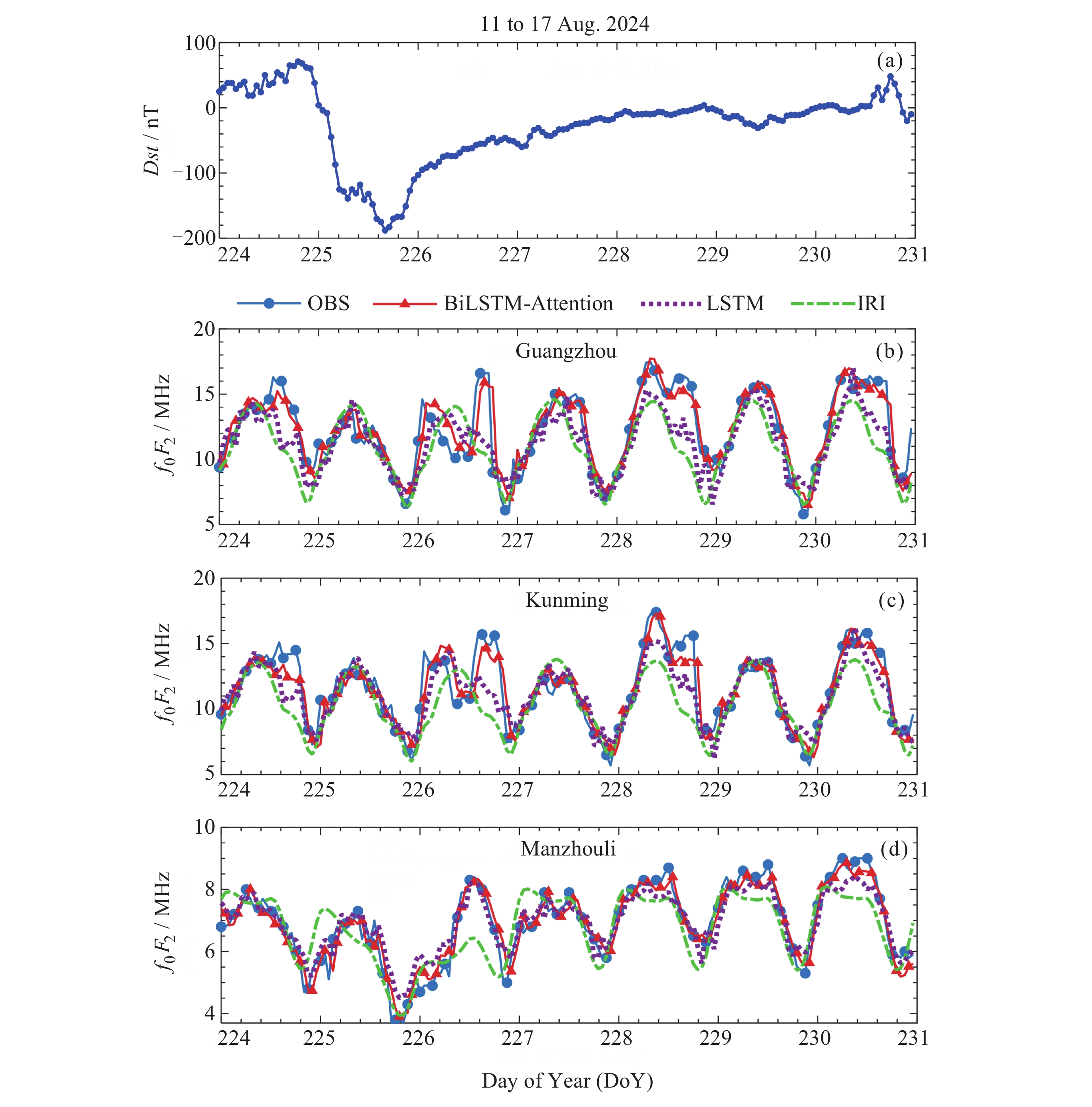
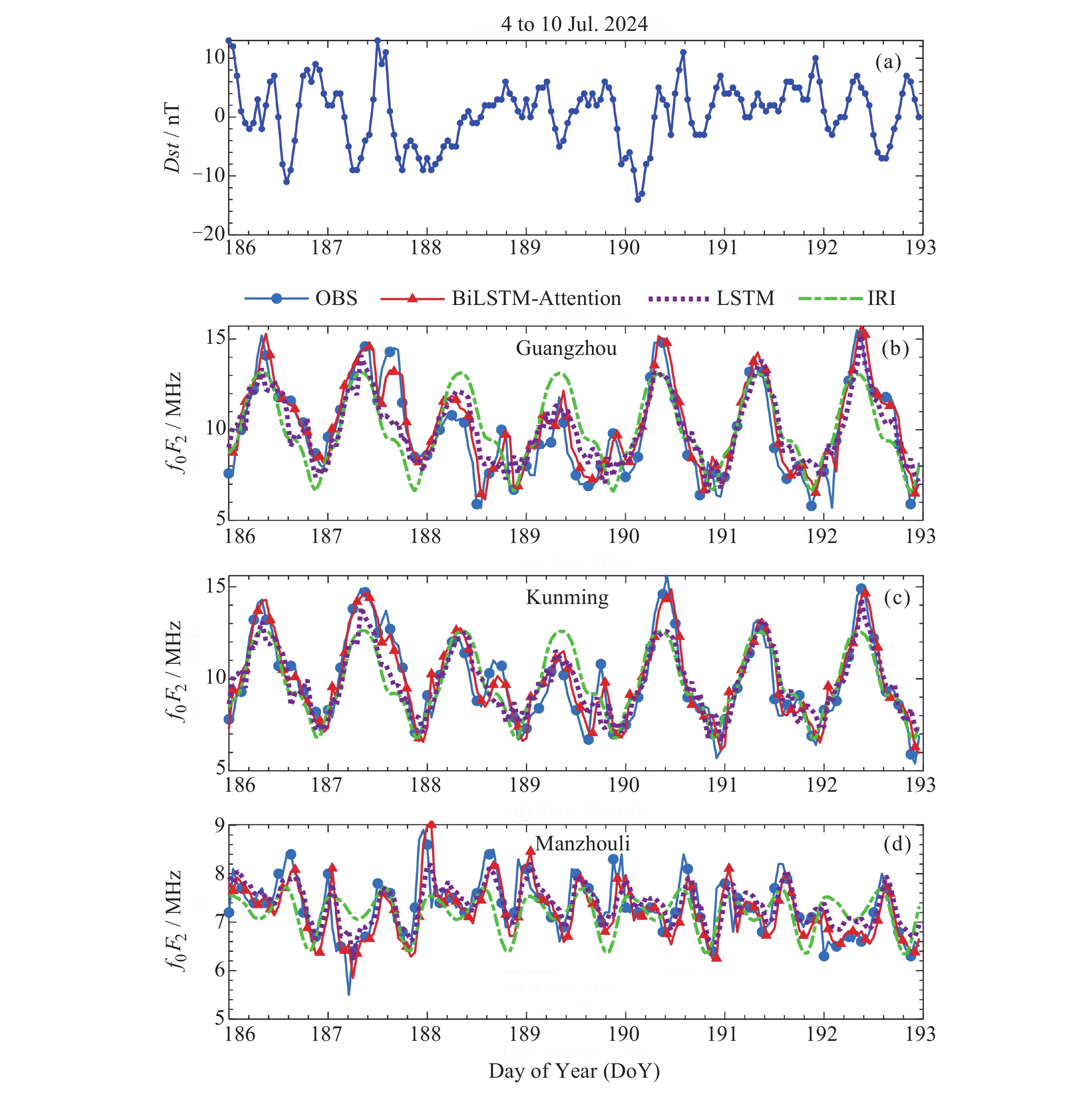
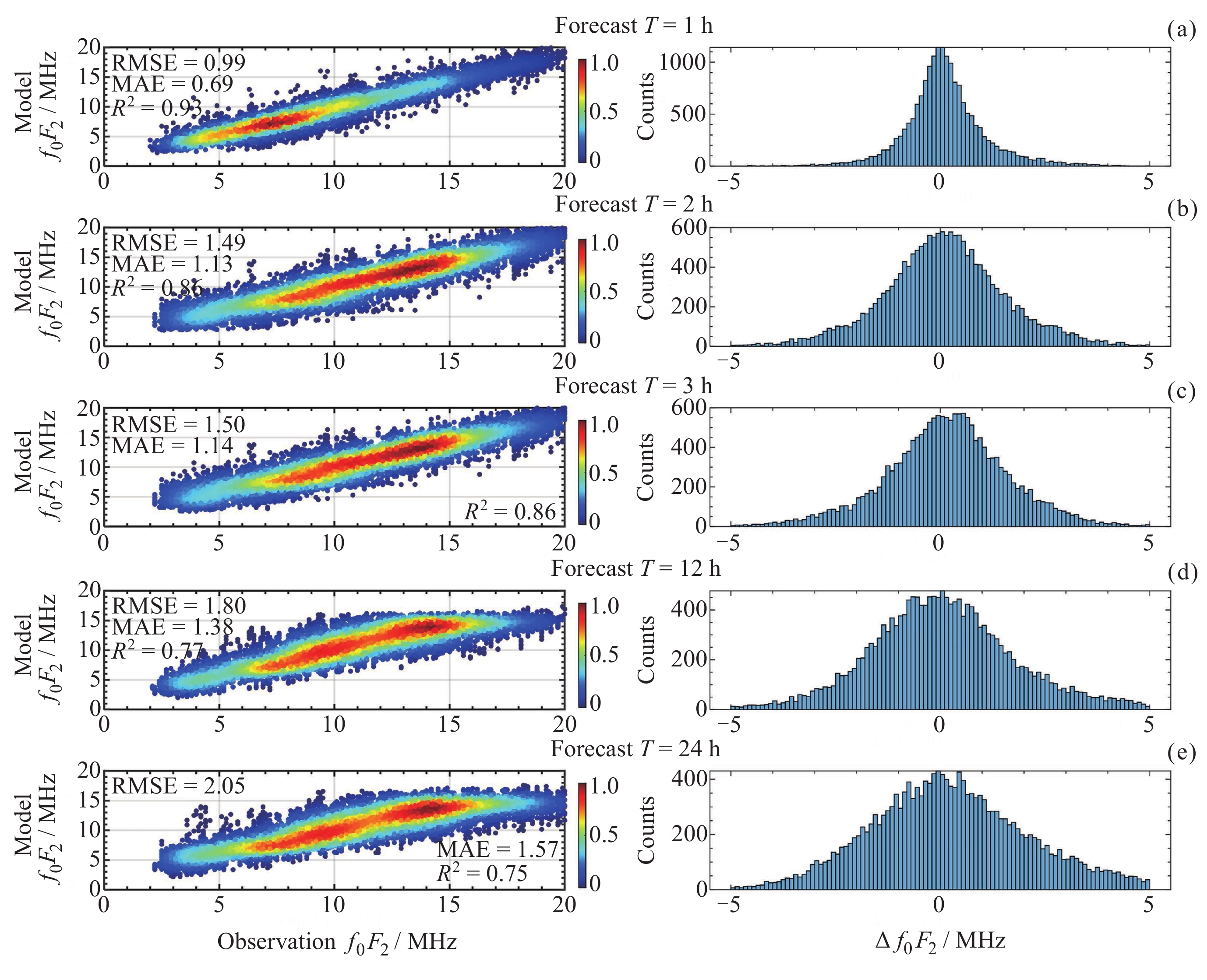
摘要: 提出一种基于深度学习的电离层f0F2短期预报方法, 通过采用注意力机制的双向长短期记忆网络(Bidirectional Long Short-Term Memory Model With Attention Mechanism, BiLSTM-Attention)算法, 结合前7天垂测站电离层f0F2观测值、世界时、太阳活动指数及地磁活动指数作为输入, 实现了中国区域电离层f0F2的预报. 模型对比分析结果表明: 低纬度台站的预报误差显著高于中纬度台站, BiLSTM-Attention模型表现最优, 长短期记忆网络(LSTM)模型次之, 与国际参考电离层模型(IRI)相比, BiLSTM-Attention模型的均方根误差(RMSE)降低了44.2%, 平均绝对误差(MAE)降低47%, 而决定系数(R2)提升21.3%; 磁暴期间, BiLSTM-Attention模型成功捕捉中国区域电离层负暴效应(f0F2下降), 与观测值非常一致, 而IRI模型开启暴时模式后, f0F2预测值与实际观测值之间依然存在一定偏差; 随着预报时间从1 h增加至24 h, 模型预报误差呈系统性上升趋势, RMSE从0.99 MHz增至2.05 MHz, MAE从0.69 MHz升至1.57 MHz, R2则由0.93减至0.75. 相关研究为空间天气预警及短波通信系统优化提供了高精度电离层参数的预报支撑.
-
关键词:
- 电离层 /
- F2层临界频率 (f0F2) /
- 注意力机制的双向长短期记忆网络 /
- 深度学习 /
- 短期预报
Abstract: As a key parameter of the ionosphere, the critical frequency of the F2 layer of the ionosphere (f0F2) is of great significance for ensuring the stable operation of systems such as high-frequency radar and short-wave communication. This paper proposes a short-term forecasting method for the ionospheric f0F2 based on deep learning. By using the Bidirectional Long Short-term Memory model with attention mechanism (BiLSTM-Attention) algorithm and combining the observed values of the ionospheric f0F2 at the ionosonde station for the previous 7 days, Universal Time (UT), solar activity index, and geomagnetic activity index as inputs, the forecasting of the ionospheric f0F2 in the Chinese region is realized. The results of the comparative analysis of the model show that: The forecasting errors for low-latitude stations were significantly higher than those for mid-latitude stations. The BiLSTM-Attention model demonstrated superior performance, followed by the Long Short-Term Memory (LSTM) model. Compared to the International Reference Ionosphere (IRI) model, the BiLSTM-Attention model achieved a 44.2% reduction in Root Mean Square Error (RMSE), 47% decrease in Mean Absolute Error (MAE), and 21.3% improvement in the Coefficient of Determination (R2). During geomagnetic storms, the BiLSTM-Attention model successfully captured the negative storm effects (characterized by f0F2 depletion) in China’s regional ionosphere, showing excellent consistency with observational data. However, even when operating in storm mode, the IRI model still exhibited noticeable deviations between predicted and observed f0F2 values. As the forecasting window extended from 1 hour to 24 hours, the model errors showed a systematic increasing trend: RMSE rose from 0.99 MHz to 2.05 MHz, MAE increased from 0.69 MHz to 1.57 MHz, while R2 decreased from 0.93 to 0.75. Relevant research provides high-precision ionospheric parameter forecasting support for space weather warning and short-wave communication system optimization. -
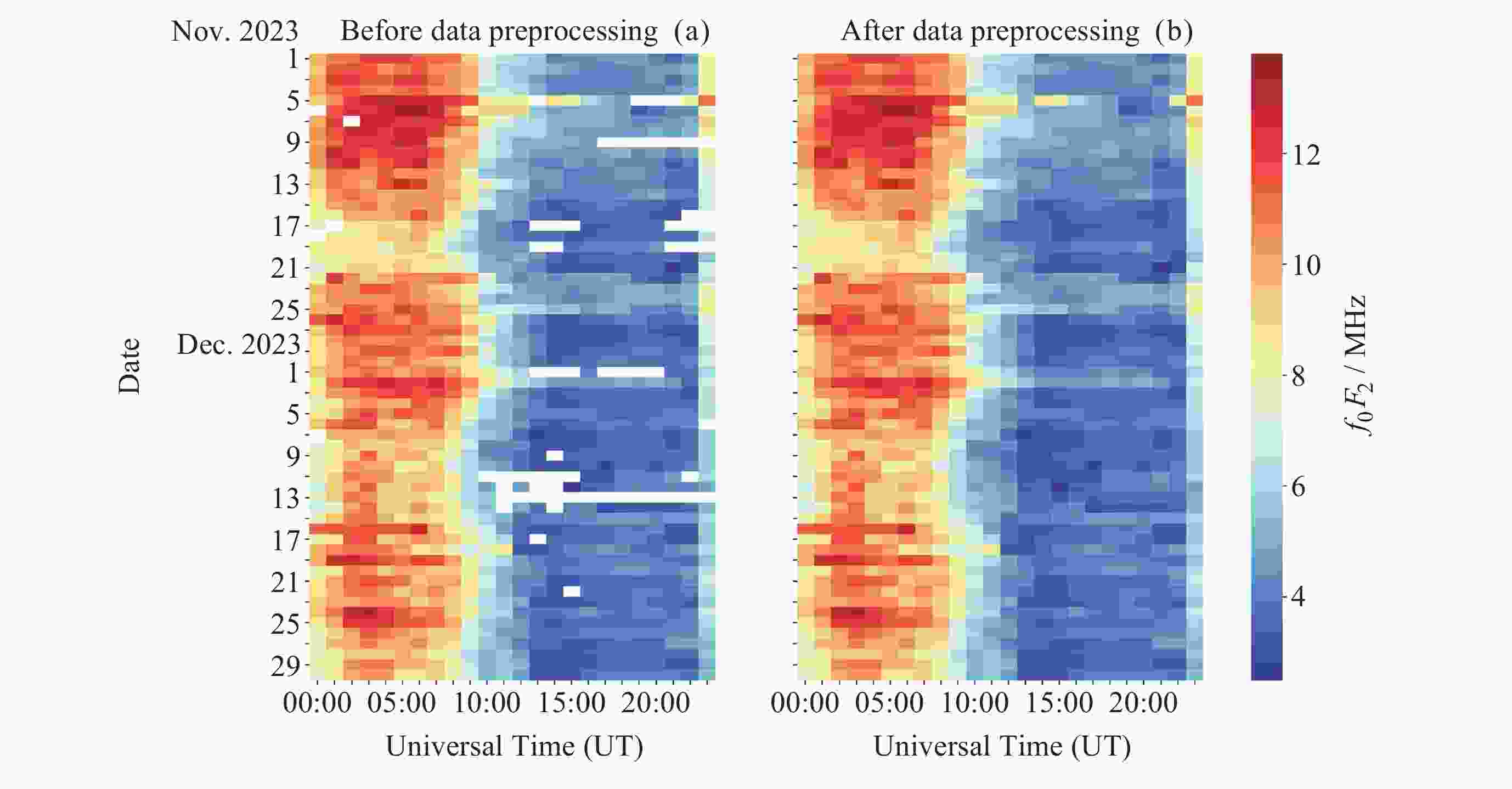
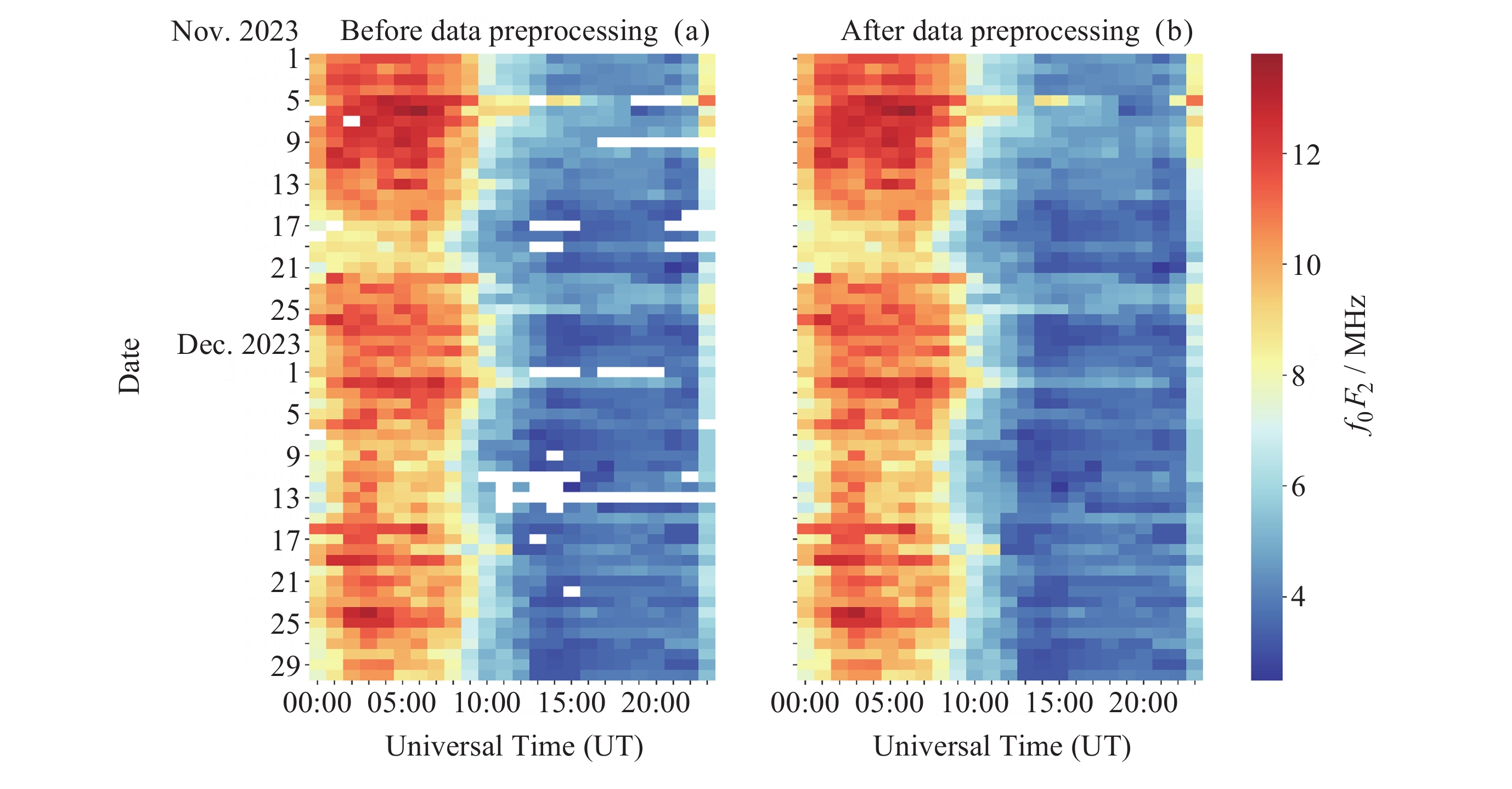
图 2 青岛站电离层垂测仪的电离层f0F2数据预处理前后对比(空白区域为数据缺失处)
Figure 2. Comparison of ionospheric f0F2 before and after data preprocessing at Qingdao station (Blank areas indicate missing data)
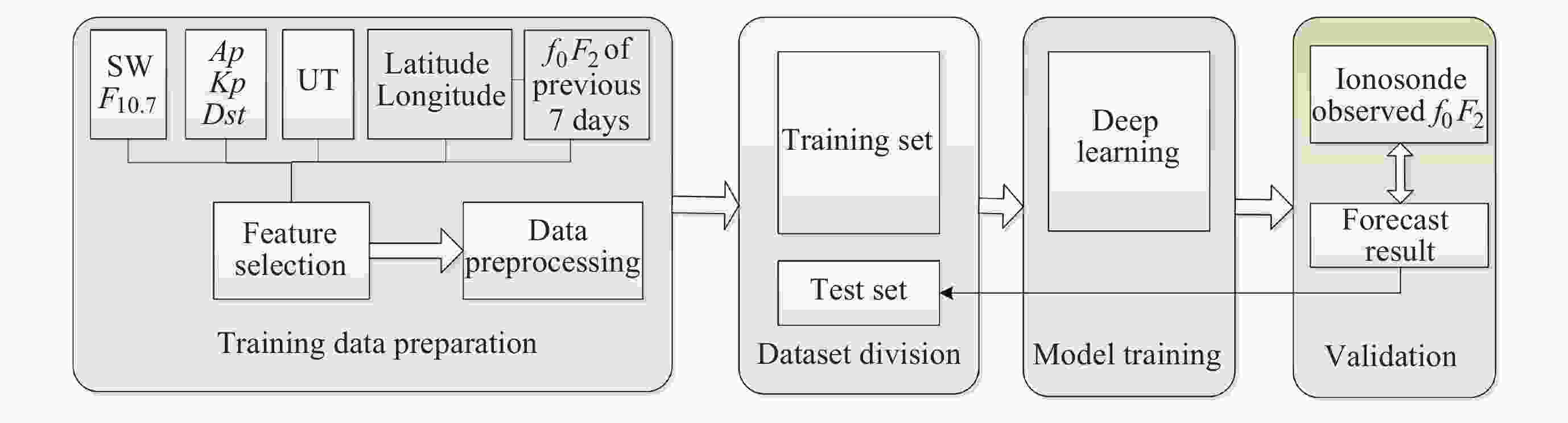
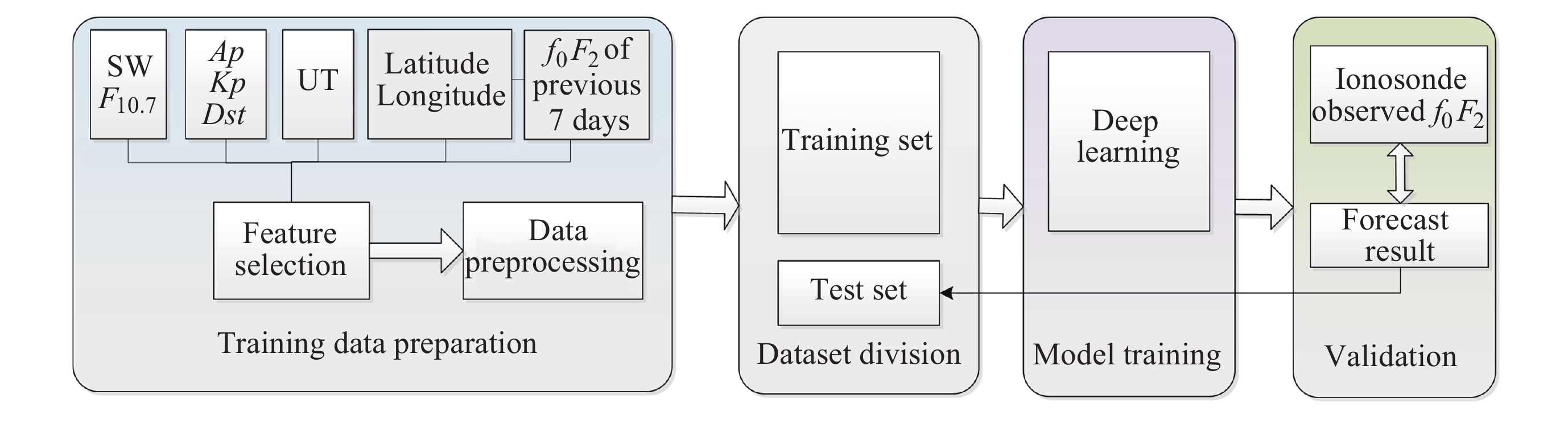
图 3 基于深度学习的电离层f0F2预报实现流程
Figure 3. Flowchart of the ionospheric f0F2 forecasting based on deep learning
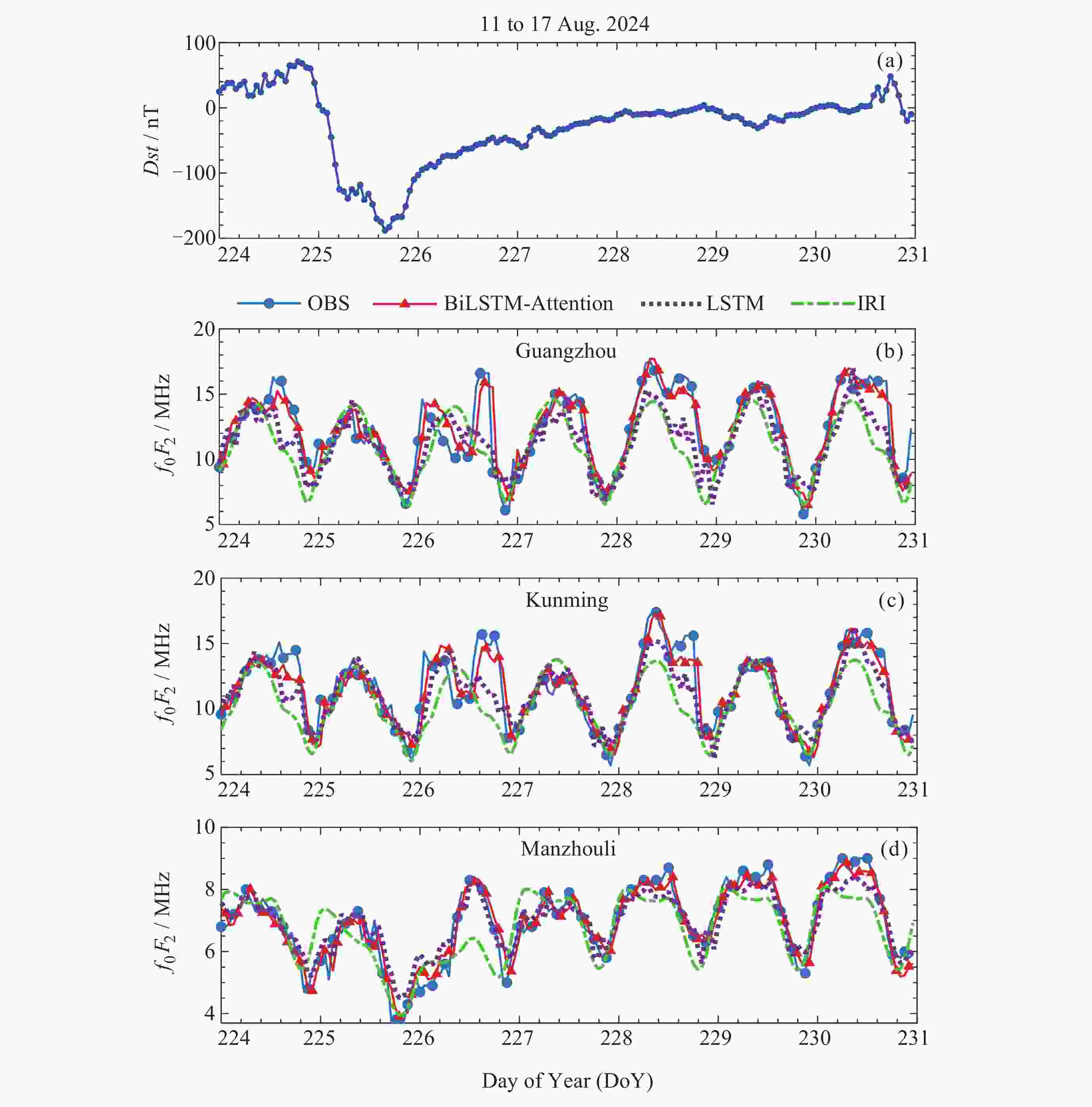
图 4 磁暴期不同模型电离层f0F2预报效果对比
Figure 4. Comparison of f0F2 forecast performance among different ionospheric models during a geomagnetic storm period
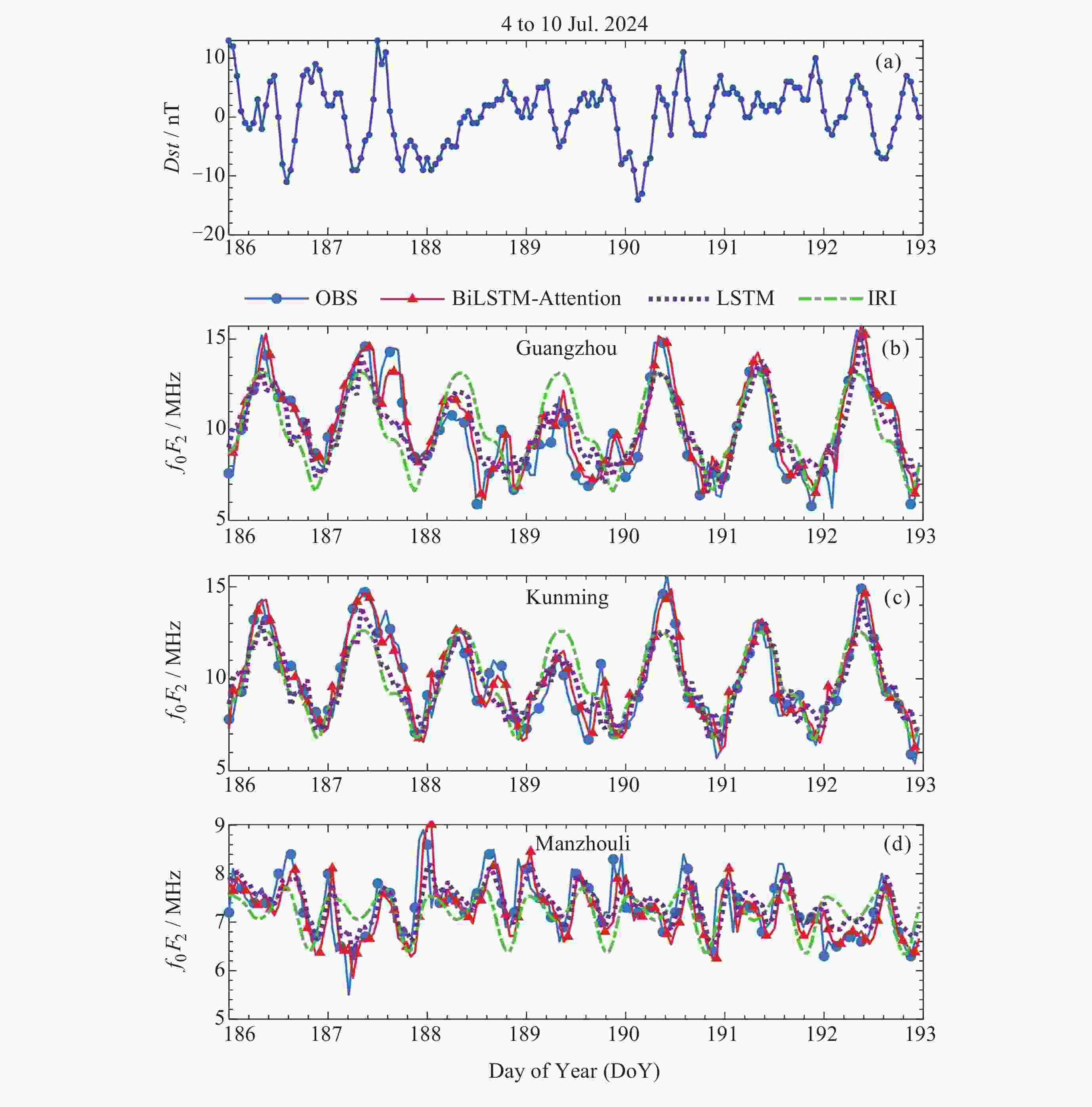
图 5 磁平静期不同模型电离层f0F2预报效果对比
Figure 5. Comparison of f0F2 forecast performance among different ionospheric models during geomagnetically quiet periods
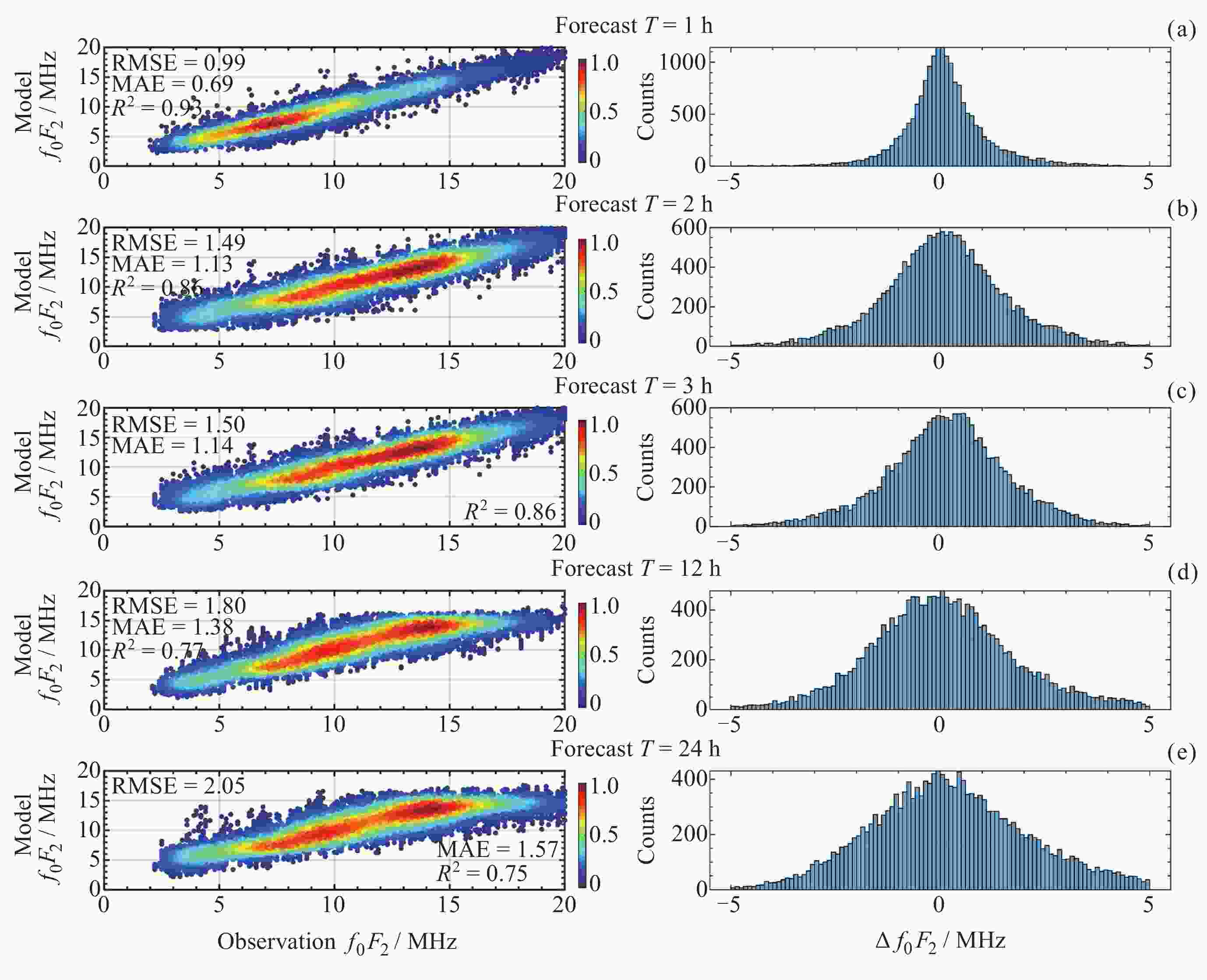
图 6 不同预报提前时间情况下电离层f0F2预报误差分析
Figure 6. Error analysis of ionospheric f0F2 forecasts under different forecast advance time
表 1 中国区域IRI-2020模型、LSTM模型和BiLSTM-Attention模型的f0F2观测值与预测值之间的RMSE, MAE和R2
Table 1. RMSE, MAE, and R2 between observed and predicted values of f0F2 for the IRI-2020 model, LSTM model, and BiLSTM-Attention model in China
台站 IRI-2020 LSTM BiLSTM-Attention RMSE/MHz MAE/MHz R2 RMSE/MHz MAE/MHz R2 RMSE/MHz MAE/MHz R2 广州 2.40 1.82 0.65 2.12 1.63 0.74 1.12 0.81 0.91 昆明 2.14 1.52 0.69 1.97 1.37 0.84 1.15 0.88 0.92 重庆 1.96 1.65 0.75 1.35 1.32 0.86 0.75 0.58 0.93 苏州 1.22 0.92 0.70 1.11 1.03 0.75 0.76 0.56 0.89 新乡 0.93 0.71 0.79 0.91 0.71 0.85 0.62 0.44 0.91 兰州 0.86 0.66 0.83 0.87 0.64 0.86 0.56 0.42 0.93 青岛 0.98 0.73 0.74 0.92 0.71 0.79 0.69 0.50 0.89 北京 0.91 0.71 0.76 0.90 0.71 0.77 0.60 0.43 0.91 伊犁 1.23 1.02 0.81 1.21 0.90 0.89 0.56 0.39 0.92 乌鲁木齐 0.94 0.72 0.84 0.81 0.70 0.88 0.53 0.41 0.95 长春 0.97 0.76 0.67 1.05 0.79 0.79 0.69 0.51 0.91 满洲里 0.99 0.76 0.73 0.94 0.86 0.87 0.61 0.44 0.93 统计平均 1.29 1.00 0.75 1.18 0.94 0.82 0.72 0.53 0.91  下载: 导出CSV
-
[1] 甄卫民, 欧明, 於晓, 等. 卫星信号电离层探测及应用技术[M]. 北京: 国防工业出版社, 2022ZHEN Weimin, OU Ming, YU Xiao, et al. Ionospheric Measurement and Application Technology Based on Satellite Beacon Signals[M]. Beijing: National Defense Industry Press, 2022 [2] 甄卫民, 欧明, 朱庆林, 等. 电离层探测及模化技术研究综述[J]. 电波科学学报, 2023, 38(4): 625-645 doi: 10.12265/j.cjors.2023067ZHEN Weimin, OU Ming, ZHU Qingling, et al. Review on ionospheric sounding and modeling[J]. Chinese Journal of Radio Science, 2023, 38(4): 625-645 doi: 10.12265/j.cjors.2023067 [3] BILITZA D, PEZZOPANE M, TRUHLIK V, et al. The International Reference Ionosphere Model: a review and description of an ionospheric benchmark[J]. Reviews of Geophysics, 2022, 60: e2022RG000792 doi: 10.1029/2022RG000792 [4] HUBA J, MAUTE A, CROWLEY G, et al. SAMI3_ICON: model of the ionosphere/plasmasphere system[J]. Space Science Reviews, 2017. DOI:10.1007/s11214-017-0415-z [5] XUE Kai, SHI Chuang, WANG Cheng. RA‐ConvLSTM: recurrent‐architecture attentional ConvLSTM networks for prediction of global total electron content[J]. Space Weather, 2025, 23: e2024SW004173 doi: 10.1029/2024SW004173 [6] 欧明, 陈龙江, 甄卫民, 等. 一种近实时全球电离层数据同化和预报系统的构建与实现[J]. 电波科学学报, 2024, 39(2): 313-321 doi: 10.12265/j.cjors.2023034OU Ming, CHEN Longjiang, ZHEN Weimin, et al. Construction and implementation of a near-real-time global ionospheric data assimilation and forecasting system[J]. Chinese Journal of Radio Science, 2024, 39(2): 313-321 doi: 10.12265/j.cjors.2023034 [7] CANDER L R, MILOSAVLJEVIC M M, STANKOVIC S S, et al. Ionospheric forecasting technique by artificial neural network[J]. Electron Lett, 1998, 34(16): 1573-1574 doi: 10.1109/neurel.2002.1057972 [8] LI Xiaojun, ZHOU Chen, TANG Qiong, et al. Forecasting ionospheric f0F2 based on deep learning method[J]. Remote Sensing, 2021, 13(19): 3849 doi: 10.3390/rs13193849 [9] Wang R, Zhou C, Deng Z, et al. Predicting f0F2 in the China region using the neural networks improved by the genetic algorithm[J]. Journal of Atmospheric and Solar-Terrestrial Physics, 2013, 92: 7-17 doi: 10.1016/j.jastp.2012.09.010 [10] 胡小希, 周晨, 赵军, 等. 基于优化神经网络算法的电离层f0F2 预测[J]. 电波科学学报, 2018, 33(6): 708-716 doi: 10.13443/j.cjors.2017111301HU Xiaoxi, ZHOU Chen, ZHAO Jun, et al. The ionospheric f0F2 prediction based on neural network optimization algorithm[J]. Chinese Journal of Radio Science, 2018, 33(6): 708-716 doi: 10.13443/j.cjors.2017111301 [11] OLIVEIRA T P, BARBAR J S, SOARES A S. Computer network traffic prediction: a comparison between traditional and deep learning neural networks[J]. International Journal of Big Data Intelligence, 2016, 3(1): 28-37 doi: 10.1109/tjgrs.2023.3336934 [12] SHI Yafei, YANG Cheng, WANG Jian, et al. A forecasting model of ionospheric f0F2 using the LSTM network based on ICEEMDAN decomposition[J]. IEEE Transactions on Geoscience and Remote Sensing, 2023, 61: 1-16 doi: 10.1109/tgrs.2023.3336934 [13] SHI Yafei, YANG Cheng, WANG Jian, et al. A hybrid deep learning-based short-term forecast model for ionospheric f0F2 in East Asia region[J]. Advances in Space Research, 2025, 75(1): 1-12 doi: 10.1016/j.asr.2024.09.062 [14] LIU Z D, FANG H X, WENG L B, et al. A comparison of ionosonde measured f0F2 and IRI-2016 predictions over China[J]. Advances in Space Research, 2020, 63(6): 1926-1936 doi: 10.1016/j.asr.2019.01.017 [15] 陈龙江, 甄卫民, 欧明, 等. 一种基于分步线性最优估计的全球中低纬区域电离层f0F2重构方法[J]. 电波科学学报, 2021, 36(1): 36-432CHEN Longjiang, ZHEN Weimin, OU Ming, et al. A method of ionospheric f0F2 reconstruction in low and middle latitudes of the world based on stepwise linear optimal estimation[J]. Chinese Journal of Radio Science, 2021, 36(1): 36-42 [16] HOCHREITER S, SCHMIDHUBER J. Long short-term memory[J]. Neural Computation, 1997, 9(8): 1735-1780 doi: 10.1162/neco.1997.9.8.1735 [17] 熊波, 李肖霖, 王宇晴, 张瀚铭, 刘子君, 丁锋, 赵必强. 基于长短时记忆神经网络的中国地区电离层TEC预测[J]. 地球物理学报, 2022, 65(7): 2365-2377 doi: 10.6038/cjg2022P0557XIONG Bo, LI XiaoLin, WANG YuQing, et al. Prediction of ionospheric TEC over China based on long and short-term memory neural network[J]. Chinese Journal of Geophysics, 2022, 65(7): 2365-2377 doi: 10.6038/cjg2022P0557 [18] JIANG Z, ZHANG Z, HE Y Y H. Efficient and accurate TEC modeling and prediction approach with random forest and Bi-LSTM for large-scale region[J]. Advances in Space Research, 2024, 73(1): 650-662 doi: 10.1016/j.asr.2023.09.003 [19] HAN C, GUO Y, OU M, et al. A lightweight prediction model for global ionospheric total electron content based on attention-BiLSTM[J]. Advances in Space Research, 2025, 75(4): 3614-3629 doi: 10.1016/j.asr.2024.11.066 [20] TANG J, YANG D, DING M. Forecasting ionospheric f0F2 using bidirectional LSTM and attention mechanism[J]. Space Weather, 2023, 21: e2023SW003508 doi: 10.1029/2023SW003508 [21] 林子扬, 陈龙江, 靳睿敏, 等. 基于随机森林算法的中国及周边区域电离层f0F2预测模型[J]. 全球定位系统, 2024, 49(5): 88-96 doi: 10.12265/j.gnss.2024140LIN Ziyang, CHEN Longjiang, JIN Ruimin, et al. A random forest-based prediction model for ionospheric f0F2 in China and surrounding regions[J]. GNSS World of China, 2024, 49(5): 88-96 doi: 10.12265/j.gnss.2024140 [22] ARAUJO-PRADERE E A, FULLER-ROWELL T J, CODRESCU M V. STORM: an empirical storm-time ionospheric correction model, 1 model description[J]. Radio Science, 2002, 37(5): 1070. DOI:10.1029/2001RS002467 [23] HE J, YUE X, WANG W, et al. EnKF ionosphere and thermosphere data assimilation algorithm through a sparse matrix method[J]. Journal of Geophysical Research: Space Physics, 2019, 124: 7356-7365 doi: 10.1029/2019JA026554 [24] 欧明, 陈龙江, 王妍, 等. 地基GNSS和天基掩星观测对全球电离层数据同化效果的影响分析[J]. 电波科学学报, 2022, 37(4): 619-628 doi: 10.12265/j.cjors.2021210OU Ming, CHEN Longjiang, WANG Yan, et al. Impact analysis of ground-based GNSS and space-based occultation observations on global ionospheric data assimilation[J]. Chinese Journal of Radio Science, 2022, 37(4): 619-628 doi: 10.12265/j.cjors.2021210 -
-

 下载:
下载:

计量
- 文章访问数: 2058
- HTML全文浏览量: 832
- PDF下载量: 140
-
被引次数:
0(来源:Crossref)
0(来源:其他)

