


外日球层行星际激波特性与离子加速
doi: 10.11728/cjss2026.03.2025-0192 cstr: 32142.14.cjss.2025-0192
-
 刘思哲 男, 1999年10月出生于湖南省醴陵市, 现为哈尔滨工业大学(深圳)空间科技学院研究生, 主要研究方向为日球层等离子体物理过程的数值模拟与观测数据分析. E-mail: 23S061014@stu.hit.edu.cn
 -
 吴明雨 男, 1987年10月出生于安徽省舒城县, 现为哈尔滨工业大学(深圳)空间科技学院教授、博士生导师, 主要研究方向为行星物理、等离子体波动、粒子加热加速和磁场重联等. E-mail: wumingyu@hit.edu.cn
作者简介:
Characteristics of Outer Heliospheric Interplanetary Shocks and Ion Acceleration
-
摘要: 新视野号实测数据表明, 随日心距增大拾起离子在太阳风总离子中的数密度占比逐渐上升. 研究其在行星际激波处的加速, 对理解外日球层太阳风与星际物质相互作用具有重要作用. 利用二维混合模拟对外日球层行星际准垂直激波进行参量研究. 结果表明, 在较强背景湍动下, 低阿尔芬马赫数($ {M}_{\mathrm{A}} $<3)激波仍可加速部分拾起离子, 并通过扩散激波加速形成幂律高能尾; 在相同湍动强度条件下, 高能离子通量强度随马赫数增大而增加; 拾起离子更易被激波加速并主导下游高能段能谱. 对新视野号观测事件的分析发现, 部分外日球层低马赫数激波可产生幂律高能尾, 与模拟预期一致. 此外, 部分事件中, 太阳风$ \alpha $粒子或与星际中性氢电荷交换, 从而增强He+在拾起离子截止能段附近的贡献. 研究结果定性揭示了外日球层影响离子加速的参量, 为进一步理解日球层终止激波下游异常宇宙线的起源提供了理论基础.Abstract: Interstellar neutral atoms entering the heliosphere can be ionized by solar ultraviolet radiation or charge exchange with solar wind ions, then picked up by the solar wind to form interstellar Pickup Ions (PUIs). New Horizons observations show that PUIs’ number density fraction in the solar wind increases with heliocentric distance, highlighting their importance in the outer heliosphere. In this study, we conduct a parametric study of outer heliospheric interplanetary shocks using two-dimensional hybrid simulations constrained by in-situ data. Our results reveal that, for a shock with fixed Mach number, stronger ambient turbulence enhances ion multiple shock crossings via intensified upstream wave-particle scattering, prolonging particle residence near the shock. Sufficiently strong turbulence enables even low Alfvén Mach number ($ {M}_{\mathrm{A}}<3 $) shocks to efficiently accelerate PUIs into power-law suprathermal tails by diffusive shock acceleration. For given turbulence intensity, acceleration efficiency rises with Mach number due to increased compression ratio, and PUIs are accelerated more efficiently than solar wind ions, forming prominent downstream suprathermal tails. New Horizons observations of outer heliospheric low MA shocks show downstream PUI power-law tails consistent with simulations. Additionally, solar wind alpha particle-related charge exchange may enhance He+ near the PUI cutoff energy, more pronounced in high-speed streams due to larger cross-sections. This paper provide outer heliospheric ion acceleration factors and insights into anomalous cosmic ray origins downstream of the heliospheric termination shock.
-
Key words:
- Pickup ions /
- Interplanetary shocks /
- Outer heliosphere /
- Turbulence /
- Ion acceleration
-
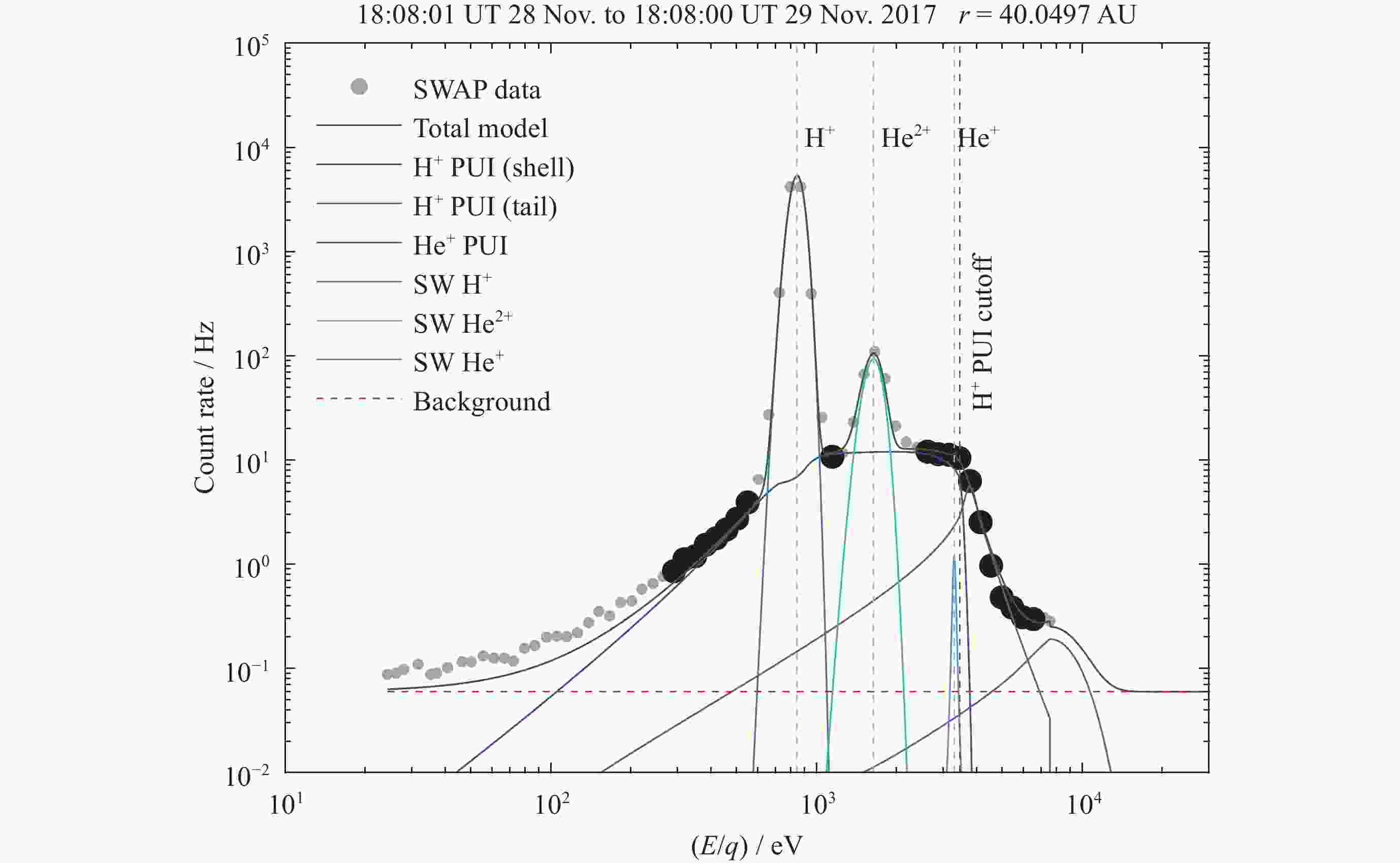
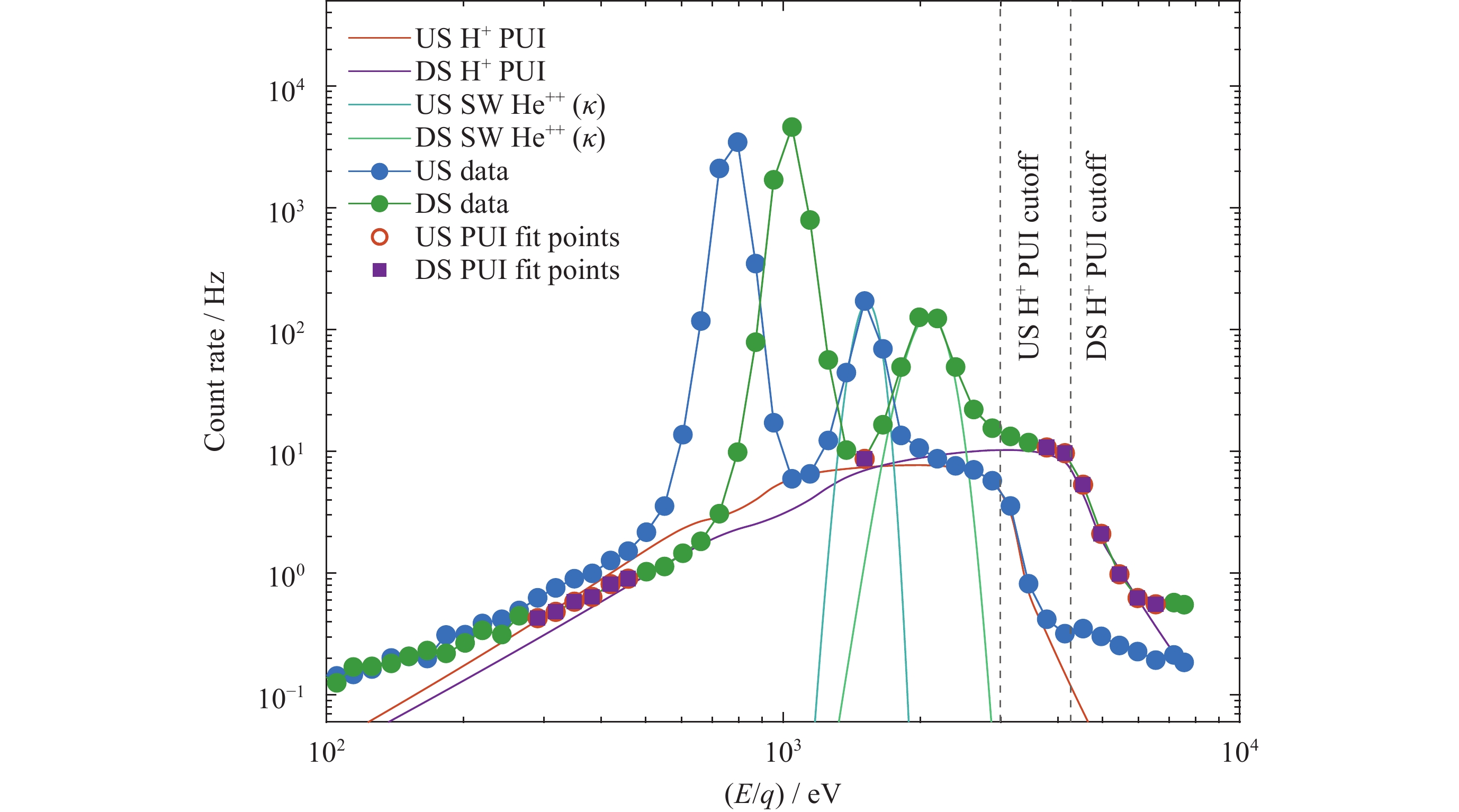
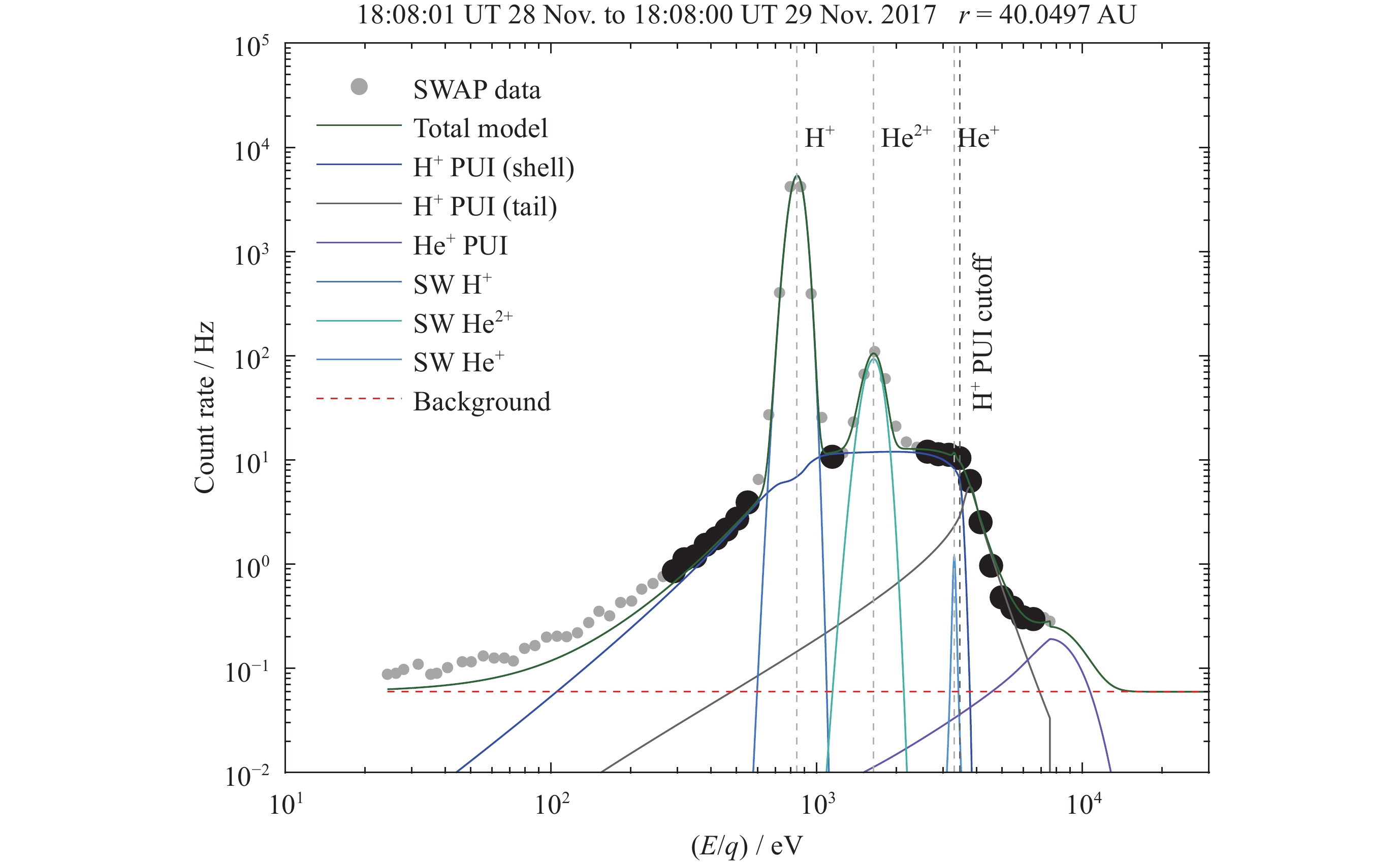
图 1 SWAP观测的典型事件下游计数率能谱
Figure 1. Downstream count rate spectrum of a typical event observed by SWAP
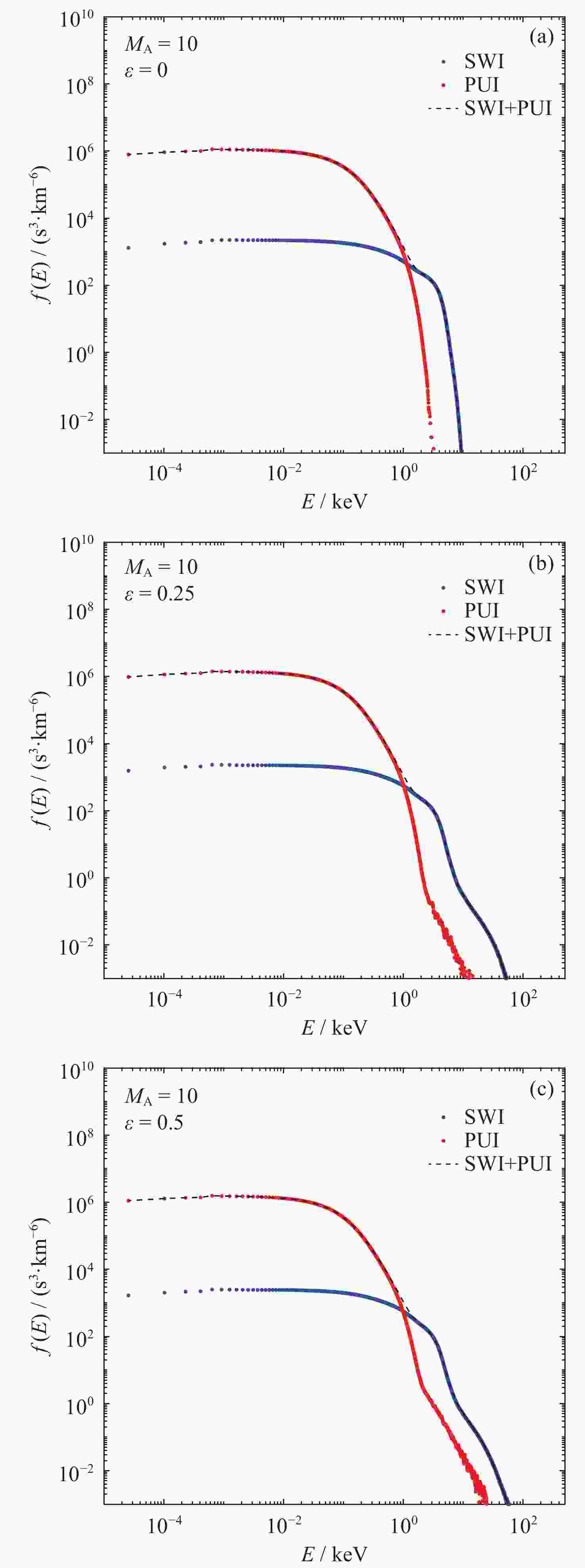
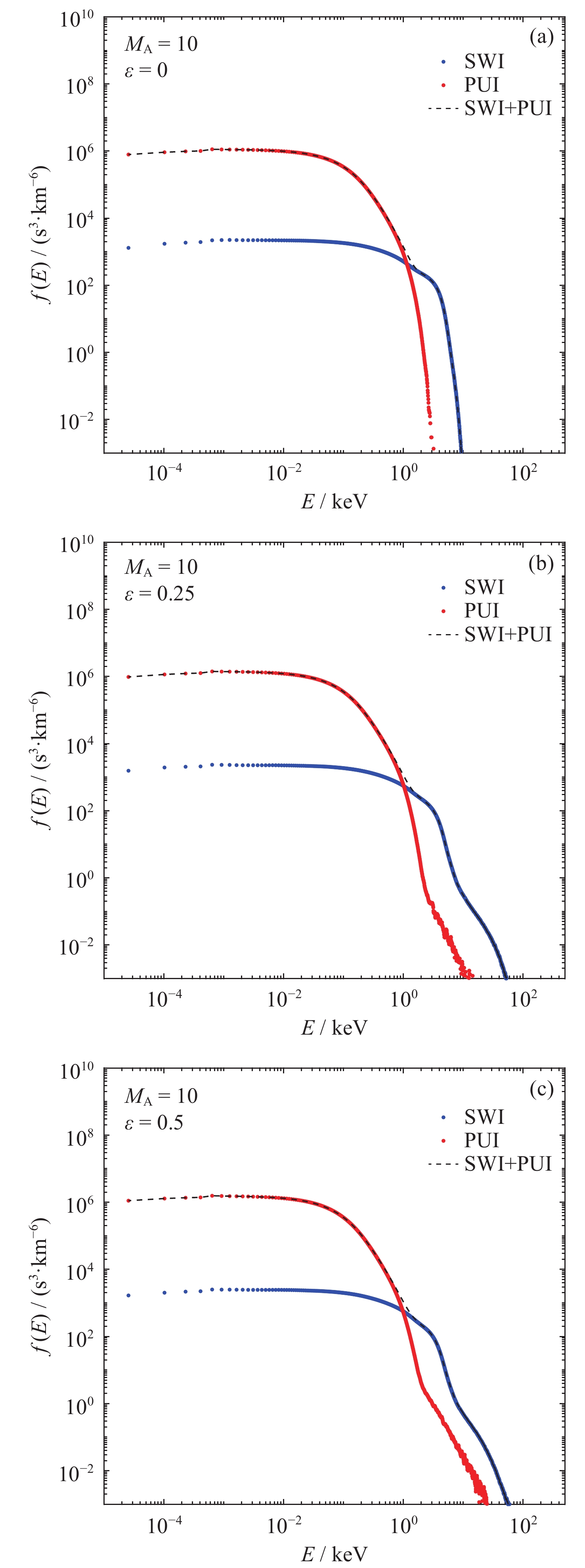
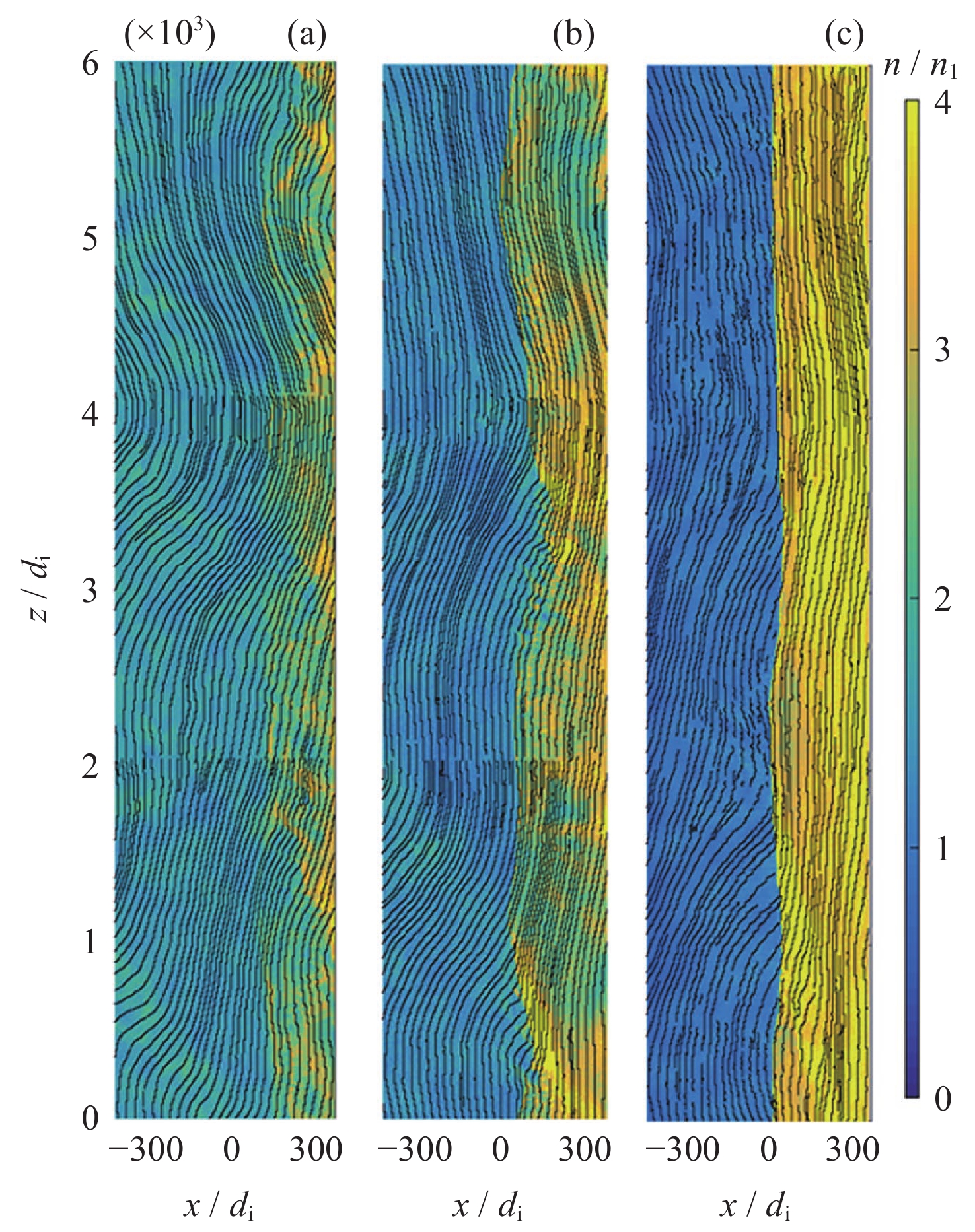
图 2 不同湍动强度激波下游离子速度分布函数的模拟结果对比
Figure 2. Comparison of simulation results of ion velocity distribution functions downstream of shocks with different turbulence levels
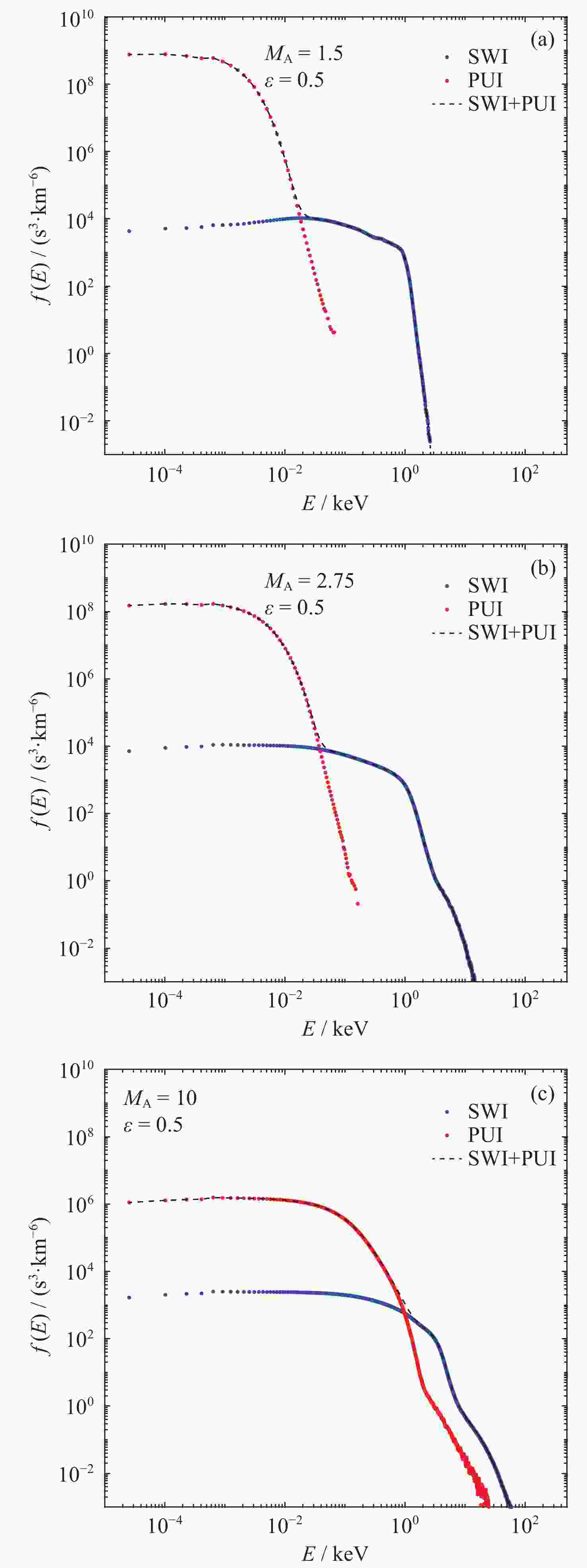
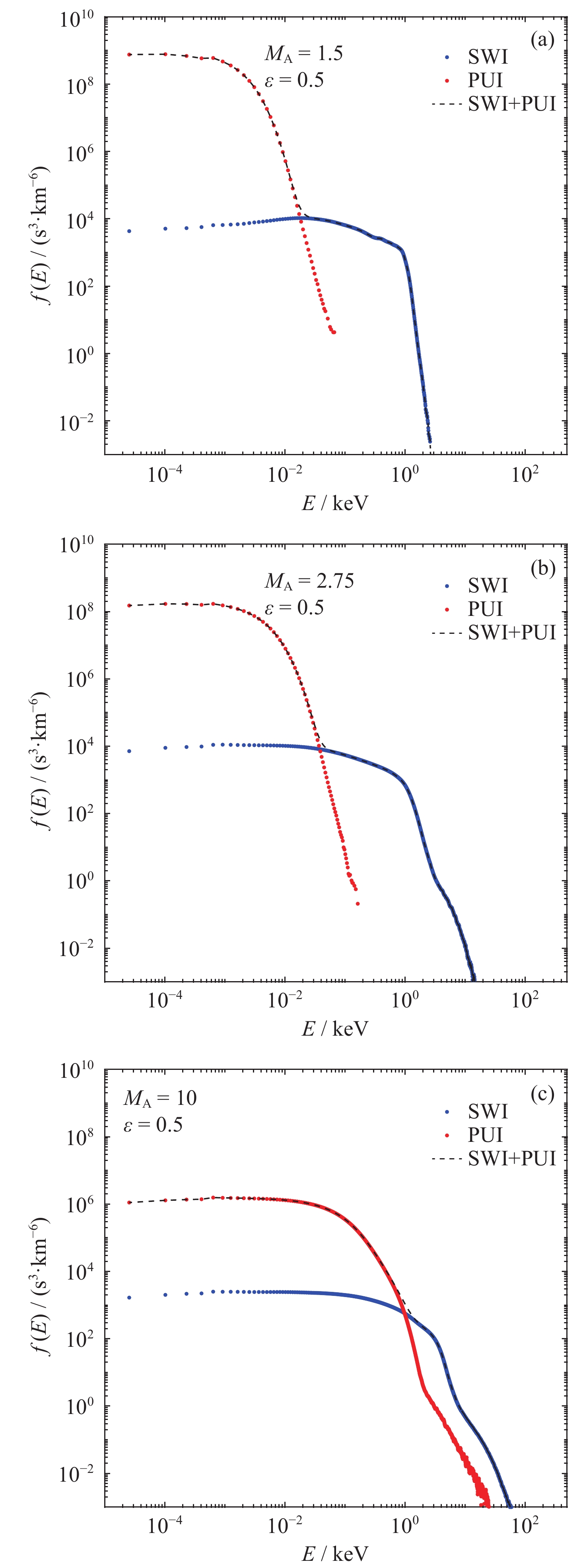
图 4 不同马赫数激波下游离子速度分布函数的模拟结果对比
Figure 4. Comparison of simulation results of ion velocity distribution functions downstream of shocksat different Mach numbers
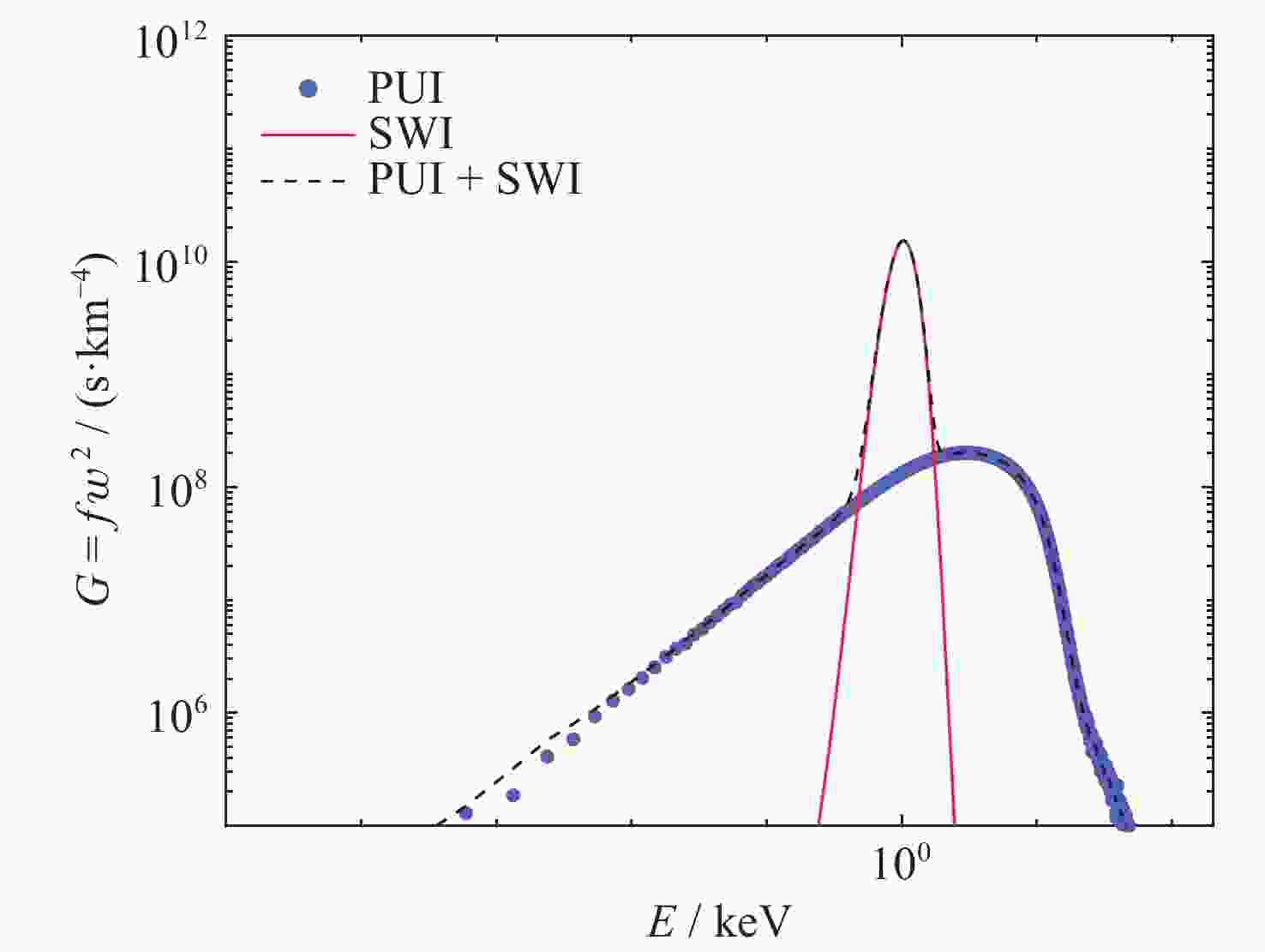
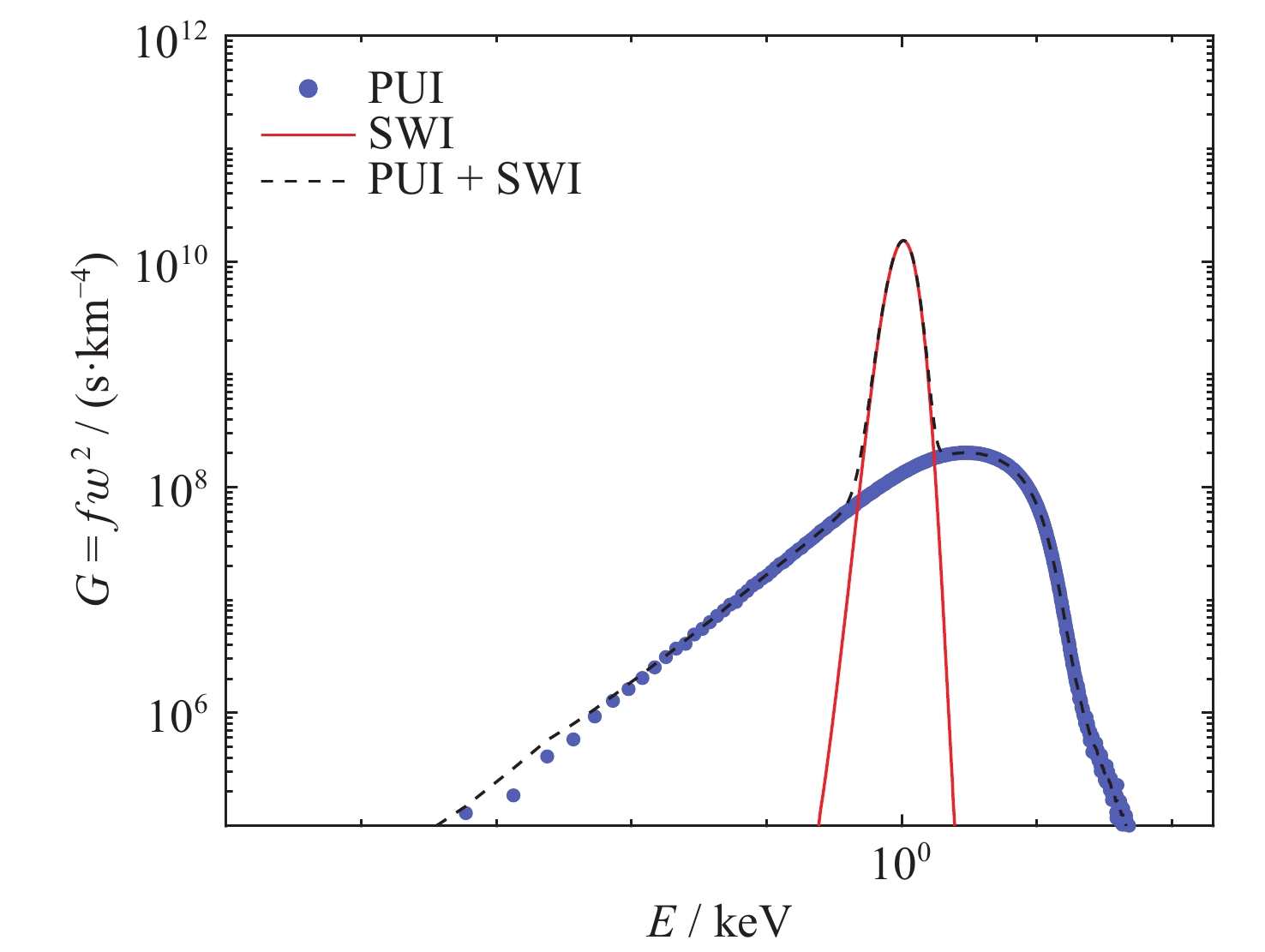
图 6 新视野号参考系下典型激波模拟的下游VDF
Figure 6. Downstream (DS) ion Velocity Distribution Function (VDF) of a typical shock in the New Horizons spacecraft frame
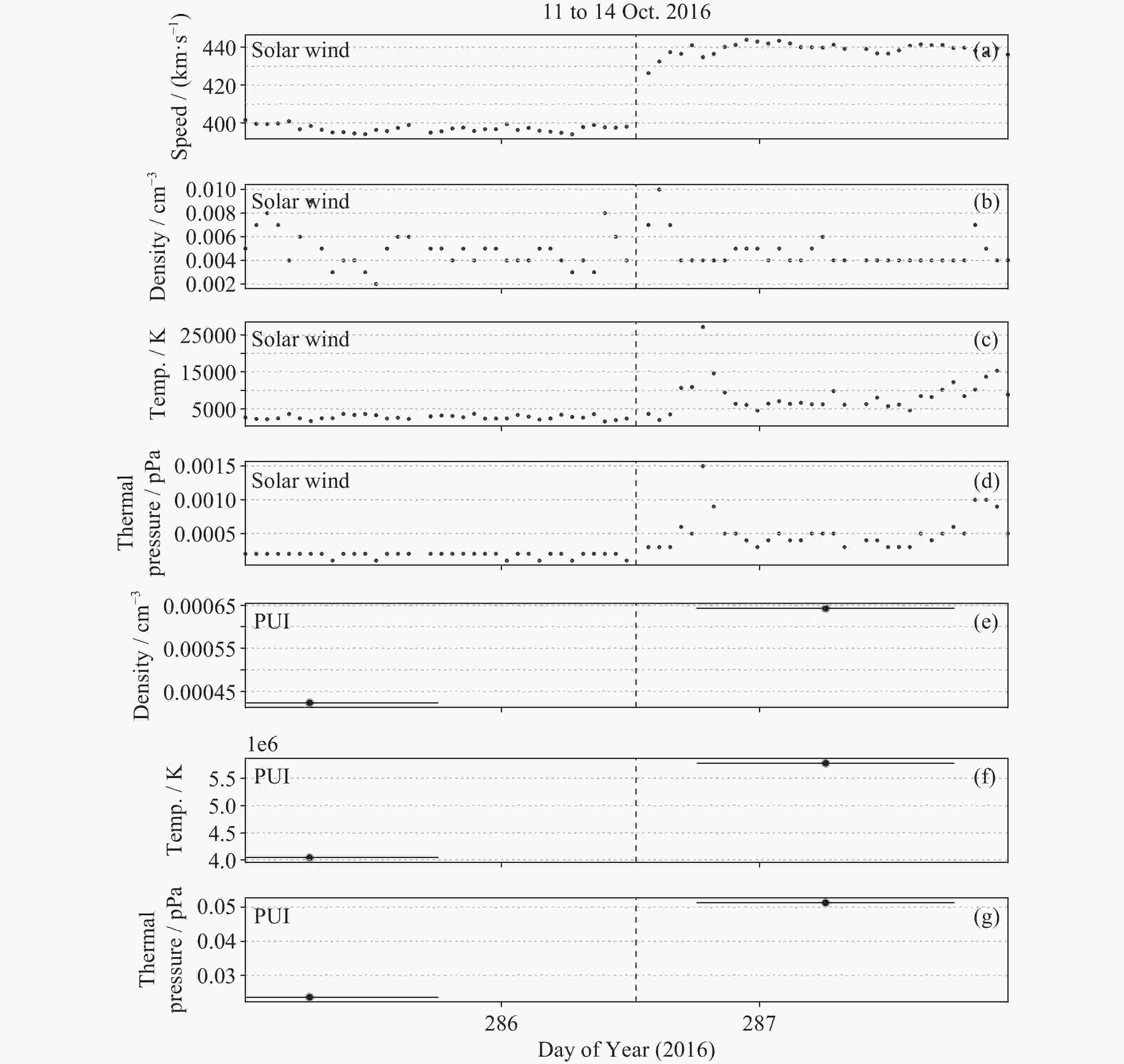
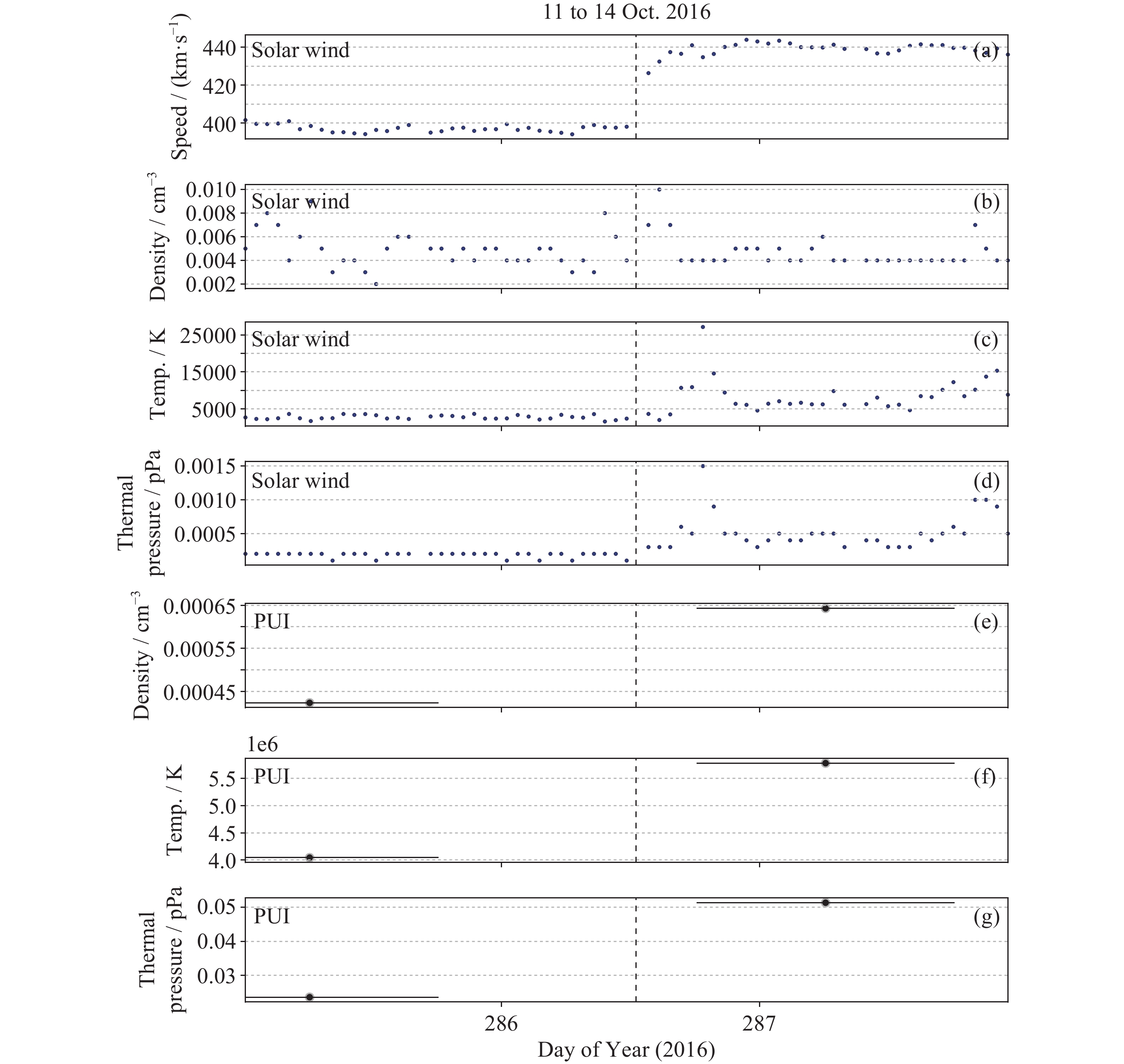
图 7 激波S1前后的等离子体参数 (虚线表示激波面的位置)
Figure 7. Plasma parameters in upstream and downstream of shock S1 (dashed line indicates the position of the shock front)
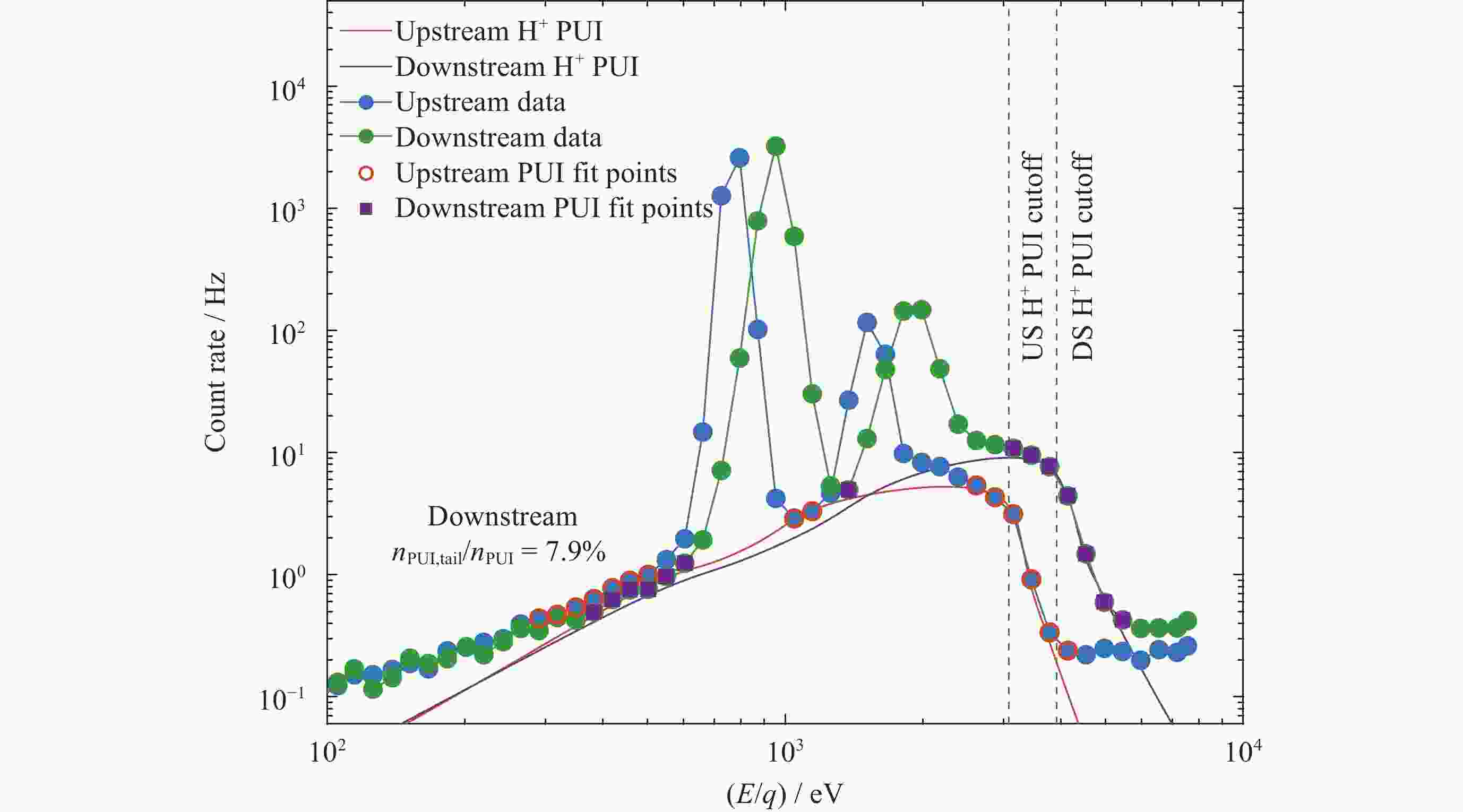
图 8 激波S1前后的离子计数率能谱(两条竖直虚线分别代表上下游PUI-H+的截止能量)
Figure 8. Ion count rate spectra upstream and downstream of shock S1 (two vertical dashed lines represent the cutoff energies of upstream and downstream PUI-H+, respectively)
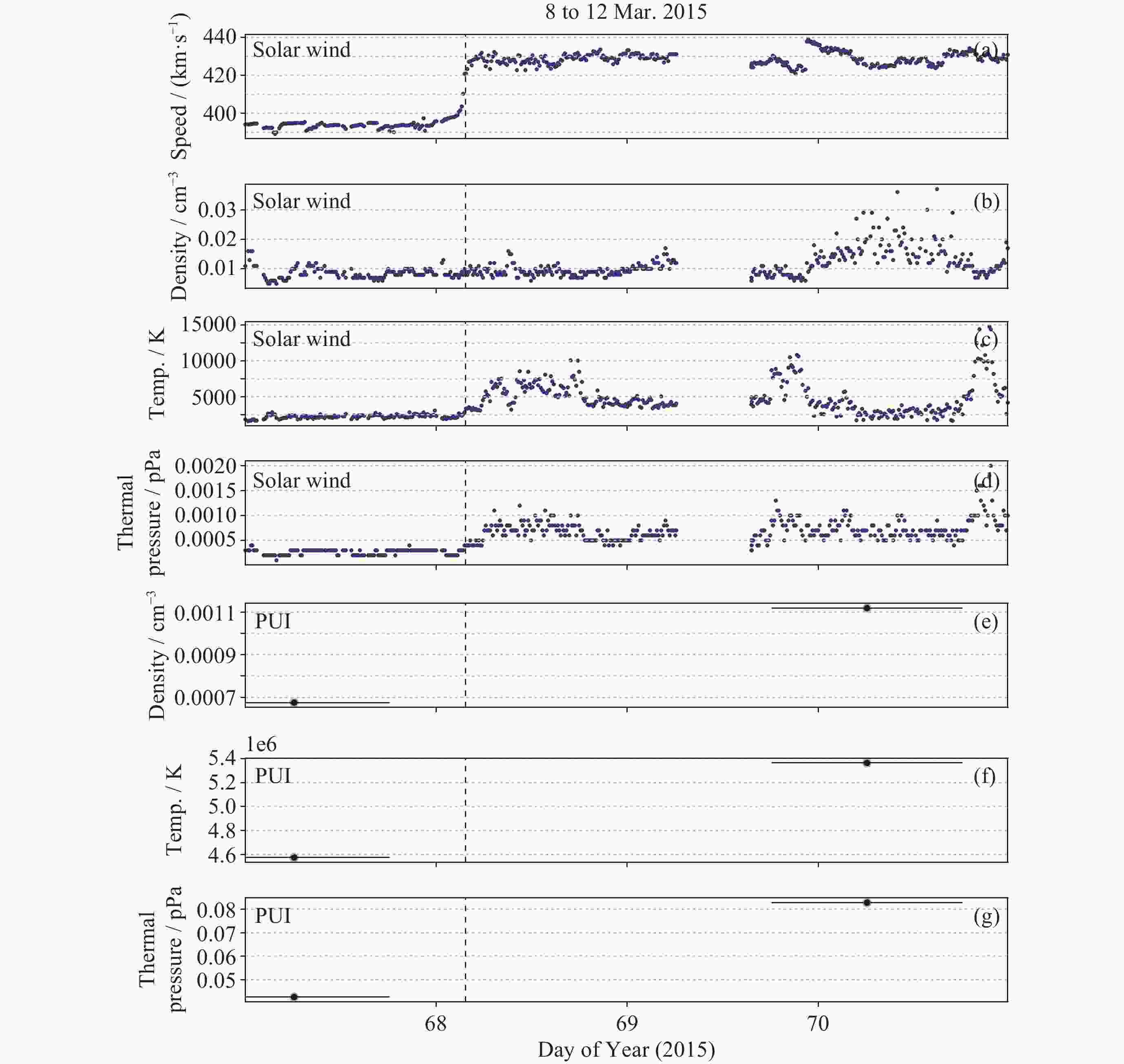
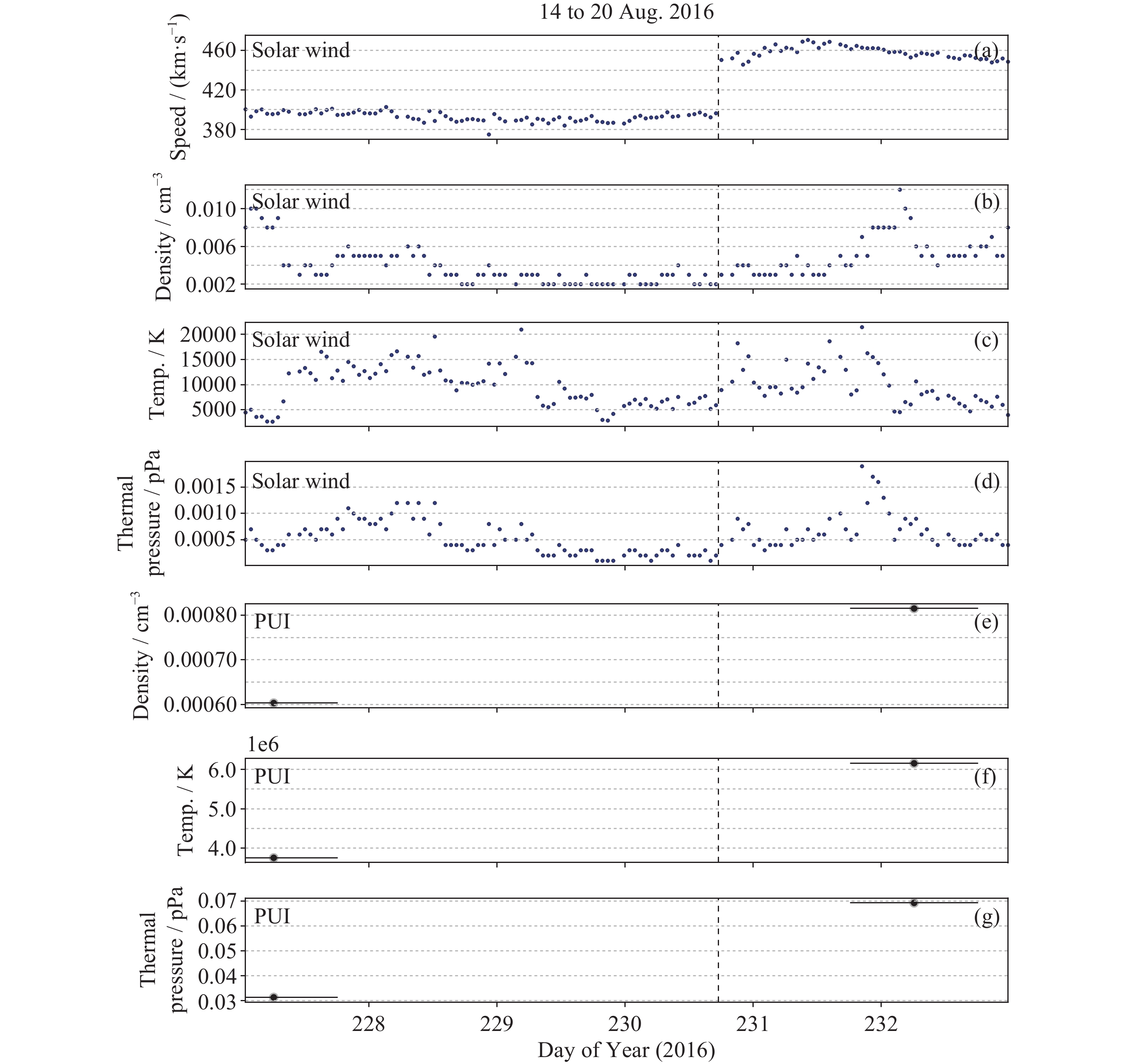
图 9 激波S3前后的等离子体参数 (虚线表示激波面的位置)
Figure 9. Plasma parameters in upstream and downstream of shock S3 (dashed line indicates the position of the shock front)
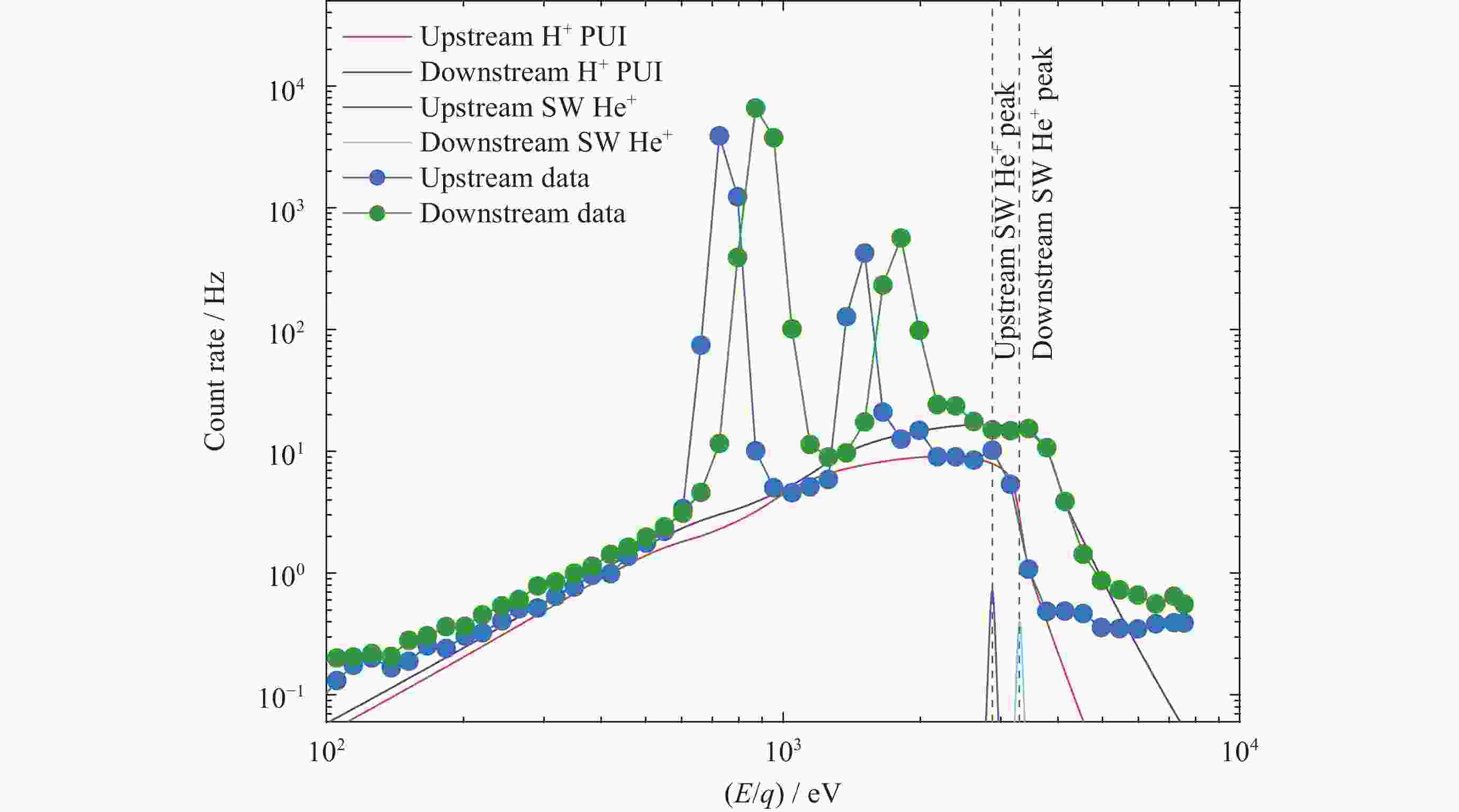
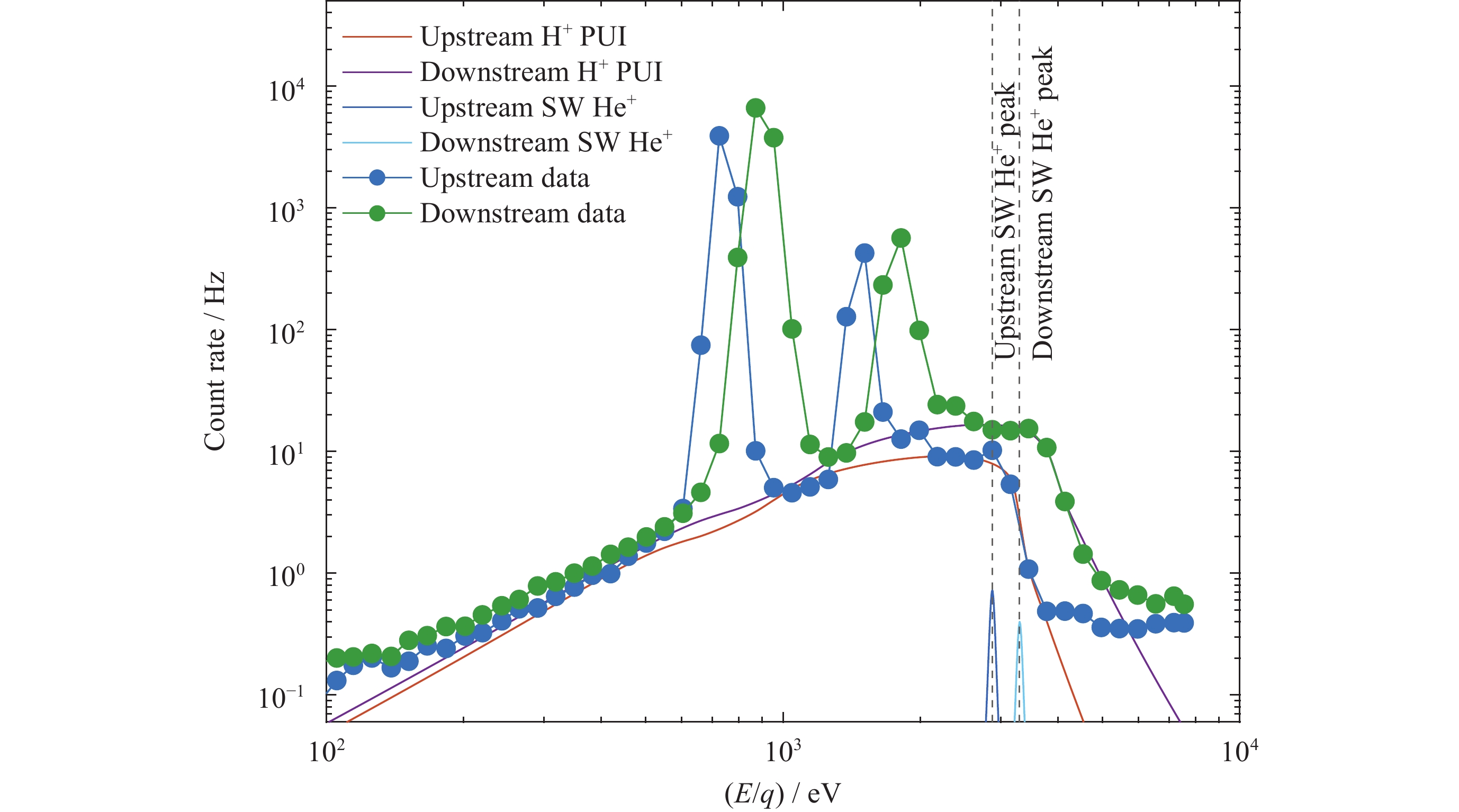
图 10 激波S3前后的离子计数率能谱(竖直虚线表示上下游SWI-He+的峰值能量)
Figure 10. Ion count rate spectra upstream and downstream of shock S3 (two vertical dashed lines indicate the peak energies of upstream and downstream SWI-He+, respectively)
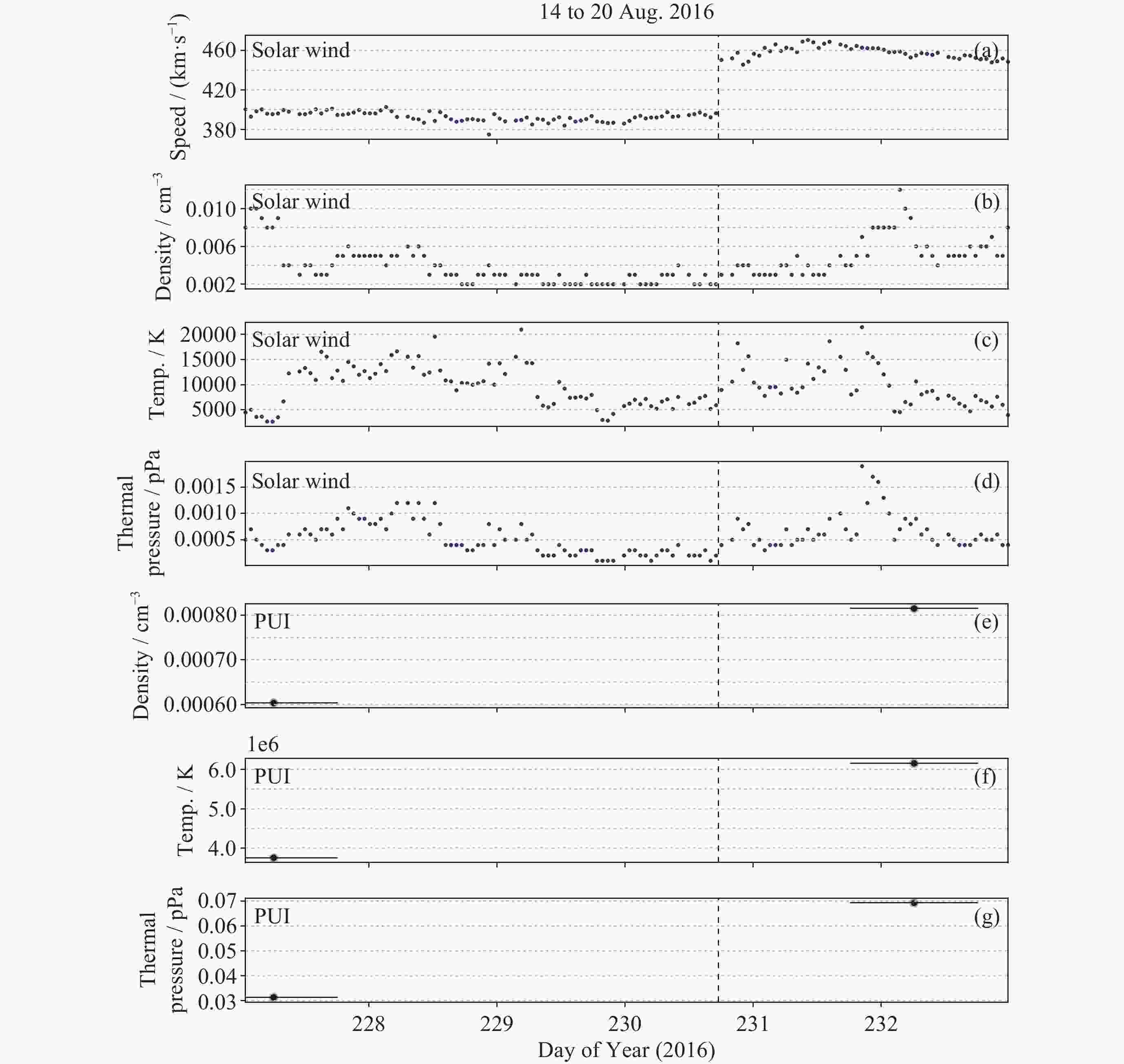
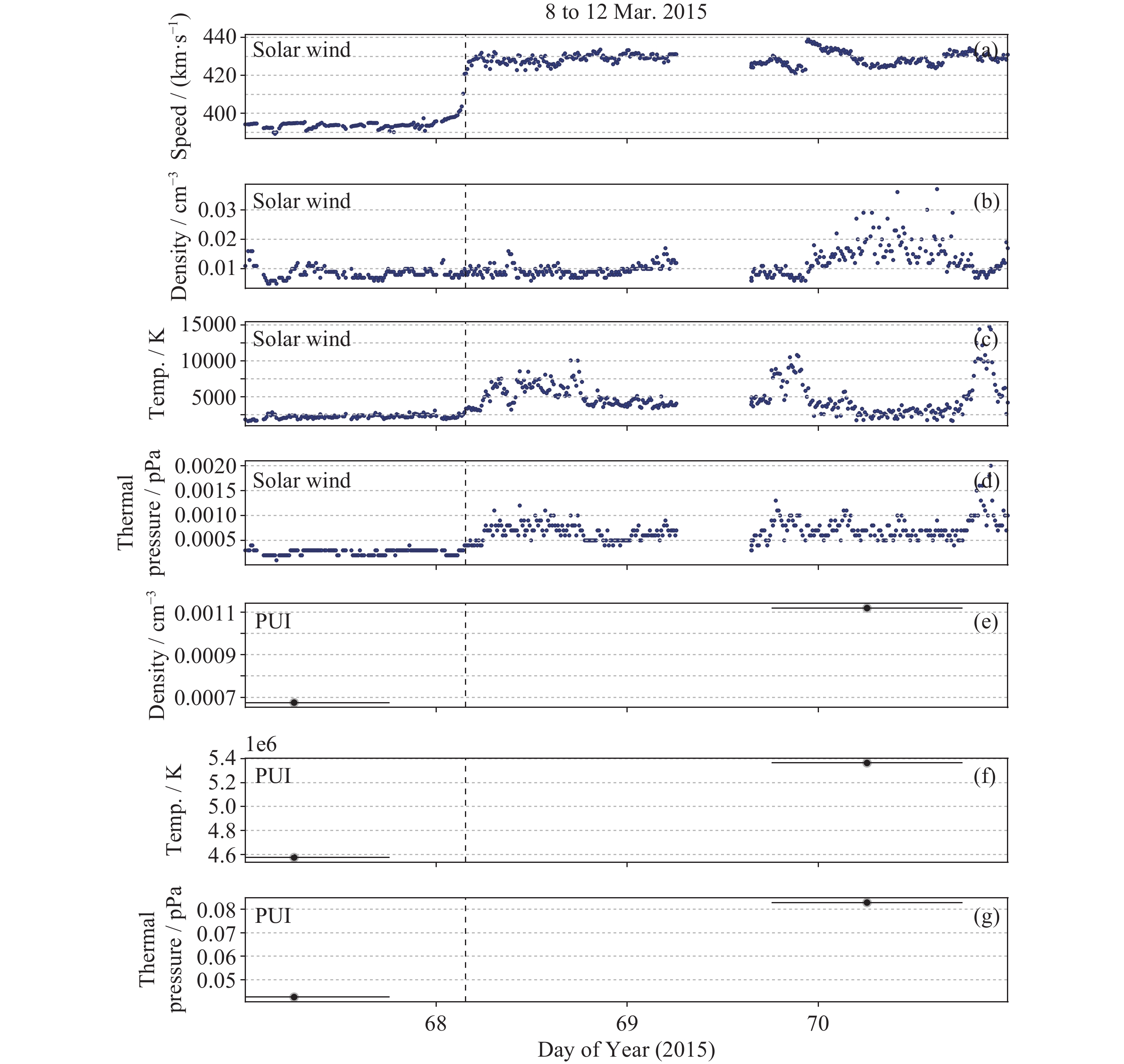
图 11 激波S4前后的等离子体参数 (虚线表示激波面的位置)
Figure 11. Plasma parameters upstream and downstream of shock S4 (dashed line indicates the position of the shock front)
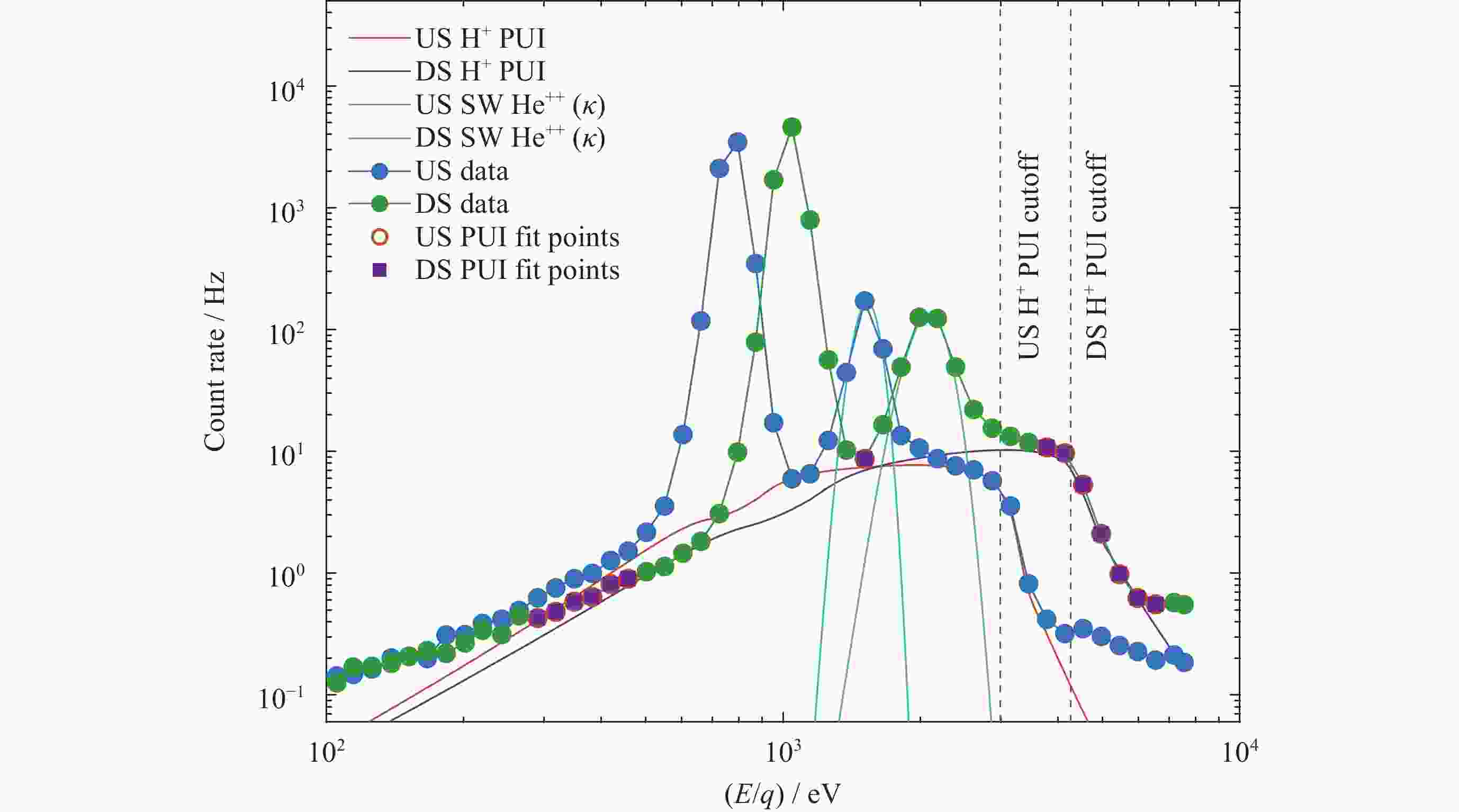
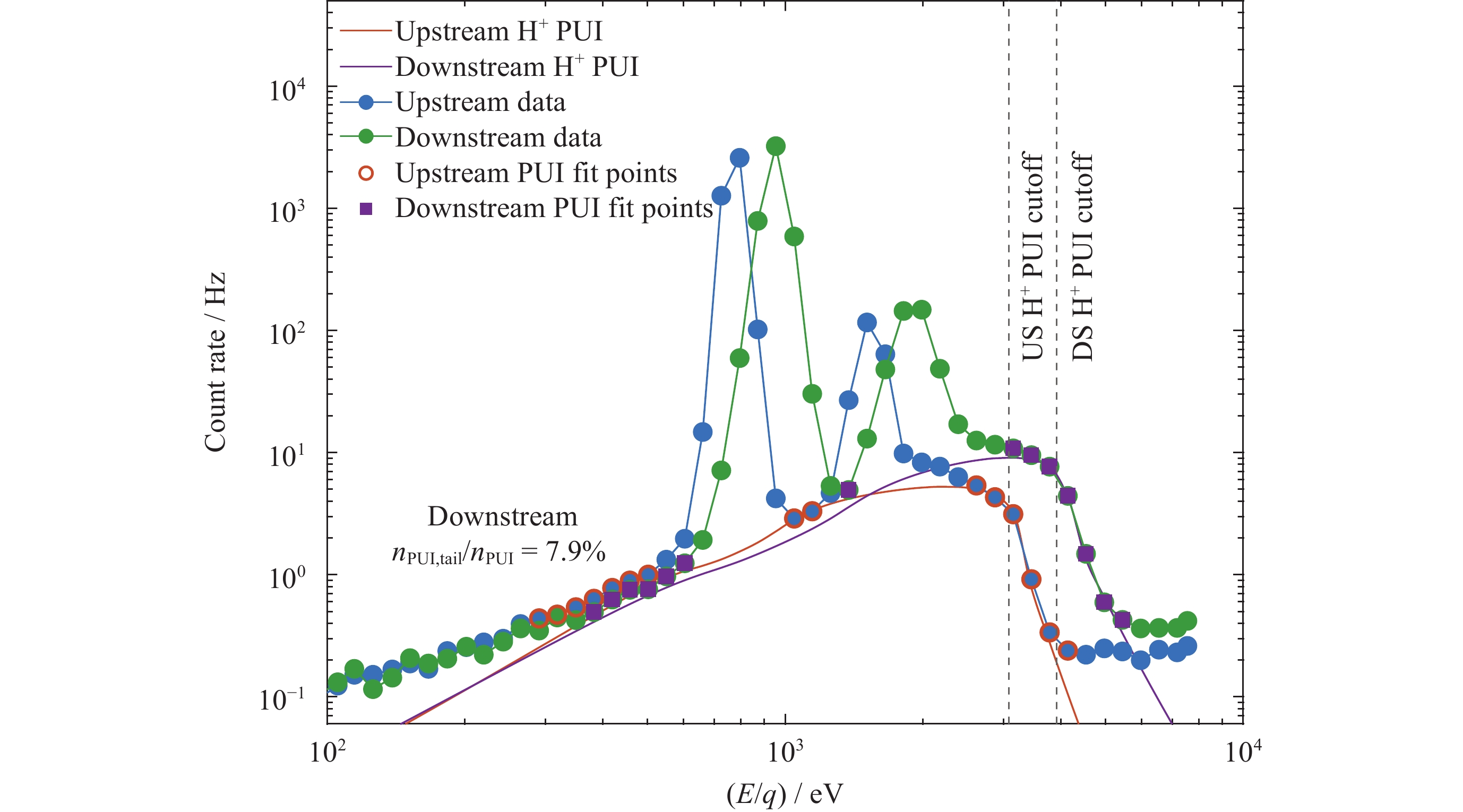
图 12 激波S4前后的离子计数率能谱(两条竖直虚线分别标明了上下游PUI-H+的截止能量)
Figure 12. Ion count rate spectra upstream and downstream of shock S4 (two vertical dashed lines indicate the cutoff energies of PUI-H+ in the upstream and downstream regions, respectively)
表 1 算例参数
Table 1. Simulation parameters
算例序号 湍动强度$ \varepsilon $ 上游阿尔芬马赫数$ {M}_{\mathrm{A}} $
(模拟参考系)1 0.00 10.00 2 0.25 10.00 3 0.50 10.00 4 0.50 1.50 5 0.50 2.75  下载: 导出CSV
表 2 典型事件参数
Table 2. Parameters of typical events
激波序号 位置 太阳风速度/
(km·s–1)SWI-H+
密度
(×10–3)/cm–3PUI-H+
密度
(×10–4)/cm–3PUI-H+
温度
(×106)/K磁场强度/
$ \text{nT} $压缩率$ {r}_{\mathrm{c}} $ 激波速度/
(km·s–1)上游阿尔芬
马赫数S1 上游 384.0 4.12 4.24 4.05 0.12 1.52 505.6 3.35 下游 425.6 4.56 6.43 5.78 0.18 S2 上游 364.5 10.14 7.36 3.85 0.11 1.52 463.0 4.59 下游 398.2 10.15 11.16 4.96 0.17 S3 上游 378.2 11.24 6.75 4.58 0.13 1.65 470.6 3.82 下游 414.6 11.15 11.19 5.37 0.21 S4 上游 389.4 2.69 4.63 3.91 0.12 1.92 519.5 2.98 下游 451.7 6.63 8.21 6.33 0.23 S5 上游 343.2 15.53 10.70 3.33 0.20 1.54 431.6 2.80 下游 374.2 26.62 16.44 3.74 0.31 S6 上游 373.3 14.82 8.09 3.22 0.13 2.94 486.2 5.34 下游 447.8 20.71 23.32 5.42 0.38
下载: 导出CSV
-
[1] RICHARDSON J D, BELCHER J W, GARCIA-GALINDO P, et al. Voyager 2 plasma observations of the heliopause and interstellar medium[J]. Nature Astronomy, 2019, 3(11): 1019-1023 doi: 10.1038/s41550-019-0929-2 [2] RICHARDSON J D, STONE E C. The solar wind in the outer heliosphere[J]. Space Science Reviews, 2009, 143(1): 7-20 doi: 10.1016/b978-0-08-040780-7.50049-x [3] VASYLIUNAS V M, SISCOE G L. On the flux and the energy spectrum of interstellar ions in the solar system[J]. Journal of Geophysical Research, 1976, 81(7): 1247-1252 doi: 10.1029/JA081i007p01247 [4] MCCOMAS D J, ZIRNSTEIN E J, BZOWSKI M, et al. Interstellar pickup ion observations to 38 au[J]. The Astrophysical Journal Supplement Series, 2017, 233(1): 8 doi: 10.3847/1538-4365/aa91d2 [5] MÖBIUS E, HOVESTADT D, KLECKER B, et al. Direct observation of He+ pick-up ions of interstellar origin in the solar wind[J]. Nature, 1985, 318(6045): 426-429 doi: 10.1038/318426a0 [6] ISENBERG P A. Evolution of interstellar pickup ions in the solar wind[J]. Journal of Geophysical Research: Space Physics, 1987, 92(A2): 1067-1073 doi: 10.1029/JA092iA02p01067 [7] GIACALONE J, JOKIPII J R. The transport of cosmic rays across a turbulent magnetic field[J]. The Astrophysical Journal, 1999, 520(1): 204-214 doi: 10.1086/307452 [8] LEE M A. The injection, acceleration, and dynamical influence of interstellar pickup ions at the solar wind termination shock[J]. Astrophysics and Space Science, 1998, 264(1): 497-508 doi: 10.1007/978-94-011-4203-8_39 [9] ZIRNSTEIN E J, HEERIKHUISEN J, FUNSTEN H O, et al. Local interstellar magnetic field determined from the interstellar boundary explorer ribbon[J]. The Astrophysical Journal Letters, 2016, 818(1): L18 doi: 10.3847/2041-8205/818/1/L18 [10] RICHARDSON J D, KASPER J C, WANG C, et al. Cool heliosheath plasma and deceleration of the upstream solar wind at the termination shock[J]. Nature, 2008, 454(7200): 63-66 doi: 10.1038/nature07024 [11] ZANK G P, PAULS H L, WILLIAMS L L, et al. Interaction of the solar wind with the local interstellar medium: a multifluid approach[J]. Journal of Geophysical Research: Space Physics, 1996, 101(A10): 21639-21655 doi: 10.1029/96JA02127 [12] DECKER R B, KRIMIGIS S M, ROELOF E C, et al. Mediation of the solar wind termination shock by non-thermal ions[J]. Nature, 2008, 454(7200): 67-70 doi: 10.1038/nature07030 [13] MATSUKIYO S, SCHOLER M. Simulations of pickup ion mediated quasi‐perpendicular shocks: implications for the heliospheric termination shock[J]. Journal of Geophysical Research: Space Physics, 2014, 119(4): 2388-2399 doi: 10.1002/2013JA019654 [14] FISK L A. The acceleration of energetic particles in the solar wind[C]//Proceedings of the Solar-Terrestrial Physics: Principles and Theoretical Foundations Based Upon the Proceedings of the Theory Institute Held at Boston College. Dordrecht: Springer, 1983: 231-241 [15] PESSES M E, JOKIPII J R, EICHLER D. Cosmic ray drift, shock wave acceleration and the anomalous component of cosmic rays[J]. Astrophysical Journal, 1981, 246(2): L85-L88 doi: 10.1086/183559 [16] MCCOMAS D J, SHRESTHA B L, SWACZYNA P, et al. First high-resolution observations of interstellar pickup ion mediated shocks in the outer heliosphere[J]. The Astrophysical Journal, 2022, 934(2): 147 doi: 10.3847/1538-4357/ac7956 [17] ZIRNSTEIN E J, MCCOMAS D J, KUMAR R, et al. In situ observations of preferential pickup ion heating at an interplanetary shock[J]. Physical Review Letters, 2018, 121(7): 075102 [18] MCCOMAS D J, SWACZYNA P, SZALAY J R, et al. Interstellar pickup ion observations halfway to the termination shock[J]. The Astrophysical Journal Supplement Series, 2021, 254(1): 19 doi: 10.3847/1538-4365/abee76 [19] SHRESTHA B L, ZIRNSTEIN E J, MCCOMAS D J, et al. Suprathermal H+ pickup ion tails in the outer heliosphere[J]. The Astrophysical Journal, 2024, 960(1): 35 doi: 10.3847/1538-4357/ad08b9 [20] ZIRNSTEIN E J, MCCOMAS D J, SHRESTHA B L, et al. Formation of H+ PUI tails downstream of distant interplanetary shocks[J]. The Astrophysical Journal, 2025, 986(2): 205 doi: 10.3847/1538-4357/addf45 [21] ZIRNSTEIN E J, MCCOMAS D J, SHRESTHA B L, et al. Predictions for new horizons’ SWAP measurements downstream of the heliospheric termination shock[J]. The Astrophysical Journal Letters, 2025, 987(1): L23 doi: 10.3847/2041-8213/ade670 [22] WANG W N, HE J S, DUAN D, et al. Spectral evolution of pickup ions across interplanetary shocks in the outer heliosphere: observational constraints and transport simulations[J]. The Astrophysical Journal Letters, 2025, 988(2): L66 doi: 10.3847/2041-8213/adeb6f [23] GIACALONE J, NAKANOTANI M, ZANK G P, et al. Hybrid simulations of interstellar pickup protons accelerated at the solar-wind termination shock at multiple locations[J]. The Astrophysical Journal, 2021, 911(1): 27 doi: 10.3847/1538-4357/abe93a [24] GIACALONE J, KORNBLEUTH M, OPHER M, et al. Hybrid simulations of interstellar pickup ions at the solar wind termination shock revisited[J]. The Astrophysical Journal, 2025, 980(1): 29 doi: 10.3847/1538-4357/ada89c [25] ZANK G P, ZHAO L L, ADHIKARI L, et al. Turbulence transport in the solar corona: theory, modeling, and Parker Solar Probe[J]. Physics of Plasmas, 2021, 28(8): 080501 doi: 10.1063/5.0055692 [26] MCCOMAS D, ALLEGRINI F, BAGENAL F, et al. The Solar Wind Around Pluto (SWAP) instrument aboard New Horizons[J]. Space Science Reviews, 2008, 140(1): 261-313 doi: 10.1007/978-0-387-89518-5_11 [27] ELLIOTT H A, MCCOMAS D J, VALEK P, et al. The new horizons Solar Wind Around Pluto (SWAP) observations of the solar wind from 11-33 au[J]. The Astrophysical Journal Supplement Series, 2016, 223(2): 19 doi: 10.3847/0067-0049/223/2/19 [28] CHEN J H, BOCHSLER P, MÖBIUS E, et al. Possible modification of the cooling index of interstellar helium pickup ions by electron impact ionization in the inner heliosphere[J]. Journal of Geophysical Research: Space Physics, 2014, 119(9): 7142-7150 doi: 10.1002/2014JA020357 [29] ZIRNSTEIN E J, MÖBIUS E, ZHANG M, et al. In situ observations of interstellar pickup ions from 1 au to the outer heliosphere[J]. Space Science Reviews, 2022, 218(4): 28 [30] RANDOL B M, MCCOMAS D J, SCHWADRON N A. Interstellar pick-up ions observed between 11 and 22 AU by New Horizons[J]. The Astrophysical Journal, 2013, 768(2): 120 doi: 10.1088/0004-637X/768/2/120 [31] WINSKE D, QUEST K B. Magnetic field and density fluctuations at perpendicular supercritical collisionless shocks[J]. Journal of Geophysical Research: Space Physics, 1988, 93(A9): 9681-9693 doi: 10.1029/JA093iA09p09681 [32] GUO F, GIACALONE J. The acceleration of thermal protons at parallel collisionless shocks: three-dimensional hybrid simulations[J]. The Astrophysical Journal, 2013, 773(2): 158 doi: 10.1088/0004-637X/773/2/158 [33] ZHAO L L, ZANK G P, ADHIKARI L. Generation mechanisms for low-energy interstellar pickup ions[J]. The Astrophysical Journal, 2019, 879(1): 32 doi: 10.3847/1538-4357/ab2381 [34] SHRESTHA B L, MCCOMAS D J, ZIRNSTEIN E J, et al. High-resolution observations of pickup-ion-mediated shocks to 60 au[J]. The Astrophysical Journal, 2025, 984(1): 11 doi: 10.3847/1538-4357/adc0a1 [35] LEMBÉGE B, YANG Z W, ZANK G P. Energy power spectra measured at an interplanetary shock by the New Horizon’s SWAP experiment: 1D full particle simulations versus observations[J]. The Astrophysical Journal, 2020, 890(1): 48 doi: 10.3847/1538-4357/ab65c5 [36] MATSUKIYO S, MATSUMOTO Y. Injection process of pickup ion acceleration at an oblique heliospheric termination shock[J]. The Astrophysical Journal Letters, 2024, 970(2): L37 doi: 10.3847/2041-8213/ad5d73 [37] MCCOMAS D J, CHRISTIAN E R, SCHWADRON N A, et al. Interstellar Mapping and Acceleration Probe (IMAP): a new NASA mission[J]. Space Science Reviews, 2018, 214(8): 116 doi: 10.1007/s11214-018-0550-1 [38] LU Q M, WANG H Y, WANG X Y, et al. Turbulence-driven magnetic reconnection in the magnetosheath downstream of a quasi-parallel shock: a three-dimensional global hybrid simulation[J]. Geophysical Research Letters, 2020, 47(1): e2019GL085661 doi: 10.1029/2019GL085661 [39] LIU T Z, LU S, TURNER D L, et al. Magnetospheric Multiscale (MMS) observations of magnetic reconnection in foreshock transients[J]. Journal of Geophysical Research: Space Physics, 2020, 125(4): e2020JA027822 doi: 10.1029/2020JA027822 [40] DECKER R B, KRIMIGIS S M, ROELOF E C, et al. Voyager 1 in the foreshock, termination shock, and heliosheath[J]. Science, 2005, 309(5743): 2020-2024 doi: 10.1126/science.1117569 [41] SWACZYNA P, MCCOMAS D J, ZIRNSTEIN E J. He+ ions comoving with the solar wind in the outer heliosphere[J]. The Astrophysical Journal, 2019, 875(1): 36 doi: 10.3847/1538-4357/ab1081 [42] LEMBÈGE B, YANG Z W. Physical roles of interstellar-origin pickup ions at the heliospheric termination shock: impact on the shock front microstructures and nonstationarity[J]. The Astrophysical Journal, 2016, 827(1): 73 doi: 10.3847/0004-637X/827/1/73 [43] LEMBÈGE B, YANG Z W. Physical roles of interstellar-origin pickup ions at heliospheric termination shock. II. Impact of the front nonstationary on the energy partition and particle velocity distribution[J]. The Astrophysical Journal, 2018, 860(1): 84 doi: 10.3847/1538-4357/aabe85 [44] ZANK G P, HEERIKHUISEN J, POGORELOV N V, et al. Microstructure of the heliospheric termination shock: implications for energetic neutral atom observations[J]. The Astrophysical Journal, 2010, 708(2): 1092-1106 doi: 10.1088/0004-637X/708/2/1092 -
-

 下载:
下载:

计量
- 文章访问数: 1377
- HTML全文浏览量: 559
- PDF下载量: 101
-
被引次数:
0(来源:Crossref)
0(来源:其他)

