


Progress on SVOM Satellite Development
doi: 10.11728/cjss2026.04.2024-yg29 cstr: 32142.14.cjss.2024-yg29
-
Abstract: SVOM (Space-based multi-band Variable Object Monitor) is a Chinese-French space mission mainly designed to study Gamma-Ray Bursts. The satellite has four instruments to detect and localize the prompt GRB emission and measure the evolution of the afterglow in the visible band and in soft X-rays, and a VHF communication system enabling the fast transmission of SVOM alerts to the ground. The ground segment includes an array of wide-angle cameras and two follow-up telescopes. It was launched into an orbit of ~635 km on 22 June 2024, with three years of nominal operations and two years extension. After the first two years in orbit, SVOM has detected 318 gamma-ray bursts, including 270 detected by GRM and 107 detected and localized by ECLAIRs, and is revealing a population of X-ray–rich bursts that had been only partially uncovered in the early 2000s by previous missions. GRB 250314A, detected by SVOM, is a burst from the early Universe with a redshift of approximately 7.3, which currently ranks as the third most distant gamma-ray burst ever spectroscopically confirmed.
-
Key words:
- Space astronomy /
- Gamma-ray burst
-
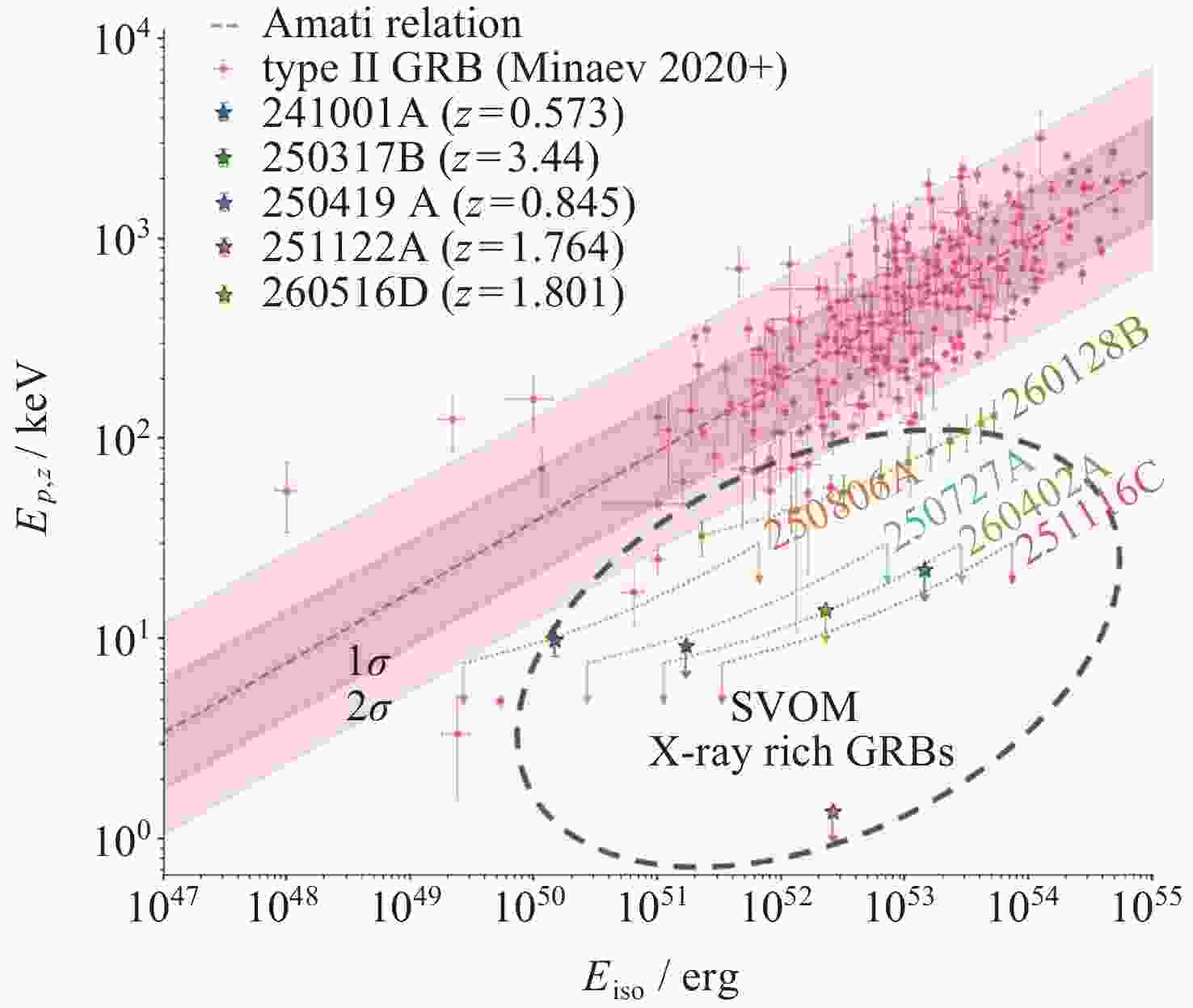
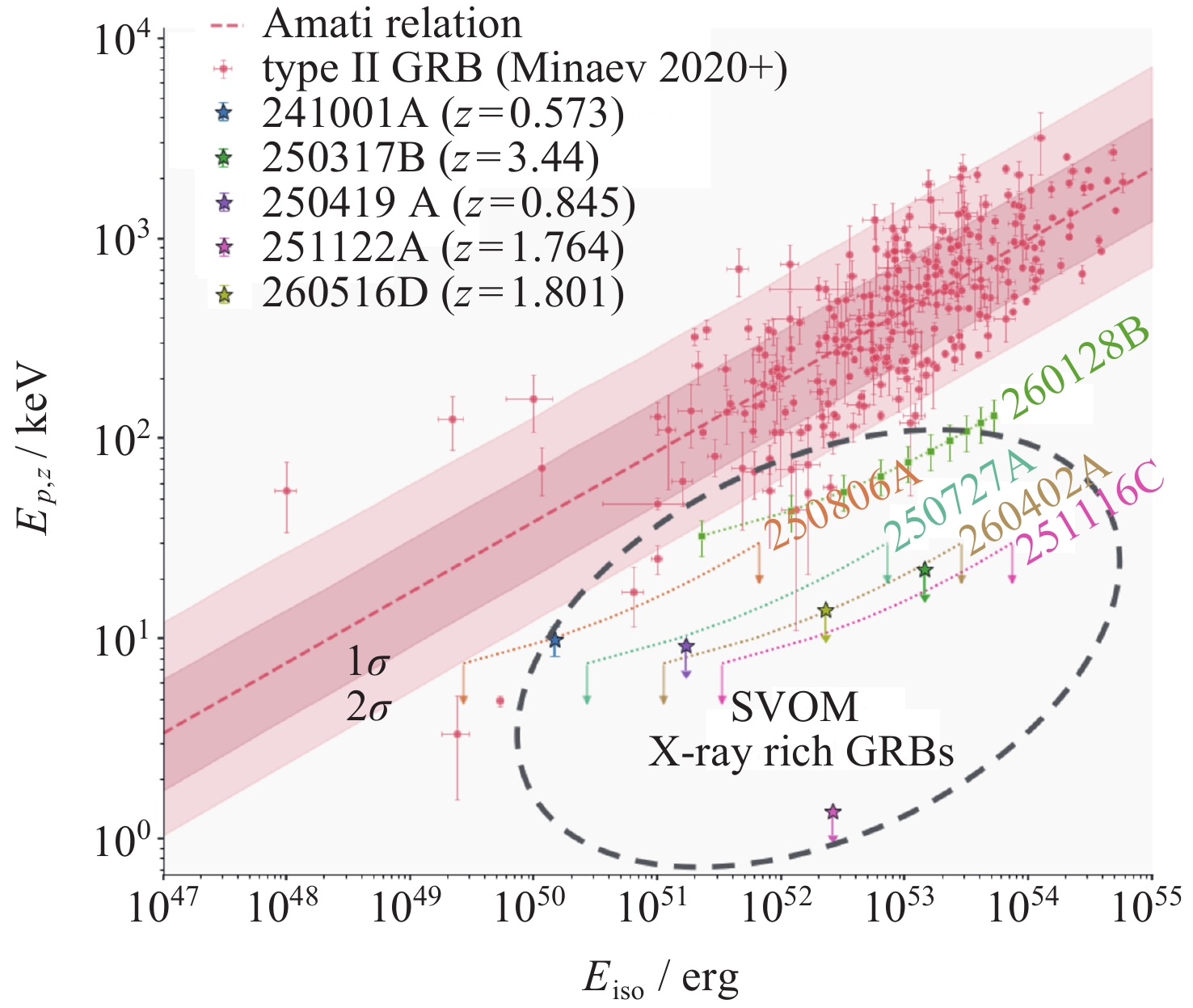
Figure 2. Distribution of the characteristic photon energy emitted by more than 200 long gamma-ray bursts detected by previous missions (in red), as a function of their total radiated energy. The higher the total radiated energy, the more energetic the emitted photons (Amati relation). The X-ray–rich bursts detected by SVOM deviate from this correlation. Stars indicate events with known redshift; dashed tracks correspond to the z = 0.5–5 interval when the redshift is unknown (Credit: SVOM Collaboration)
-
[1] WEI J, CORDIER B, ANTIER S, et al. The deep and transient universe in the SVOM era: new challenges and opportunities–scientific prospects of the SVOM mission [J]. arXiv161006892W, 2016 [2] The mission : CORDIER B, WEI J, ZHANG S, et al. The SVOM mission, its profile and its system arXiv: 2604.24257, 2026 [3] GEHRELS N, RAMIREZ-RUIZ E, FOX D B. Gamma-ray bursts in the swift era[J]. Ann. Re. Astron. Astrophys., 2009, 47(1): 567-617 doi: 10.1146/annurev.astro.46.060407.145147 [4] GOLDSTEIN A, VERES P, BURNS E, et al. An ordinary short gamma-ray burst with extraordinary implications: fermi-GBM detection of GRB 170817A[J]. Astrophys. J. Lett., 2017, 848(2): 14 doi: 10.3847/2041-8213/aa8f41 [5] ECLAIRs: GODET O, ATTEIA J-L, SCHANNE S, et al. ECLAIRs: the SVOM high-energy transient trigger camera, arXiv: 2604.24249, 2026 [6] GRM: SUN J, DONG W, HE J, et al. The Gamma-Ray Monitor onboard the SVOM satellite, arXiv: 2604.18985, 2026 [7] MXT: GOTZ D, CREPALDI S, DOUMAYROU E, et al. , The Microchannel X-ray Telescope on board the SVOM mission: in-flight scientific performance, arXiv: 2604.24246, 2026 [8] VT: QIU Y, XIN L, DENG J, et al. SVOM/VT: Instrument Overview, Science Objectives, and First-Year Performance, arXiv: 2604.24248, 2026 [9] C-GFT: WU C, KANG Z, LU X, et al. SVOM/C-GFT: Instrumentation and Performances on the SVOM Alerts, arXiv: 2604.24272, 2026 [10] F-GFT: BASA S, LEE W, WATSON A, et al. COLIBRI (SVOM/FM-GFT): Instrumentation and Performances on the SVOM Alerts, arXiv: 2604.24259, 2026 [11] GWAC: XIN L, HUANG L, CAI H, et al. Overview of Ground-based Wide-Angle Cameras array, arXiv: 2604.24260, 2026 [12] VHF network: CORDIER B, JANNIN L, LAFABRIE Ph, et al. The VHF alert network of the SVOM mission, arXiv: 2604.24263, 2026 [13] CORDIER B, WEI J, TANVIR N, et al. SVOM GRB 250314A at z ≃ 7.3: An exploding star in the era of re-ionization[J]. Astronomy & Astrophysics, 2025, 704: L7 doi: 10.1051/0004-6361/202556580 [14] LEVAN A, SCHNEIDER B, et al. JWST reveals a supernova following a gamma-ray burst at z ≃ 7.3[J]. Astronomy & Astrophysics, 2025, 704: L8 doi: 10.1051/0004-6361/202556581 -
-

 下载:
下载:

图(2)
计量
- 文章访问数: 166
- HTML全文浏览量: 105
- PDF下载量: 1
-
被引次数:
0(来源:Crossref)
0(来源:其他)

