


中国扇区夜间电离层中尺度行扰分布特征及与中纬度扩展F的关联
doi: 10.11728/cjss2026.05.2025-0177 cstr: 32142.14.cjss.2025-0177
-
 李科 男, 2000年1月出生于山东省济南市, 现为北京大学地球与空间科学学院博士研究生, 主要研究方向为电离层物理, 目前开展中低纬电离层不均匀结构的演化特征和物理机制等研究. E-mail: likespace@stu.pku.edu.cn
 -
 张东和 男, 北京大学地球与空间科学学院教授, 博士生导师, 主要从事空间物理、空间天气、电离层物理的教学和科研工作, 主要研究方向为基于GNSS数据的电离层TEC和闪烁数据处理方法、耀斑的电离层效应、电离层闪烁形态与效应、平流层突然增温与电离层全球响应等. E-mail: zhangdh@pku.edu.cn
作者简介:
通讯作者:
Distribution Characteristics of Nighttime MSTIDs over China and Their Connections with Mid-latitude Spread-F
-
摘要: 电离层中尺度行扰(MSTIDs)与中纬度扩展F(MSF)是中纬度电离层F层最常见的两个不同尺度的现象. 利用CMONOC的250余个GNSS(Global Navigation Satellite System)接收站及4个CRIRP(China Research Institute of Radiowave Propagation)测高仪台站数据, 对2014-2023年夏季夜间中MSTIDs(Medium-Scale Traveling Ionospheric Disturbances)活动的分布规律以及与扩展F现象的关联进行了统计分析. 结果揭示了中国扇区MSTIDs的太阳活动和季节依赖性——太阳活动低年发生率显著高于高年, 且主要活跃于夏季夜间; 空间分布上, MSTIDs存在两个机制不同的发生率峰值区域: 东侧峰值符合Perkins不稳定性驱动特征, 西侧峰值则与青藏高原东南侧区域频发的重力波活动密切相关. 进一步研究发现, MSTIDs与FSF(Frequency Spread-F)倾向于在同一夜晚出现, 但二者存在稳定的统计时间先后关系, 即MSTIDs先于FSF发生, 该时序特征为揭示MSTIDs对FSF的潜在激发作用提供了关键观测依据.Abstract: This study investigates the spatiotemporal characteristics of periodic Total Electron Content (TEC) disturbances associated with Medium-Scale Traveling Ionospheric Disturbances (MSTIDs) over the Chinese sector and examines their statistical relationship with Mid-latitude Spread-F (MSF). MSTIDs and MSF are two common ionospheric phenomena occurring at different spatial and temporal scales in the midlatitude F region, and previous studies have suggested that they may be dynamically connected. To clarify this relationship, we use observations from more than 250 Global Navigation Satellite System (GNSS) stations of the Crustal Movement Observation Network of China (CMONOC), together with ionogram data from four ionosonde stations operated by the China Research Institute of Radiowave Propagation (CRIRP). A statistical analysis is conducted to characterize the occurrence, temporal variability, and spatial distribution of nighttime MSTIDs from 2014 to 2023, with particular attention to summer conditions and their association with spread-F events. The results reveal clear solar-cycle and seasonal dependences of MSTID activity in the Chinese sector. Their occurrence rates are substantially higher during solar minimum years than during solar maximum years, and the disturbances occur most frequently during summer nights. Spatially, two distinct regions of enhanced MSTID occurrence are identified, suggesting the influence of different generation mechanisms. The characteristics presented by the eastern peak are basically consistent with those driven or amplified by the MSTIDs associated with the Perkins instability and its related electrodynamic processes. In contrast, the western peak is closely associated with frequent atmospheric gravity wave activity southeast of the Tibetan Plateau, where complex terrain and active convection may provide strong wave sources. Further analysis shows that MSTIDs and MSF frequently occur on the same night and exhibit a relatively stable temporal sequence, with MSTID activity generally preceding the onset of MSF. This chronological relationship suggests that MSTIDs may create favorable conditions for spread-F development by perturbing plasma density gradients, modifying the bottomside F layer, or enhancing polarization electric fields. Although the statistical results do not by themselves establish direct causality, they provide important observational evidence supporting a possible triggering or preconditioning role of MSTIDs in the generation of MSF. These findings improve our understanding of multiscale coupling processes in the midlatitude ionosphere.
-
Key words:
- MSTIDs /
- Spread-F /
- Mid-latitude ionosphere /
- Ionospheric disturbances
-
图 2 不同世界时下的扰动分布
Figure 2. Disturbance distribution maps in geographic coordinates at different UT
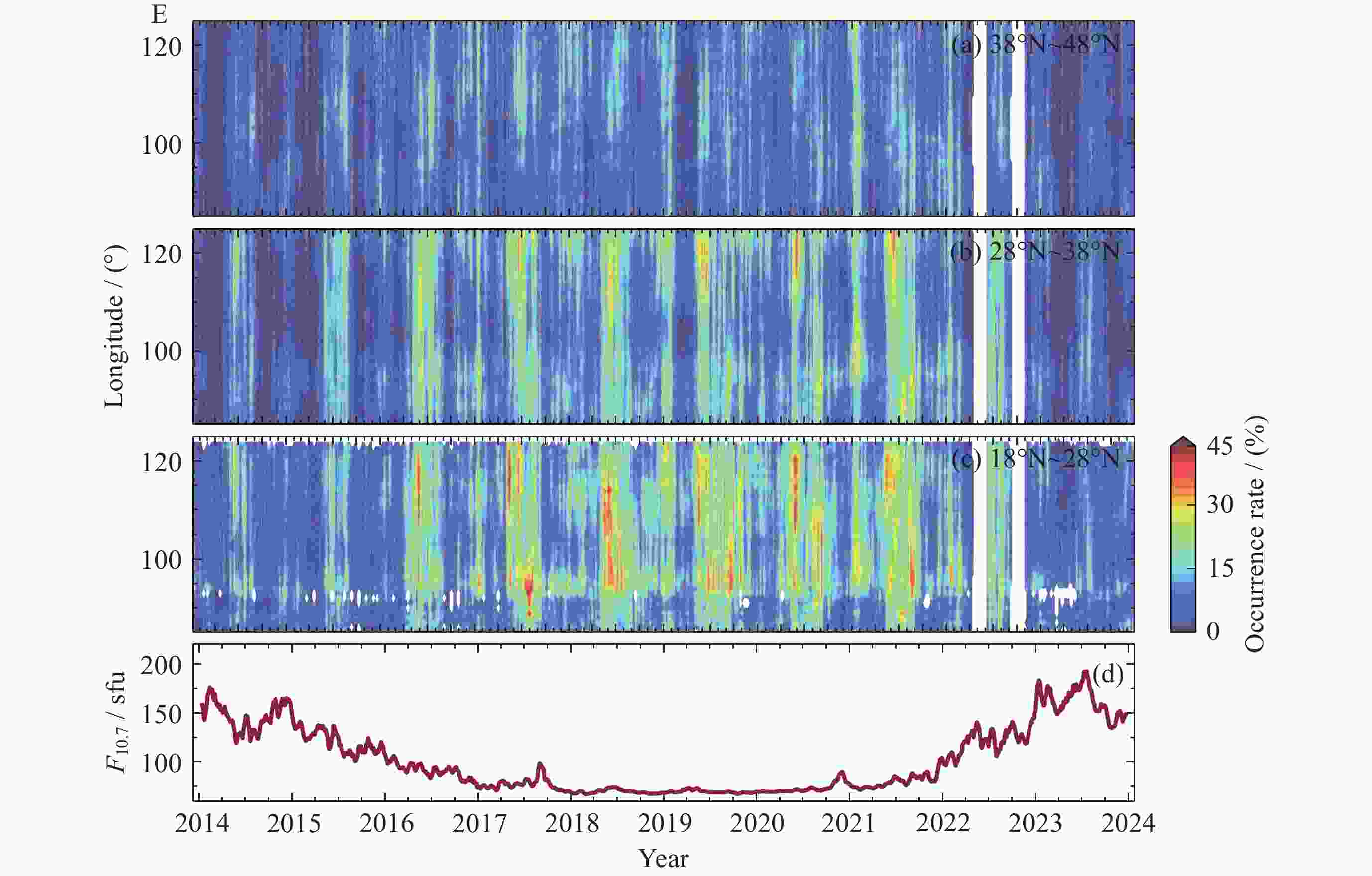
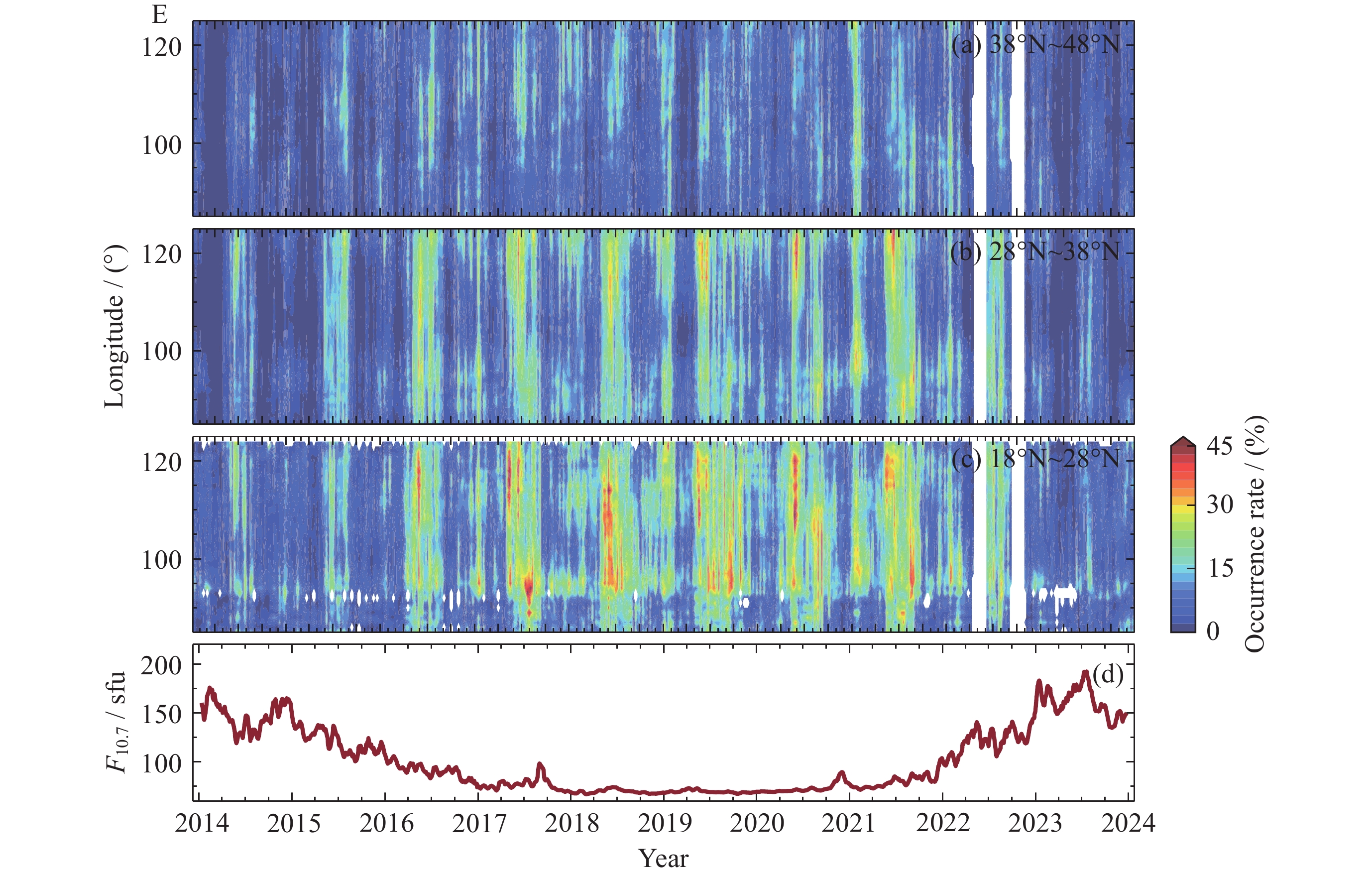
图 3 2014-2023年间中国扇区不同纬度带下与MSTIDs周期性扰动发生率的经度–时间分布以及 27天平均F10.7指数随时间的变化曲线
Figure 3. Longitude-time distribution of the occurrence rate of periodic MSTID disturbances across different latitudinal bands in China from 2014 to 2023, and temporal variations of the 27-day averaged F10.7 index
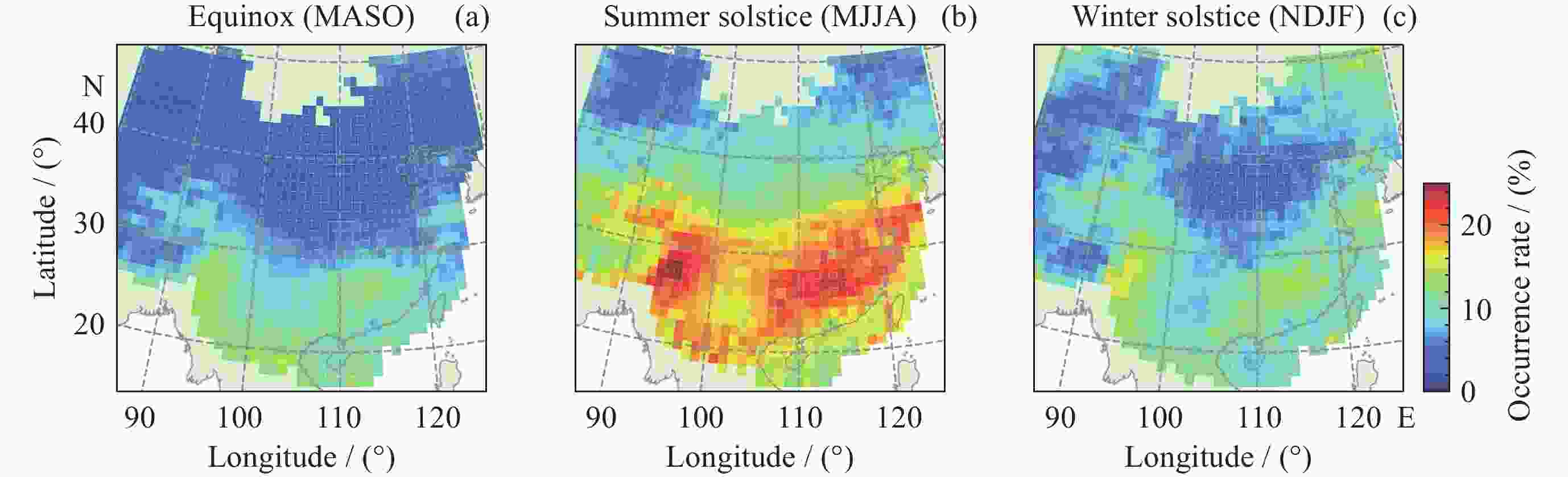
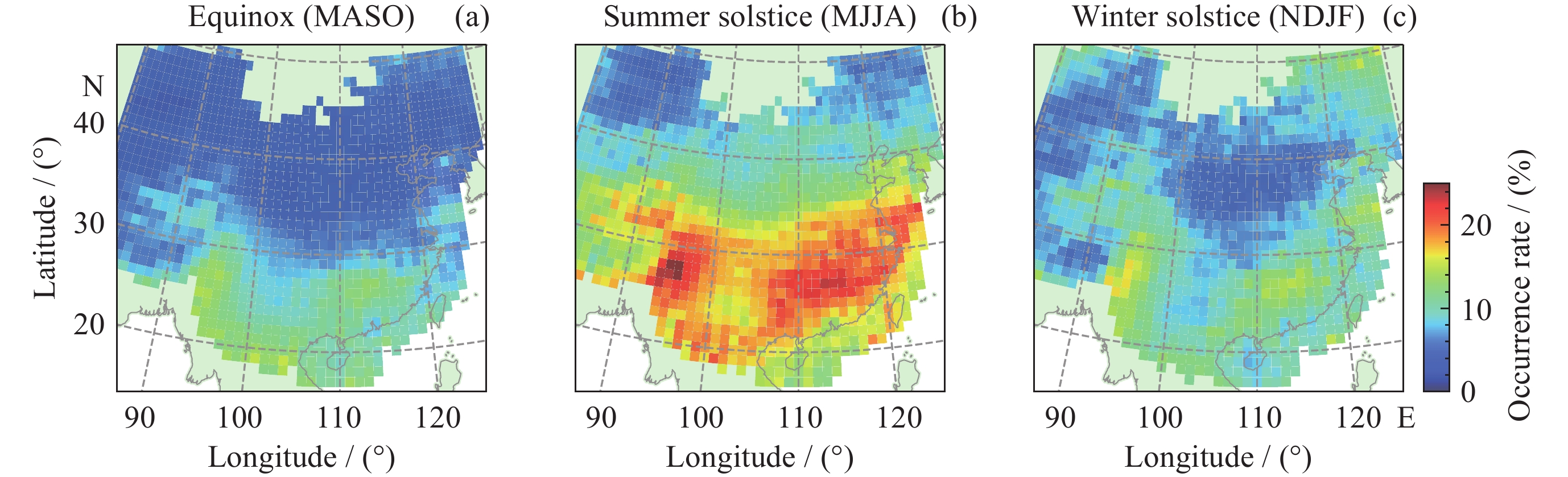
图 4 不同季节下中国扇区夜间MSTID周期性扰动发生率的地理空间分布
Figure 4. Geospatial distribution of the occurrence rate of nighttime MSTID periodic disturbances in the Chinese sector across different seasons
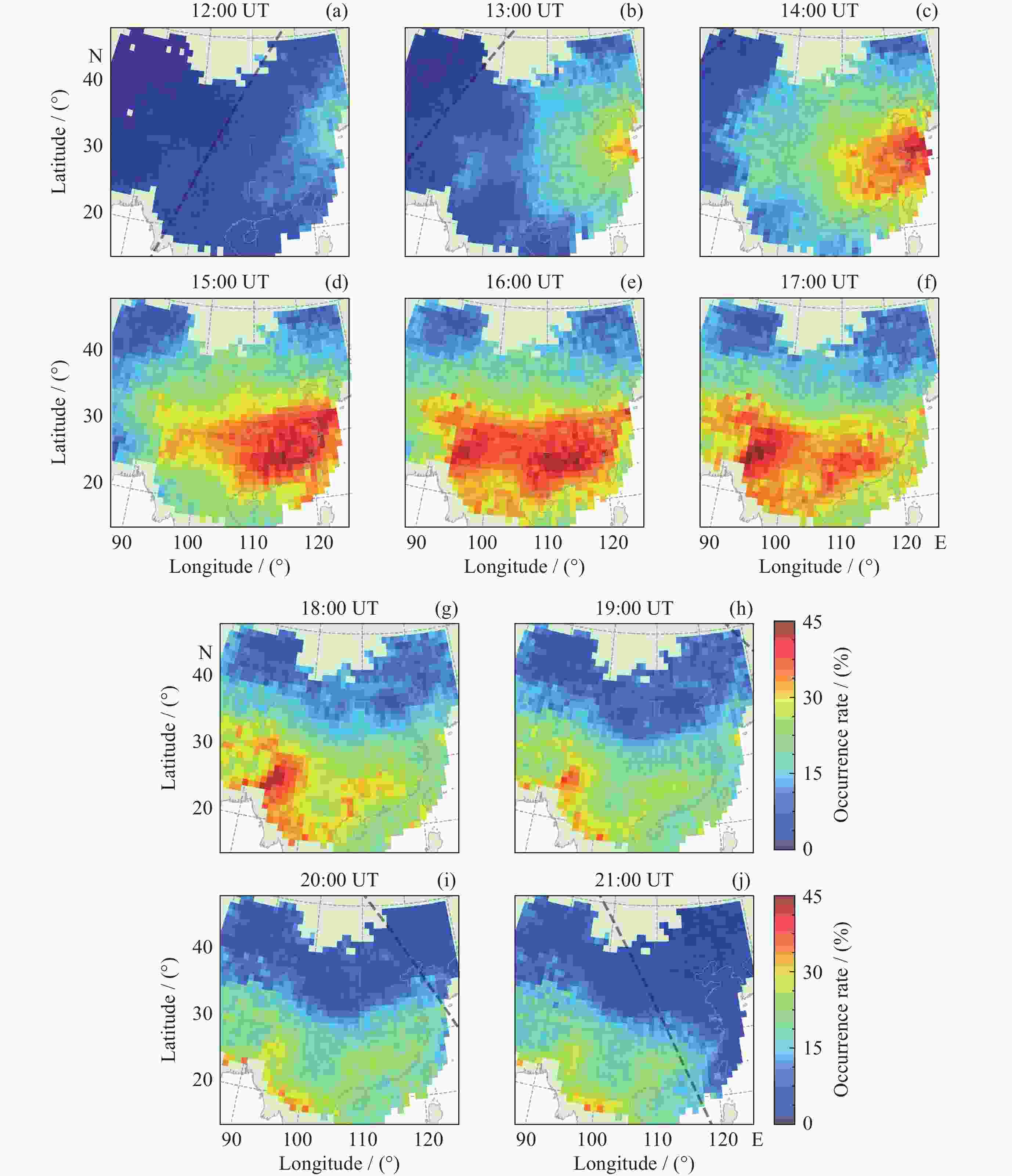
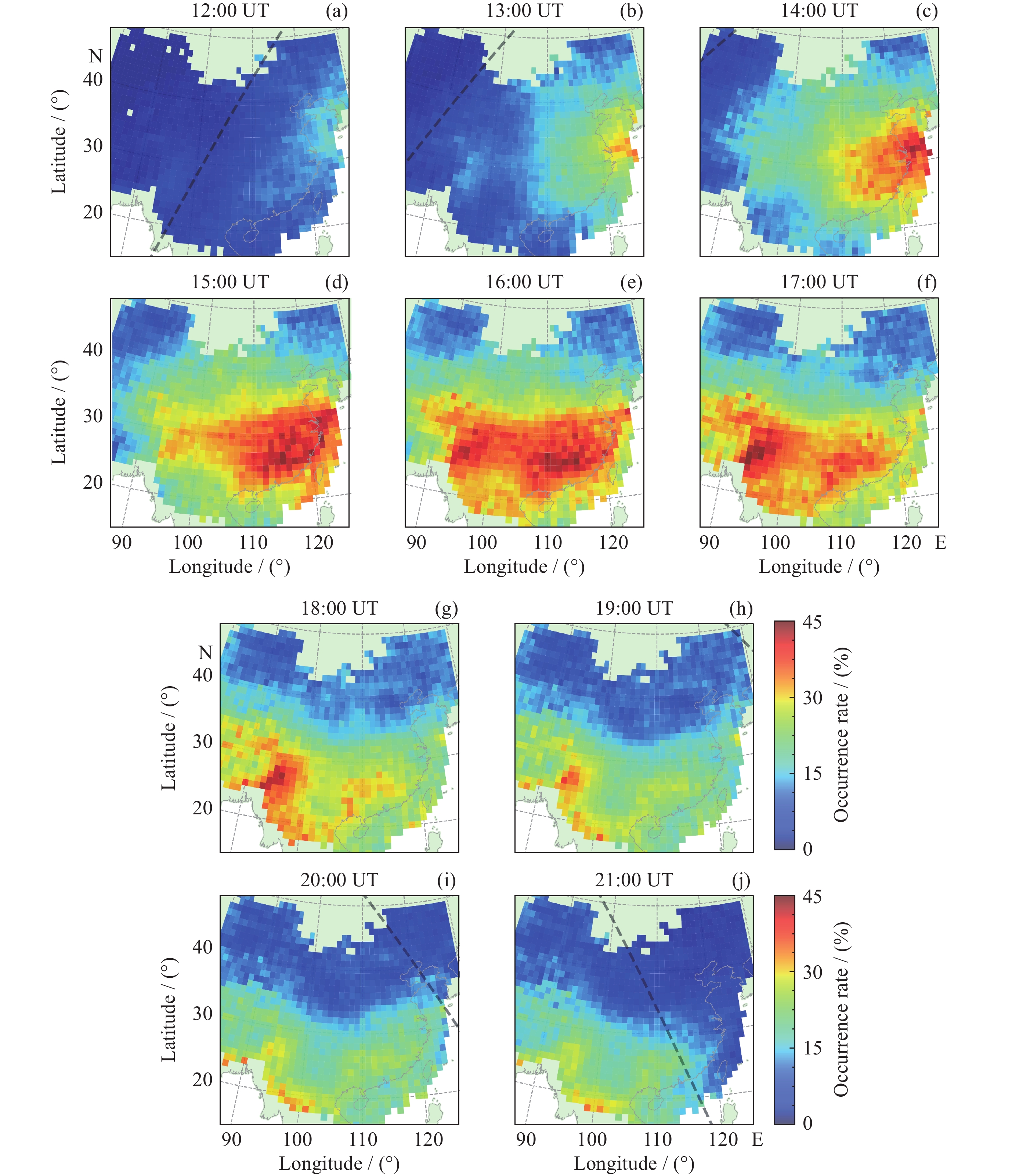
图 5 夏季MSTIDs周期性扰动发生率在不同世界时下的地理空间分布
Figure 5. Geospatial distribution of the occurrence rate of periodic disturbances in MSTIDs with respect to different Universal Time (UT) during summer
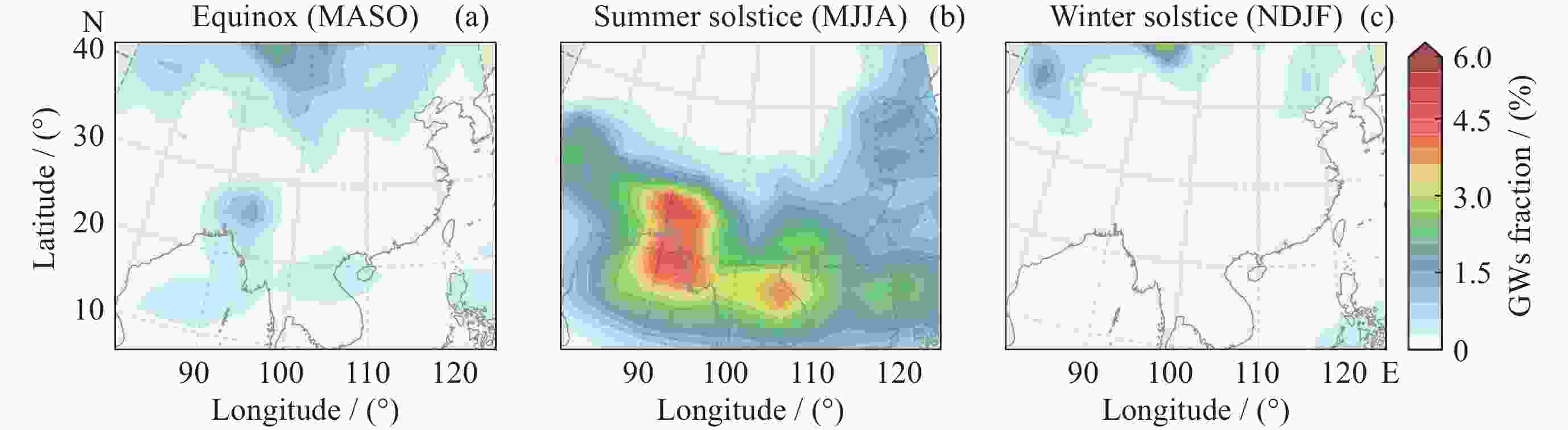
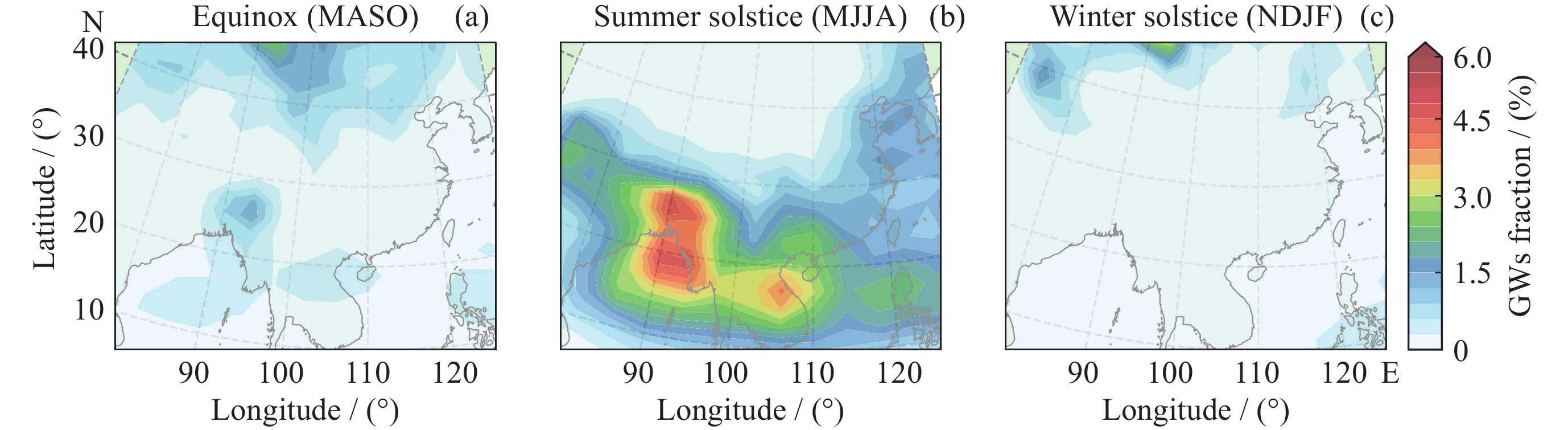
图 6 2014-2023年间不同季节的夜间亮温扰动数据提取的平流层重力波成分地理空间分布
Figure 6. Geospatial distribution of stratospheric GWs fraction extracted from nighttime brightness temperature perturbation data of AIRs across different seasons from 2014 to 2023
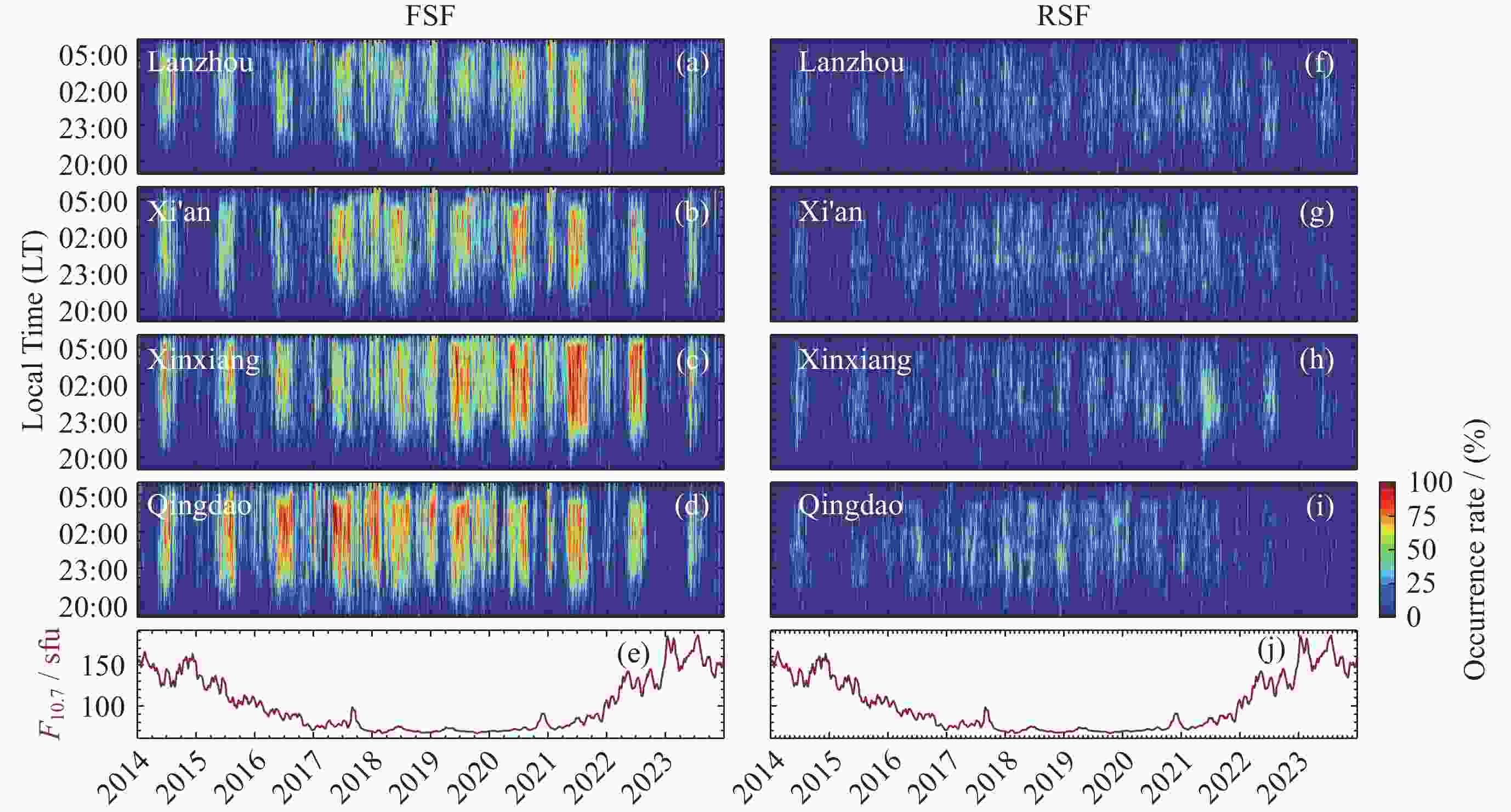
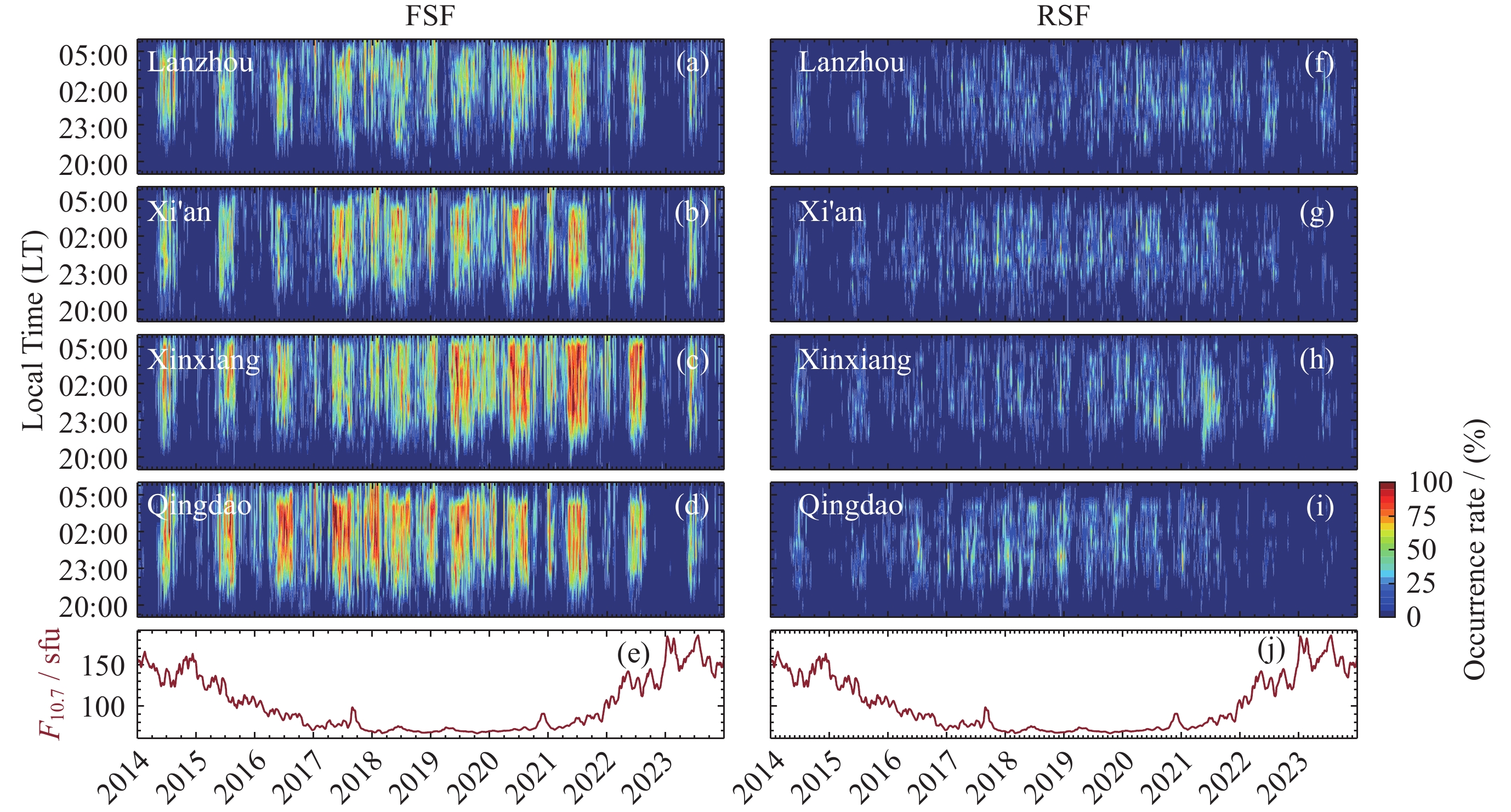
图 7 FSF和RSF发生率随时间的变化以及27天平均F10.7指数随时间的变化
Figure 7. Temporal variation in the occurrence rate of FSF and of RSF at four ionosonde stations from 2014 to 2023, and temporal variation of the 27-day average F10.7 index
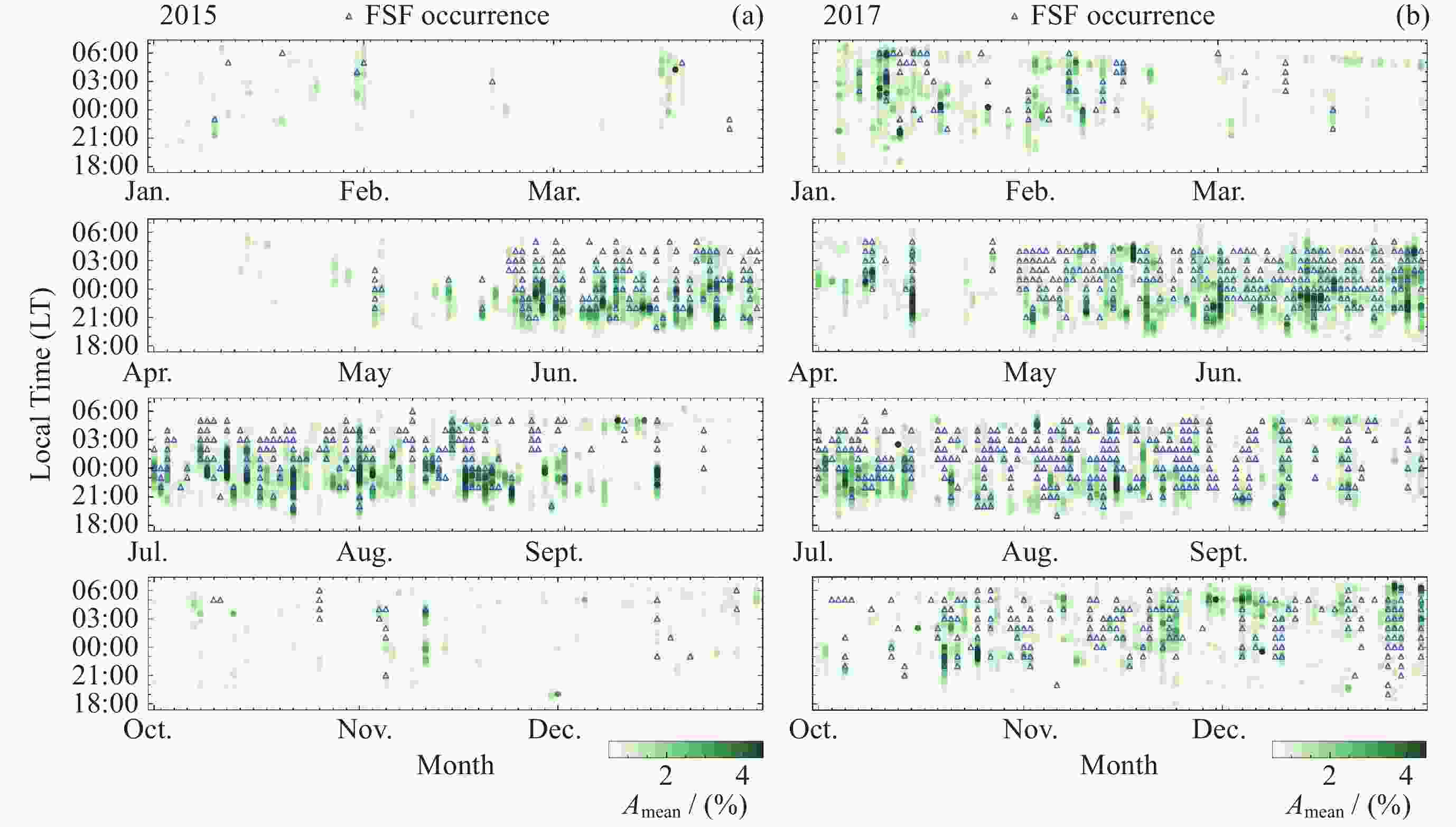
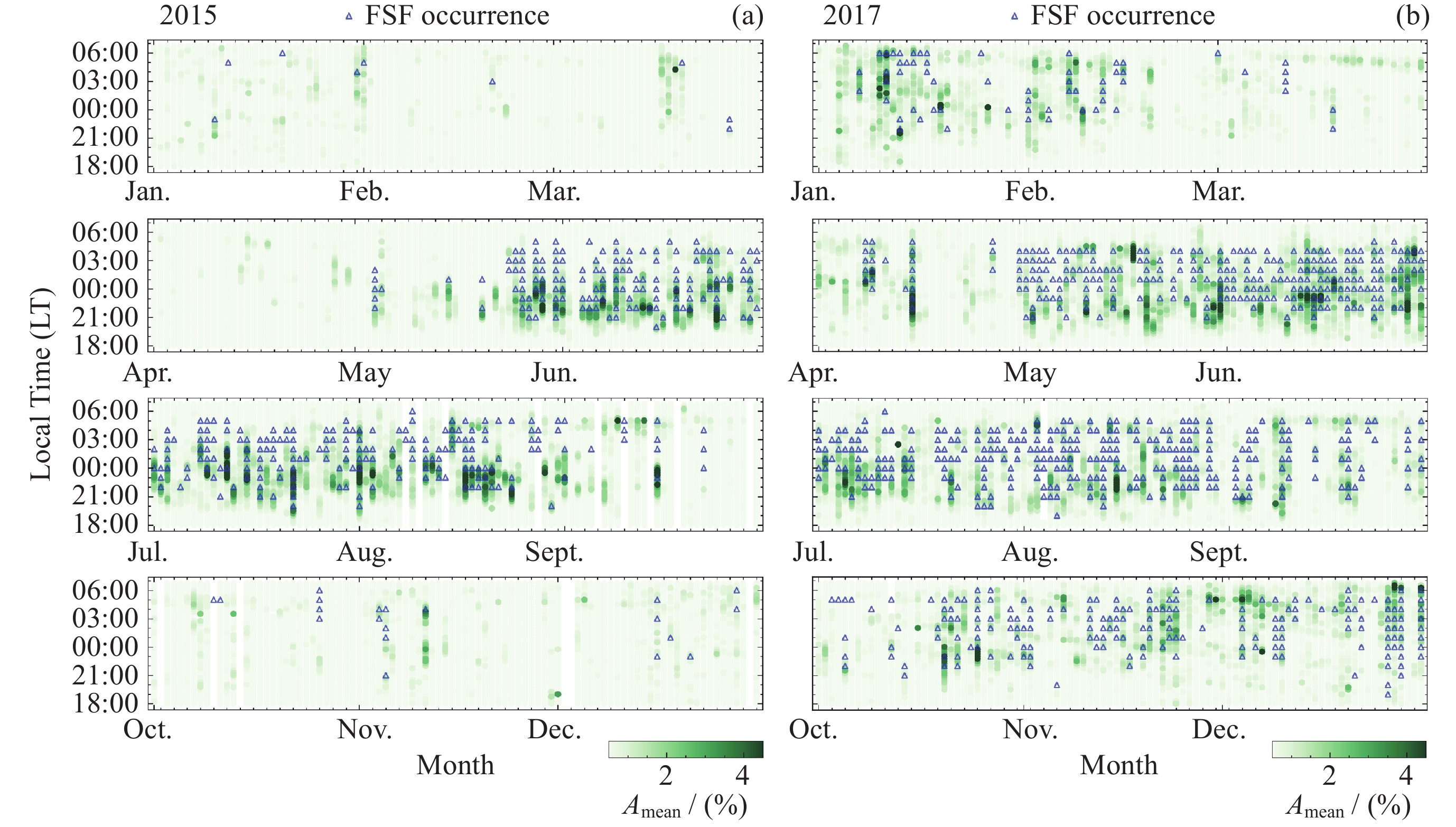
图 8 西安站的MSTIDs活动水平$ {A}_{\text{mean}} $与FSF发生时间分布
Figure 8. Time distribution of MSTIDs activity level magnitude $ {A}_{\text{mean}} $ and FSF occurrence in Xi’an
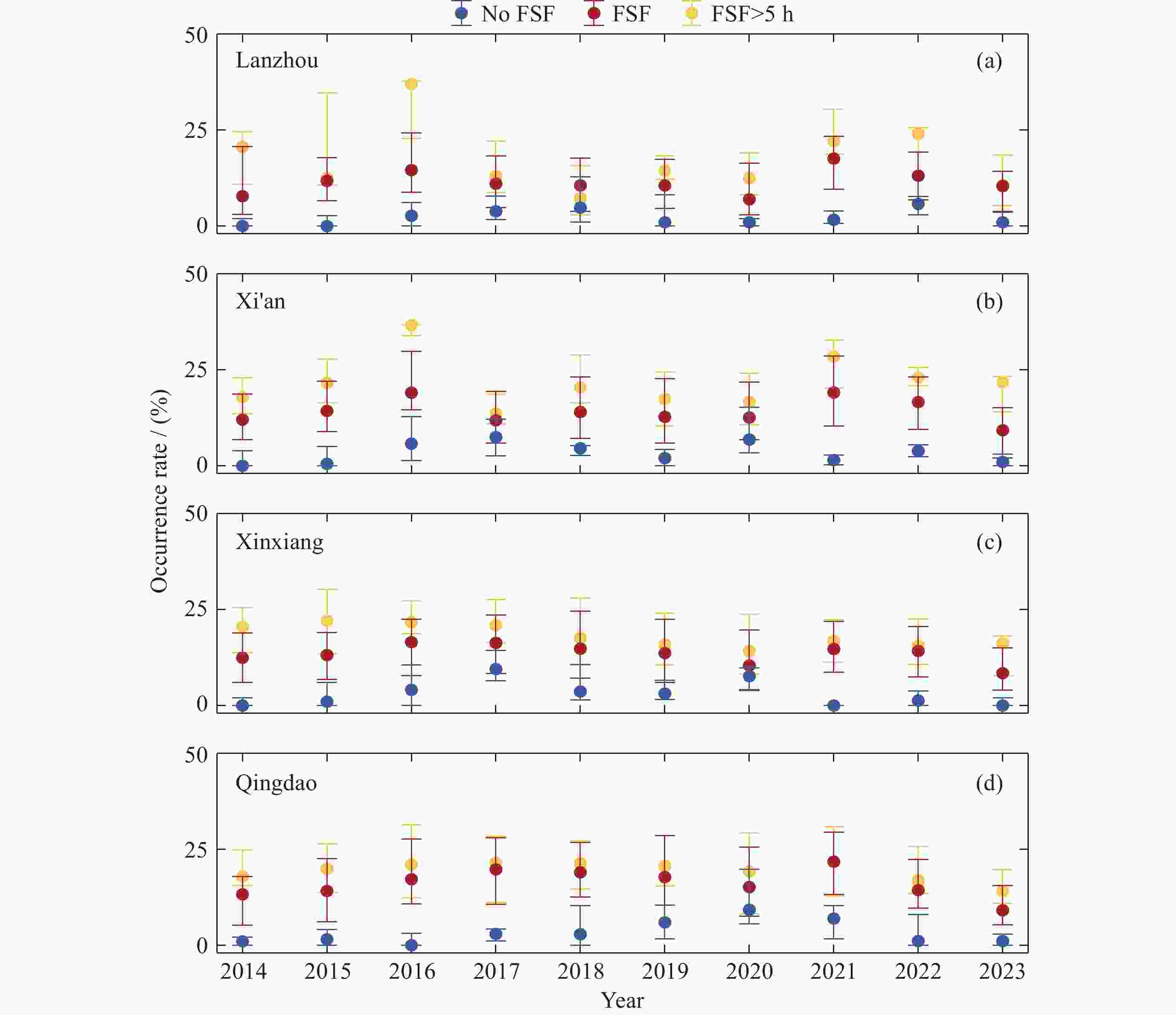
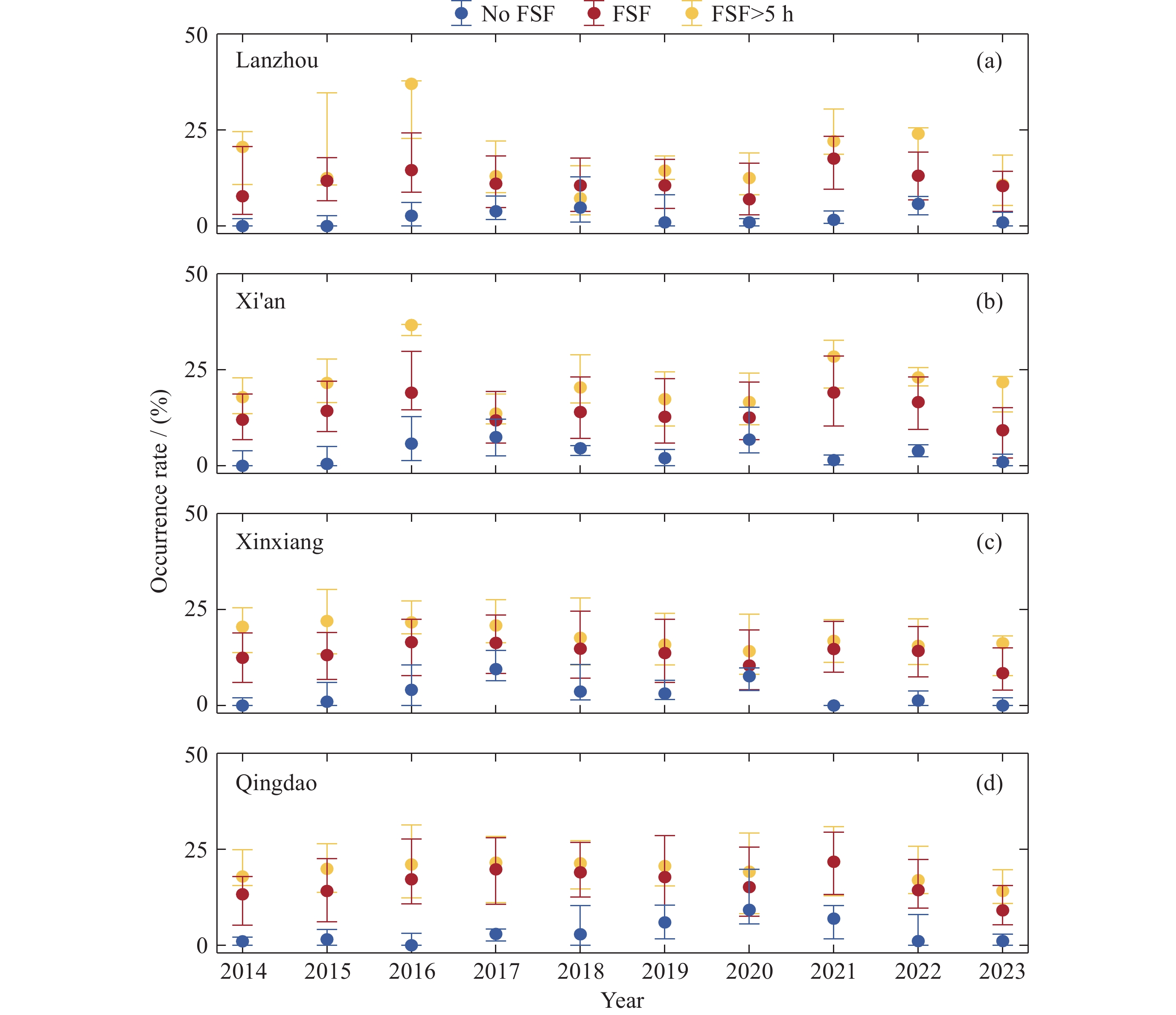
图 9 2014-2023年各测高仪台站观测的夏季夜间(19:00-06:00 LT)在不同FSF发生条件下, MSTIDs活动发生率分布
Figure 9. Distribution of MSTID activity occurrence rates under different FSF conditions during summer nights (19:00-06:00 LT) observed at various ionosonde stations from 2014 to 2023
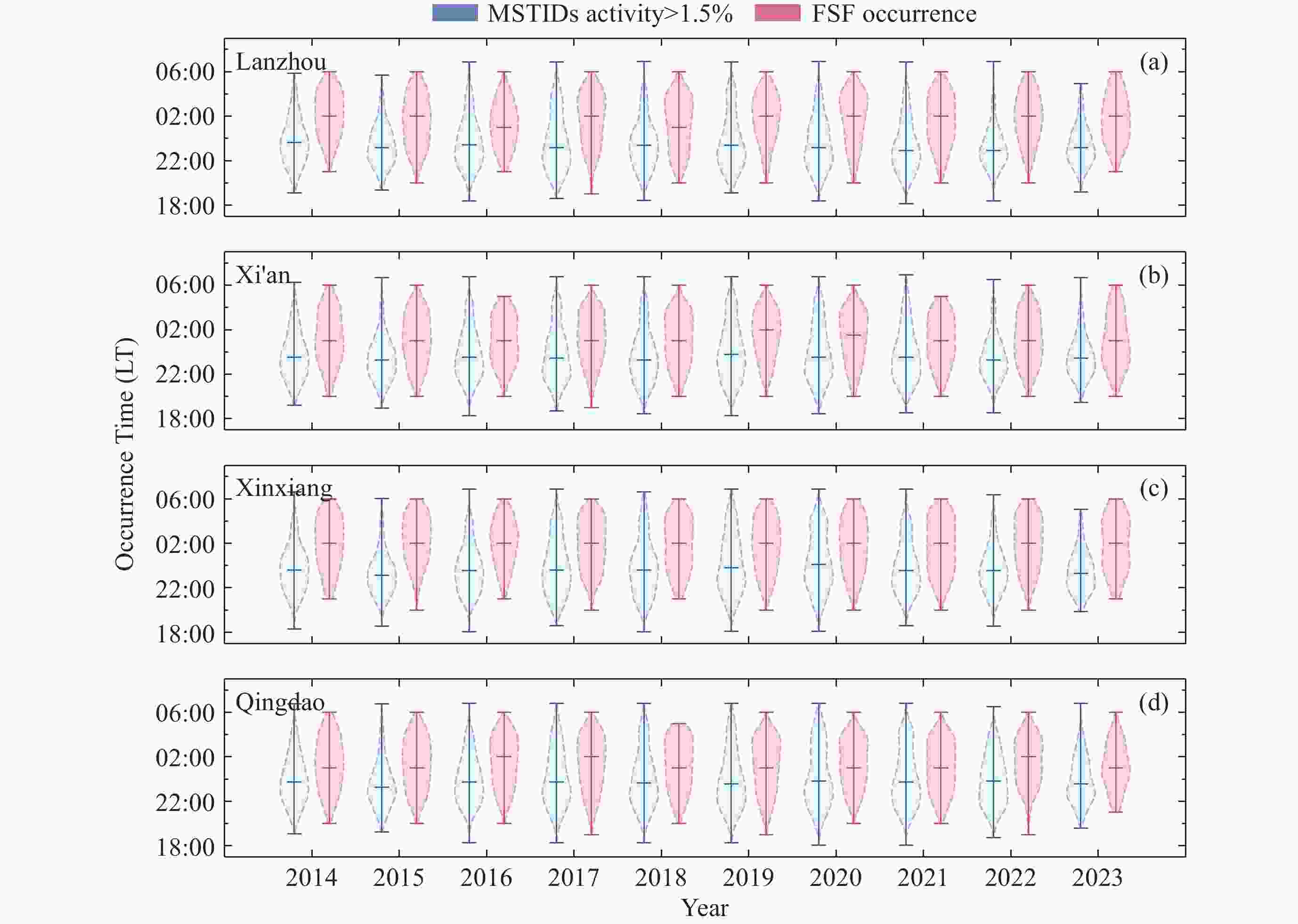
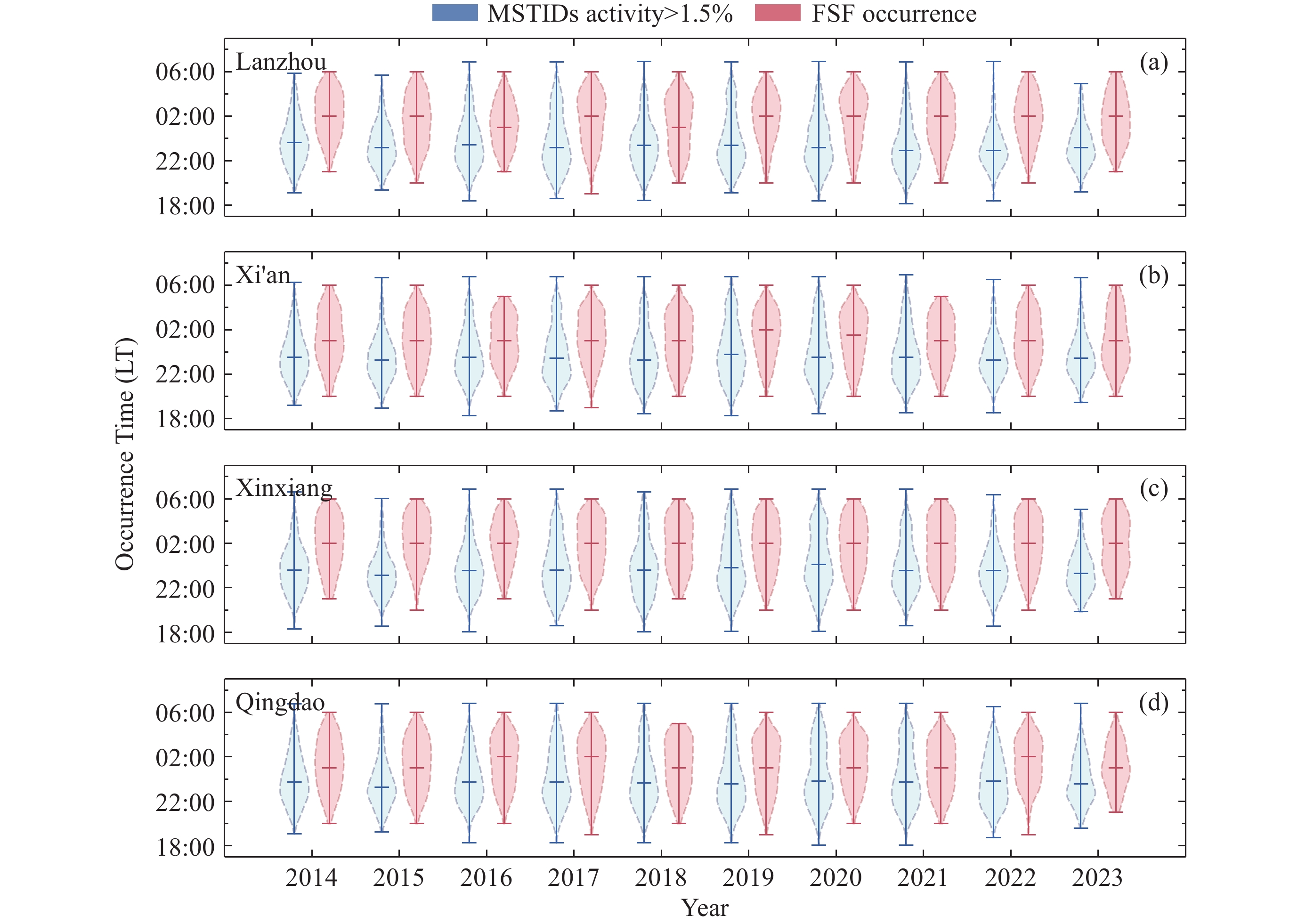
图 10 2014-2023年各测高仪台站MSTIDs活动和FSF发生时间分布
Figure 10. Distribution of MSTIDs activity and FSF occurrence times at different ionosonde stations from 2014 to 2023
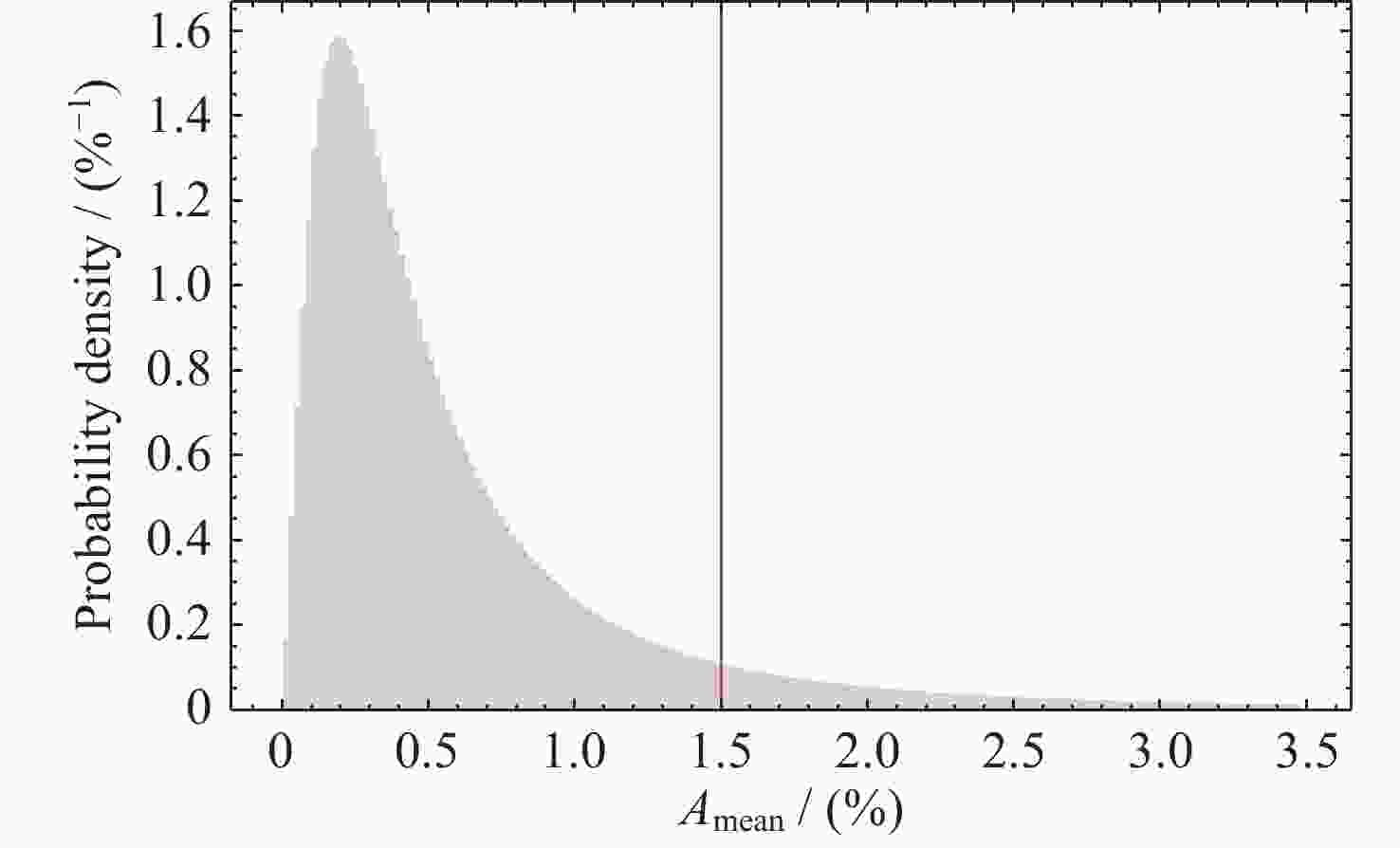
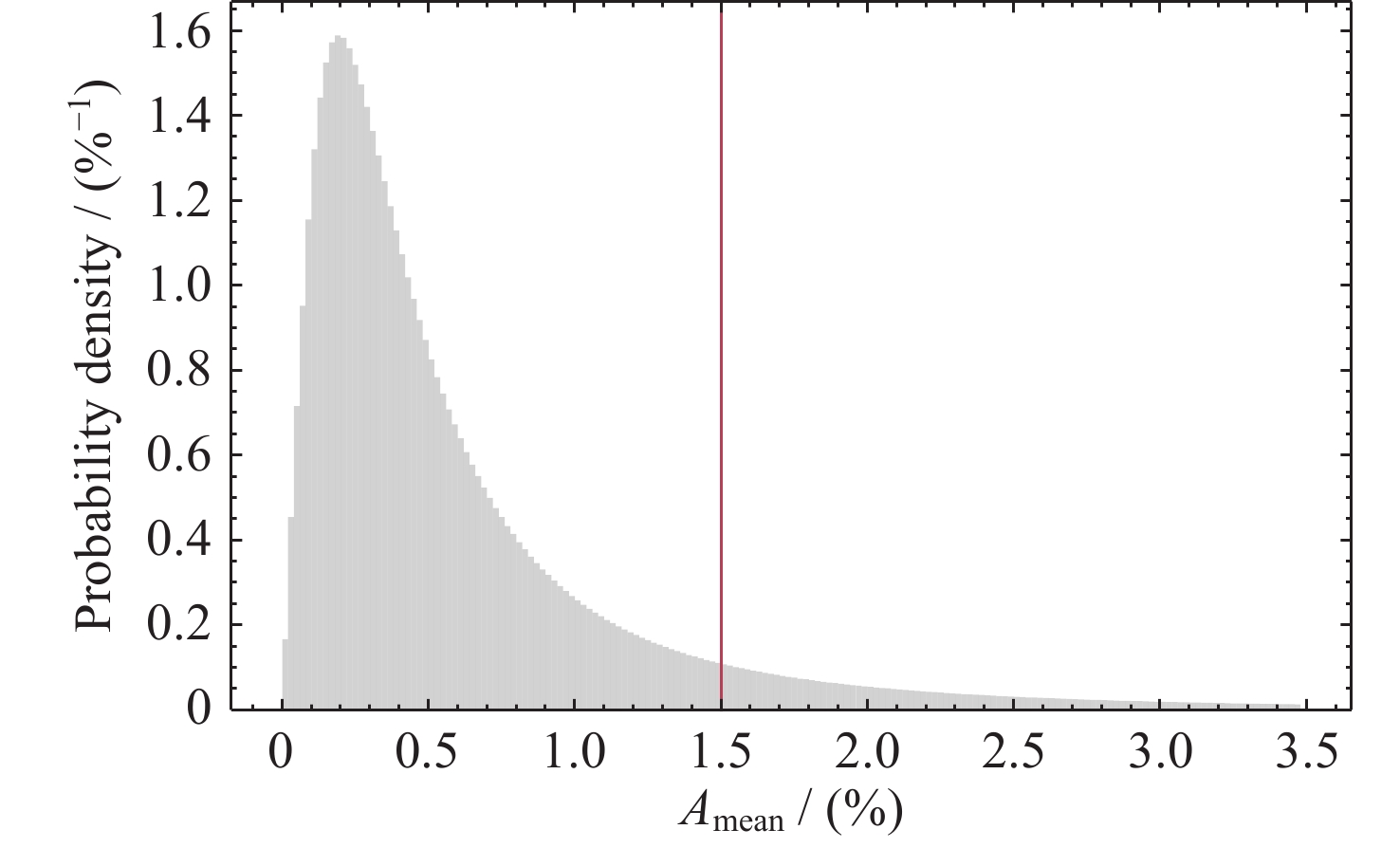
图 11 MSTIDs活动水平$ {A}_{\text{mean}} $的统计概率分布
Figure 11. Statistical probability distribution of MSTIDs activity level magnitude $ {A}_{\text{mean}} $
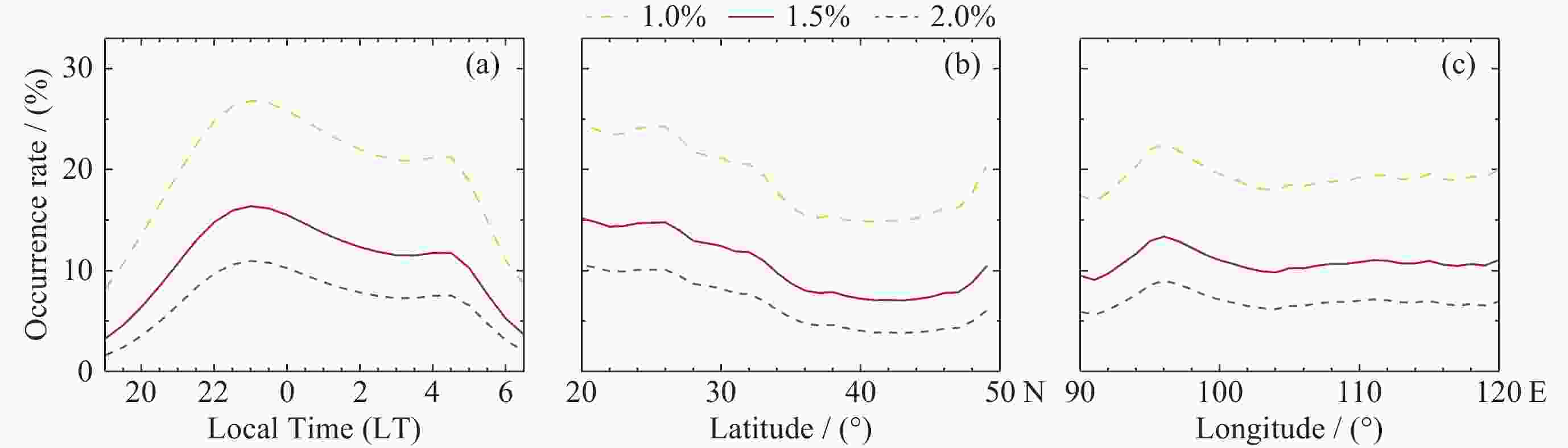
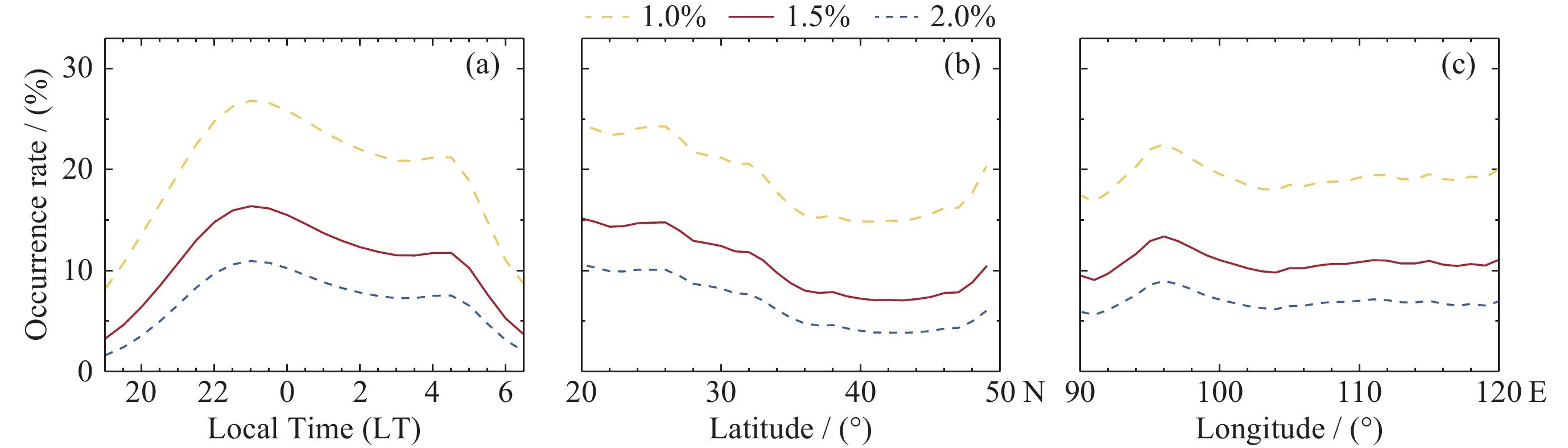
图 12 不同$ {A}_{\text{mean}} $阈值条件下MSTIDs活动发生率的时空分布
Figure 12. Temporal and spatial distribution of MSTIDs activity occurrence under different thresholds of $ {A}_{\text{mean}} $
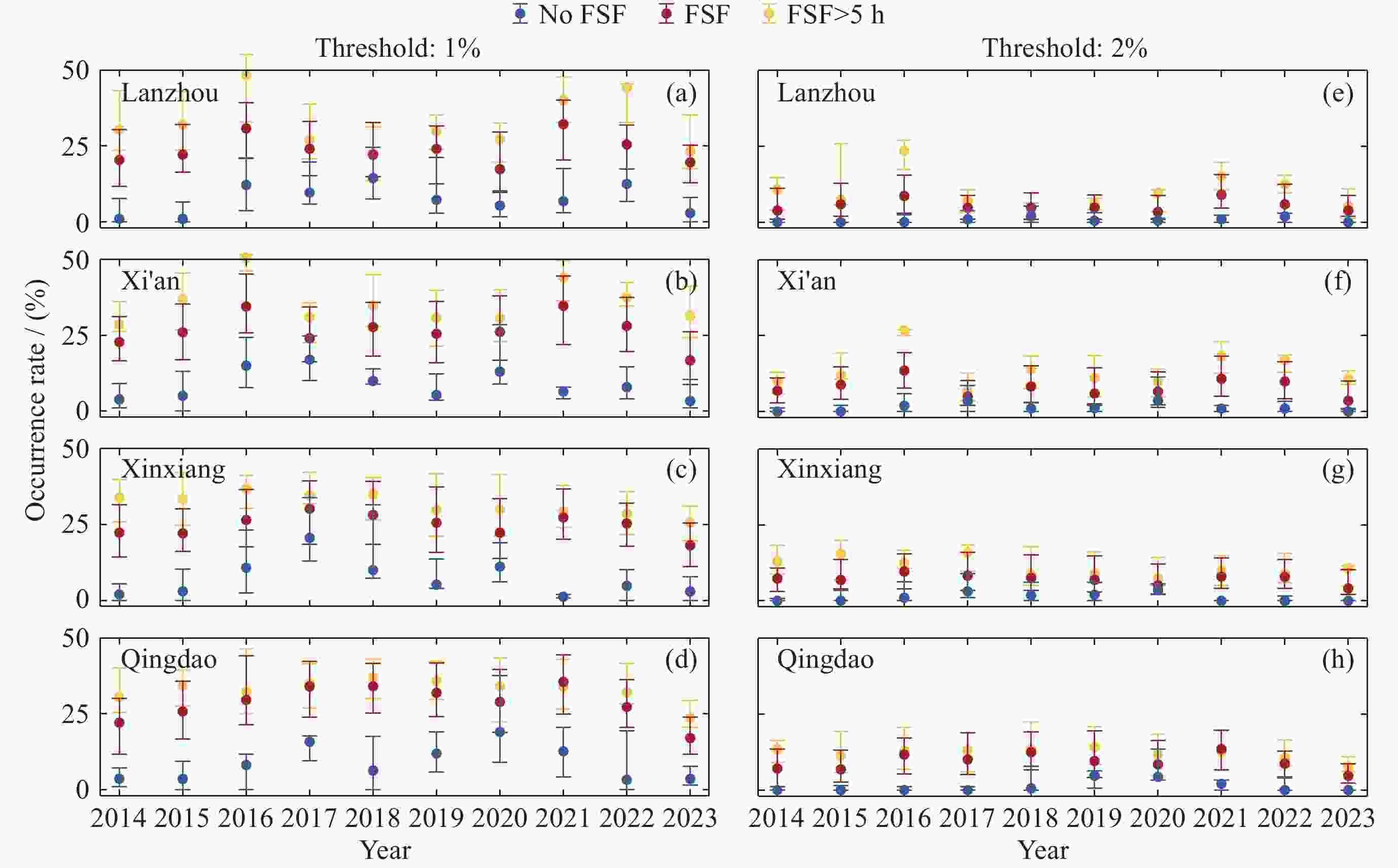
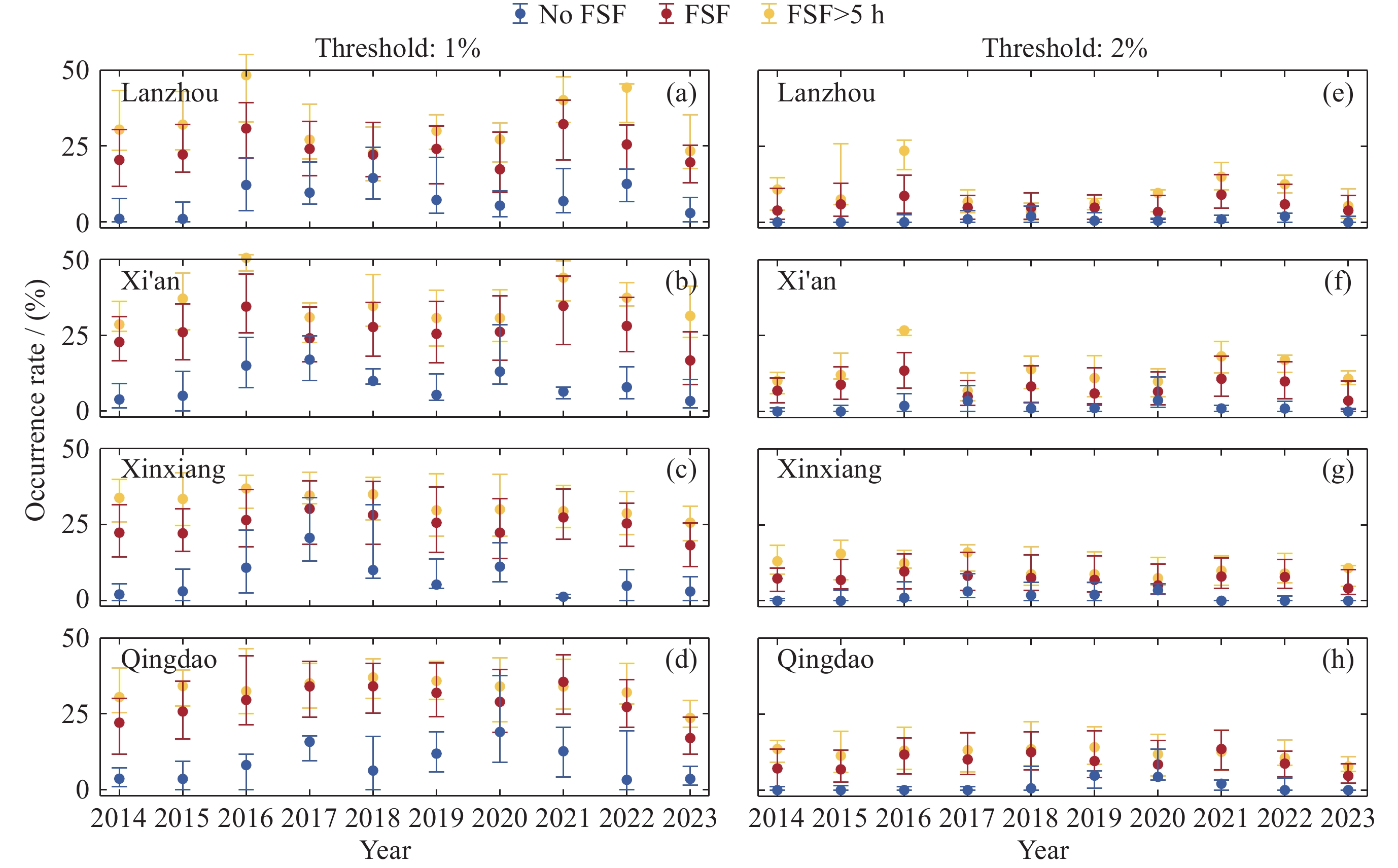
图 13 2014-2023年各测高仪台站夏季夜间(19:00-06:00 LT)在不同FSF发生条件和不同$ {A}_{\text{mean}} $阈值下MSTIDs活动发生率分布
Figure 13. Distribution of MSTIDs activity occurrence rates at each ionosonde station during summer nighttime (19:00-06:00 LT) under different FSF occurrence conditions and different $ {A}_{\text{mean}} $ thresholds from 2014 to 2023
-
[1] BOWMAN G G, FUKAO S, YAMAMOTO M, et al. MU-radar recorded field-aligned irregularities in the F2 region and associated sporadic-E disturbances[J]. Journal of Geomagnetism and Geoelectricity, 1994, 46(10): 873-889 doi: 10.5636/jgg.46.873 [2] OTSUKA Y, ONOMA F, SHIOKAWA K, et al. Simultaneous observations of nighttime medium-scale traveling ionospheric disturbances and E region field-aligned irregularities at midlatitude[J]. Journal of Geophysical Research: Space Physics, 2007, 112(A6): A06317 doi: 10.1029/2005JA011548 [3] HYSELL D, LARSEN M, FRITTS D, et al. Major upwelling and overturning in the mid-latitude F region ionosphere[J]. Nature Communications, 2018, 9(1): 3326 doi: 10.1038/s41467-018-05809-x [4] LIU Y, ZHOU C, XU T, et al. Review of ionospheric irregularities and ionospheric electrodynamic coupling in the middle latitude region[J]. Earth and Planetary Physics, 2021, 5(5): 462-482 doi: 10.26464/epp2021025 [5] BOWMAN G G. A review of some recent work on mid-latitude spread-F occurrence as detected by ionosondes[J]. Journal of Geomagnetism and Geoelectricity, 1990, 42(2): 109-138 doi: 10.5636/jgg.42.109 [6] HYSELL D L, LARSEN M, SULZER M. Observational evidence for new instabilities in the midlatitude E and F region[J]. Annales Geophysicae, 2016, 34(11): 927-941 doi: 10.5194/angeo-34-927-2016 [7] WATSON C, PEDATELLA N M. Climatology and characteristics of medium-scale F region ionospheric plasma irregularities observed by COSMIC radio occultation receivers[J]. Journal of Geophysical Research: Space Physics, 2018, 123(10): 8610-8630 doi: 10.1029/2018JA025696 [8] GEORGES T M. HF Doppler studies of traveling ionospheric disturbances[J]. Journal of Atmospheric and Terrestrial Physics, 1968, 30(5): 735-746 doi: 10.1016/S0021-9169(68)80029-7 [9] OTSUKA Y. medium-scale traveling ionospheric disturbances[M]//HUANG C S, LU G, ZHANG Y L, et al. Ionosphere Dynamics and Applications. Washington: American Geophysical Union (AGU), 2021: 421-437. DOI: 10.1002/9781119815617.ch18 [10] HINES C O. Internal atmospheric gravity waves at ionospheric heights[J]. Canadian Journal of Physics, 1960, 38(11): 1441-1481 doi: 10.1139/p60-150 [11] ASTAFYEVA E. Ionospheric detection of natural hazards[J]. Reviews of Geophysics, 2019, 57(4): 1265-1288 doi: 10.1029/2019RG000668 [12] LI K, ZHANG D H, ZENG Y, et al. Revisiting the ionospheric disturbances over low latitude region of China during super typhoon Hato[J]. Space Weather, 2024, 22(5): e2023SW003694 doi: 10.1029/2023SW003694 [13] DING F, WAN W X, XU G R, et al. Climatology of medium-scale traveling ionospheric disturbances observed by a GPS network in central China[J]. Journal of Geophysical Research: Space Physics, 2011, 116(A9): A09327 doi: 10.1029/2011JA016545 [14] LAI C, XU J Y, LIN Z S, et al. Statistical characteristics of nighttime medium-scale traveling ionospheric disturbances from 10-years of airglow observation by the machine learning method[J]. Space Weather, 2023, 21(5): e2023SW003430 doi: 10.1029/2023SW003430 [15] SHIOKAWA K, OTSUKA Y, IHARA C, et al. Ground and satellite observations of nighttime medium-scale traveling ionospheric disturbance at midlatitude[J]. Journal of Geophysical Research: Space Physics, 2003, 108(A4): 1145 doi: 10.1029/2002JA009639 [16] PERKINS F. Spread F and ionospheric currents[J]. Journal of Geophysical Research, 1973, 78(1): 218-226 doi: 10.1029/JA078i001p00218 [17] HUANG F Q, DOU X K, LEI J H, et al. Statistical analysis of nighttime medium-scale traveling ionospheric disturbances using airglow images and GPS observations over central China[J]. Journal of Geophysical Research: Space Physics, 2016, 121(9): 8887-8899 doi: 10.1002/2016JA022760 [18] CHEN G Y, ZHOU C, LIU Y, et al. A statistical analysis of medium-scale traveling ionospheric disturbances during 2014-2017 using the Hong Kong CORS network[J]. Earth, Planets and Space, 2019, 71(1): 52 doi: 10.1186/s40623-019-1031-9 [19] BOOKER H G, WELLS H W. Scattering of radio waves by the F-region of the ionosphere[J]. Terrestrial Magnetism and Atmospheric Electricity, 1938, 43(3): 249-256 doi: 10.1029/TE043i003p00249 [20] ABDU M A. Outstanding problems in the equatorial ionosphere-thermosphere electrodynamics relevant to spread F[J]. Journal of Atmospheric and Solar-Terrestrial Physics, 2001, 63(9): 869-884 doi: 10.1016/S1364-6826(00)00201-7 [21] KELLEY M C, HAERENDEL G, KAPPLER H, et al. Evidence for a Rayleigh-Taylor type instability and upwelling of depleted density regions during equatorial spread F[J]. Geophysical Research Letters, 1976, 3(8): 448-450 doi: 10.1029/GL003i008p00448 [22] GAO H Y, ZHANG D H, ZHANG Y B, et al. Case studies of the unseasonal ionospheric irregularities in China’s low latitude on July 5 and July 17, 2013[J]. Science China Technological Sciences, 2025, 68(11): 2120601 doi: 10.1007/s11431-025-3046-x [23] HAJKOWICZ L A. Morphology of quantified ionospheric range spread-F over a wide range of midlatitudes in the Australian longitudinal sector[J]. Annales Geophysicae, 2007, 25(5): 1125-1130 doi: 10.5194/angeo-25-1125-2007 [24] PAUL K S, HARALAMBOUS H, OIKONOMOU C, et al. Mid-latitude spread F over an extended European area[J]. Journal of Atmospheric and Solar-Terrestrial Physics, 2023, 248: 106093 doi: 10.1016/j.jastp.2023.106093 [25] BEHNKE R. F layer height bands in the nocturnal ionosphere over Arecibo[J]. Journal of Geophysical Research: Space Physics, 1979, 84(A3): 974-978 doi: 10.1029/JA084iA03p00974 [26] KELLEY M C, FUKAO S. Turbulent upwelling of the mid-latitude ionosphere: 2. Theoretical framework[J]. Journal of Geophysical Research: Space Physics, 1991, 96(A3): 3747-3753 doi: 10.1029/90JA02252 [27] HUANG C S, MILLER C A, KELLEY M C. Basic properties and gravity wave initiation of the midlatitude F region instability[J]. Radio Science, 1994, 29(1): 395-405 doi: 10.1029/93RS01669 [28] XIAO S G, XIAO Z, SHI J K, et al. Observational facts in revealing a close relation between acoustic-gravity waves and midlatitude spread F[J]. Journal of Geophysical Research: Space Physics, 2009, 114(A1): A01303 doi: 10.1029/2008JA013747 [29] YU S M, XIAO Z, AA E, et al. Observational investigation of the possible correlation between medium-scale TIDs and mid-latitude spread F[J]. Advances in Space Research, 2016, 58(3): 349-357 doi: 10.1016/j.asr.2016.05.002 [30] WANG N, GUO L X, ZHAO Z W, et al. A comparative study of ionospheric spread-F and scintillation at low- and mid-latitudes in China during the 24th solar cycle[J]. Advances in Space Research, 2019, 63(2): 986-998 doi: 10.1016/j.asr.2018.10.010 [31] HUANG W Q, XIAO Z, XIAO S G, et al. Case study of apparent longitudinal differences of spread F occurrence for two midlatitude stations[J]. Radio Science, 2011, 46(1): RS1015 doi: 10.1029/2009RS004327 [32] SHIOKAWA K, IHARA C, OTSUKA Y, et al. Statistical study of nighttime medium-scale traveling ionospheric disturbances using midlatitude airglow images[J]. Journal of Geophysical Research: Space Physics, 2003, 108(A1): 1052 doi: 10.1029/2002JA009491 [33] KOTAKE N, OTSUKA Y, TSUGAWA T, et al. Climatological study of GPS total electron content variations caused by medium-scale traveling ionospheric disturbances[J]. Journal of Geophysical Research: Space Physics, 2006, 111(A4): A04306 doi: 10.1029/2005JA011418 [34] OLIVER W L, FUKAO S, YAMAMOTO Y, et al. Middle and upper atmosphere radar observations of ionospheric density gradients produced by gravity wave packets[J]. Journal of Geophysical Research: Space Physics, 1994, 99(A4): 6321-6329 doi: 10.1029/94JA00171 [35] SU S Y, TSUNODA R T, LIU C H, et al. ROCSAT observations of topside ionospheric undulations and irregularities at low to middle latitudes[J]. Journal of Geophysical Research: Space Physics, 2007, 112(A11): A11309 doi: 10.1029/2007JA012371 [36] LIN F F, WANG C Y, SU C L, et al. Coordinated observations of F region 3 m field-aligned plasma irregularities associated with medium-scale traveling ionospheric disturbances[J]. Journal of Geophysical Research: Space Physics, 2016, 121(4): 3750-3766 doi: 10.1002/2016JA022511 [37] LI K, ZHANG D H, ZENG Y, et al. Morphology and climatology of nighttime periodic ionospheric TEC disturbances associated with MSTIDs over China[J]. Space Weather, 2024, 22(11): e2024SW004041 doi: 10.1029/2024SW004041 [38] LI K, ZHANG D H, TIAN Y Y, et al. Statistical study on the connections between TEC periodic disturbances associated with MSTIDs and mid-latitude frequency spread F in summer nights over China[J]. Journal of Geophysical Research: Space Physics, 2025, 130(6): e2025JA033706 doi: 10.1029/2025JA033706 [39] LUO J, XU J Y, WU K, et al. Investigation on chasing and interaction of traveling ionospheric disturbances based on multi-instrument[J]. Journal of Geophysical Research: Space Physics, 2024, 129(8): e2023JA032283 doi: 10.1029/2023JA032283 [40] OTSUKA Y, SHINBORI A, TSUGAWA T, et al. Solar activity dependence of medium-scale traveling ionospheric disturbances using GPS receivers in Japan[J]. Earth, Planets and Space, 2021, 73(1): 22 doi: 10.1186/s40623-020-01353-5 [41] TSUCHIYA S, SHIOKAWA K, FUJINAMI H, et al. Statistical analysis of the phase velocity distribution of mesospheric and ionospheric waves observed in airglow images over a 16-year period: comparison between Rikubetsu and Shigaraki, Japan[J]. Journal of Geophysical Research: Space Physics, 2018, 123(8): 6930-6947 doi: 10.1029/2018JA025585 [42] TSUNODA R T. On the coupling of layer instabilities in the nighttime midlatitude ionosphere[J]. Journal of Geophysical Research: Space Physics, 2006, 111(A11): 11304 doi: 10.1029/2006JA011630 [43] NARAYANAN V L, SHIOKAWA K, OTSUKA Y, et al. On the role of thermospheric winds and sporadic E layers in the formation and evolution of electrified MSTIDs in geomagnetic conjugate regions[J]. Journal of Geophysical Research: Space Physics, 2018, 123(8): 6957-6980 doi: 10.1029/2018JA025261 [44] MATOZA R S, FEE D, ASSINK J D, et al. Atmospheric waves and global seismoacoustic observations of the January 2022 Hunga eruption, Tonga[J]. Science, 2022, 377(6601): 95-100 doi: 10.1126/science.abo7063 [45] CHOU M Y, LIN C C H, YUE J, et al. Medium-scale traveling ionospheric disturbances triggered by Super Typhoon Nepartak (2016)[J]. Geophysical Research Letters, 2017, 44(15): 7569-7577 doi: 10.1002/2017GL073961 [46] WAN W X, YUAN H, NING B Q, et al. Traveling ionospheric disturbances associated with the tropospheric vortexes around Qinghai-Tibet Plateau[J]. Geophysical Research Letters, 1998, 25(20): 3775-3778 doi: 10.1029/1998GL900030 [47] LI Q Z, XU J Y, LIU X, et al. Characteristics of mesospheric gravity waves over the southeastern Tibetan Plateau region[J]. Journal of Geophysical Research: Space Physics, 2016, 121(9): 9204-9221 doi: 10.1002/2016JA022823 [48] HOFFMANN L, XUE X, ALEXANDER M J. A global view of stratospheric gravity wave hotspots located with Atmospheric Infrared Sounder observations[J]. Journal of Geophysical Research: Atmospheres, 2013, 118(2): 416-434 doi: 10.1029/2012JD018658 [49] ZHANG Y, XIONG J, LIU L, et al. A global morphology of gravity wave activity in the stratosphere revealed by the 8-year SABER/TIMED data[J]. Journal of Geophysical Research: Atmospheres, 2012, 117(D21): D21101 doi: 10.1029/2012JD017676 [50] LIU X, XU J Y, YUE J, et al. Orographic primary and secondary gravity waves in the middle atmosphere from 16-year SABER observations[J]. Geophysical Research Letters, 2019, 46(8): 4512-4522 doi: 10.1029/2019GL082256 [51] ZENG X Y, XUE X H, DOU X K, et al. COSMIC GPS observations of topographic gravity waves in the stratosphere around the Tibetan Plateau[J]. Science China Earth Sciences, 2017, 60(1): 188-197 doi: 10.1007/s11430-016-0065-6 [52] HOFFMANN L, ALEXANDER M J. Retrieval of stratospheric temperatures from Atmospheric Infrared Sounder radiance measurements for gravity wave studies[J]. Journal of Geophysical Research: Atmospheres, 2009, 114(D7): D07105 doi: 10.1029/2008JD011241 -
-

 下载:
下载:

计量
- 文章访问数: 315
- HTML全文浏览量: 55
- PDF下载量: 35
-
被引次数:
0(来源:Crossref)
0(来源:其他)

