


太阳耀斑对热层–电离层–磁层耦合系统影响研究进展
doi: 10.11728/cjss2026.05.2025-0218 cstr: 32142.14.cjss.2025-0218
-
 刘宣青 女, 1996年12月出生于山西省朔州市, 现为山东大学空间科学与技术学院博士后, 主要研究方向为太阳耀斑对地球电离层–热层耦合系统影响. E-mail: xuanqingliu@sdu.edu.cn
 -
 刘晶 男, 1983年12月出生于湖北省黄冈市, 现为山东大学空间科学与技术学院教授, 博士生导师, 主要研究方向为地球电离层–磁层耦合系统以及数值与人工智能建模等. E-mail: liujing2019@sdu.edu.cn
作者简介:
通讯作者:
Research Progress on the Effects of Solar Flares on the Thermosphere-Ionosphere-Magnetosphere (T-I-M) Coupling System
-
摘要: 作为太阳爆发的重要形式, 耀斑可瞬时释放出强烈的电磁辐射, 可显著扰动地球热层–电离层–磁层(T-I-M)耦合系统. 系统综述了近10年来中国在耀斑对T-I-M(Thermosphere-Ionosphere-Magnetosphere)系统多尺度影响及其耦合物理机制方面的研究进展. 在热层响应方面, 重点总结耀斑引起的热层加热、中性成分变化及大气动力学过程; 在电离层扰动方面, 分析耀斑引发的瞬时光电离响应、动力学变化以及电动力学过程中电场、电流体系的重构, 尤其关注了耀斑极紫外后相对电离层的影响; 在磁层耦合方面, 阐述耀斑通过极区电导率变化调制场向电流与磁层对流结构的观测证据与机理, 探讨耀斑与磁暴共同作用下的非线性耦合特征.
-
关键词:
- 太阳耀斑 /
- 热层–电离层–磁层耦合 /
- 空间天气 /
- 极紫外后相
Abstract: Solar flares release intense electromagnetic radiation and can strongly perturb the Earth’s Thermosphere-Ionosphere-Magnetosphere (T-I-M) coupling system. Here, we review progress made by Chinese researchers over the past decade in understanding the multiscale effects of solar flares on the T-I-M system and the underlying coupling mechanisms. For the thermosphere, we summarize flare-induced heating, changes in neutral composition, and atmospheric dynamics. For the ionosphere, we discuss the rapid photoionization response, dynamical changes, and the electrodynamic restructuring of electric fields and current systems, with particular attention to the effects of the extreme ultraviolet late phase. For magnetospheric coupling, we review observational evidence and physical mechanisms showing how flare-driven changes in polar ionospheric conductance modulate field-aligned currents and magnetospheric convection. We also discuss the nonlinear coupling between solar flares and geomagnetic storms. -
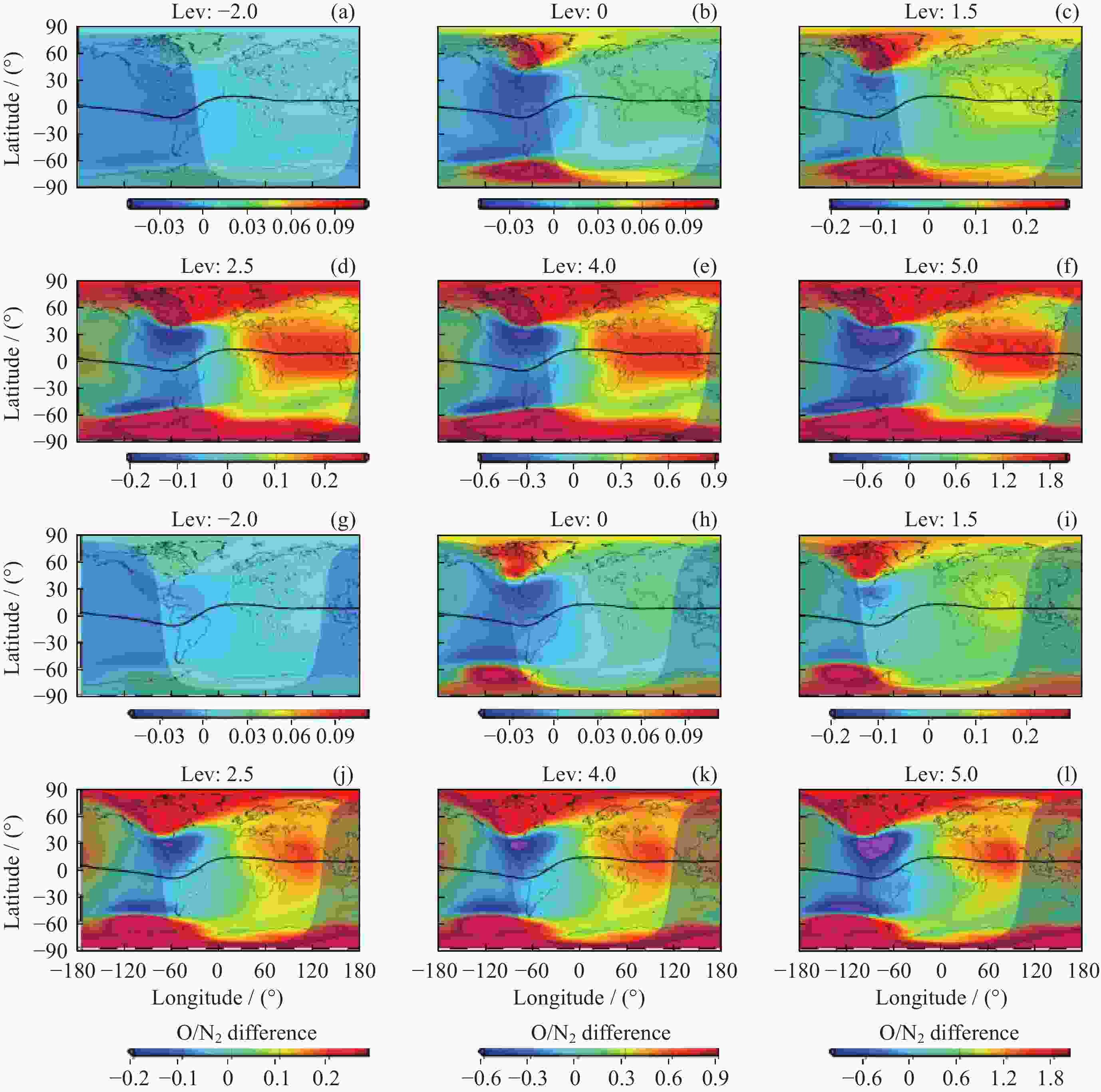
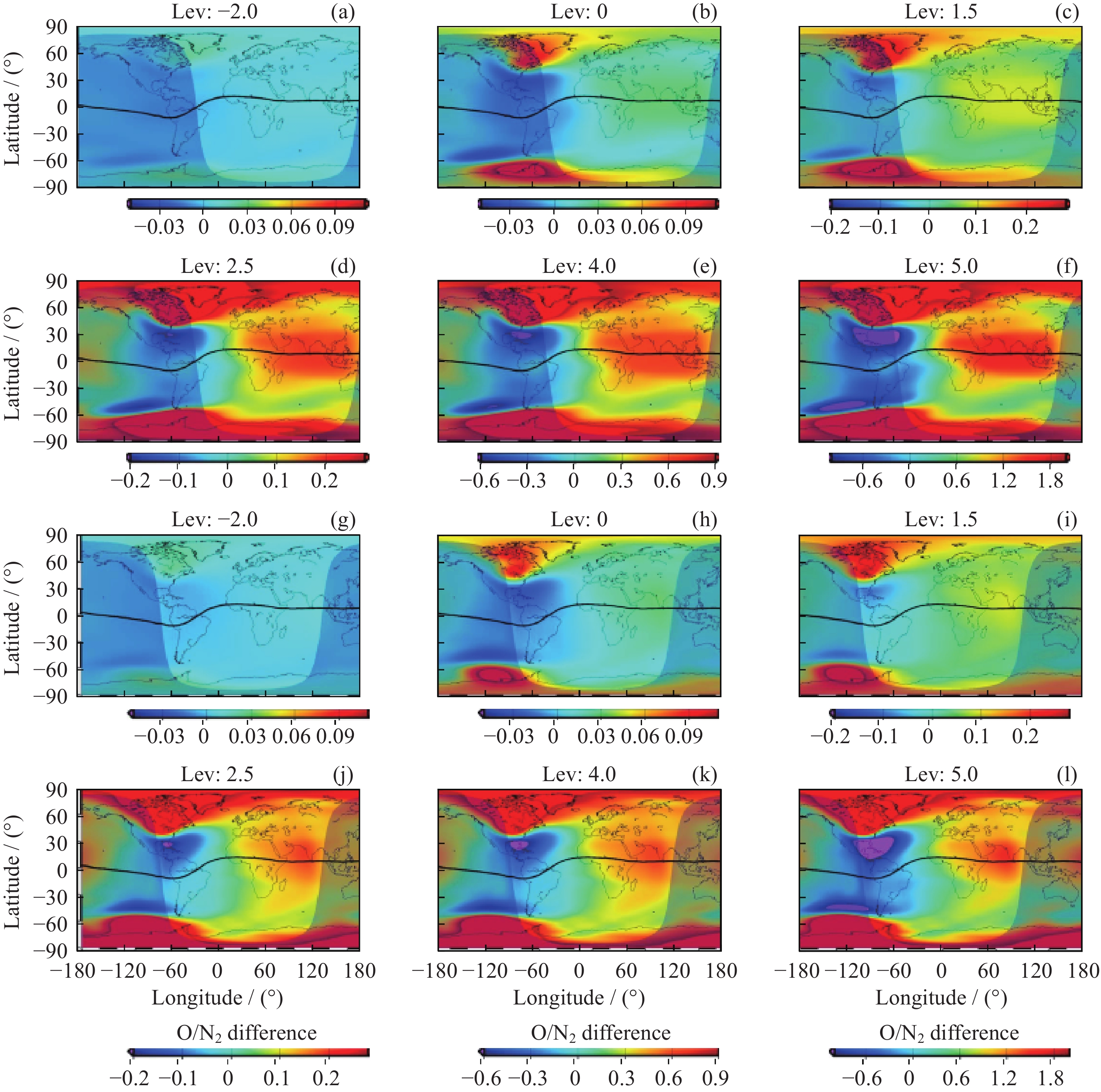
图 5 TIEGCM模拟的有无耀斑条件下O/N2差值
Figure 5. TIEGCM-simulated O/N2 differences between flare and no-flare conditions
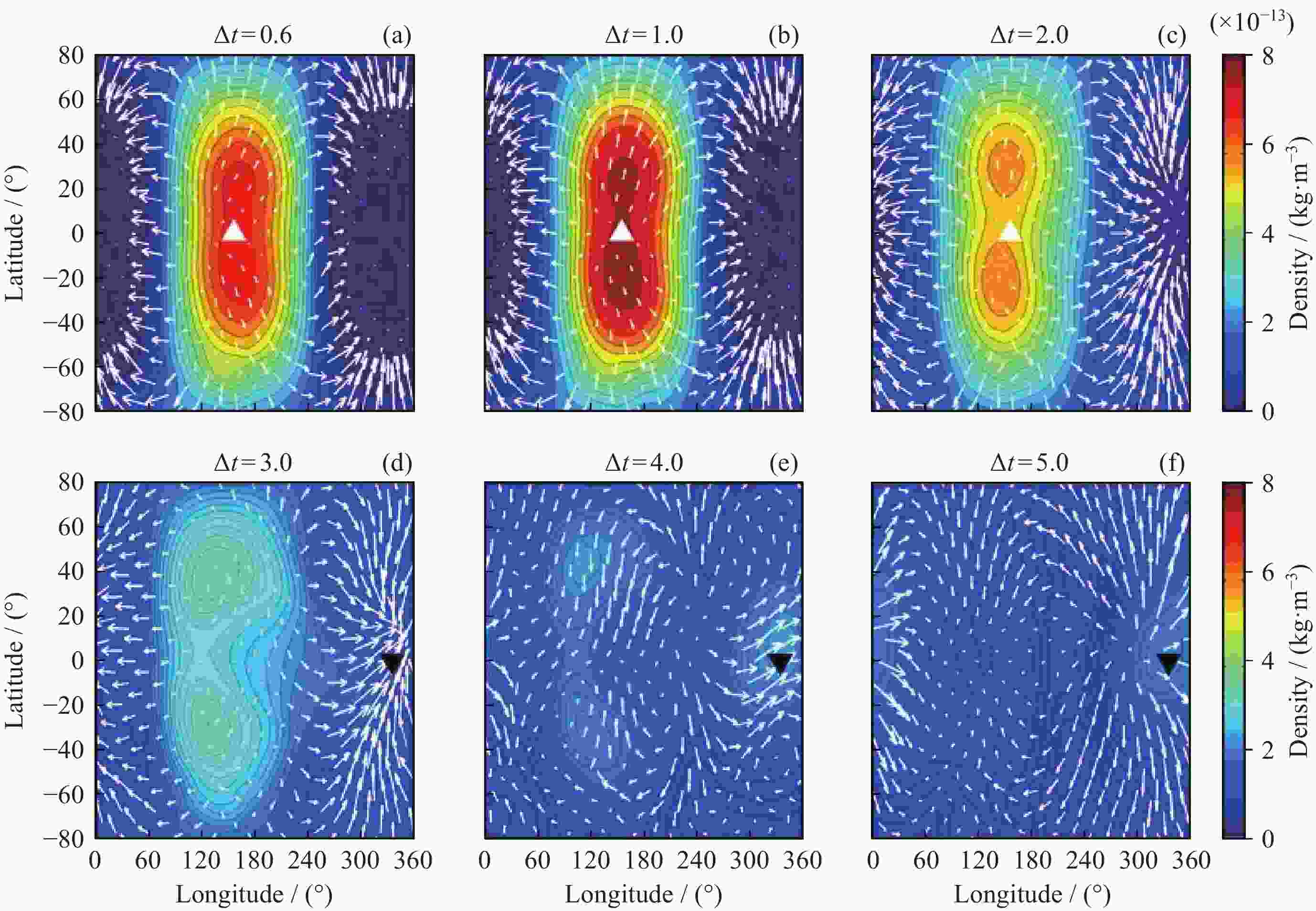
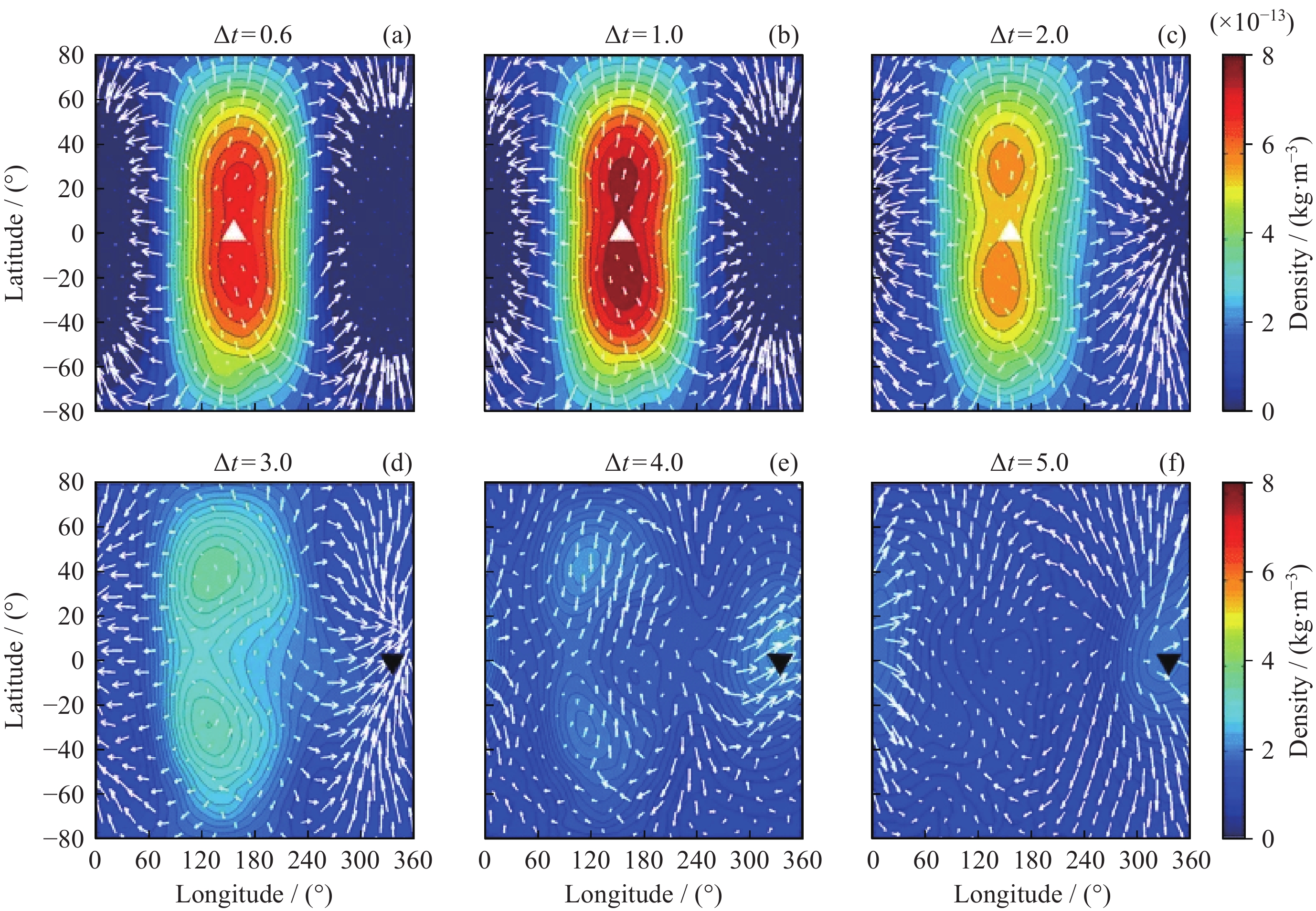
图 6 耀斑发生后400 km高度水平风和中性密度变化
Figure 6. Changes in horizontal wind and neutral density at 400 km after solar flare onset
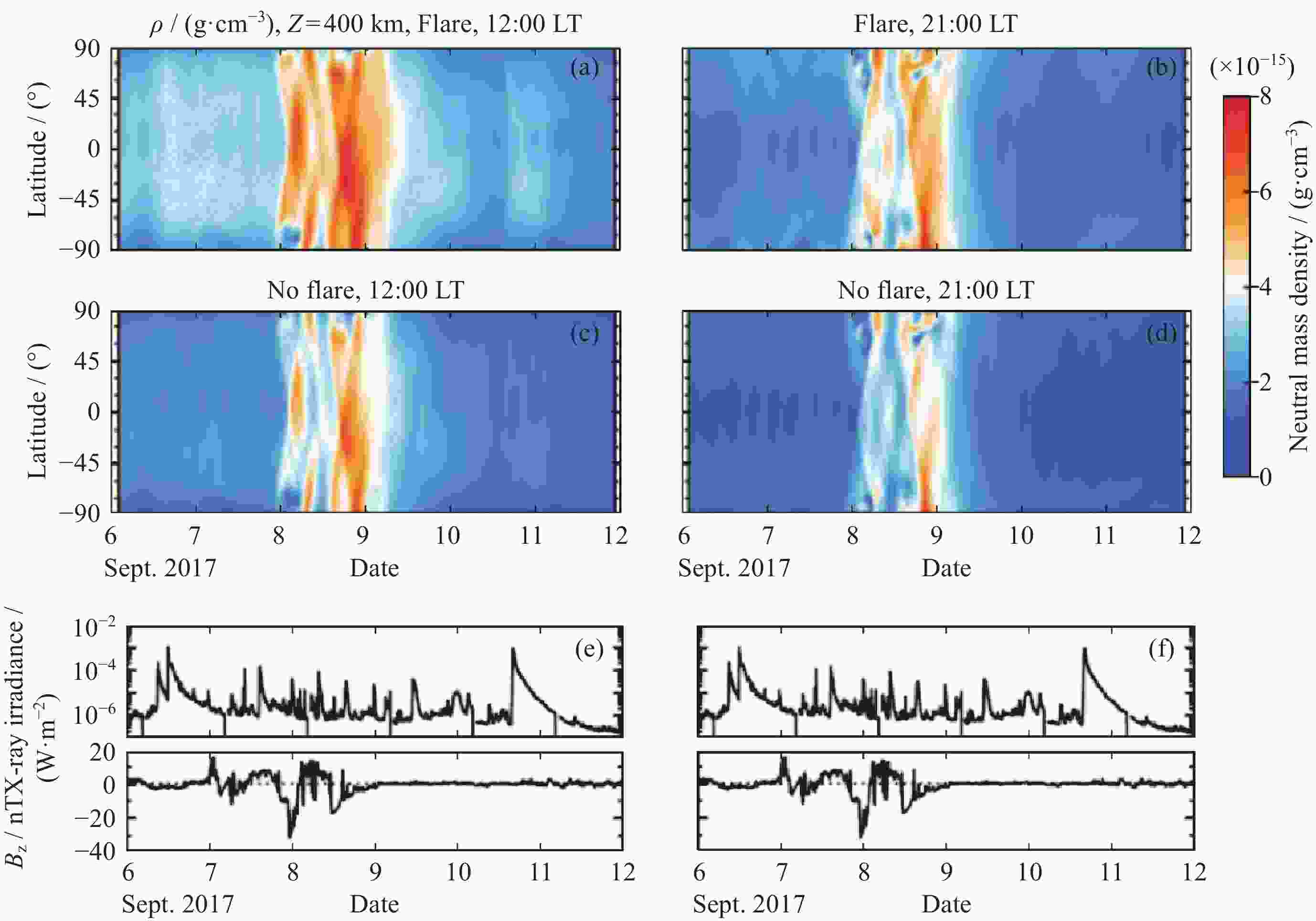
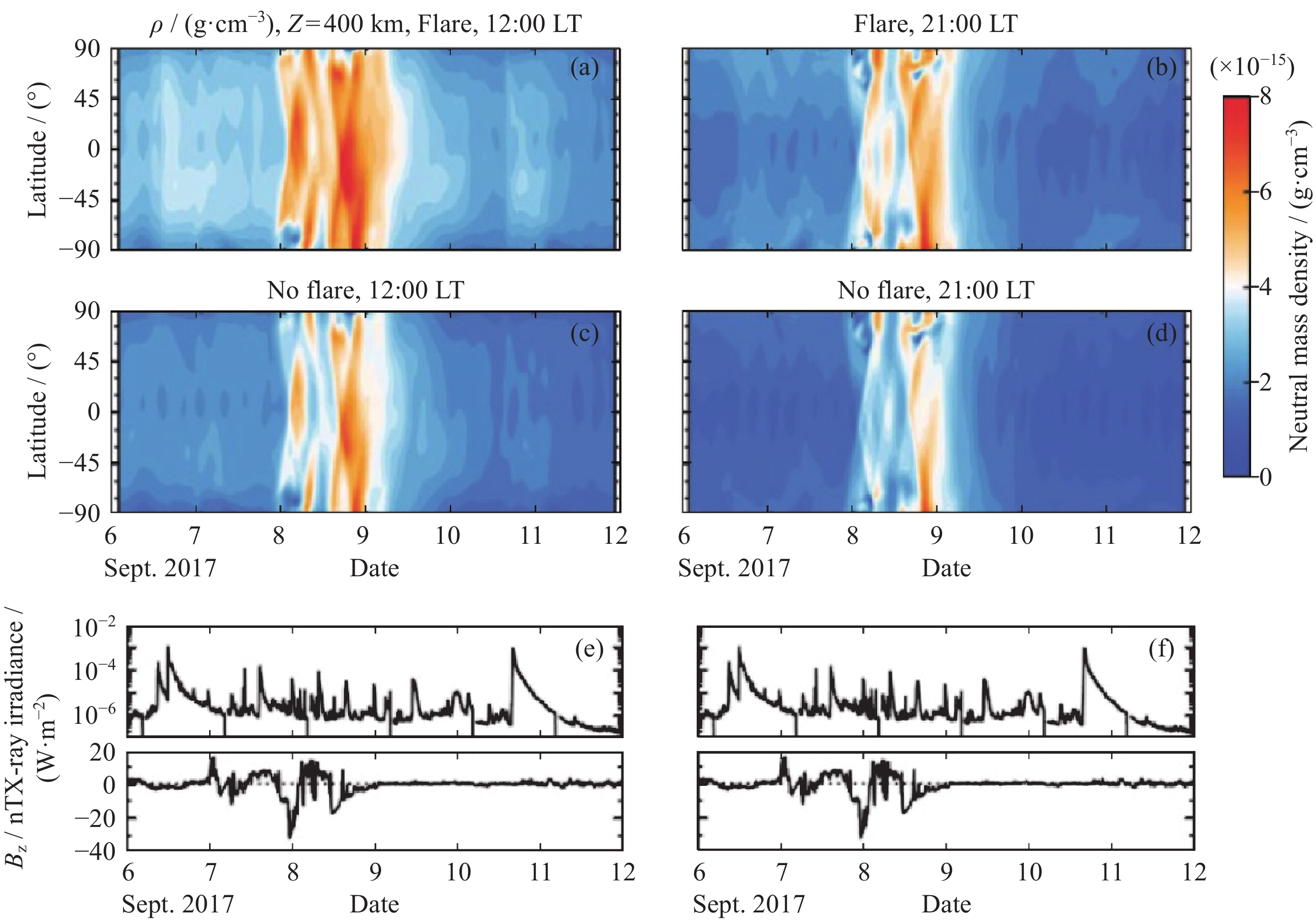
图 7 TIME-GCM模拟的2017年9月6-11日热层中性密度(400 km高度). (a) 12:00 LT有耀斑情况, (b) 21:00 LT有耀斑情况, (c) 12:00 LT无耀斑情况, (d) 21:00 LT 无耀斑情况[18]
Figure 7. TIME‐GCM simulated thermosphere mass density at 400 km from 6 to 11 September 2017. (a) With flares at 12:00 LT, (b) with flares at 21:00 LT, (c) without flares at 12:00 LT, (d) without flares at 21:00 LT[18]
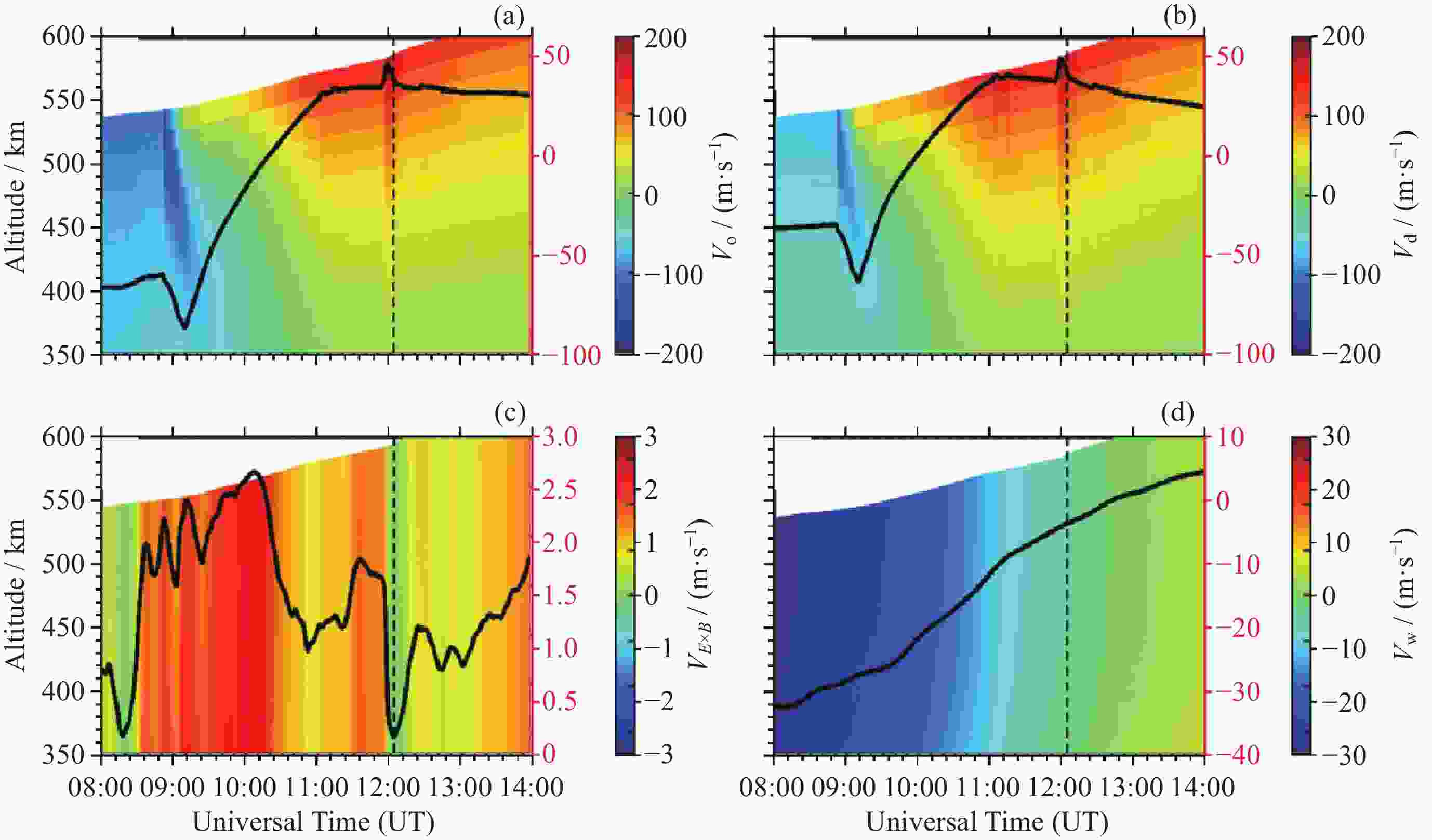
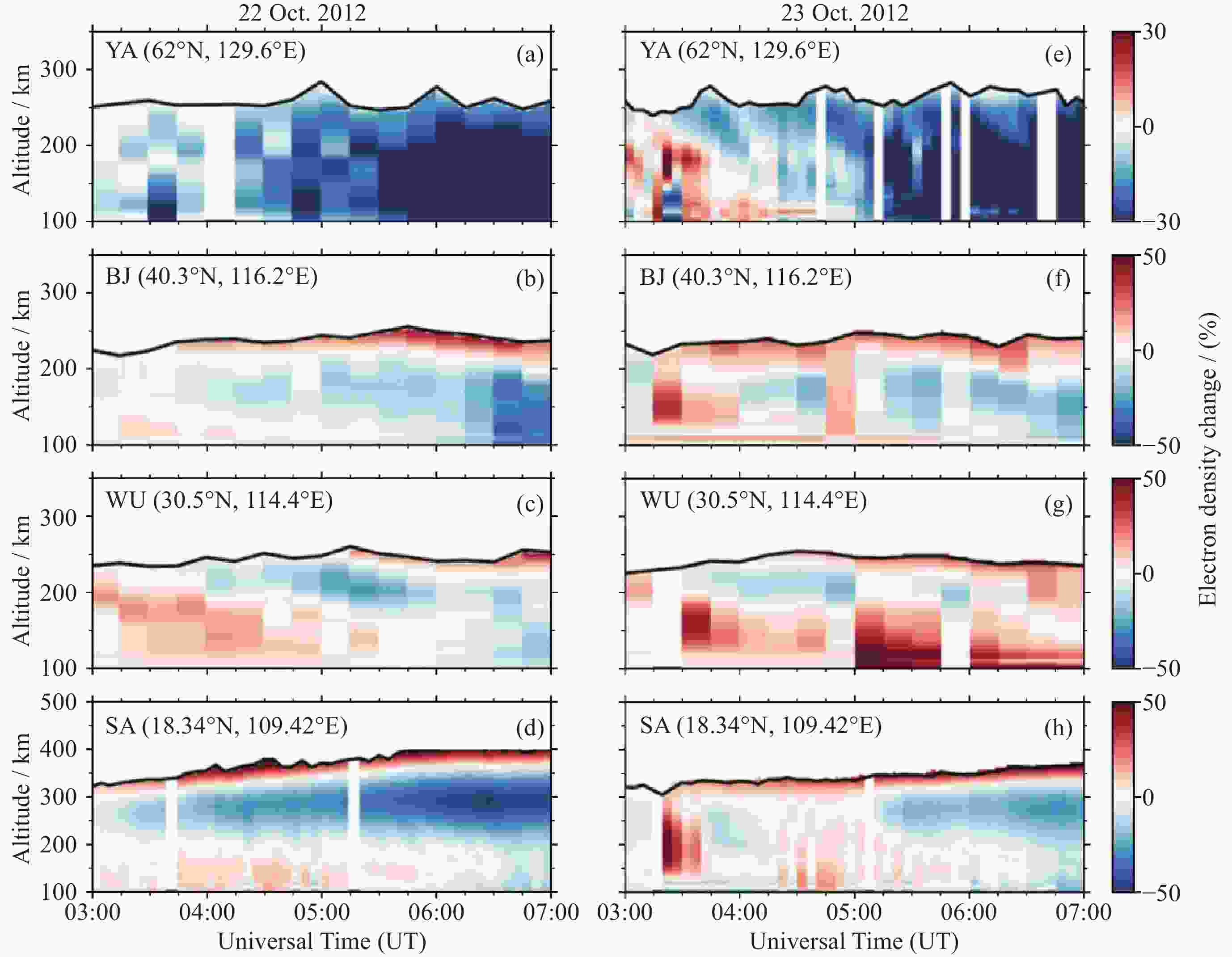
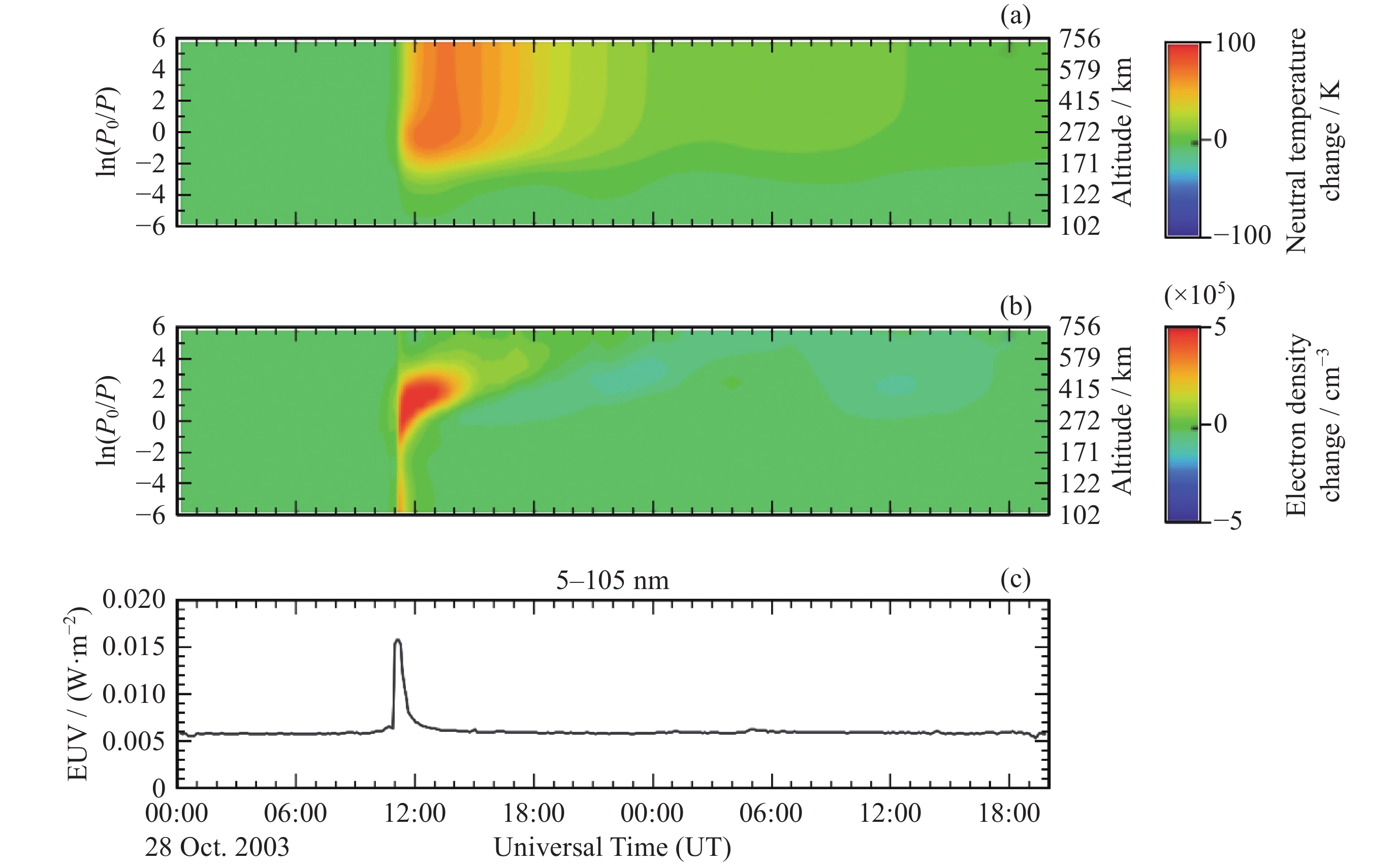
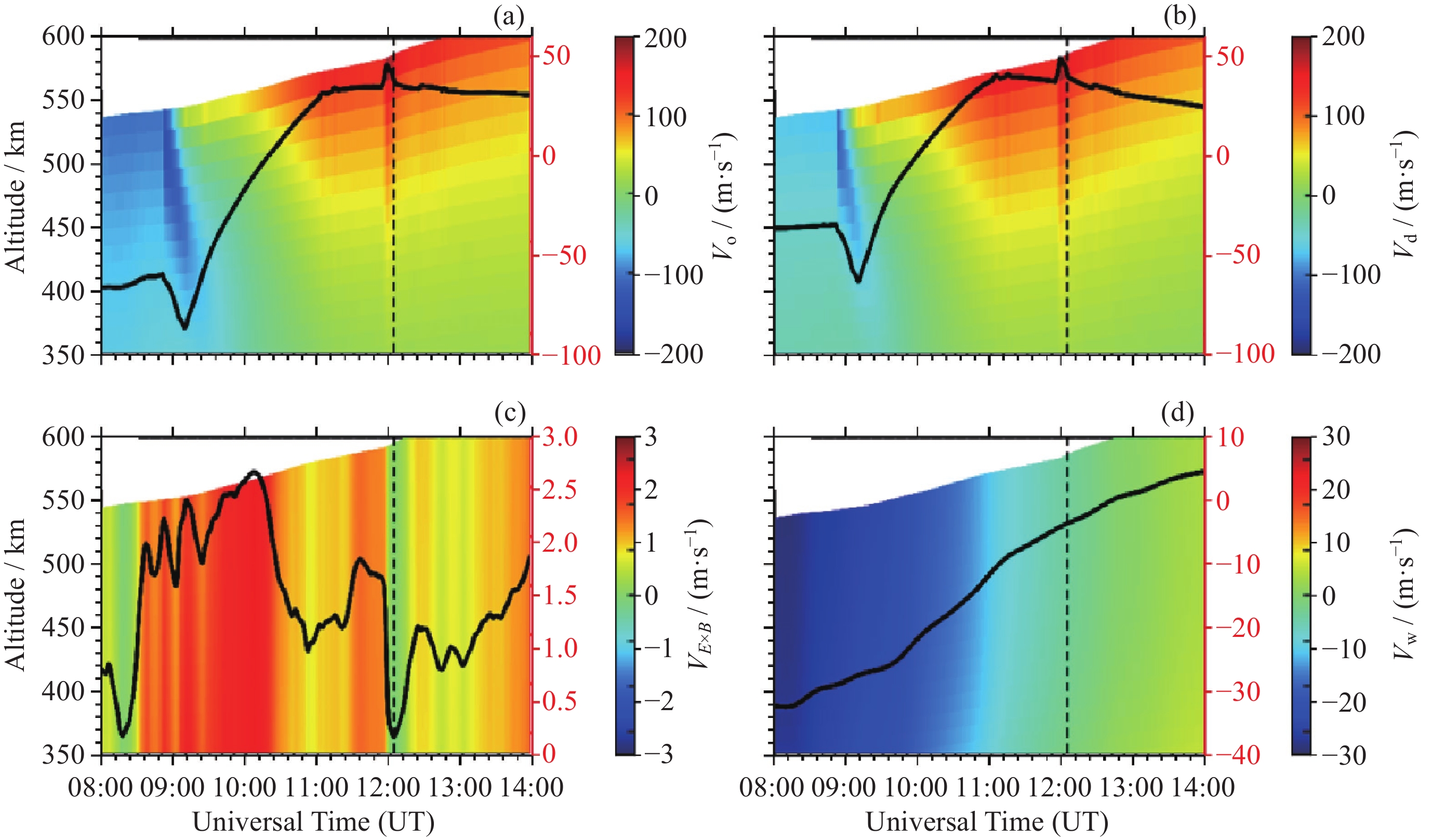
图 11 模拟的离子垂直速度及不同输运过程的贡献随高度和时间变化. (a) 离子垂直速度 (Vo), (b) 双极扩散 (Vd), (c) 漂移贡献 ($ {V}_{\boldsymbol{E}×\boldsymbol{B}} $), (d) 中性风贡献 ($ {V}_{\text{w}} $)[66]
Figure 11. Simulated ion vertical velocity and contributions from different transport processes as functions of altitude and UT. (a) Ion vertical geometric velocity (Vo), (b) ambipolar diffusion contributions (Vd), (c) drift contributions ($ {V}_{\boldsymbol{E}\times \boldsymbol{B}} $), (d) neutral winds contributions (Vw)[66]
-
[1] BAKER D N. Effects of the Sun on the Earth’s environment[J]. Journal of Atmospheric and Solar-Terrestrial Physics, 2000, 62(17/18): 1669-1681 doi: 10.1016/S1364-6826(00)00119-X [2] PULKKINEN T. Space weather: terrestrial perspective[J]. Living Reviews in Solar Physics, 2007, 4(1): 1 doi: 10.12942/lrsp-2007-1 [3] MILAN S E, CLAUSEN L B N, COXON J C, et al. Overview of solar wind-magnetosphere-ionosphere-atmosphere coupling and the generation of magnetospheric currents[J]. Space Science Reviews, 2017, 206(1/2/3/4): 547-573 doi: 10.1007/s11214-017-0333-0 [4] LIU J, WANG W B, QIAN L Y, et al. Solar flare effects in the Earth’s magnetosphere[J]. Nature Physics, 2021, 17(7): 807-812 doi: 10.1038/s41567-021-01203-5 [5] ZHANG D H, SHI H, JIN Y Q, et al. The variation of the estimated GPS instrumental bias and its possible connection with ionospheric variability[J]. Science China Technological Sciences, 2014, 57(1): 67-79 doi: 10.1007/s11431-013-5419-7 [6] HAO Y Q, HUANG J P, LIU W L, et al. Prompt GPS TEC response to magnetospheric compression[J]. Journal of Geophysical Research: Space Physics, 2017, 122(4): 4357-4366 doi: 10.1002/2017JA023866 [7] PRÖLSS G W. Physics of the Earth’s Space Environment: An Introduction[M]. Berlin, Heidelberg: Springer, 2004. DOI: 10.1007/978-3-642-97123-5 [8] SARRIS T E. Understanding the ionosphere thermosphere response to solar and magnetospheric drivers: status, challenges and open issues[J]. Philosophical Transactions of the Royal Society A: Mathematical, Physical and Engineering Sciences, 2019, 377(2148): 20180101 doi: 10.1098/rsta.2018.0101 [9] ZHANG D H, XIAO Z. Study of the ionospheric TEC using GPS during the large solar flare burst on Nov. 6, 1997[J]. Chinese Science Bulletin, 2000, 45(19): 1749-1752 doi: 10.1007/BF02886258 [10] XIAO Z, YU S M, SHI H, et al. A brief of recent research progress on ionospheric disturbances[J]. Science China Information Sciences, 2013, 56(12): 1-9 doi: 10.1007/s11432-013-5042-z [11] EPARVIER F G, WOODS T N. Solar EUV spectral irradiance: measurements and variability[C]//WILSON A. Solar Variability as an Input to the Earth’s Environment: International Solar Cycle Studies (ISCS) Symposium. Noordwijk: ESA Publications Division, 2003: 209-216 [12] ZHANG D H, XIAO Z, LIU J, et al. Sunlit boundary ionospheric response to the great flare on Oct. 28, 2003[J]. Chinese Science Bulletin, 2004, 49(15): 1570-1574 doi: 10.1007/BF03184123 [13] BENZ A O. Flare observations[J]. Living Reviews in Solar Physics, 2017, 14(1): 2 doi: 10.1007/s41116-016-0004-3 [14] MITRA A P. Ionospheric Effects of Solar Flares[M]. Dordrecht: Springer, 1974. DOI: 10.1007/978-94-010-2231-6 [15] TSURUTANI B T, VERKHOGLYADOVA O P, MANNUCCI A J, et al. A brief review of “solar flare effects” on the ionosphere[J]. Radio Science, 2009, 44(1): RS0A17 doi: 10.1029/2008RS004029 [16] ZHANG D H, XIAO Z, IGARASHI K, et al. GPS-derived ionospheric total electron content response to a solar flare that occurred on 14 July 2000[J]. Radio Science, 2002, 37(5): 1086 doi: 10.1029/2001RS002542 [17] QIAN L Y, BURNS A G, CHAMBERLIN P C, et al. Variability of thermosphere and ionosphere responses to solar flares[J]. Journal of Geophysical Research: Space Physics, 2011, 116(A10): A10309 doi: 10.1029/2011JA016777 [18] QIAN L Y, WOODS T N. Solar flare effects on the thermosphere and ionosphere[M]//WANG W B, ZHANG Y L, PAXTON L J. Upper Atmosphere Dynamics and Energetics. Hoboken: American Geophysical Union, 2021: 253-274. DOI: 10.1002/9781119815631.ch14 [19] SHIBATA K, MAGARA T. Solar flares: magnetohydrodynamic processes[J]. Living Reviews in Solar Physics, 2011, 8(1): 6 doi: 10.12942/lrsp-2011-6 [20] TORIUMI S, WANG H M. Flare-productive active regions[J]. Living Reviews in Solar Physics, 2019, 16(1): 3 doi: 10.1007/s41116-019-0019-7 [21] HESSE M, CASSAK P A. Magnetic reconnection in the space sciences: past, present, and future[J]. Journal of Geophysical Research: Space Physics, 2020, 125(2): e2018JA025935 doi: 10.1029/2018JA025935 [22] PONTIN D I, PRIEST E R. Magnetic reconnection: MHD theory and modelling[J]. Living Reviews in Solar Physics, 2022, 19(1): 1 doi: 10.1007/s41116-022-00032-9 [23] FLEISHMAN G D, GARY D E, CHEN B, et al. Decay of the coronal magnetic field can release sufficient energy to power a solar flare[J]. Science, 2020, 367(6475): 278-280 doi: 10.1126/science.aax6874 [24] FLEISHMAN G D, NITA G M, CHEN B, et al. Solar flare accelerates nearly all electrons in a large coronal volume[J]. Nature, 2022, 606(7915): 674-677 doi: 10.1038/s41586-022-04728-8 [25] PRÖLSS G W. Physics of the Earth’s Space Environment: An Introduction[M]. Berlin, Heidelberg: Springer, 2012 [26] THOMAS R J, TESKE R G. Solar soft X-rays and solar activity[J]. Solar Physics, 1971, 16(2): 431-453 doi: 10.1007/BF00162486 [27] HARGREAVES J K. The Solar-Terrestrial Environment[M]. Cambridge: Cambridge University Press, 1992 [28] RISHBETH H, GARRIOTT O K. Introduction to ionospheric physics[M]. New York: Academic Press, 1969 [29] HUANG J P, HAO Y Q, ZHANG D H, et al. Changes of solar extreme ultraviolet spectrum in solar cycle 24[J]. Journal of Geophysical Research: Space Physics, 2016, 121(7): 6844-6854 doi: 10.1002/2015JA022231 [30] WOODS T N, HOCK R, EPARVIER F, et al. New solar extreme-ultraviolet irradiance observations during flares[J]. The Astrophysical Journal, 2011, 739(2): 59 doi: 10.1088/0004-637X/739/2/59 [31] LIU X Q, QIAN L Y, CHAMBERLIN P C, et al. Data-driven simulation of effects of a solar flare with extreme-ultraviolet late phase on ionospheric electron density[J]. The Astrophysical Journal, 2024, 974(2): 157 doi: 10.3847/1538-4357/ad6ddf [32] ASCHWANDEN M J, BENZ A O, DENNIS B R, et al. Solar electron beams detected in hard X-rays and radio waves[J]. The Astrophysical Journal, 1995, 455: 347 doi: 10.1086/176582 [33] FÁRNÍK F, HUDSON H, WATANABE T. Spatial relations between preflares and flares[J]. Solar Physics, 1996, 165(1): 169-179 doi: 10.1007/BF00149096 [34] WARREN H P, WARSHALL A D. Ultraviolet flare ribbon brightenings and the onset of hard X-ray emission[J]. The Astrophysical Journal, 2001, 560(1): L87-L90 doi: 10.1086/324060 [35] FÁRNÍK F, HUDSON H S, KARLICKÝ M, et al. X-ray and radio observations of the activation stages of an X-class solar flare[J]. Astronomy & Astrophysics, 2003, 399(3): 1159-1166 doi: 10.1051/0004-6361:20021852 [36] ZARRO D M, CANFIELD R C, STRONG K T, et al. Explosive plasma flows in a solar flare[J]. The Astrophysical Journal, 1988, 324: 582 doi: 10.1086/165919 [37] MILLIGAN R O, GALLAGHER P T, MATHIOUDAKIS M, et al. RHESSI and SOHO CDS observations of explosive chromospheric evaporation[J]. The Astrophysical Journal, 2006, 638(2): L117-L120 doi: 10.1086/500555 [38] QIU J, LONGCOPE D W. Long duration flare emission: impulsive heating or gradual heating?[J]. The Astrophysical Journal, 2016, 820(1): 14 doi: 10.3847/0004-637X/820/1/14 [39] ZHU C M, QIU J, LONGCOPE D W. Two-phase heating in flaring loops[J]. The Astrophysical Journal, 2018, 856(1): 27 doi: 10.3847/1538-4357/aaad10 [40] NAGEM T A M H, QAHWAJI R, IPSON S, et al. Deep learning technology for predicting solar flares from (geostationary operational environmental satellite) data[J]. International Journal of Advanced Computer Science and Applications, 2018, 9(1): 492-498 doi: 10.14569/ijacsa.2018.090168 [41] WOODS T N. Extreme ultraviolet late-phase flares: before and during the solar Dynamics observatory mission[J]. Solar Physics, 2014, 289(9): 3391-3401 doi: 10.1007/s11207-014-0483-0 [42] HUANG Y S, RICHMOND A D, DENG Y, et al. Wavelength dependence of solar irradiance enhancement during X-class flares and its influence on the upper atmosphere[J]. Journal of Atmospheric and Solar-Terrestrial Physics, 2014, 115-116: 87-94. DOI: 10.1016/j.jastp.2013.10.011 [43] LE H J, LIU L B, REN Z P, et al. A modeling study of global ionospheric and thermospheric responses to extreme solar flare[J]. Journal of Geophysical Research: Space Physics, 2016, 121(1): 832-840 doi: 10.1002/2015JA021930 [44] LE H J, REN Z P, LIU L B, et al. Global thermospheric disturbances induced by a solar flare: a modeling study[J]. Earth, Planets and Space, 2015, 67(1): 3 doi: 10.1186/s40623-014-0166-y [45] LI W, YUE J P, YANG Y, et al. Ionospheric and thermospheric responses to the recent strong solar flares on 6 september 2017[J]. Journal of Geophysical Research: Space Physics, 2018, 123(10): 8865-8883 doi: 10.1029/2018JA025700 [46] QIAN L Y, WANG W B, BURNS A G, et al. Responses of the thermosphere and ionosphere system to concurrent solar flares and geomagnetic storms[J]. Journal of Geophysical Research: Space Physics, 2020, 125(3): e2019JA027431 doi: 10.1029/2019JA027431 [47] BURNS A G, SOLOMON S C, WANG W, et al. Explaining solar cycle effects on composition as it relates to the winter anomaly[J]. Journal of Geophysical Research: Space Physics, 2015, 120(7): 5890-5898 doi: 10.1002/2015JA021220 [48] QIAN L Y, BURNS A G, SOLOMON S C, et al. Solar cycle variations of thermospheric composition at the solstices[J]. Journal of Geophysical Research: Space Physics, 2016, 121(4): 3740-3749 doi: 10.1002/2016JA022390 [49] LE H J, LIU L B, WAN W X. An analysis of thermospheric density response to solar flares during 2001-2006[J]. Journal of Geophysical Research: Space Physics, 2012, 117(A3): A03307 doi: 10.1029/2011JA017214 [50] ASWATHY R P, DAVIS E V, KRISHNA PRAKASH K R. Wave perturbations in Earth’s thermosphere in conjunction with X1.7 solar flare: observational perspective[J]. Advances in Space Research, 2024, 73(7): 3722-3729 doi: 10.1016/j.asr.2023.08.027 [51] PAWLOWSKI D J, RIDLEY A J. Modeling the thermospheric response to solar flares[J]. Journal of Geophysical Research: Space Physics, 2008, 113(A10): A10309 doi: 10.1029/2008JA013182 [52] ZHU J, RIDLEY A J. Modeling subsolar thermospheric waves during a solar flare and penetration electric fields[J]. Journal of Geophysical Research: Space Physics, 2014, 119(12): 10507-10527 doi: 10.1002/2014JA020473 [53] QIAN L Y, BURNS A G, LIU H L, et al. Effect of a solar flare on a traveling atmospheric disturbance[J]. Journal of Geophysical Research: Space Physics, 2012, 117(A10): A10319 doi: 10.1029/2012JA017806 [54] LI N, LEI J H, LUAN X L, et al. Responses of the D region ionosphere to solar flares revealed by MF radar measurements[J]. Journal of Atmospheric and Solar-Terrestrial Physics, 2019, 182: 211-216 doi: 10.1016/j.jastp.2018.11.014 [55] QUAN L, CAI B, HU X, et al. Study of ionospheric D region changes during solar flares using MF radar measurements[J]. Advances in Space Research, 2021, 67(2): 715-721 doi: 10.1016/j.asr.2020.10.015 [56] MACOTELA E L, CLILVERD M, MANNINEN J, et al. D-region high-latitude forcing factors[J]. Journal of Geophysical Research: Space Physics, 2019, 124(1): 765-781 doi: 10.1029/2018JA026049 [57] LI N, LEI J H, LUAN X L, et al. Responses of the D region ionosphere to solar flares revealed by MF radar measurements[J]. Journal of Atmospheric and Solar-Terrestrial Physics, 2019, 182: 211-216 doi: 10.1016/j.jastp.2018.11.014 [58] HAYES L A, GALLAGHER P T, MCCAULEY J, et al. Pulsations in the earth’s lower ionosphere synchronized with solar flare emission[J]. Journal of Geophysical Research: Space Physics, 2017, 122(10): 9841-9847 doi: 10.1002/2017JA024647 [59] QIAN L Y, WANG W B, BURNS A G, et al. Solar flare and geomagnetic storm effects on the thermosphere and ionosphere during 6-11 September 2017[J]. Journal of Geophysical Research: Space Physics, 2019, 124(3): 2298-2311 doi: 10.1029/2018JA026175 [60] LE H J, LIU L B, HE H, et al. Statistical analysis of solar EUV and X-ray flux enhancements induced by solar flares and its implication to upper atmosphere[J]. Journal of Geophysical Research: Space Physics, 2011, 116(A11): A11301 doi: 10.1029/2011JA016704 [61] NOGUEIRA P A B, SOUZA J R, ABDU M A, et al. Modeling the equatorial and low-latitude ionospheric response to an intense X-class solar flare[J]. Journal of Geophysical Research: Space Physics, 2015, 120(4): 3021-3032 doi: 10.1002/2014JA020823 [62] DE PAULA E R, MARTINON A R F, CARRANO C, et al. Solar flare and radio burst effects on GNSS signals and the ionosphere during September 2017[J]. Radio Science, 2022, 57(10): e2021RS007418 doi: 10.1029/2021RS007418 [63] YASYUKEVICH Y, ASTAFYEVA E, PADOKHIN A, et al. The 6 September 2017 X-class solar flares and their impacts on the ionosphere, GNSS, and HF radio wave propagation[J]. Space Weather, 2018, 16(8): 1013-1027 doi: 10.1029/2018SW001932 [64] LIU X Q, NIU X Y, LIU J, et al. Solar flare-induced prenoon-postnoon asymmetry of ionospheric electron density[J]. Journal of Geophysical Research: Space Physics, 2025, 130(8): e2024JA033581 doi: 10.1029/2024JA033581 [65] ZHANG S R, COSTER A J, ERICKSON P J, et al. Traveling ionospheric disturbances and ionospheric perturbations associated with solar flares in September 2017[J]. Journal of Geophysical Research: Space Physics, 2019, 124(7): 5894-5917 doi: 10.1029/2019JA026585 [66] LIU X Q, LIU J, WANG W B, et al. Explaining solar flare-induced ionospheric ion upflow at millstone hill (42.6°N)[J]. Journal of Geophysical Research: Space Physics, 2022, 127(7): e2021JA030185 doi: 10.1029/2021JA030185 [67] ZHANG R L, LIU L B, LE H J, et al. Equatorial ionospheric electrodynamics during solar flares[J]. Geophysical Research Letters, 2017, 44(10): 4558-4565 doi: 10.1002/2017GL073238 [68] SUMOD S G, PANT T K. An investigation of solar flare effects on equatorial ionosphere and thermosphere using co-ordinated measurements[J]. Earth, Planets and Space, 2019, 71(1): 125 doi: 10.1186/s40623-019-1105-8 [69] ZHANG K D, WANG H, LIU J, et al. The significant enhanced quiet-time equatorial ionization anomaly by the intense solar flare on 06 September 2017[J]. Journal of Geophysical Research: Space Physics, 2024, 129(12): e2024JA033264 doi: 10.1029/2024JA033264 [70] ANNADURAI N M N, HAMID N S A, YAMAZAKI Y, et al. Investigation of unusual solar flare effect on the global ionospheric current system[J]. Journal of Geophysical Research: Space Physics, 2018, 123(10): 8599-8609 doi: 10.1029/2018JA025601 [71] CURTO J J, MARSAL S, BLANCH E, et al. Analysis of the solar flare effects of 6 September 2017 in the ionosphere and in the earth’s magnetic field using spherical elementary current systems[J]. Space Weather, 2018, 16(11): 1709-1720 doi: 10.1029/2018SW001927 [72] OWOLABI C, LEI J H, BOLAJI O S, et al. Ionospheric current variations induced by the solar flares of 6 and 10 September 2017[J]. Space Weather, 2020, 18(11): e2020SW002608 doi: 10.1029/2020SW002608 [73] MAO T, SUN L F, WANG Y G, et al. Response of the equatorial and low-latitude ionosphere over the West Pacific Ocean Sector to an X1.2 solar flare on 15 May 2013[J]. Advances in Space Research, 2017, 60(5): 1029-1038 doi: 10.1016/j.asr.2017.05.036 [74] CHEN J J, LEI J H, WANG W B, et al. Ionospheric electrodynamic response to solar flares in september 2017[J]. Journal of Geophysical Research: Space Physics, 2021, 126(11): e2021JA029745 doi: 10.1029/2021JA029745 [75] GOPIKA P G, AMBILI K M, CHOUDHARY R K. The response of the D and E regions of the equatorial ionosphere to solar flare events[J]. Journal of Geophysical Research: Space Physics, 2021, 126(12): e2021JA029350 doi: 10.1029/2021JA029350 [76] LIU J, QIAN L Y, MAUTE A, et al. Electrodynamical coupling of the geospace system during solar flares[J]. Journal of Geophysical Research: Space Physics, 2021, 126(1): e2020JA028569 doi: 10.1029/2020JA028569 [77] WOODS T N, EPARVIER F G, HOCK R, et al. Extreme Ultraviolet Variability Experiment (EVE) on the Solar Dynamics Observatory (SDO): overview of science objectives, instrument design, data products, and model developments[J]. Solar Physics, 2012, 275(1): 115-143 doi: 10.1007/s11207-009-9487-6 [78] BEKKER S, MILLIGAN R O, RYAKHOVSKY I A. The influence of different phases of a solar flare on changes in the total electron content in the earth’s ionosphere[J]. The Astrophysical Journal, 2024, 971(2): 188 doi: 10.3847/1538-4357/ad631d [79] SMITHTRO C G, SOJKA J J, BERKEY T, et al. Anomalous F region response to moderate solar flares[J]. Radio Science, 2006, 41(5): RS5S03 doi: 10.1029/2005RS003350 [80] MENDILLO M, ERICKSON P J, ZHANG S R, et al. Flares at earth and mars: an ionospheric escape mechanism?[J]. Space Weather, 2018, 16(8): 1042-1056 doi: 10.1029/2018SW001872 [81] LIU X Q, FAN X Y, LIU J, et al. Response of global ionospheric currents to solar flares with extreme ultraviolet late phases[J]. The Astrophysical Journal, 2024, 963(1): 27 doi: 10.3847/1538-4357/ad1930 [82] CHAMBERLIN P C, EPARVIER F G, KNOER V, et al. The Flare Irradiance Spectral Model-version 2 (FISM2)[J]. Space Weather, 2020, 18(12): e2020SW002588 doi: 10.1029/2020SW002588 [83] NISHIMOTO S, WATANABE K, JIN H, et al. Statistical analysis for EUV dynamic spectra and their impact on the ionosphere during solar flares[J]. Earth, Planets and Space, 2023, 75(1): 30 doi: 10.1186/s40623-023-01788-6 [84] LIU J, QIAN L Y, WANG W B, et al. Energy deposition into the ionosphere during a solar flare with extreme-ultraviolet late phase[J]. The Astrophysical Journal Letters, 2024, 963(1): L8 doi: 10.3847/2041-8213/ad250b [85] LIU X Q, LIU J, CHEN J J, et al. Impacts of extreme ultraviolet late phase of the solar flare on ionospheric electrodynamics[J]. The Astrophysical Journal Letters, 2024, 974(1): L19 doi: 10.3847/2041-8213/ad7ba5 [86] CHAKRABORTY S. Characterization and Modeling of Solar Flare Effects in the Ionosphere Observed by HF Instruments[D]. Blacksburg: Virginia Tech University, 2021 [87] LIU J, WANG W B, QIAN L Y, et al. Impacts of ionospheric conductance on magnetosphere-ionosphere coupling[J]. Journal of Geophysical Research: Space Physics, 2023, 128(2): e2022JA030864 doi: 10.1029/2022JA030864 -
-

 下载:
下载:

计量
- 文章访问数: 1077
- HTML全文浏览量: 142
- PDF下载量: 113
-
被引次数:
0(来源:Crossref)
0(来源:其他)

