


背景重离子对质子壳速度分布激发的快磁声波的影响
doi: 10.11728/cjss2026.05.2025-0228 cstr: 32142.14.cjss.2025-0228
-
 王若晗 男, 2000年2月出生于山东省青岛市, 现为南方科技大学地球与空间科学系地球物理学博士研究生, 主要研究方向为地球内磁层波动的动理学不稳定性分析和PIC模拟等. E-mail: 12231203@mail.sustech.edu.cn
 -
 刘凯军 男, 1977年9月出生于河南省洛阳市, 现为南方科技大学地球与空间科学系教授, 主要研究方向为空间等离子体中与动理学不稳定性相关的波动激发及粒子散射. E-mail: liukj@sustech.edu.cn
作者简介:
通讯作者:
Effects of Background Heavy Ions on Fast Magnetosonic Waves Excited by Proton-shell Velocity Distributions
-
摘要: 一般认为, 地球内磁层中的快磁声波由沿垂直速度方向有正梯度的质子速度分布所驱动的质子伯恩斯坦波不稳定性激发. 研究采用等离子体动理学线性理论, 分析质子壳速度分布激发的质子伯恩斯坦波不稳定性的增长率、波数及不稳定波模范围等特征, 受背景冷等离子体中氦离子、氧离子浓度变化的影响. 结果表明, 背景氦离子或氧离子占比升高, 均会造成不稳定波模波数增大(波长变小), 整体增长率降低, 不稳定波模的谐波范围向低频移动; 相较于氦离子, 上述变化在氧离子占比升高时表现得更为显著. 对上述变化出现的物理原因进行分析与讨论, 研究结果不仅可以增进地球磁层中MS波激发机制的物理理解, 还对分析其他行星富含重离子磁层中类似波的激发机制具有重要意义.
-
关键词:
- 地球辐射带 /
- 快磁声波 /
- 质子伯恩斯坦波不稳定性 /
- 动理学线性理论
Abstract: Fast Magnetosonic (MS) waves are frequently observed in the Earth’s inner magnetosphere and play a vital role in the acceleration of radiation belt electrons and the perpendicular heating of magnetospheric ions. They are generally believed to be generated via the proton Bernstein instability driven by proton velocity distributions with a positive gradient along the velocity component perpendicular to the background magnetic field. However, the effects of cool background heavy ions, such as helium ions and oxygen ions, on the instability remain insufficiently explored. The present study employs linear kinetic plasma theory to investigate how the concentrations of cool background helium and oxygen ions affect the growth rate, wave number, and unstable harmonic range of the proton Bernstein instability driven by proton-shell velocity distributions. The results show that increasing the concentrations of these heavy ions shifts the unstable waves toward larger wave numbers (corresponding to shorter wavelengths), reduces their overall growth rate, and moves the unstable harmonic range toward lower frequencies. These modulations of the proton Bernstein instability are more pronounced with the increase of the oxygen ion concentration than with that of the helium ion concentration. The reasons for these modulations are also discussed. First, the unstable waves approximately follow the cold plasma dispersion relation of MS waves which moves to larger wave numbers with the addition of heavy ions, leading to the wave number increase of the unstable waves. This also explains the overall growth rate reduction, because the most unstable waves tend to occur with wave numbers determined by the first peak of the squared Bessel function of the first kind involved in the growth rate calculation. This peak becomes farther away from the MS wave dispersion relation when the heavy ion concentrations increase. Finally, the heavy ion concentration increase comes with the background proton concentration decrease. Fewer background protons mean less damping on the lower harmonic modes, producing the shift of the unstable harmonic range toward lower frequencies. These findings improve the physical understanding of the excitation of not only MS waves in the Earth’s magnetosphere but also similar waves in heavy-ion-rich magnetospheres of other planets. -
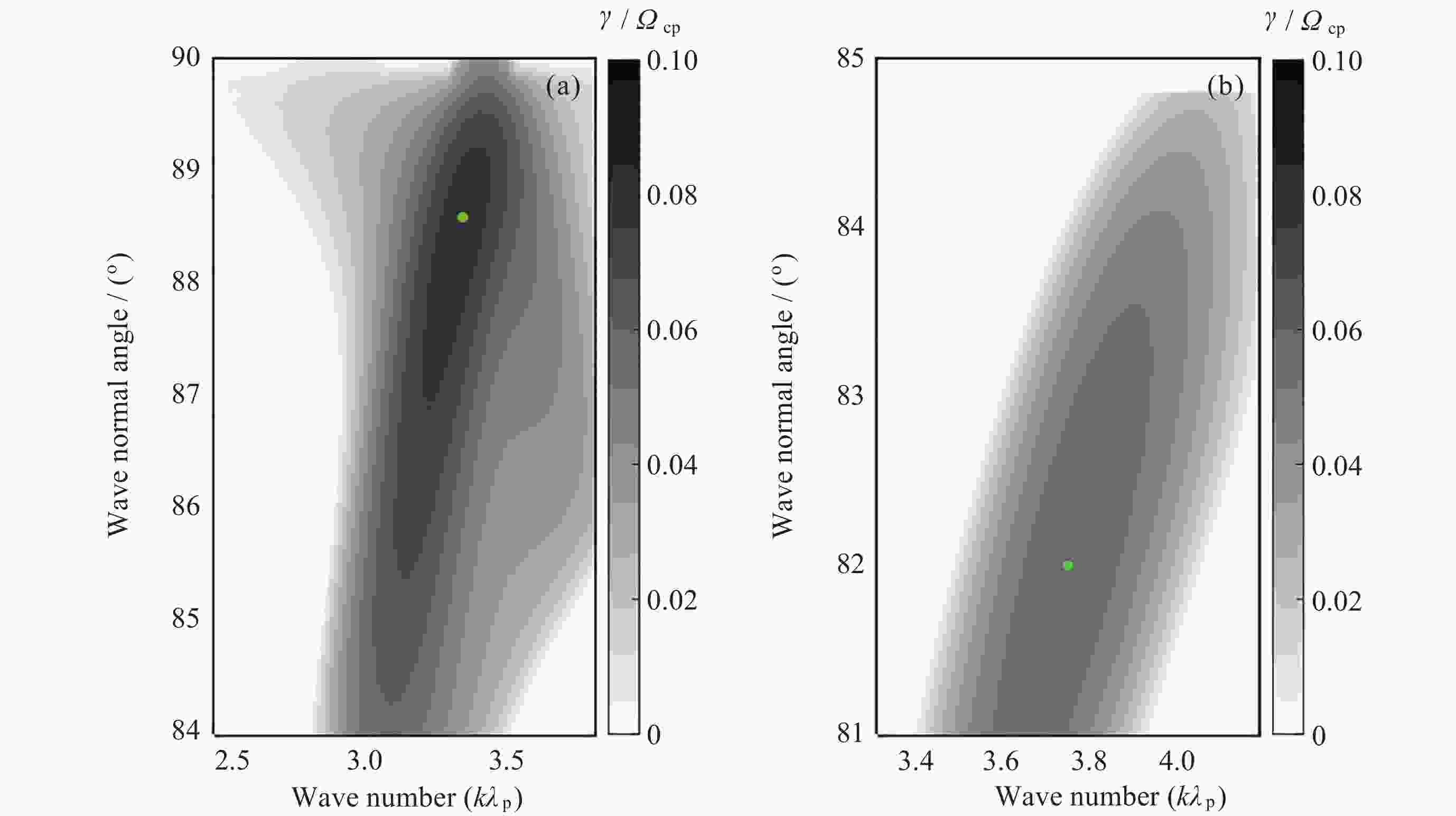
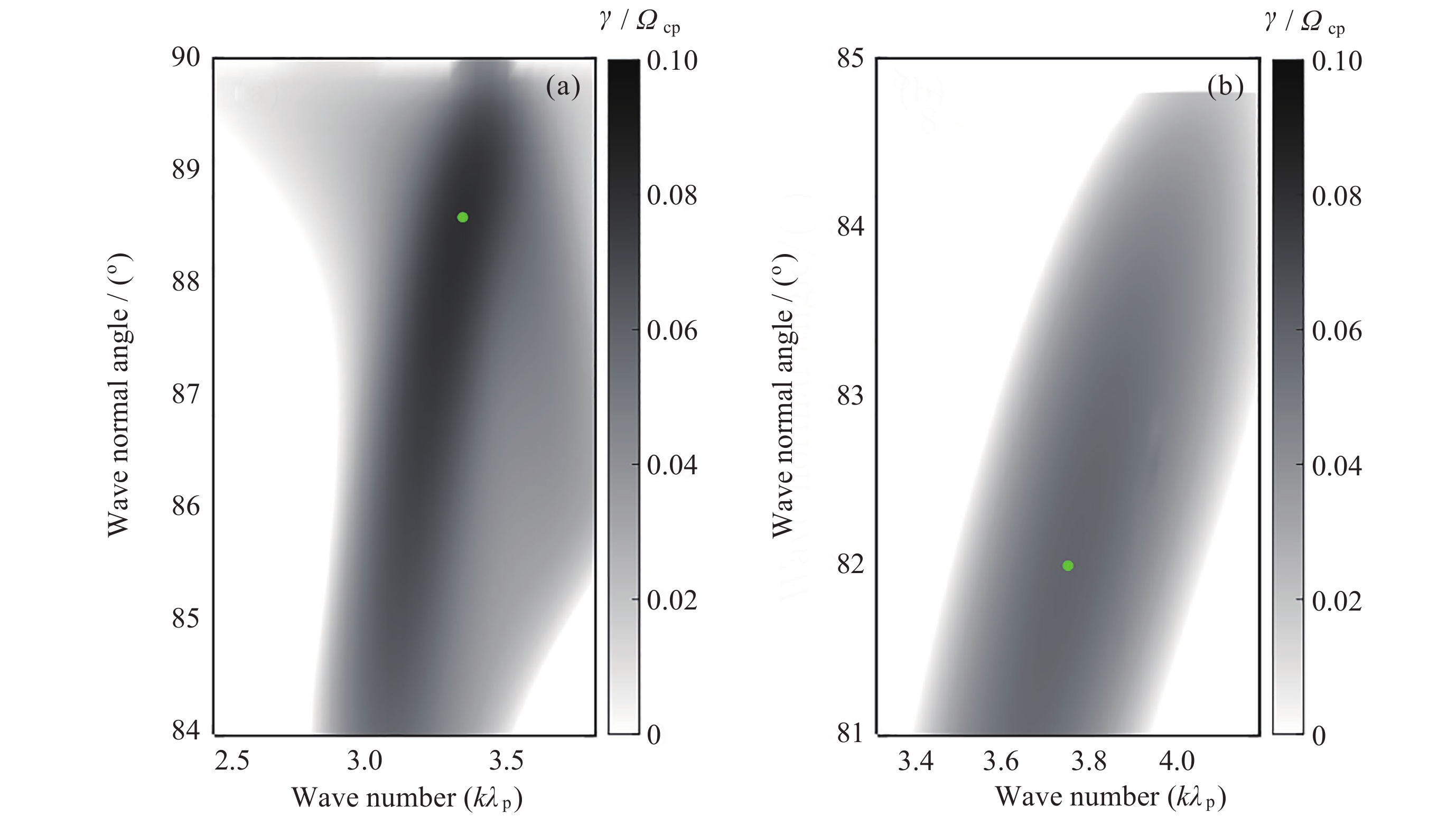
图 1 质子伯恩斯坦波不稳定性线性增长率$ \gamma $随波数$ k $和传播角$ \psi $的变化. (a)接近$ 3{{\varOmega }}_{\text{cp}} $的第三谐波模式, (b)接近$ 3.5{{\varOmega }}_{\text{cp}} $时的半倍频波模
Figure 1. Variation of the proton Bernstein instability linear growth rate ($ \gamma $) with wave number ($ k $) and wave normal angle ($ \psi $). Left panel (a) Third-harmonic mode near $ 3{{\varOmega }}_{\text{cp}} $, (b) Half-harmonic wave mode near $ 3.5{{\varOmega }}_{\text{cp}} $
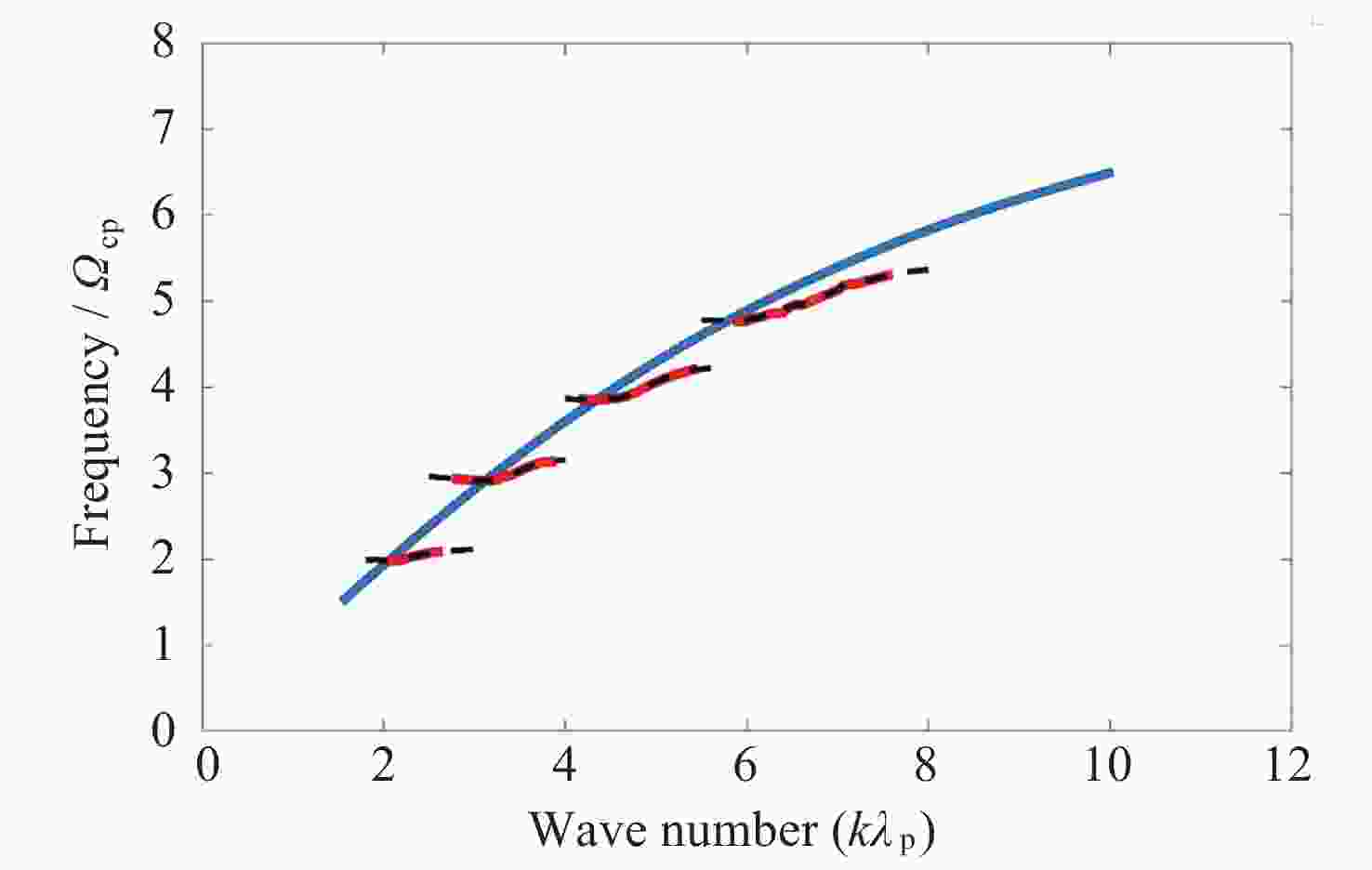
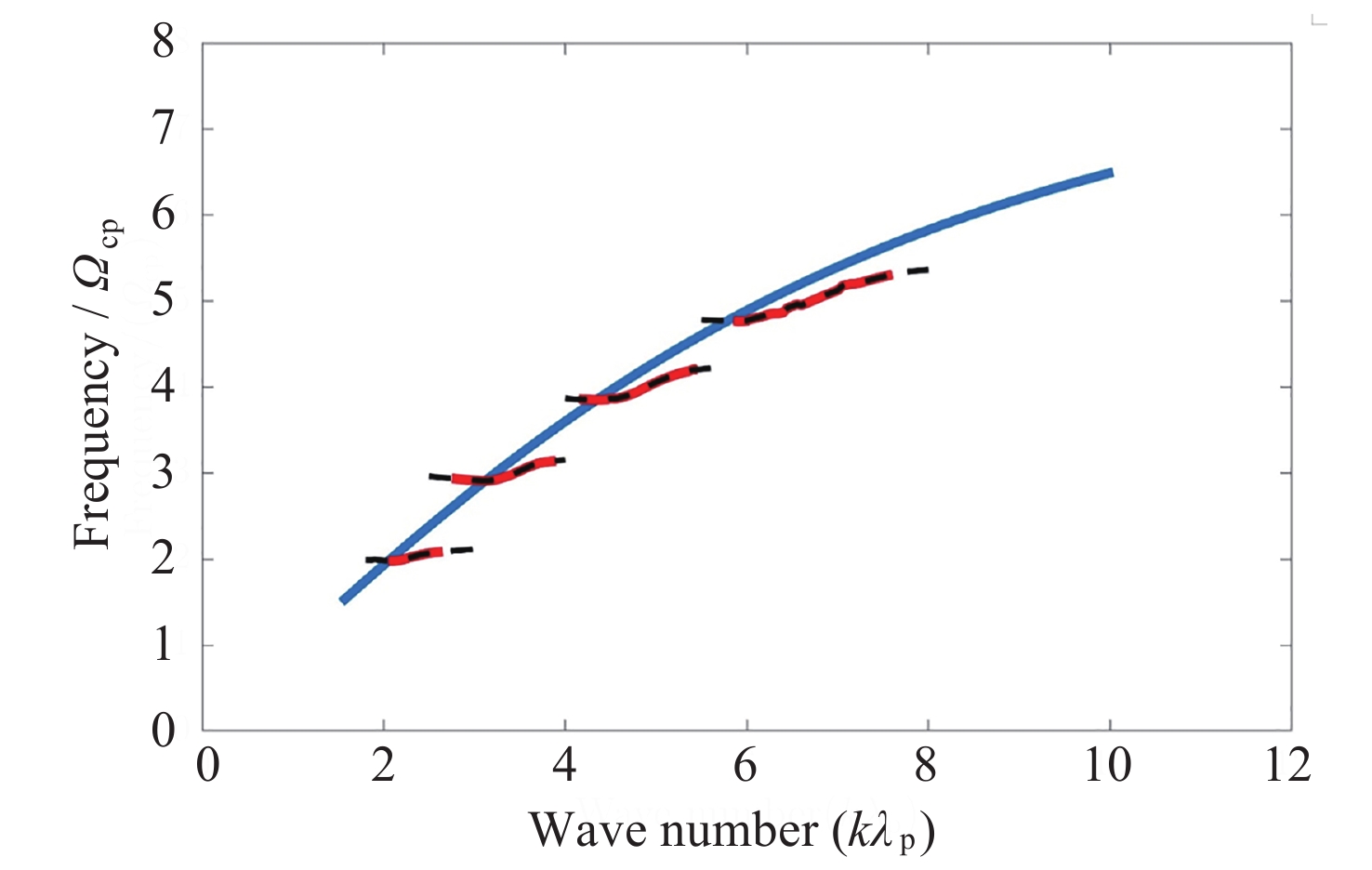
图 2 传播角为88.6°时动理学色散关系求解器计算得到的质子伯恩斯坦波模的色散关系与磁流体力学中快磁声波对应的冷等离子体色散关系曲线对比
Figure 2. Comparison between the proton Bernstein wave dispersion relation obtained from the kinetic dispersion relation solver and the cold plasma dispersion relation of fast magnetosonic waves in magnetohydrodynamics at the wave normal angle of 88.6°
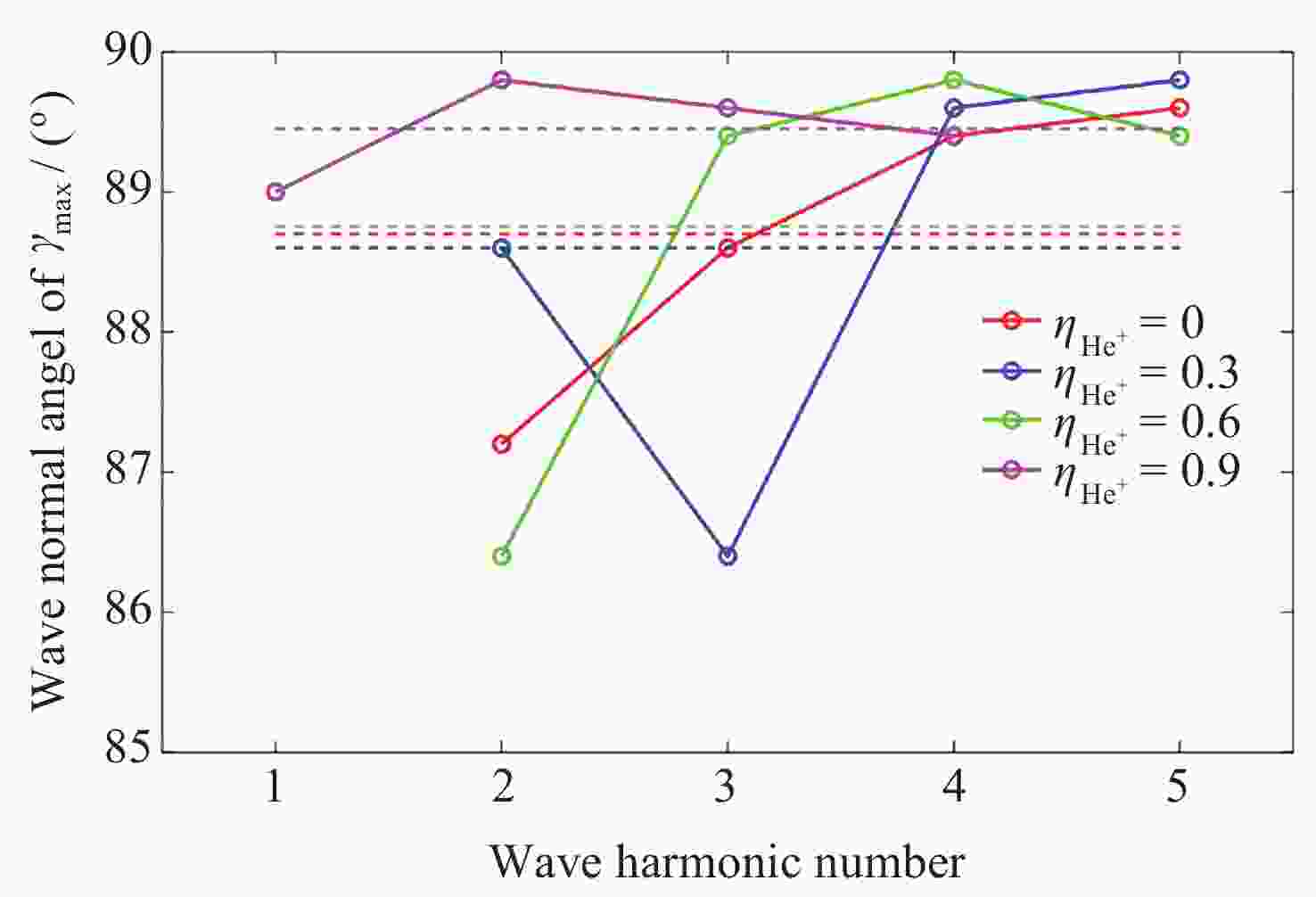
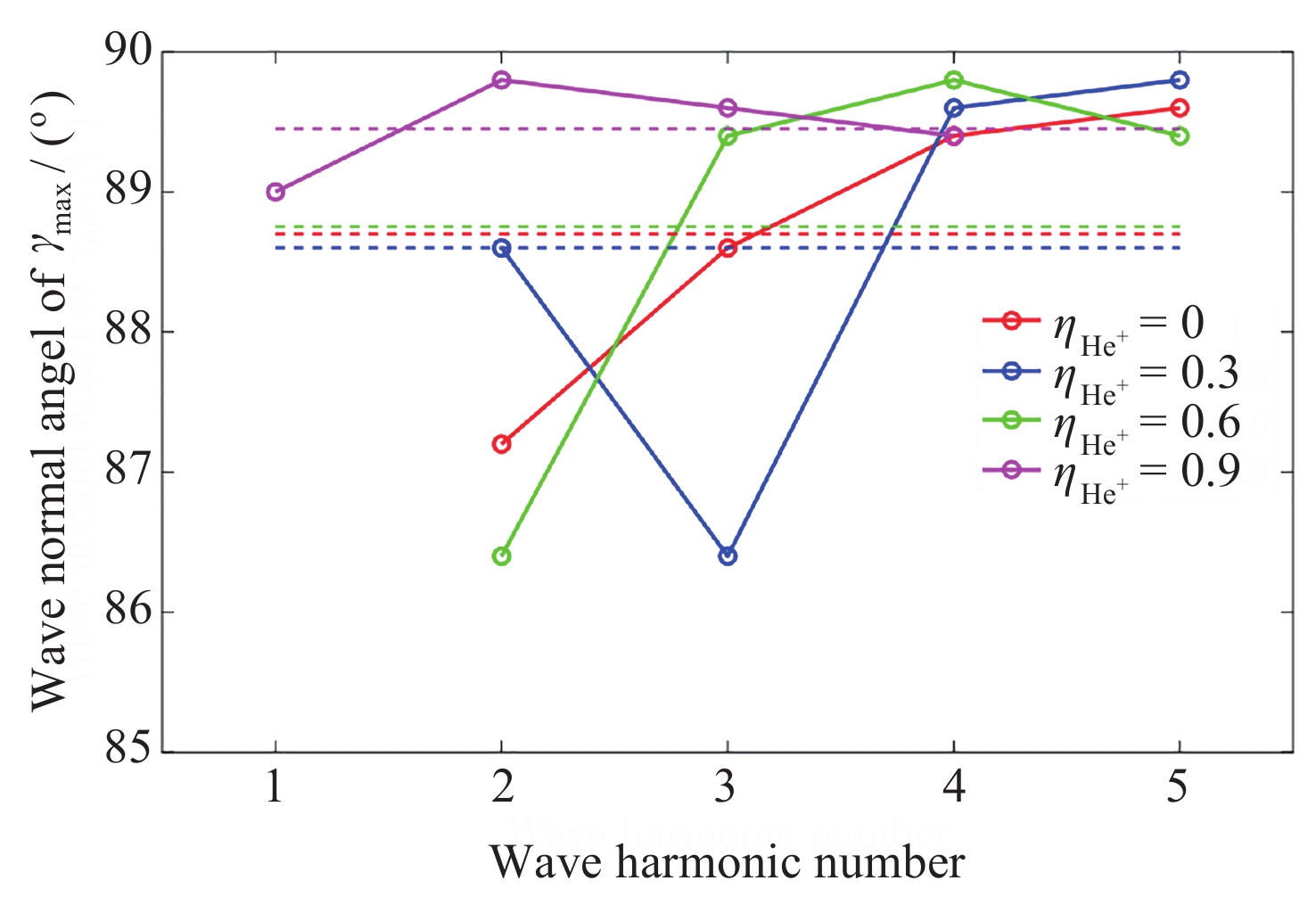
图 3 不同背景氦离子占比条件下质子伯恩斯坦波不稳定性各波模的最大增长率所在传播角的变化
Figure 3. Wave normal angles of the most unstable proton Bernstein waves at various harmonics under different background helium ion concentrations
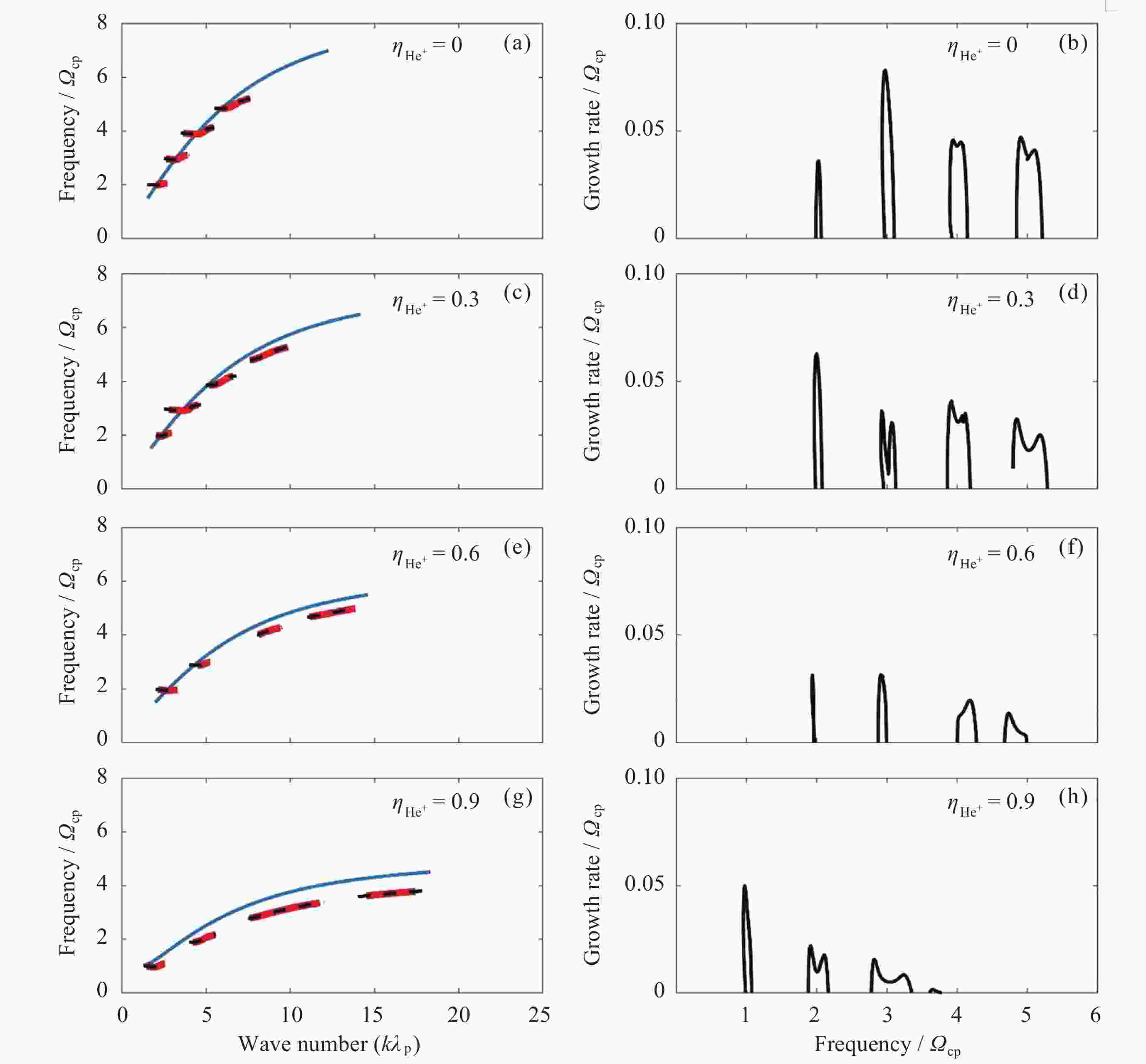
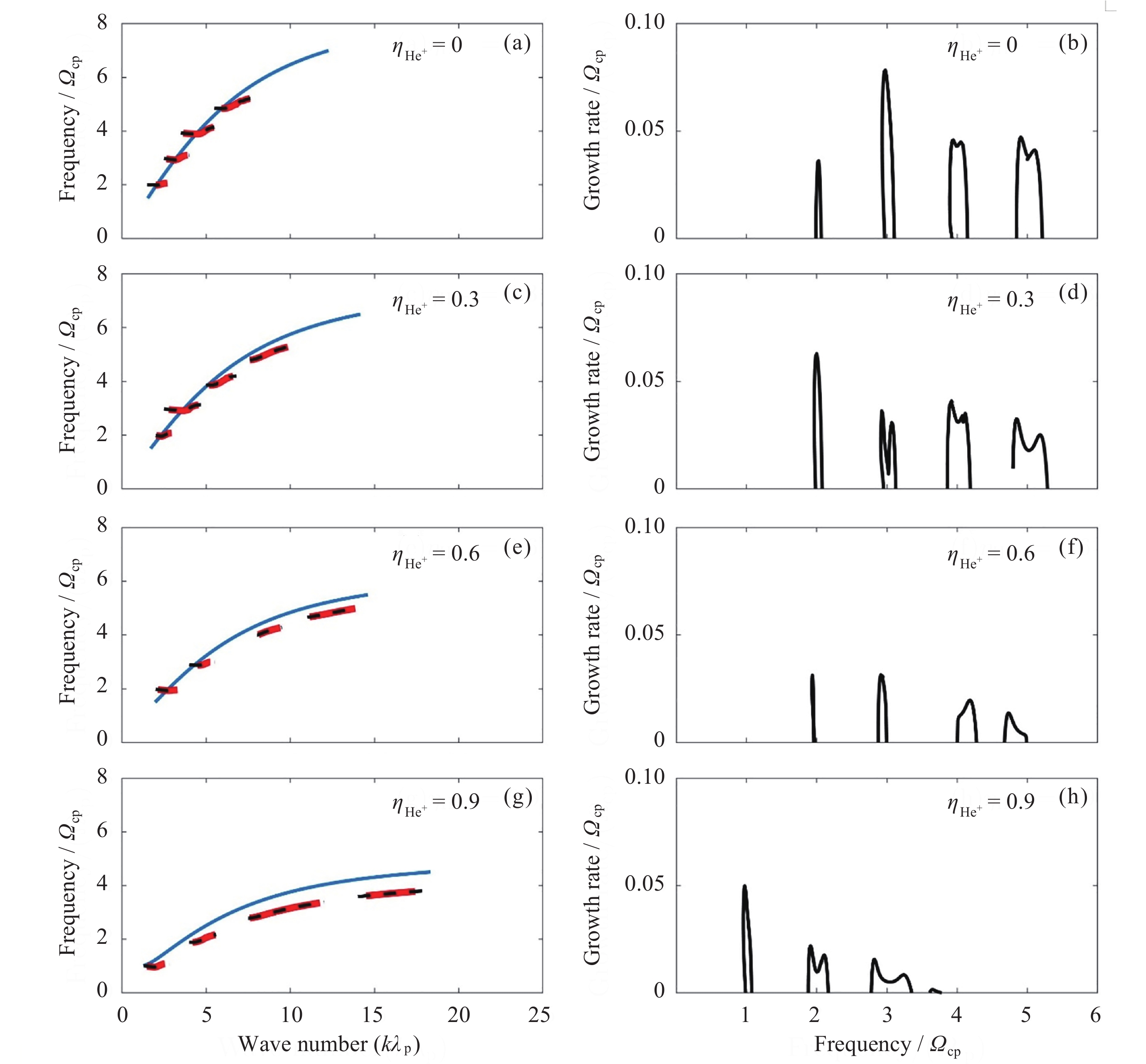
图 4 不同背景氦离子占比条件下固定传播角为89°时, 动理学色散关系求解器计算出的质子伯恩斯坦波模的色散关系与磁流体力学中对应于快磁声波的冷等离子体色散关系曲线对比(左列)以及各不稳定波模增长率γ随频率ω的变化情况(右列)
Figure 4. Comparison between the proton Bernstein wave dispersion relation obtained from the kinetic dispersion relation solver and the cold plasma dispersion relation of fast magnetosonic waves in magnetohydrodynamics (left column) and the wave growth rate γ versus frequency ω (right column) under different background helium ion concentrations and at a fixed wave normal angle of 89°
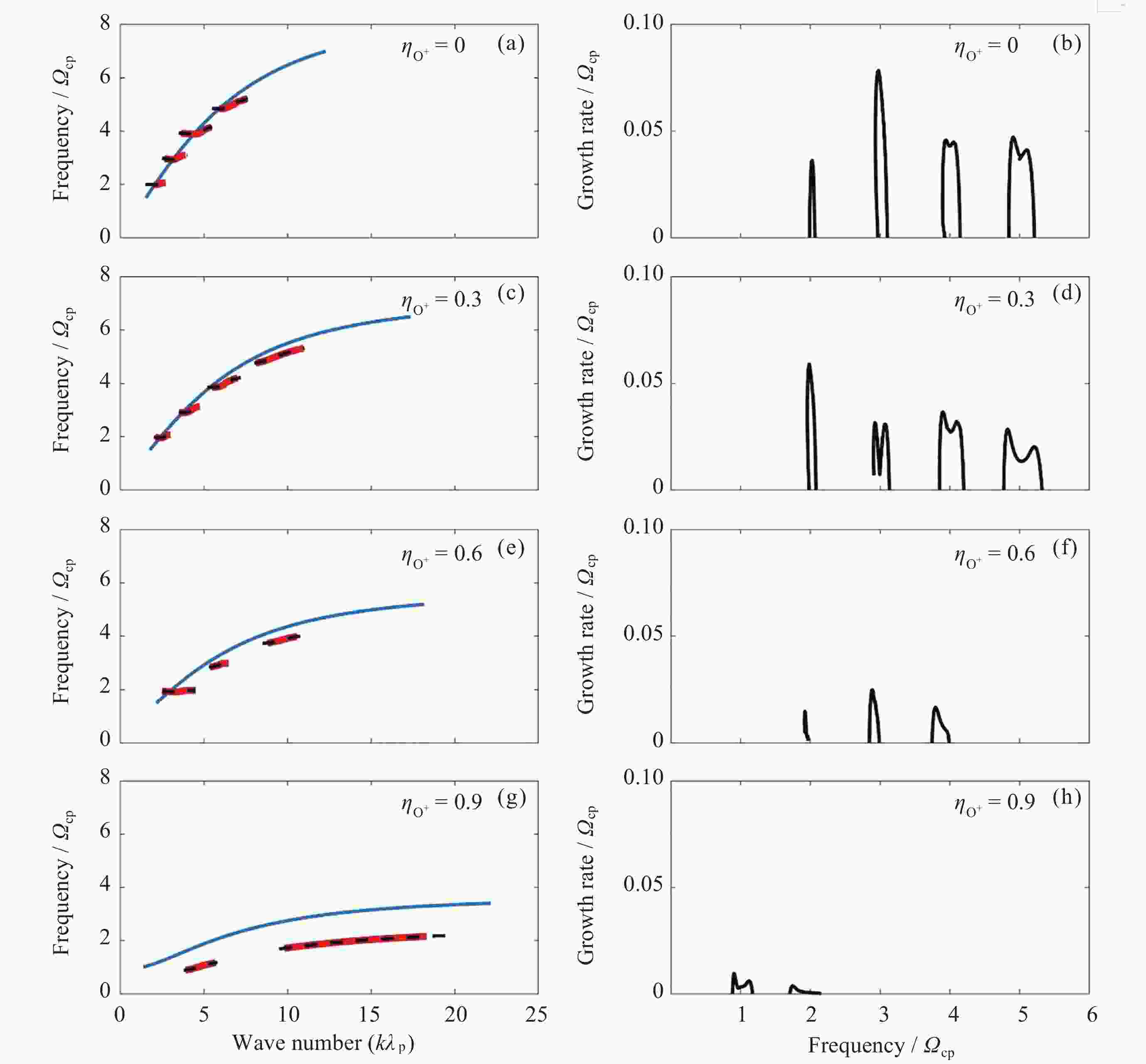
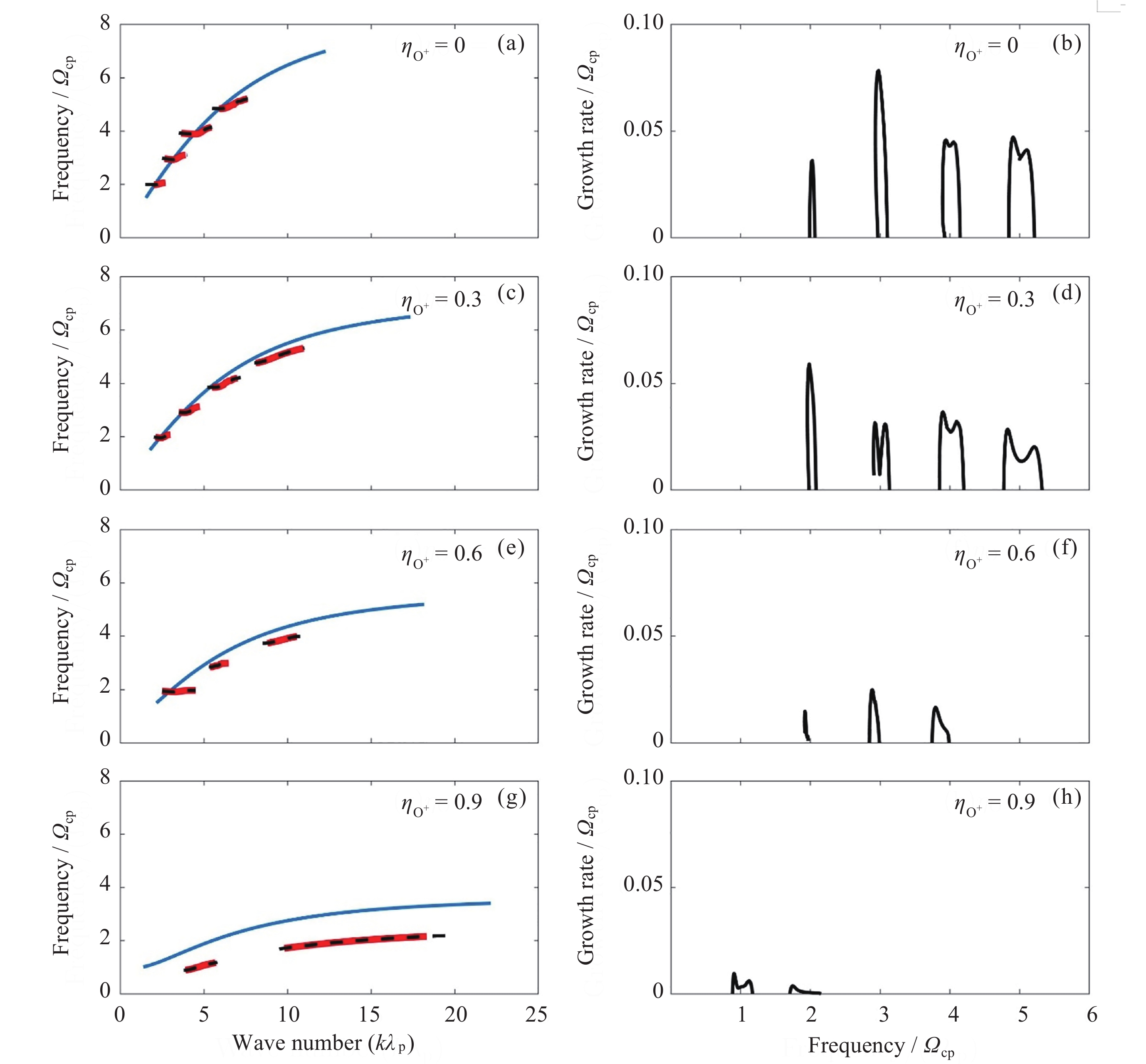
图 5 不同背景氧离子占比条件下固定传播角为89°时, 动理学色散关系求解器给出的质子伯恩斯坦波模的色散关系与磁流体力学中对应于快磁声波的冷等离子体色散关系曲线对比(左列)以及各不稳定波模增长率γ随频率ω的变化情况(右列)
Figure 5. Comparison between the proton Bernstein wave dispersion relation obtained from the kinetic dispersion relation solver and the cold plasma dispersion relation of fast magnetosonic waves in magnetohydrodynamics (left column) and the wave growth rate γ versus frequency ω (right column) under different background oxygen ion concentrations and at a fixed wave normal angle of 89°
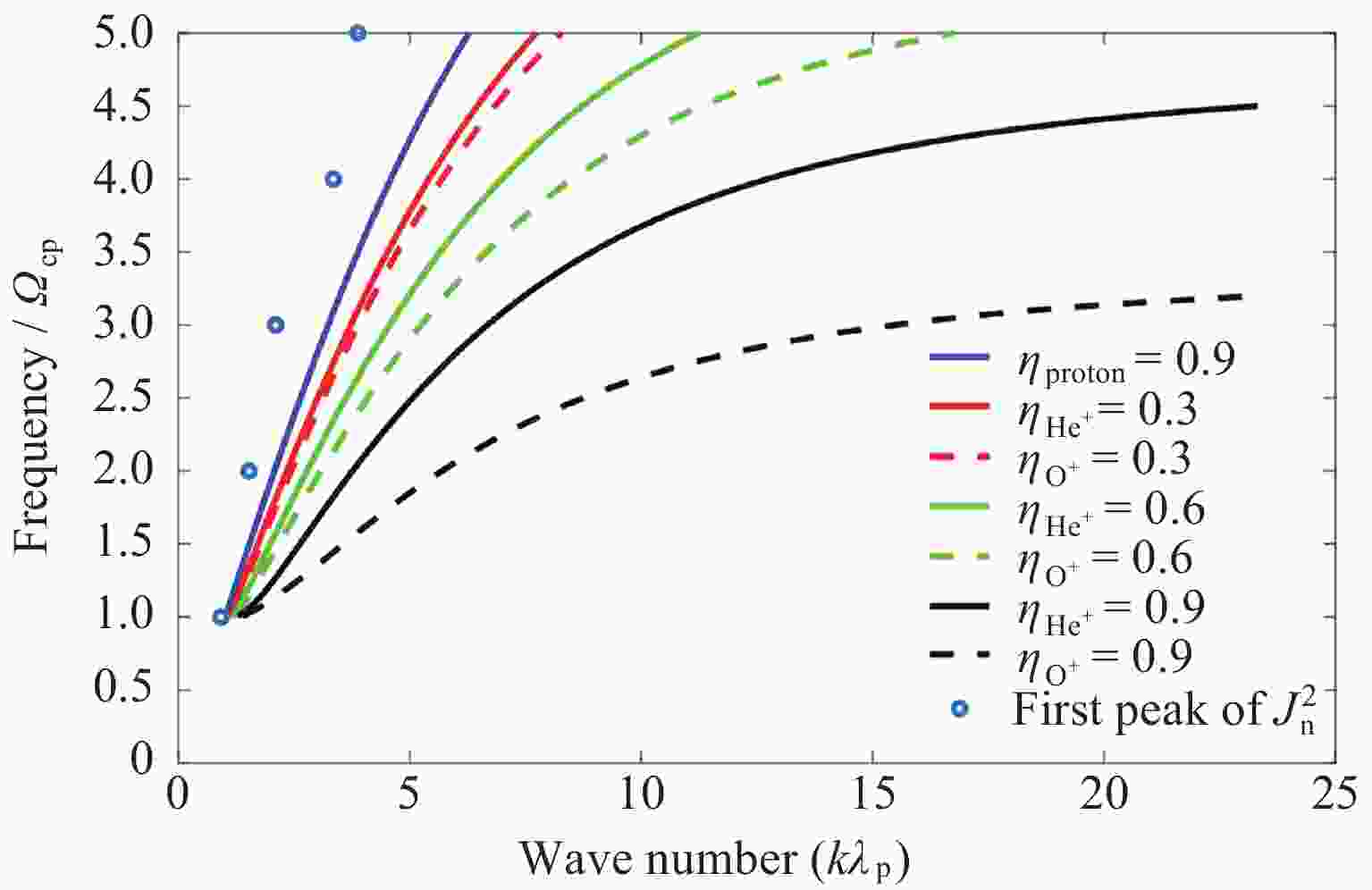
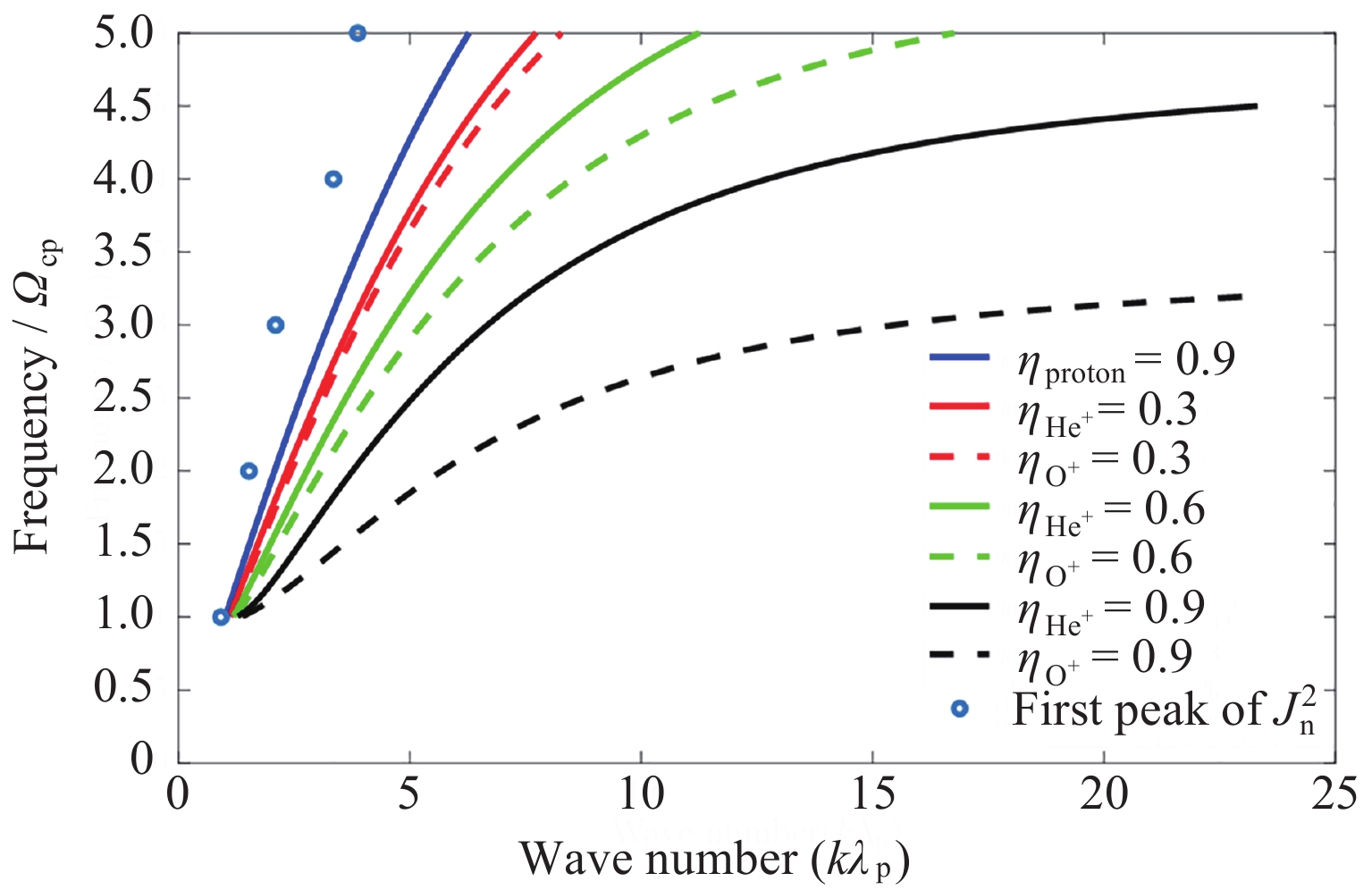
图 6 不同背景氦离子与氧离子占比条件下固定传播角为89°时, 对应于快磁声波的冷等离子体色散关系曲线与第一类贝塞尔函数$ J_{n}^{2}(\dfrac{{k}_{\bot }{v}_{\text{s}}}{{{\varOmega }}_{\text{cp}}}) $的第一峰值位置(圆圈)对比
Figure 6. Comparison between the cold plasma dispersion relations of fast magnetosonic waves and the locations of the first peaks of the squared Bessel function of the first kind, $ J_{n}^{2}(\dfrac{{k}_{\bot }{v}_{s}}{{{\varOmega }}_{\text{cp}}}) $ (marked by circles), under different background helium and oxygen ion concentrations and at a fixed wave normal angle of 89°
-
[1] SANTOLÍK O, PICKETT J S, GURNETT D A, et al. Spatiotemporal variability and propagation of equatorial noise observed by Cluster[J]. Journal of Geophysical Research: Space Physics, 2002, 107(A12): 1495 doi: 10.1029/2001ja009159 [2] PERRAUT S, ROUX A, ROBERT P, et al. A systematic study of ULF waves above FH+ from GEOS 1 and 2 measurements and their relationships with proton ring distributions[J]. Journal of Geophysical Research: Space Physics, 1982, 87(A8): 6219-6236. doi: 10.1029/JA087iA08p06219 [3] BALIKHIN M A, SHPRITS Y Y, WALKER S N, et al. Observations of discrete harmonics emerging from equatorial noise[J]. Nature Communications, 2015, 6(1): 7703 doi: 10.1038/ncomms8703 [4] RUSSELL C T, HOLZER R E, SMITH E J. OGO 3 observations of ELF noise in the magnetosphere: 1. spatial extent and frequency of occurrence[J]. Journal of Geophysical Research, 1969, 74(3): 755-777 doi: 10.1029/JA074i003p00755 [5] BOARDSEN S A, GALLAGHER D L, GURNETT D A, et al. Funnel‐shaped, low‐frequency equatorial waves[J]. Journal of Geophysical Research: Space Physics, 1992, 97(A10): 14967-14976 doi: 10.1029/92JA00827 [6] HORNE R B, WHEELER G V, ALLEYNE H S C K. Proton and electron heating by radially propagating fast magnetosonic waves[J]. Journal of Geophysical Research: Space Physics, 2000, 105(A12): 27597-27610 doi: 10.1029/2000JA000018 [7] WANG J, YU J, CHEN Z Z, et al. Local generation of magnetosonic waves by ring beam hot protons in the martian ionosphere[J]. Geophysical Research Letters, 2023, 50(9): e2023GL102911 doi: 10.1029/2023GL102911 [8] WANG J, YU J, CHEN Z Z, et al. A parametric study of locally generated magnetosonic waves by ring-beam hot protons in the Martian heavy ion-rich environment[J]. Geophysical Research Letters, 2024, 51(15): e2024GL110084 doi: 10.1029/2024GL110084 [9] MCCLEMENTS K G, DENDY R O, LASHMORE‐DAVIES C N. A model for the generation of obliquely propagating ULF waves near the magnetic equator[J]. Journal of Geophysical Research: Space Physics, 1994, 99(A12): 23685-23693 doi: 10.1029/94JA01979 [10] CHEN L J, THORNE R M, JORDANOVA V K, et al. Global simulation of magnetosonic wave instability in the storm time magnetosphere[J]. Journal of Geophysical Research: Space Physics, 2010, 115(A11): A11222 doi: 10.1029/2010ja015707 [11] MIN K, LIU K J. Fast magnetosonic waves driven by shell velocity distributions[J]. Journal of Geophysical Research: Space Physics, 2015, 120(4): 2739-2753 doi: 10.1002/2015JA021041 [12] MIN K, LIU K J. Regime transition of ion Bernstein instability driven by ion shell velocity distributions[J]. Journal of Geophysical Research: Space Physics, 2015, 120(10): 8448-8454 doi: 10.1002/2015JA021514 [13] XIAO F L, ZHOU Q H, HE Z G, et al. Magnetosonic wave instability by proton ring distributions: simultaneous data and modeling[J]. Journal of Geophysical Research: Space Physics, 2013, 118(7): 4053-4058 doi: 10.1002/jgra.50401 [14] YUAN Z G, OUYANG Z H, YU X D, et al. Global distribution of proton rings and associated magnetosonic wave instability in the inner magnetosphere[J]. Geophysical Research Letters, 2018, 45(19): 10160-10166 doi: 10.1029/2018gl079999 [15] WALKER S N, BALIKHIN M A, SHKLYAR D R, et al. Experimental determination of the dispersion relation of magnetosonic waves[J]. Journal of Geophysical Research: Space Physics, 2015, 120(11): 9632-9650 doi: 10.1002/2015JA021746 [16] YU X D, YUAN Z G, YAO F, et al. Electromagnetic characteristics of fast magnetosonic waves in the inner magnetosphere[J]. Journal of Geophysical Research: Space Physics, 2021, 126(9): e2021JA029759 doi: 10.1029/2021JA029759 [17] GAO Z L, LIU S, XIAO F L, et al. Observation and fully thermal simulation of quasi-electrostatic magnetosonic waves[J]. Geophysical Research Letters, 2021, 48(24): e2021GL095757 doi: 10.1029/2021GL095757 [18] LIU S, WANG W Y, GAO Z L, et al. Dependence of quasi-electrostatic magnetosonic wave generation on plasma density and suprathermal protons[J]. Geophysical Research Letters, 2023, 50(8): e2023GL103083 doi: 10.1029/2023GL103083 [19] GAO Z L, ZHOU Y X, YANG H M, et al. A statistical study of quasi-electrostatic magnetosonic waves[J]. Journal of Geophysical Research: Space Physics, 2024, 129(1): e2023JA032064 doi: 10.1029/2023JA032064 [20] YAO F, LIU K J, YU X D, et al. Scattering of radiation belt electrons by fast magnetosonic waves: considering the kinetic effects[J]. Geophysical Research Letters, 2023, 50(8): e2023GL103292 doi: 10.1029/2023GL103292 [21] LIU K J, GARY S P, WINSKE D. Excitation of magnetosonic waves in the terrestrial magnetosphere: particle‐in‐cell simulations[J]. Journal of Geophysical Research: Space Physics, 2011, 116(A7): A07212 doi: 10.1029/2010ja016372 [22] MIN K, LIU K J. Understanding the growth rate patterns of ion Bernstein instabilities driven by ring-like proton velocity distributions[J]. Journal of Geophysical Research: Space Physics, 2016, 121(4): 3036-3049 doi: 10.1002/2016JA022524 [23] LIU X, CHEN L J, WANG X Y. Magnetosonic wave instability by proton ring and shell distributions[J]. Frontiers in Astronomy and Space Sciences, 2024, 11: 1446194 doi: 10.3389/fspas.2024.1446194 [24] MIN K, LIU K J. Proton velocity ring‐driven instabilities in the inner magnetosphere: linear theory and particle‐in‐cell simulations[J]. Journal of Geophysical Research: Space Physics, 2016, 121(1): 475-491 doi: 10.1002/2015JA022042 [25] MIN K, LIU K J, WANG X Y, et al. Fast magnetosonic waves observed by Van Allen Probes: testing local wave excitation mechanism[J]. Journal of Geophysical Research: Space Physics, 2018, 123(1): 497-512 doi: 10.1002/2017JA024867 -
-

 下载:
下载:

计量
- 文章访问数: 784
- HTML全文浏览量: 140
- PDF下载量: 93
-
被引次数:
0(来源:Crossref)
0(来源:其他)

