


载人航天任务中的空间辐射环境、效应与探测
doi: 10.11728/cjss2026.05.2025-0233 cstr: 32142.14.cjss.2025-0233
-
 贺鹏志 男, 1997年11月出生于山东省潍坊市, 现为山东大学空间科学研究院在读博士生, 主要研究方向为空间辐射环境数据分析、粒子探测、辐射生物效应等. E-mail: hpz@mail.sdu.edu.cn
 -
 贾向红 女, 1973年9月出生于山西省太原市, 现为山东大学空间科学研究院研究员, 主要研究方向为空间辐射探测技术、辐射防护、剂量学等. E-mail: jiaxh@sdu.edu.cn
作者简介:
通讯作者:
Space Radiation Environment, Effects and Detection in Manned Space Missions
-
摘要: 随着人类航天活动由近地空间向地月空间和行星际区域拓展, 空间辐射已成为制约任务可靠性与人类长期驻留能力的基础安全问题. 多源、高能、强时变的空间辐射环境, 对航天器安全和人体健康构成持续且难以预测的风险挑战. 尤其在失去地磁场保护的深空探测任务中, 空间辐射的时空特征与作用机制更加复杂, 对辐射监测与风险评估提出更高要求. 针对上述挑战, 有必要在环境认知、辐射影响和探测技术等层面开展研究. 本文围绕空间辐射环境特征及其航天器和生物效应, 以及辐射探测与剂量表征方法, 梳理相关研究进展, 并结合典型航天任务加以分析, 可为载人航天任务的辐射监测与风险评估提供科学依据, 对未来深空探测的安全性论证具有重要参考价值.Abstract: As human space activities extend from low Earth orbit to the cislunar region and interplanetary space, space radiation has emerged as a fundamental safety issue constraining mission reliability and the feasibility of long-term human presence beyond Earth. Characterized by multiple sources, high particle energies, and strong temporal variability, the space radiation not only affects the reliability of spacecraft structural materials and electronic systems, but also poses potential risks to the physiological functions and long-term health of astronauts. In low Earth orbit, the radiation environment is primarily composed of trapped particle radiation, galactic cosmic rays, and sporadic high-intensity solar particle events. For deep-space exploration missions beyond the protection of the geomagnetic field, the spatiotemporal behavior and interaction mechanisms of space radiation become increasingly complex, exposing both spacecraft systems and astronauts to elevated radiation levels and cumulative effects. Meanwhile, long-duration missions involving extended habitation within spacecraft or extraterrestrial bases further amplify the effect of radiation on mission design and feasibility. This necessitates greater rigor in radiation monitoring, effects analysis, and risk assessment. To address these challenges, a systematic study integrating environmental characterization, radiation effects, and detection technologies is needed. This paper reviews the characteristics of the space radiation environment and its effects on both spacecraft systems and biological organisms. It further introduces the principles and current development of radiation detection technologies, including various dosimetric methods, particle identification techniques, and energy spectrum measurement approaches. In addition, representative space missions are examined as case studies to illustrate the evolution of radiation monitoring strategies and in-orbit measurement capabilities. Overall, this study provides a comprehensive review of the space radiation environment, its effects, and associated detection technologies in the context of human spaceflight. This study provides a scientific basis for radiation monitoring and risk assessment in manned spaceflight, and offers important references for safety analyses and mission design in deep-space exploration.
-
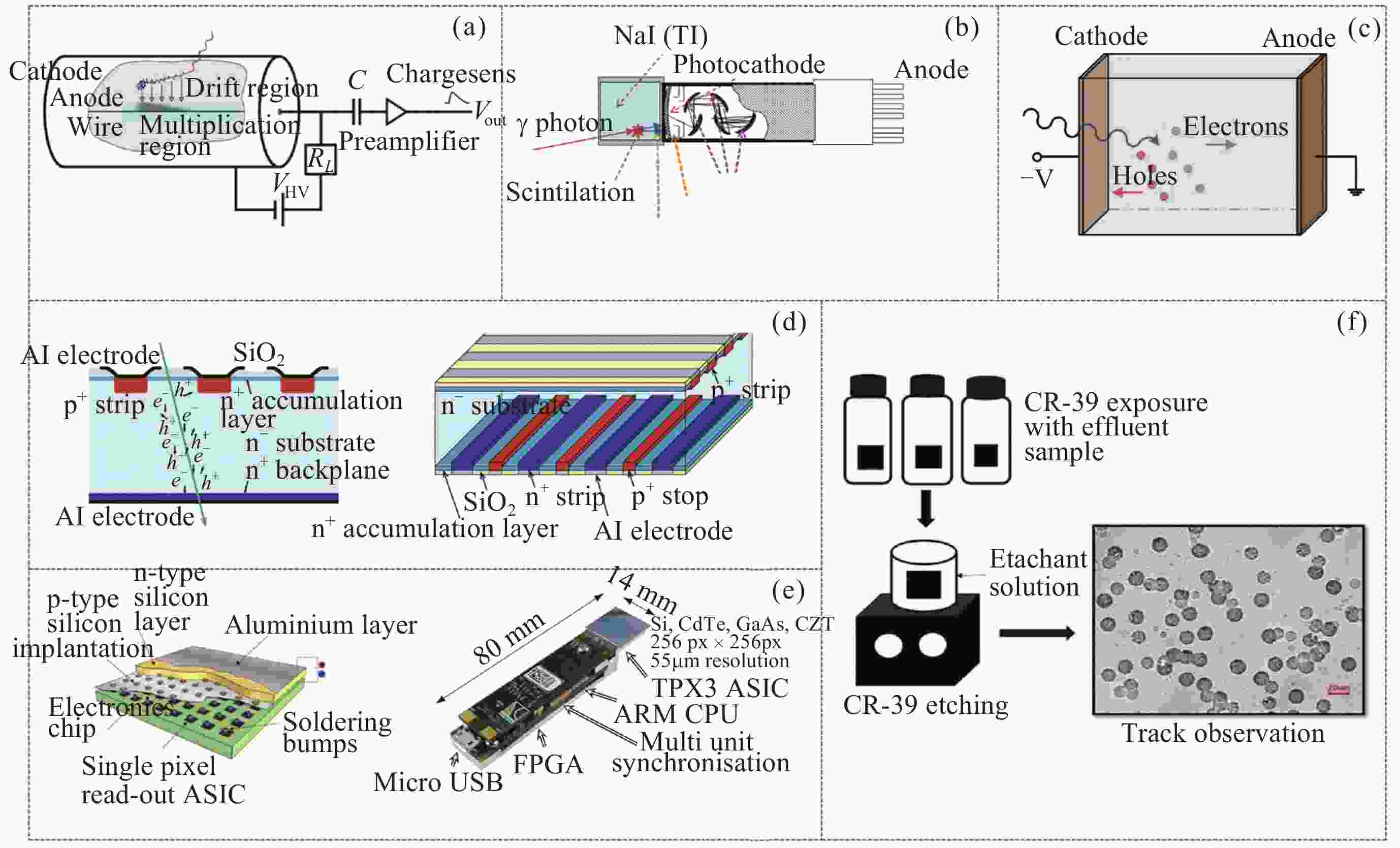
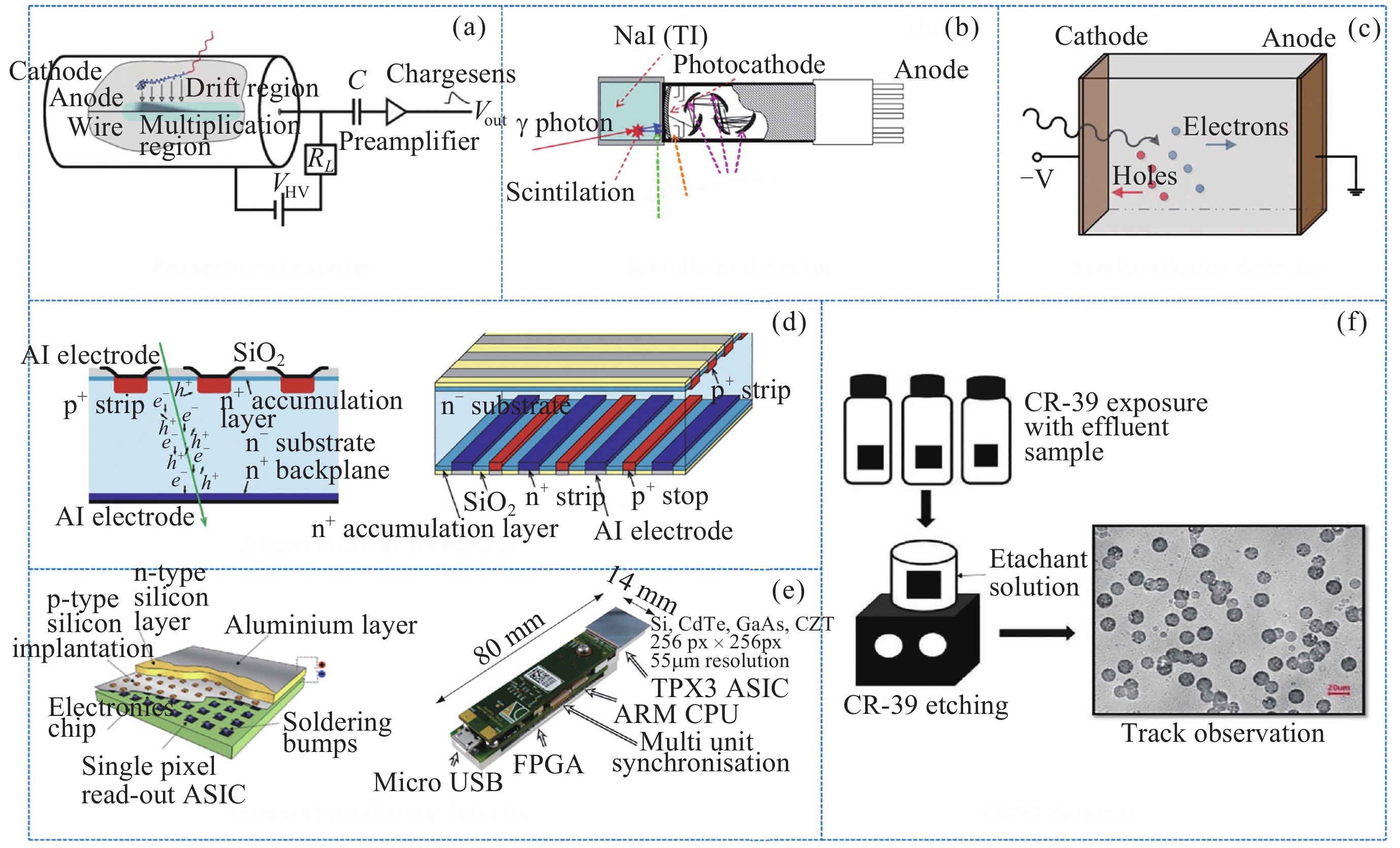
表 1 空间辐射探测器类型及性能特征概述
Table 1. Overview of types and performance characteristics of space radiation detectors
探测器
类型代表器件 探测原理 主要监测指标 数据主要用途 监测能力 主动型
探测器气体
探测器电离室
正比计数器
GM计数管
多丝正比室带电粒子在气体中电离产生电子-离子对, 外加电场收集电荷形成电信号 电离电流、脉冲计数、沉积能量 辐射剂量监测、粒子计数、能谱
分析结构可靠、环境适应性强, 高计数率及累积测量能力, 空间分辨率中等 闪烁体
探测器无机闪烁体(NaI(Tl)和CsI(Tl)等)
有机闪烁体(液体及塑料闪烁体)
气体闪烁体入射粒子激发介质原子或分子, 退激释放光子, 光电器件转换为电信号 光子信号、沉积能量、时间信息 粒子快速计数、能谱分析、时间分辨测量 响应快、探测效率高、具备高通量监测能力, 能量分辨率中等 半导体
探测器硅、锗
宽禁带(碳化硅、
氮化镓等)
超宽禁带(金刚石、
氧化镓、氮化铝等)粒子在半导体中产生电子-空穴对, 偏置电场收集电荷, 信号与沉积能量成正比 感生电荷、沉积能量、能量分辨 能谱精密测量、粒子种类判别、辐射环境监测 能量分辨率高、体积较小, 对高温和强辐照环境适应性强 多通道阵列探测器 硅微条
混合像素阵列
CMOS像素阵列基于半导体原理, 每个像素独立收集电子-空穴对, 经集成读出电路实现空间、能量及时间信息同步采集 空间分布、径迹形态、沉积能量、飞行时间 粒子径迹重建、事件成像、混合辐射场分析 高空间分辨率、多维信息采集、实时在轨监测、可区分高能粒子与背景 被动型探测器 核径迹探测器
荧光探测器(如热释光和光致发光探测器)
核乳胶探测器入射粒子在材料中形成微观损伤或亚稳态缺陷, 然后通过化学或热处理读取信号 累积剂量、径迹密度 长期剂量评估、辐射风险分析、校准主动型探测器 灵敏度高、体积小、结构稳健, 但无实时测量, 种类和能谱分辨能力有限  下载: 导出CSV
-
[1] BOURDARIE S, XAPSOS M. The near-earth space radiation environment[J]. IEEE Transactions on Nuclear Science, 2008, 55(4): 1810-1832 doi: 10.1109/TNS.2008.2001409 [2] GU Y D. The China space station: a new opportunity for space science[J]. National Science Review, 2021, 9(1): nwab219 doi: 10.1093/nsr/nwab219 [3] CHEN H F, ZOU H, SHI W H, et al. High energy charged particle experiment–a payload proposal to KuaFu-B mission[J]. Advances in Space Research, 2009, 44(1): 39-45 doi: 10.1016/j.asr.2009.02.001 [4] KOSKINEN H E J, KILPUA E K J. Radiation belts and their environment[M]//KOSKINEN H E J, KILPUA E K J. Physics of Earth’s Radiation Belts: Theory and Observations. Cham: Springer, 2022: 1-25 [5] 曹兴, 倪彬彬, 雷源, 等. 地球辐射带电子数据同化建模研究进展[J]. 地球与行星物理论评(中英文), 2026, 57(3): 292-309 doi: 10.19975/j.dqyxx.2025-022CAO Xing, NI Binbin, LEI Yuan, et al. Research advances in the data assimilative modeling of the earth’s radiation belt electrons[J]. Reviews of Geophysics and Planetary Physics, 2026, 57(3): 292-309 doi: 10.19975/j.dqyxx.2025-022 [6] ZONG Q G, YUAN C J, WANG Y F, et al. Dynamic variation and the fast acceleration of particles in earth’s radiation belt[J]. Science China Earth Sciences, 2013, 56(7): 1118-1140 doi: 10.1007/s11430-013-4644-z [7] ANDERSON P C, RICH F J, BORISOV S. Mapping the south Atlantic anomaly continuously over 27 years[J]. Journal of Atmospheric and Solar-Terrestrial Physics, 2018, 177: 237-246 doi: 10.1016/j.jastp.2018.03.015 [8] 史全岐, 张江, 乐超, 等. 地月空间粒子辐射环境及其对月表物质的影响研究进展[J]. 地球物理学报, 2023, 66(7): 2685-2702 doi: 10.6038/cjg2022Q0892SHI Quanqi, ZHANG Jiang, YUE Chao, et al. Review of particle radiation environment of the earth-moon space and its impact on Lunar surficial material generation[J]. Chinese Journal of Geophysics, 2023, 66(7): 2685-2702 doi: 10.6038/cjg2022Q0892 [9] BELOV A, SHLYK N, ABUNINA M, et al. Solar energetic particle events and Forbush decreases driven by the same solar sources[J]. Universe, 2022, 8(8): 403 doi: 10.3390/universe8080403 [10] MELKUMYAN A A, BELOV A V, SHLYK N S, et al. Forbush decreases and geomagnetic disturbances: 1. Events associated with different types of solar and interplanetary sources[J]. Geomagnetism and Aeronomy, 2023, 63(6): 686-700 doi: 10.1134/S0016793223600650 [11] 马宇倩, 王焕玉, 张承模, 等. 2001年4月2日太阳耀斑及其太阳质子事件的观测结果研究[J]. 地球物理学报, 2004, 47(5): 737-742 doi: 10.3321/j.issn:0001-5733.2004.05.001MA Yuqian, WANG Huanyu, ZHANG Chengmo, et al. A conjunctive study of solar flare 20010402 and related solar proton events by the observation of SZ2/XD and ZY1/CBMC[J]. Chinese Journal of Geophysics, 2004, 47(5): 737-742 doi: 10.3321/j.issn:0001-5733.2004.05.001 [12] 邹鸿, 肖佐, 郝永强, 等. “资源一号”卫星星内粒子探测器对扰动事件的观测[J]. 地球物理学报, 2006, 49(3): 636-641 doi: 10.3321/j.issn:0001-5733.2006.03.005ZOU Hong, XIAO Zuo, HAO Yongqiang, et al. Observation of the disturbed events by the particle detector inside “ZY-1” satellite[J]. Chinese Journal of Geophysics, 2006, 49(3): 636-641 doi: 10.3321/j.issn:0001-5733.2006.03.005 [13] REAMES D V. What are the sources of solar energetic particles? Element abundances and source plasma temperatures[J]. Space Science Reviews, 2015, 194(1/2/3/4): 303-327 doi: 10.1007/s11214-015-0210-7 [14] GOPALSWAMY N, XIE H, AKIYAMA S, et al. Major solar eruptions and high-energy particle events during solar cycle 24[J]. Earth, Planets and Space, 2014, 66(1): 104 doi: 10.1186/1880-5981-66-104 [15] JIN W, WEI W S, CHEN L, et al. The charged particle detection system of the SRD module onboard the China space station[J]. Nuclear Instruments and Methods in Physics Research Section A: Accelerators, Spectrometers, Detectors and Associated Equipment, 2024, 1064: 169463 doi: 10.1016/j.nima.2024.169463 [16] ZEITLIN C, CASTRO A J, BEARD K B, et al. Results from the radiation assessment detector on the international space station, part 2: the fast neutron detector[J]. Life Sciences in Space Research, 2023, 39: 76-85 doi: 10.1016/j.lssr.2023.03.005 [17] WANG H Z, ZHANG J, SHI Q Q, et al. Earth wind as a possible exogenous source of lunar surface hydration[J]. The Astrophysical Journal Letters, 2021, 907(2): L32 doi: 10.3847/2041-8213/abd559 [18] YU X Q, CHEN H F, ZONG Q G, et al. Mitigating deep dielectric charging effects in space[J]. IEEE Transactions on Nuclear Science, 2017, 64(11): 2822-2828 doi: 10.1109/TNS.2017.2759199 [19] 杨艳, 郑义, 高志强, 等. 等离子体对空间飞行器表面充电效应探测研究[J]. 遥测遥控, 2020, 41(6): 51-56,68 doi: 10.13435/j.cnki.ttc.003105YANG Yan, ZHENG Yi, GAO Zhiqiang, et al. Research on detection scheme and application technology of surface charge effect for spacecraft[J]. Journal of Telemetry, Tracking and Command, 2020, 41(6): 51-56,68 doi: 10.13435/j.cnki.ttc.003105 [20] 黄建国, 韩建伟. 航天器内部充电效应及典型事例分析[J]. 物理学报, 2010, 59(4): 2907-2913 doi: 10.7498/aps.59.2907HUANG Jianguo, HAN Jianwei. Analysis of a typical internal charging induced spacecraft anomaly[J]. Acta Physica Sinica, 2010, 59(4): 2907-2913 doi: 10.7498/aps.59.2907 [21] LU Y F, SHAO Q, YUE H H, et al. A review of the space environment effects on spacecraft in different orbits[J]. IEEE Access, 2019, 7: 93473-93488 doi: 10.1109/ACCESS.2019.2927811 [22] Khamidullina N M, Zefirov I V, Chernikov P S. Analysis of single event effects created by space ionizing radiation in the microcircuits of the interplanetary spacecraft radio electronic equipment[J]. Solar System Research, 2022, 56(7): 537-544 doi: 10.1134/S0038094622070115 [23] 贾向红, 邹鸿, 许峰, 等. 空间电子辐射风险及其防护策略研究进展[J]. 航天医学与医学工程, 2014, 27(6): 453-457 doi: 10.16289/j.cnki.1002-0837.2014.06.016JIA Xianghong, ZOU Hong, XU Feng, et al. Research progress of space electrons radiation risk and its protection strategy[J]. Space Medicine & Medical Engineering, 2014, 27(6): 453-457 doi: 10.16289/j.cnki.1002-0837.2014.06.016 [24] 赵磊, 尚钰轩, 袁爽, 等. 载人深空探索中空间辐射防护技术的研究进展[J]. 科学通报, 2019, 64(20): 2087-2103 doi: 10.1360/N972019-00096ZHAO Lei, SHANG Yuxuan, YUAN Shuang, et al. Research progress of space radiation protection technologies in manned deep space exploration missions[J]. Chinese Science Bulletin, 2019, 64(20): 2087-2103 doi: 10.1360/N972019-00096 [25] SIMONSEN L C, NEALY J E, SAUER H H, et al. Solar flare protection for manned lunar missions: analysis of the October 1989 proton flare event[C]//International Conference on Environmental Systems. San Francisco: SAE, 1991 [26] NWANKWO V U J, JIBIRI N N, KIO M T. The impact of space radiation environment on satellites operation in near-earth space[M]//DEMYANOV V, BECEDAS J. Satellites Missions and Technologies for Geosciences. London: IntechOpen, 2020 [27] MAURER R H, FRETZ K, ANGERT M P, et al. Radiation-induced single-event effects on the Van Allen probes spacecraft[J]. IEEE Transactions on Nuclear Science, 2017, 64(11): 2782-2793 doi: 10.1109/TNS.2017.2754878 [28] LOTO'ANIU T M, SINGER H J, RODRIGUEZ J V, et al. Space weather conditions during the Galaxy 15 spacecraft anomaly[J]. Space Weather, 2015, 13(8): 484-502 doi: 10.1002/2015SW001239 [29] 沈自才, 夏彦, 杨艳斌, 等. 航天器空间辐射防护材料与防护结构[J]. 宇航材料工艺, 2020, 50(2): 1-7 doi: 10.12044/j.issn.1007-2330.2020.02.001SHEN Zicai, XIA Yan, YANG Yanbin, et al. Protection of materials and structures from space radiation environments on spacecraft[J]. Aerospace Materials & Technology, 2020, 50(2): 1-7 doi: 10.12044/j.issn.1007-2330.2020.02.001 [30] ANDERSON P C. Characteristics of spacecraft charging in low earth orbit[J]. Journal of Geophysical Research: Space Physics, 2012, 117(A7): A07308 [31] HAMMERL J, SCHAUB H. Coupled spacecraft charging due to continuous electron beam emission and impact[J]. Journal of Spacecraft and Rockets, 2024, 61(5): 1258-1271 doi: 10.2514/1.A36010 [32] ECONOMIDES S. Biological effects of ionizing radiations[M]//GEROULAKOS G, AVGERINOS E, BECQUEMIN J P, et al. Mastering Endovascular Techniques: Tips and Tricks in Endovascular Surgery. Cham: Springer, 2024: 3-7 [33] SABOL J. Exposure pathways and potential biological effects at different biological organizational levels[M]//GUPTA D K, WALTHER C. Radionuclide Uptake in Food and Consequences for Humans. New Jersey: World Scientific, 2025: 205-245 [34] POHJOISMÄKI J L O, GOFFART S. Adaptive and pathological outcomes of radiation stress-induced redox signaling[J]. Antioxidants & Redox Signaling, 2022, 37(4/5/6): 336-348 doi: 10.1089/ars.2021.0257 [35] CUCINOTTA F A. Non-targeted effects and space radiation risks for astronauts on multiple International Space Station and lunar missions[J]. Life Sciences in Space Research, 2024, 40: 166-175 doi: 10.1016/j.lssr.2023.08.003 [36] CHANCELLOR J C, SCOTT G B I, SUTTON J P. Space radiation: the number one risk to astronaut health beyond low earth orbit[J]. Life, 2014, 4(3): 491-510 doi: 10.3390/life4030491 [37] 康金兰, 邢雷, 赵亚丽, 等. 载人深空探索任务空间辐射风险及医学对策研究进展[J]. 载人航天, 2025, 31(5): 701-710 doi: 10.16329/j.cnki.zrht.2025.05.005KANG Jinlan, XING Lei, ZHAO Yali, et al. Research progress of space radiation risk and medical countermeasure for manned deep space exploration mission[J]. Manned Spaceflight, 2025, 31(5): 701-710 doi: 10.16329/j.cnki.zrht.2025.05.005 [38] HU S W, MONADJEMI S, BARZILLA J E, et al. Acute Radiation Risks Tool (ARRT) development for the upcoming human exploration missions[OL]. Authorea Preprints, 2022 [39] TOMSIA M, CIEŚLA J, ŚMIESZEK J, et al. Long-term space missions’ effects on the human organism: what we do know and what requires further research[J]. Frontiers in Physiology, 2024, 15: 1284644 doi: 10.3389/fphys.2024.1284644 [40] 吴康, 方美华, 张昭, 等. 空间辐射对空间站航天员的剂量影响分析[J]. 航天器环境工程, 2023, 40(5): 475-483 doi: 10.12126/see.2023041WU Kang, FANG Meihua, ZHANG Zhao, et al. Analysis of the dose effect of space radiation to astronauts on the space station[J]. Spacecraft Environment Engineering, 2023, 40(5): 475-483 doi: 10.12126/see.2023041 [41] BASELET B, AZIMZADEH O, ERBELDINGER N, et al. Differential impact of single-dose Fe ion and X-ray irradiation on endothelial cell transcriptomic and proteomic responses[J]. Frontiers in Pharmacology, 2017, 8: 570 doi: 10.3389/fphar.2017.00570 [42] MARTIN C J. The LNT model provides the best approach for practical implementation of radiation protection[J]. The British Journal of Radiology, 2005, 78(925): 14-16 doi: 10.1259/bjr/31745335 [43] KENNEDY A R. Biological effects of space radiation and development of effective countermeasures[J]. Life Sciences in Space Research, 2014, 1: 10-43 doi: 10.1016/j.lssr.2014.02.004 [44] SISHC B J, ZAWASKI J, SAHA J, et al. The need for biological countermeasures to mitigate the risk of space radiation-induced carcinogenesis, cardiovascular disease, and central nervous system deficiencies[J]. Life Sciences in Space Research, 2022, 35: 4-8 doi: 10.1016/j.lssr.2022.06.003 [45] KOLANOSKI H, WERMES N. Particle Detectors: Fundamentals and Applications[M]. Oxford: Oxford University Press, 2020 [46] JAKUBEK J, CEJNAROVA A, HOLY T, et al. Pixel detectors for imaging with heavy charged particles[J]. Nuclear Instruments and Methods in Physics Research Section A: Accelerators, Spectrometers, Detectors and Associated Equipment, 2008, 591(1): 155-158 doi: 10.1016/j.nima.2008.03.091 [47] WILLIAMS M C S. Particle identification using time of flight[J]. Journal of Physics G: Nuclear and Particle Physics, 2012, 39(12): 123001 doi: 10.1088/0954-3899/39/12/123001 [48] CAPPUZZELLO F, CARBONE D, CAVALLARO M. Measuring the ions momentum vector with a large acceptance magnetic spectrometer[J]. Nuclear Instruments and Methods in Physics Research Section A: Accelerators, Spectrometers, Detectors and Associated Equipment, 2011, 638(1): 74-82 doi: 10.1016/j.nima.2011.02.045 [49] TAVERNIER S. Detectors based on scintillation[M]//TAVERNIER S. Experimental Techniques in Nuclear and Particle Physics. Berlin: Springer, 2009: 167-208 [50] HILKE H J, RIEGLER W. Gaseous detectors[M]//FABJAN C W, SCHOPPER W. Particle Physics Reference Library: Volume 2: Detectors for Particles and Radiation. Cham: Springer, 2020: 91-136 [51] FLAKUS F. Detecting and measuring ionizing radiation - a short history[J]. IAEA Bulletin, 1982, 23(4): 31-36 [52] DASTGHEIBI-FARD A, GERIBIER G, COLLABORATION N G. Development of spherical proportional counter for light WIMP search within NEWS-G collaboration[J]. Nuclear Instruments and Methods in Physics Research Section A: Accelerators, Spectrometers, Detectors and Associated Equipment, 2020, 958: 162390 doi: 10.1016/j.nima.2019.162390 [53] KARTALOVIĆ N, DALIBOR A, JUSIĆ A, et al. Stability of Geiger-Müller counter characteristics under operating conditions[J]. Vacuum, 2025, 235: 114150 doi: 10.1016/j.vacuum.2025.114150 [54] BERNARD D, HUNTER S D, TANIMORI T. Time projection chambers for gamma-ray astronomy[M]//BAMBI C, SANTANGELO A. Handbook of X-Ray and Gamma-Ray Astrophysics. Singapore: Springer, 2024: 2123-2172 [55] LIU X, CHENG S T, LIU H, et al. A survey on gas sensing technology[J]. Sensors, 2012, 12(7): 9635-9665 doi: 10.3390/s120709635 [56] YUAN Z Y, LI R, MENG F L, et al. Approaches to enhancing gas sensing properties: a review[J]. Sensors, 2019, 19(7): 1495 doi: 10.3390/s19071495 [57] LECOQ P, GEKTIN A, KORZHIK M. Inorganic Scintillators for Detector Systems: Physical Principles and Crystal Engineering[M]. 2nd ed. Cham: Springer, 2017 [58] AN B Y, DENG Y J, JIN Z W, et al. Scintillators for neutron detection and imaging: advances and prospects[J]. Advanced Functional Materials, 2025, 35(19): 2422522 doi: 10.1002/adfm.202422522 [59] SINGH P, DOSOVITSKIY G, BEKENSTEIN Y. Bright innovations: review of next-generation advances in scintillator engineering[J]. ACS Nano, 2024, 18(22): 14029-14049 doi: 10.1021/acsnano.3c12381 [60] KOSHIMIZU M. Recent progress of organic scintillators[J]. Japanese Journal of Applied Physics, 2023, 62(1): 010503 doi: 10.35848/1347-4065/ac94fe [61] MORAB S, SUNDARAM M M, PIVRIKAS A. Review on charge carrier transport in inorganic and organic semiconductors[J]. Coatings, 2023, 13(9): 1657 doi: 10.3390/coatings13091657 [62] 武蕊, 范东海, 康阳, 等. 半导体辐射探测材料与器件研究进展[J]. 人工晶体学报, 2021, 50(10): 1813-1829 doi: 10.16553/j.cnki.issn1000-985x.20210906.002WU Rui, FAN Donghai, KANG Yang, et al. Research progress on semiconductor materials and devices for radiation detection[J]. Journal of Synthetic Crystals, 2021, 50(10): 1813-1829 doi: 10.16553/j.cnki.issn1000-985x.20210906.002 [63] MILBRATH B D, PEURRUNG A J, BLISS M, et al. Radiation detector materials: an overview[J]. Journal of Materials Research, 2008, 23(10): 2561-2581 doi: 10.1557/JMR.2008.0319 [64] OWENS A, PEACOCK A. Compound semiconductor radiation detectors[J]. Nuclear Instruments and Methods in Physics Research Section A: Accelerators, Spectrometers, Detectors and Associated Equipment, 2004, 531(1/2): 18-37 doi: 10.1201/b11943 [65] RAFIN S M S H, AHMED R, HAQUE M A, et al. Power electronics revolutionized: a comprehensive analysis of emerging wide and ultrawide bandgap devices[J]. Micromachines, 2023, 14(11): 2045 doi: 10.3390/mi14112045 [66] ENGEL G L, HALL M J, PROCTOR J M, et al. Design and performance of a multi-channel, multi-sampling, PSD-enabling integrated circuit[J]. Nuclear Instruments and Methods in Physics Research Section A: Accelerators, Spectrometers, Detectors and Associated Equipment, 2009, 612(1): 161-170 doi: 10.1016/j.nima.2009.10.058 [67] LLOPART X, BALLABRIGA R, CAMPBELL M, et al. Timepix, a 65k programmable pixel readout chip for arrival time, energy and/or photon counting measurements[J]. Nuclear Instruments and Methods in Physics Research Section A: Accelerators, Spectrometers, Detectors and Associated Equipment, 2007, 581(1/2): 485-494 doi: 10.1016/j.nima.2007.08.079 [68] STOFFLE N, PINSKY L, KROUPA M, et al. Timepix-based radiation environment monitor measurements aboard the international space station[J]. Nuclear Instruments and Methods in Physics Research Section A: Accelerators, Spectrometers, Detectors and Associated Equipment, 2015, 782: 143-148 doi: 10.1016/j.nima.2015.02.016 [69] KOUNINE A, COLLABORATION A. AMS experiment on the international space station[J]. AIP Conference Proceedings, 2012, 1441(1): 63-70 doi: 10.1063/1.3700482 [70] SOMAN M R, ALLANWOOD E A H, HOLLAND A D, et al. Proton irradiation of the CIS115 for the JUICE mission[C]//Proceedings of SPIE 9602, UV/Optical/IR Space Telescopes and Instruments: Innovative Technologies and Concepts VII. San Diego: SPIE, 2015: 96020O [71] HARRISON F A, CRAIG W W, CHRISTENSEN F E, et al. The Nuclear Spectroscopic Telescope Array (NuSTAR) high-energy X-ray mission[J]. The Astrophysical Journal, 2013, 770(2): 103 doi: 10.1088/0004-637X/770/2/103 [72] AMBROŽOVÁ I, BRABCOVÁ K, SPURNÝ F, et al. Monitoring on board spacecraft by means of passive detectors[J]. Radiation Protection Dosimetry, 2011, 144(1/2/3/4): 605-610 doi: 10.1093/rpd/ncq305 [73] Schollmeier M S, Bekx J J, Hartmann J, et al. Differentiating multi-MeV, multi-ion spectra with CR-39 solid-state nuclear track detectors[J]. Scientific Reports, 2023, 13(1): 18155 doi: 10.1038/s41598-023-45208-x [74] EFENJI G I, ISKANDAR S M, YUSOF N N, et al. Structural properties of thermoluminescence dosimeter materials, preparation, application, and adaptability: a systematic review[J]. Journal of Applied Sciences and Environmental Management, 2024, 28(4): 1129-1150 doi: 10.4314/jasem.v28i4.13 [75] DE LELLIS G, EREDITATO A, NIWA K. Nuclear emulsions[M]//FABJAN C W, SCHOPPER H. Detectors for Particles and Radiation. Part 1: Principles and Methods. Berlin: Springer, 2011: 262-287 [76] KODAIRA S, KAWASHIMA H, KITAMURA H, et al. Analysis of radiation dose variations measured by passive dosimeters onboard the International Space Station during the solar quiet period (2007-2008)[J]. Radiation Measurements, 2013, 49: 95-102 doi: 10.1016/j.radmeas.2012.11.020 [77] CHAVAN S S, BAGLA H K. Measurements of alpha radioactivity in thermal power plant effluents employing CR-39 detector based improved alpha track detection method[J]. Journal of Environmental Radioactivity, 2021, 233: 106574 doi: 10.1016/j.jenvrad.2021.106574 [78] DIEBOLD S. Proportional counters and microchannel plates[M]//BAMBI C, SANTANGELO A. Handbook of X-Ray and Gamma-Ray Astrophysics. Singapore: Springer, 2024: 573-608 [79] GRANJA C, JAKUBEK J, POLANSKY S, et al. Resolving power of pixel detector Timepix for wide-range electron, proton and ion detection[J]. Nuclear Instruments and Methods in Physics Research Section A: Accelerators, Spectrometers, Detectors and Associated Equipment, 2018, 908: 60-71 doi: 10.1016/j.nima.2018.08.014 [80] MATOVIC M. Basic principles of scintillation detectors and gamma camera[J]. Serbian Journal of Experimental and Clinical Research, 2010, 11(2): 73-77 [81] TAJIMA H, HAGINO K. Silicon strip detectors[M]//BAMBI C, SANTANGELO A. Handbook of X-Ray and Gamma-Ray Astrophysics. Singapore: Springer, 2024: 991-1015 [82] ZHANG Q S, ZHANG C Z, LU Y Y, et al. Progress in the development of CdZnTe unipolar detectors for different anode geometries and data corrections[J]. Sensors, 2013, 13(2): 2447-2474 doi: 10.3390/s130202447 [83] 高欣, 杨生胜. 航天器舱内中子辐射探测技术[J]. 航天器环境工程, 2010, 27(5): 595-599 doi: 10.3969/j.issn.1673-1379.2010.05.010GAO Xin, YANG Shengsheng. Detection techniques of neutron irradiation inside spacecraft[J]. Spacecraft Environment Engineering, 2010, 27(5): 595-599 doi: 10.3969/j.issn.1673-1379.2010.05.010 [84] 刘毅娜, 叶宏生, 李玮, 等. 空间辐射剂量测量技术发展[J]. 宇航计测技术, 2013, 33(5): 68-73 doi: 10.3969/j.issn.1000-7202.2013.05.015LIU Yina, YE Hongsheng, LI Wei, et al. Review of measurement lechnique for dosimetry in space[J]. Journal of Astronautic Metrology and Measurement, 2013, 33(5): 68-73 doi: 10.3969/j.issn.1000-7202.2013.05.015 [85] 张紫霞, 魏志勇, 方美华, 等. 空间环境中子效应及测量技术[J]. 装备环境工程, 2009, 6(4): 5-11 doi: 10.3969/j.issn.1672-9242.2009.04.002ZHANG Zixia, WEI Zhiyong, FANG Meihua, et al. Neutron radiation effects of space environment and measuring technique[J]. Equipment Environmental Engineering, 2009, 6(4): 5-11 doi: 10.3969/j.issn.1672-9242.2009.04.002 [86] AHMAD N, DARSONO, FEBRIANTO I R, et al. Revisiting the Midori-II satellite anomaly: evidence of electrostatic discharge from SPENVIS simulations[J]. Advances in Space Research, 2026, 77(4): 5354-5363 doi: 10.1016/j.asr.2025.12.023 [87] SARNO‐SMITH L K, LARSEN B A, SKOUG R M, et al. Spacecraft surface charging within geosynchronous orbit observed by the Van Allen Probes[J]. Space Weather, 2016, 14(2): 151-164 doi: 10.1002/2015SW001345 [88] 王润福, 孙迎萍, 刘海波. 低轨等离子体环境中航天器充电研究及在轨试验[J]. 空间科学与试验学报, 2024, 1(1): 102-109 doi: 10.19963/j.cnki.2097-4302.2024.01.012WANG Runfu, SUN Yingping, LIU Haibo. Research on spacecraft charging in low orbit plasma environment and in orbit experiments[J]. Journal of Space Science and Experiment, 2024, 1(1): 102-109 doi: 10.19963/j.cnki.2097-4302.2024.01.012 [89] WILSON K T, BENGTSON M T, SCHAUB H. X-ray spectroscopic determination of electrostatic potential and material composition for spacecraft: experimental results[J]. Space Weather, 2020, 18(4): e2019SW002342 doi: 10.1029/2019SW002342 [90] BENGTSON M T, WILSON K T, SCHAUB H. Experimental results of electron method for remote spacecraft charge sensing[J]. Space Weather, 2020, 18(3): e2019SW002341 doi: 10.1029/2019SW002341 [91] WILSON J W, CUCINOTTA F A, GOLIGHTLY M J, et al. International space station: a testbed for experimental and computational dosimetry[J]. Advances in Space Research, 2006, 37(9): 1656-1663 doi: 10.1016/j.asr.2005.02.038 [92] ZHANG H X, SHEN G H, HOU D H, et al. Space environment monitoring unit on Wentian laboratory cabin module of China space station[J]. Aerospace, 2024, 11(12): 1006 doi: 10.3390/aerospace11121006 [93] SCHAEFER H J, BENTON E V, HENKE R P, et al. Nuclear track recordings of the astronauts’ radiation exposure on the first lunar landing mission Apollo XI[J]. Radiation Research, 1972, 49(2): 245-271 doi: 10.2307/3573264 [94] EHRESMANN B, HASSLER D M, ZEITLIN C, et al. Charged particle spectra measured during the transit to mars with the Mars Science Laboratory Radiation Assessment Detector (MSL/RAD)[J]. Life Sciences in Space Research, 2016, 10: 29-37 doi: 10.1016/j.lssr.2016.07.001 [95] BACCELLI F, CANDEL S, PERRIN G, et al. Large Satellite Constellations: Challenges and Impact[R]. Paris: Académie des Sciences, 2024 -
-

 下载:
下载:

图(1) / 表(1)
计量
- 文章访问数: 957
- HTML全文浏览量: 268
- PDF下载量: 119
-
被引次数:
0(来源:Crossref)
0(来源:其他)

