


Coupled Evolution of Storm-Enhanced Density, Tongue of Ionization, and Polar Ionospheric Hole during the 10 May 2024 Superstorm
doi: 10.11728/cjss2026.05.2026-0019 cstr: 32142.14.cjss.2026-0019
-
Abstract: This study investigates the concurrent evolution of subauroral storm-enhanced density (SED), the polar Tongue Of Ionization (TOI), and the Polar Ionospheric Hole (PIH) during the 10 May 2024 geomagnetic superstorm. Using global GNSS Total Electron Content (TEC) and TIMED/GUVI thermospheric O/N2 ratio measurements, we focus on the interplay between ionized and neutral density structures at polar latitudes. Our observation exhibited the following scenario that highlights the new understanding of peculiar O/N2 influences on TOI and plasma patches during this storm. (i) With the arrival of the ICME shock and subsequent Interplanetary Magnetic Field (IMF) Bz southward turning, Prompt Penetration Electric Field (PPEF) drove Equatorial Ionization Anomaly (EIA) crests moving poleward, causing a mid-latitude density enhancement. At midlatitude, the poleward Subauroral Polarization Stream (SAPS) provided significantly intensified sunward flow, while PPEF generated poleward flow, thus the two ion drift components led to the buildup of high electron density, forming the SED base and plume. (ii) At noon, the SED plume was entrained into the anti-sunward flow channel toward the polar cap. (iii) An unusual dayside PIH was formed as the neutral gas with a depleted O/N2 ratio began circulating in the morning sector toward afternoon. This presumed neutral circulation was primarily driven by the increased ion drag associated with significant storm-time auroral electric fields. (iv) Fresh TOI plasma is moving into the polar cap and rotating eastward, with some portion continuing antisunward convecting. Successively following the TOI eastward convection, the PIH also rotates eastward. (v) PIH and TOI continued to be depleted, with TOI being segmented, as the entire polar cap was soaked by the substantially suppressed O/N2 air. The TOI and PIH remained eastward convicting for several hours, including a 2-hour interval of larger positive IMF By.
-
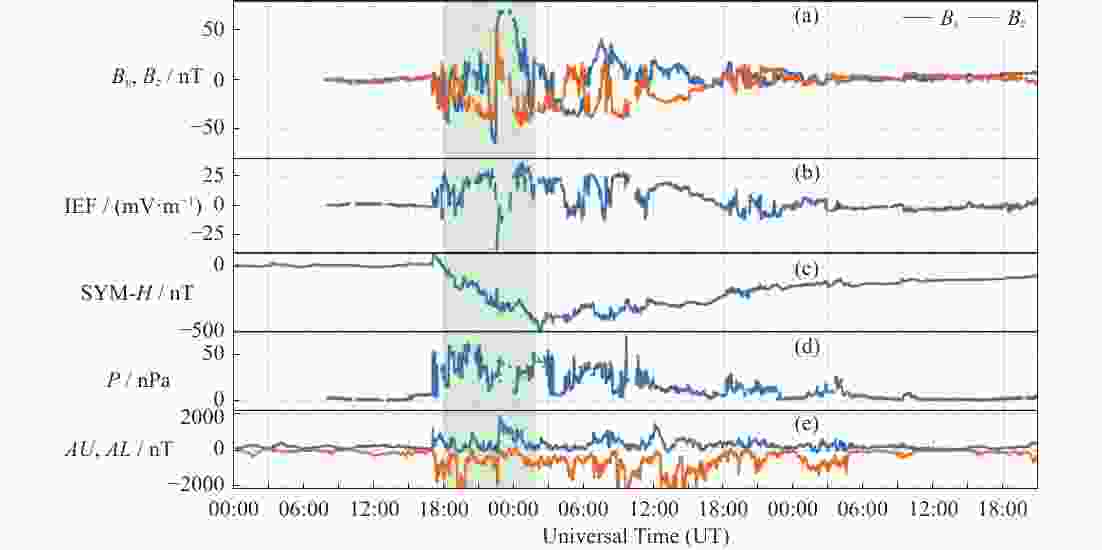
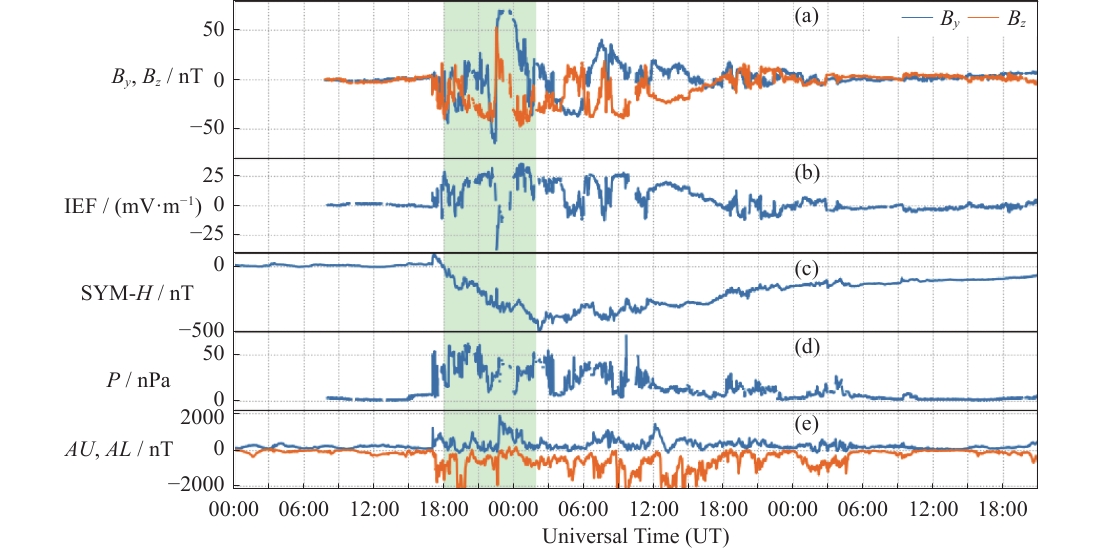
Figure 1. Solar geophysical conditions for 10–12 May 2024. IMF By and Bz (a), interplanetary electric field (b), SYM-H index (c), solar wind dynamic pressure (d), auroral AU and AL index (e)
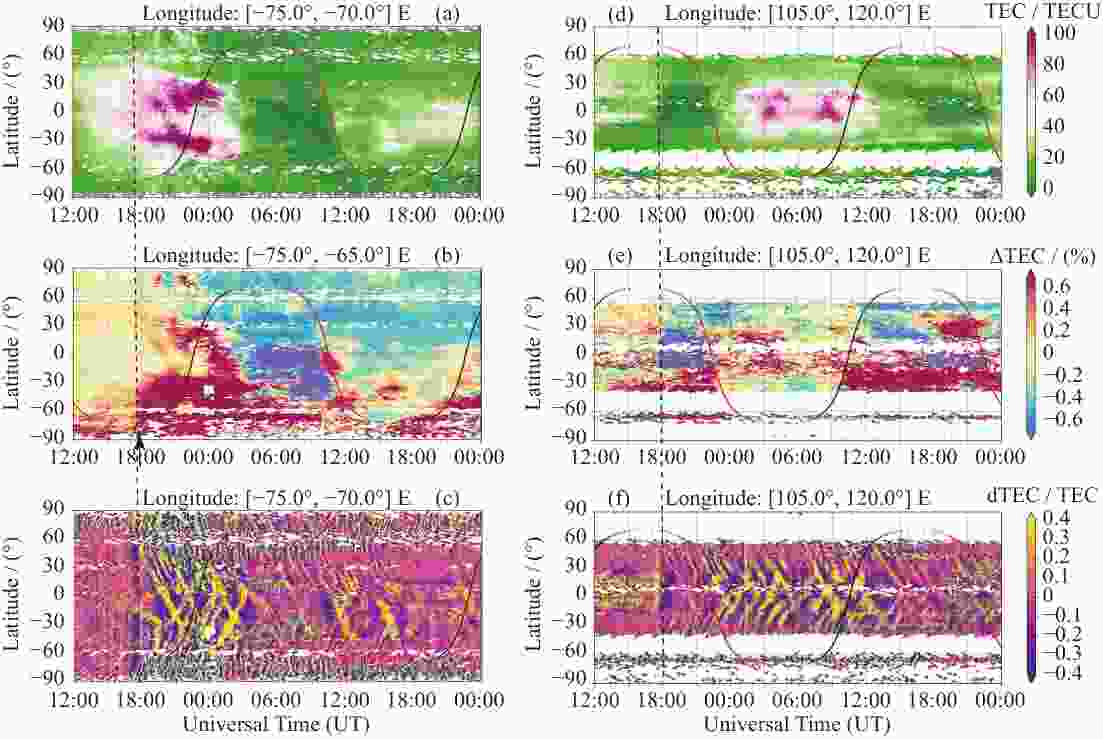
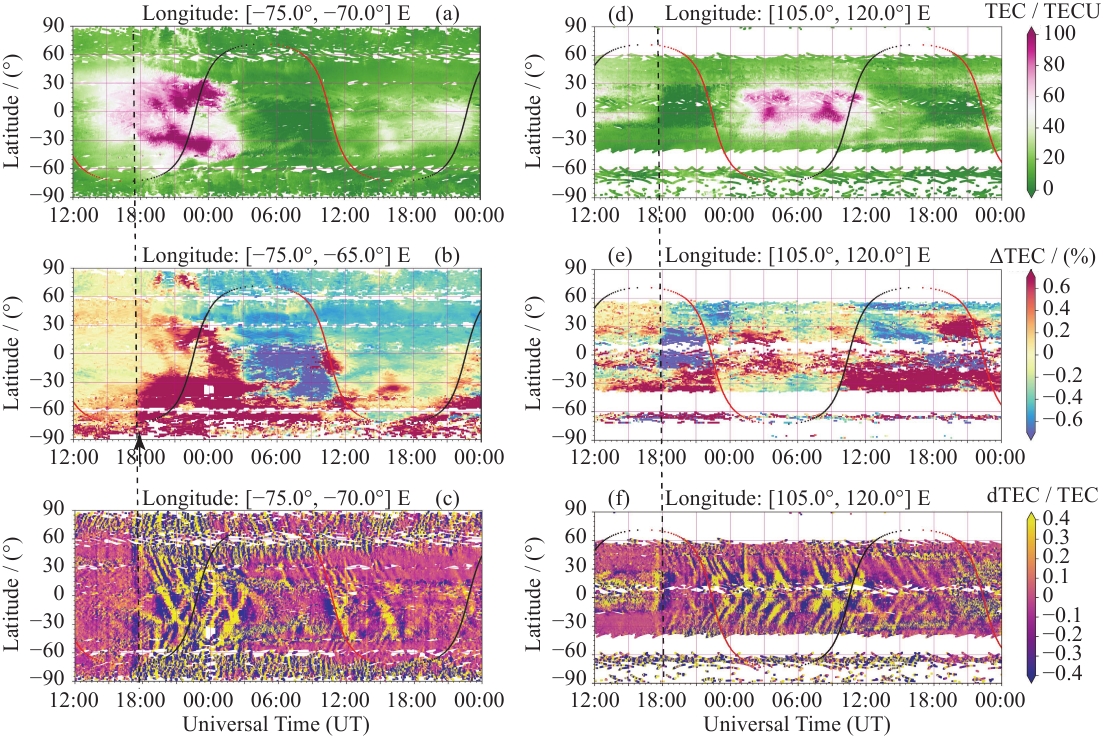
Figure 2. Latitudinal and UT variations in TEC (TECU, a and d), TEC relative changes (percentage fraction) from the reference on 10 May 2024 (b and e), and dTEC (TECU, c and f) in American (left panels) and Asian (right panels) sectors which have 12-hour local time offset. Dashed lines mark the ICME arrival induced simultaneous ionospheric variations
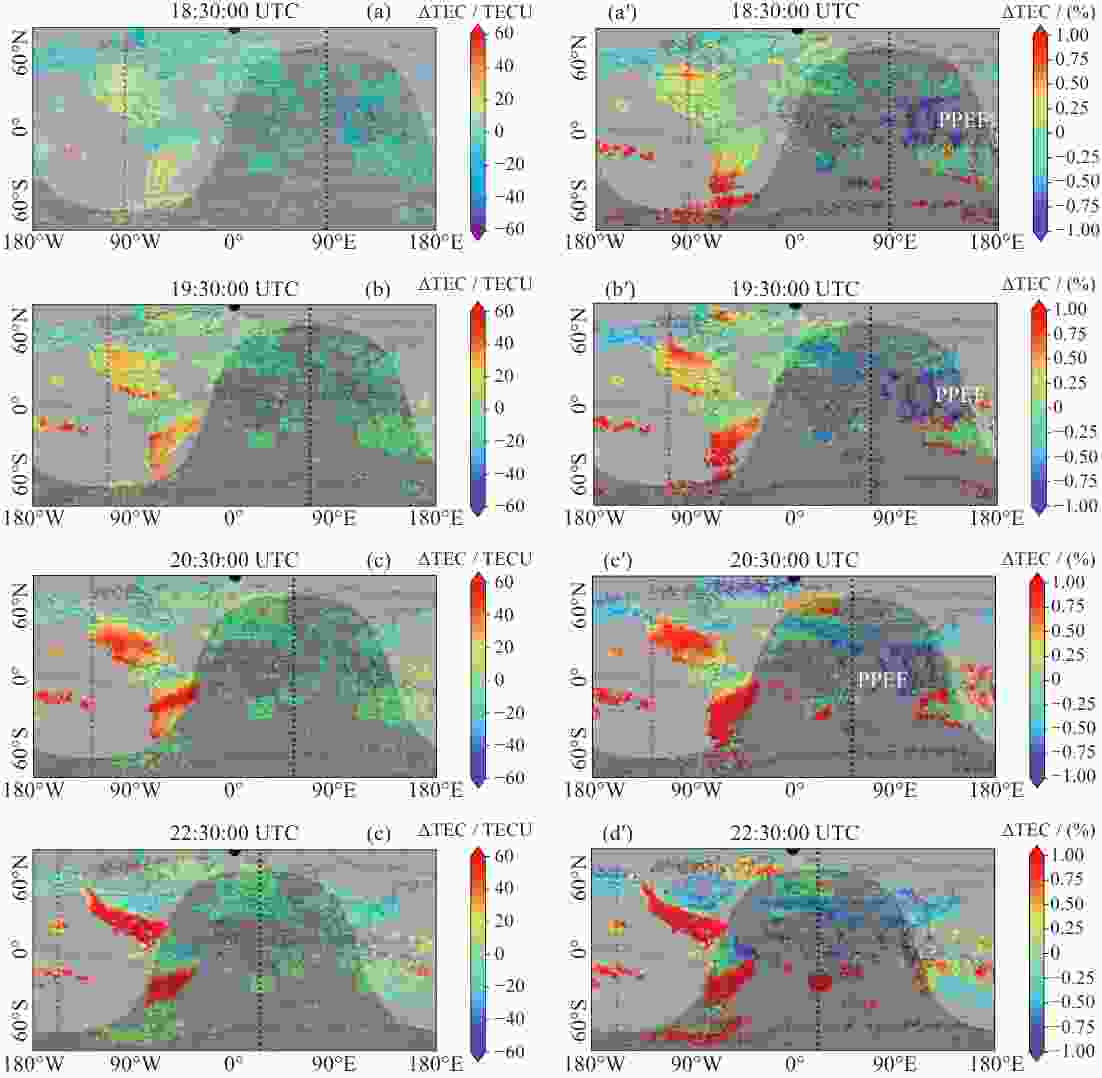
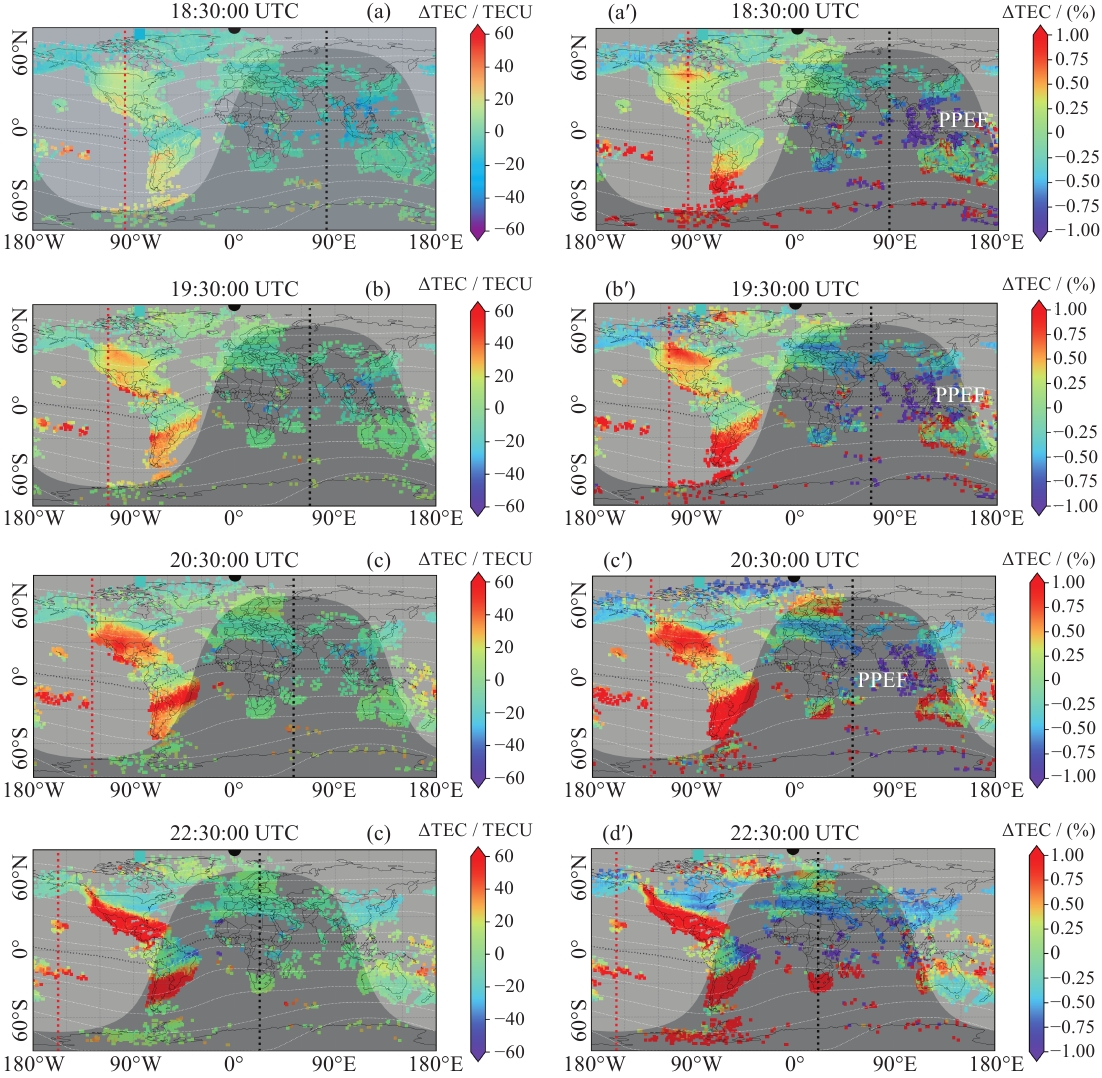
Figure 3. A sequence of global TEC maps to demonstrate the SED development. TEC variations are shown as absolute difference from the reference day 10 May 2024 (left) and relative percentage (fractional) change (right)
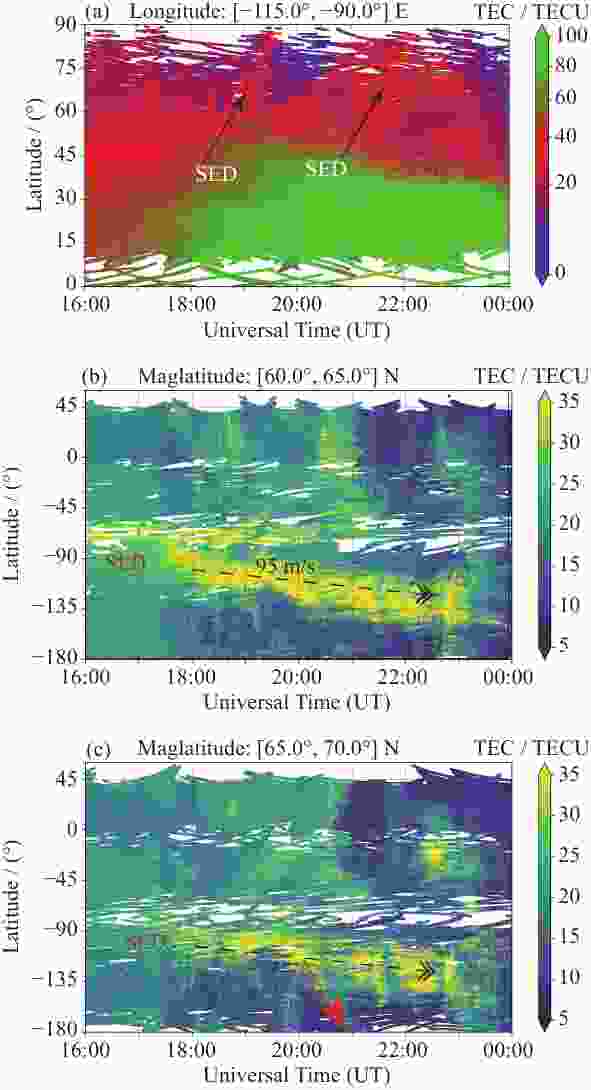
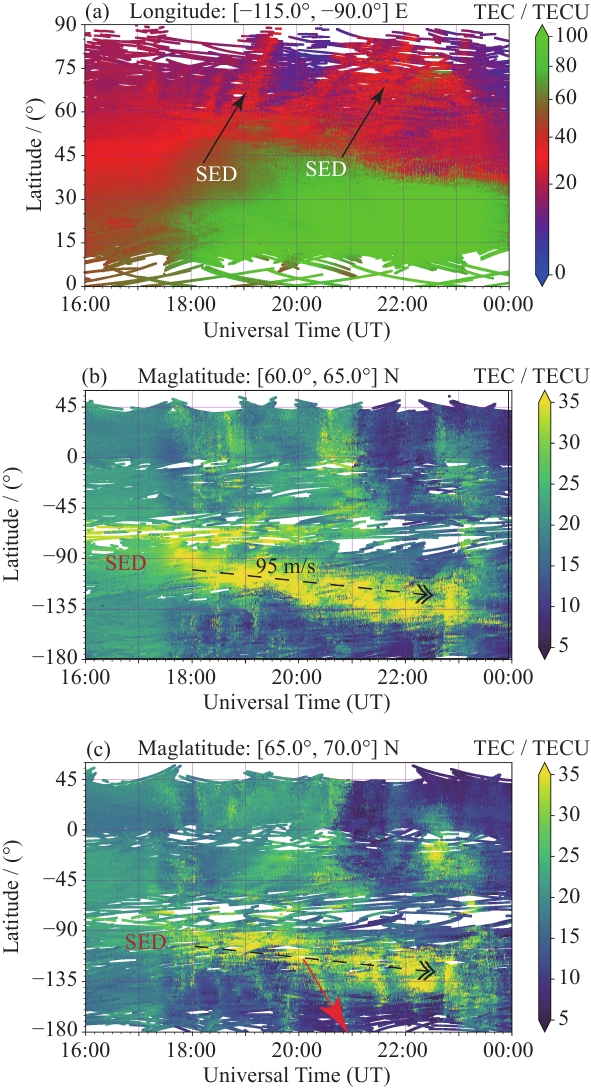
Figure 4. SED plume temporal evolution in latitude for a broad longitude bin −115°E to −90°E degrees (a), and in longitude at 60°N–65°N Apex latitude (b), and at 65 N–70°N Apex latitude (c) on 10 May 2024
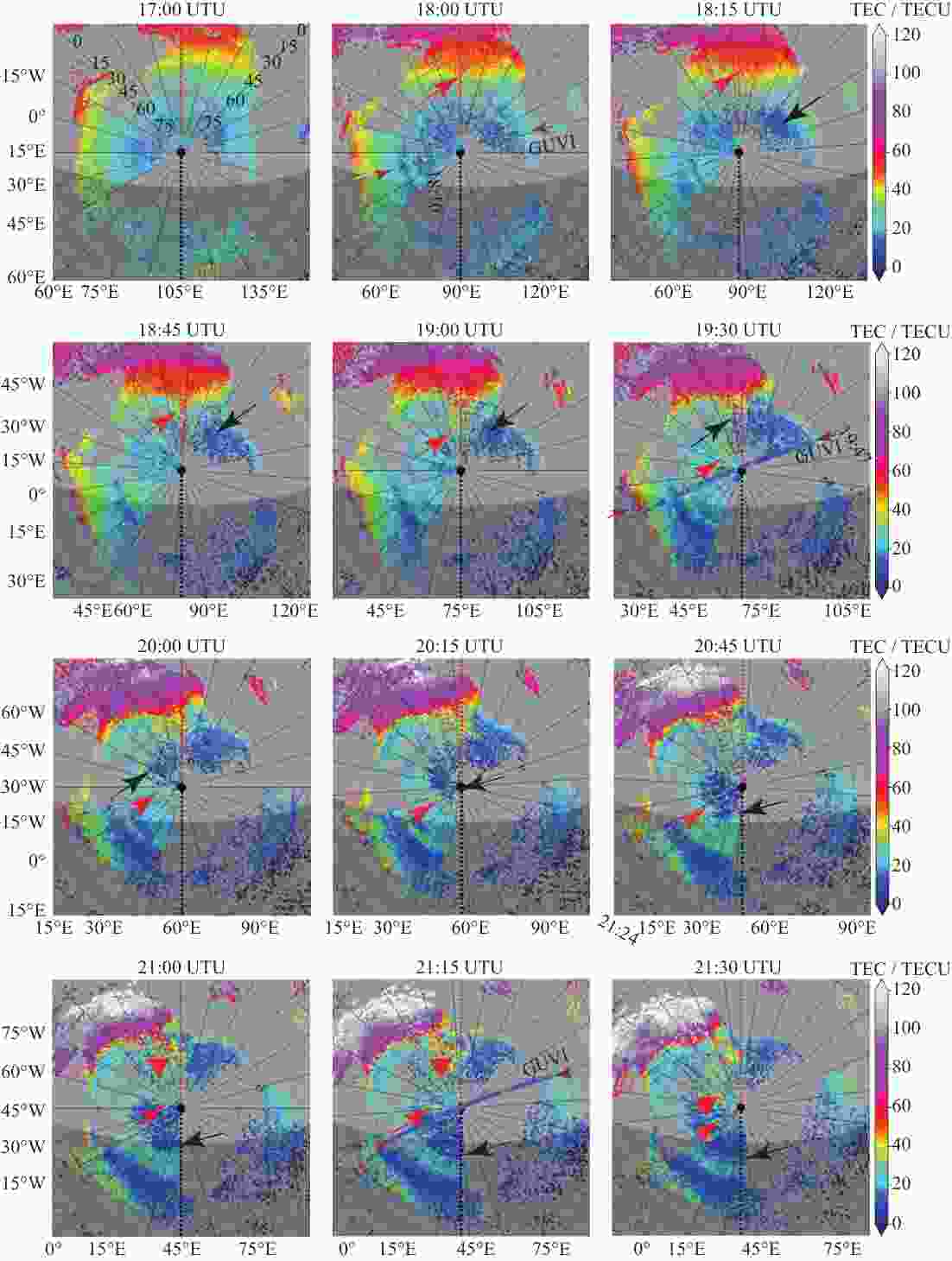
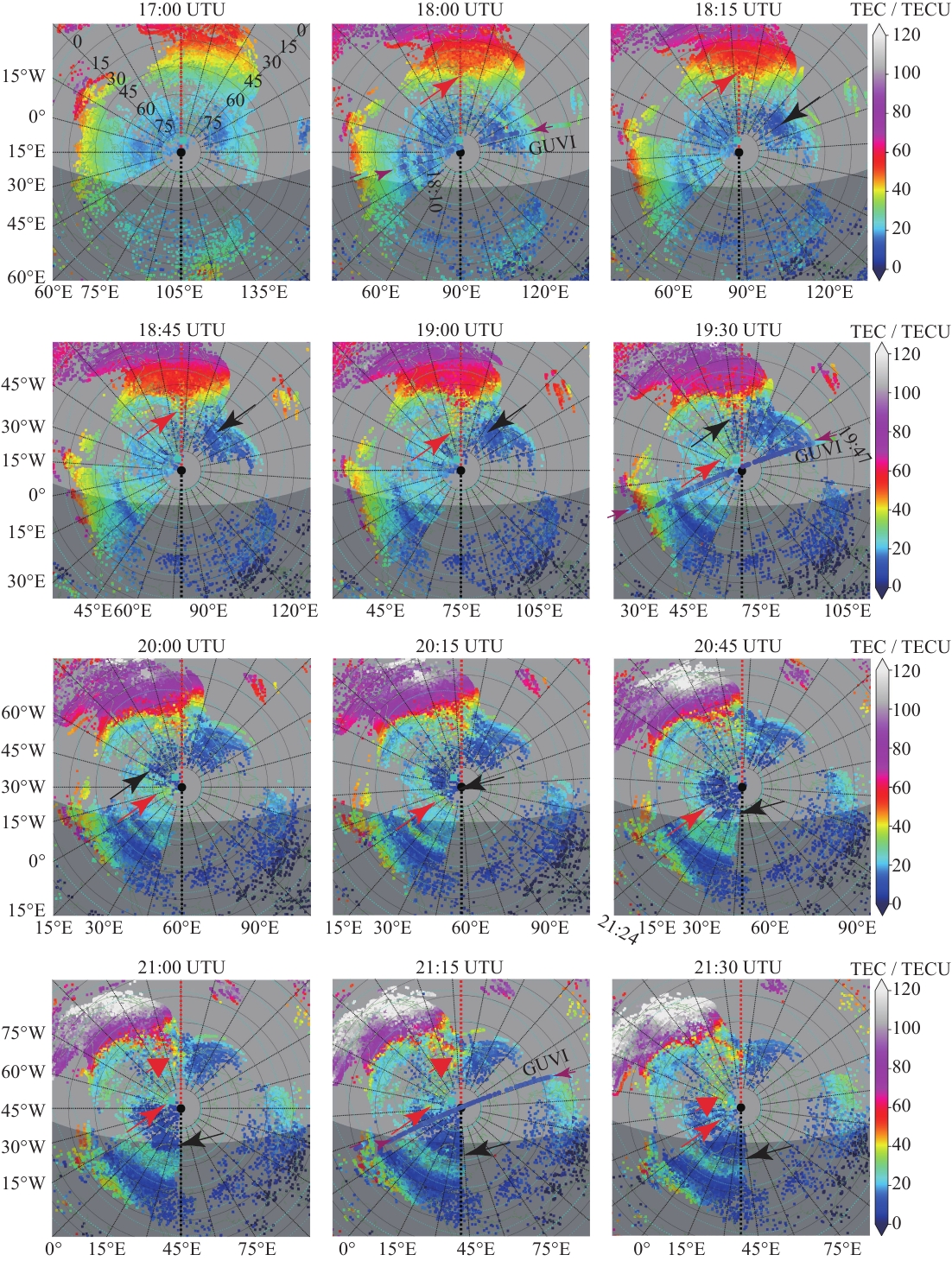
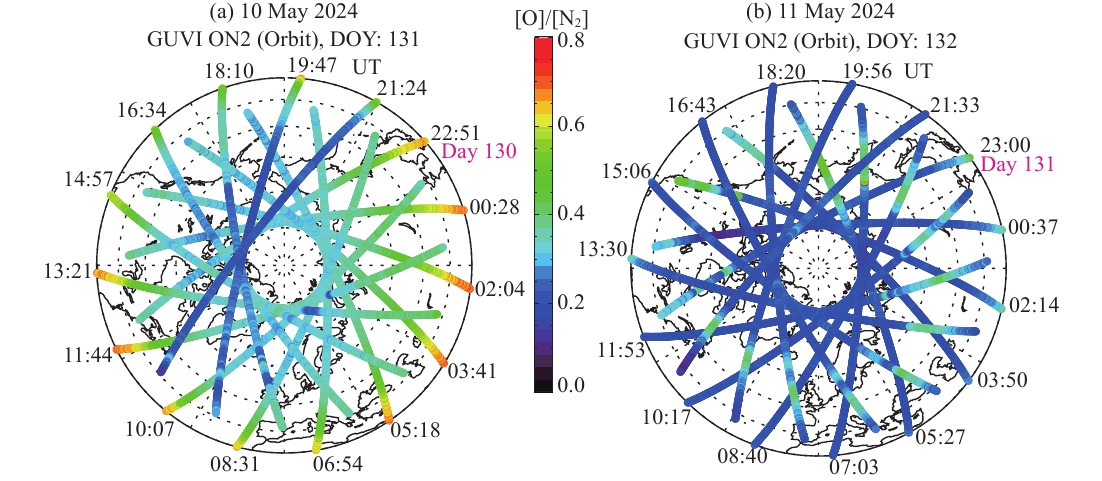
Figure 5. A polar view of TEC snapshots between 17:00–21:30 UT on 10 May 2024 to demonstrate the plasma density gradients TOI or the patch (see red arrows) and Polar Ionization Hole (back arrows). Corresponding GUVI O/N2 variations along the trajectory of the TIMED are also shown at approximate times of TEC snapshots. Note that the depletion of O/N2 inside the polar cap does not align with the region of enhanced TEC, which would suggest auroral precipitation
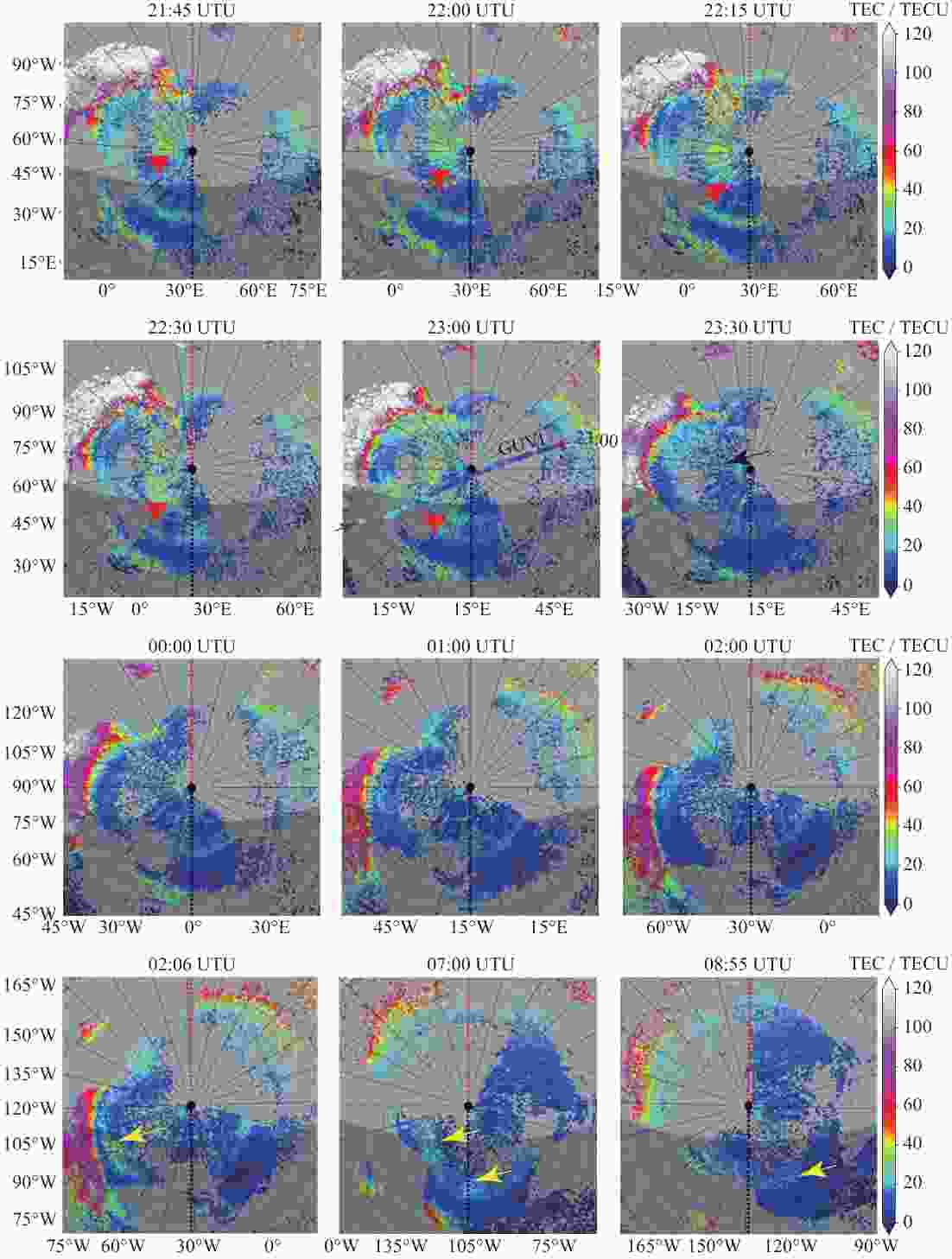
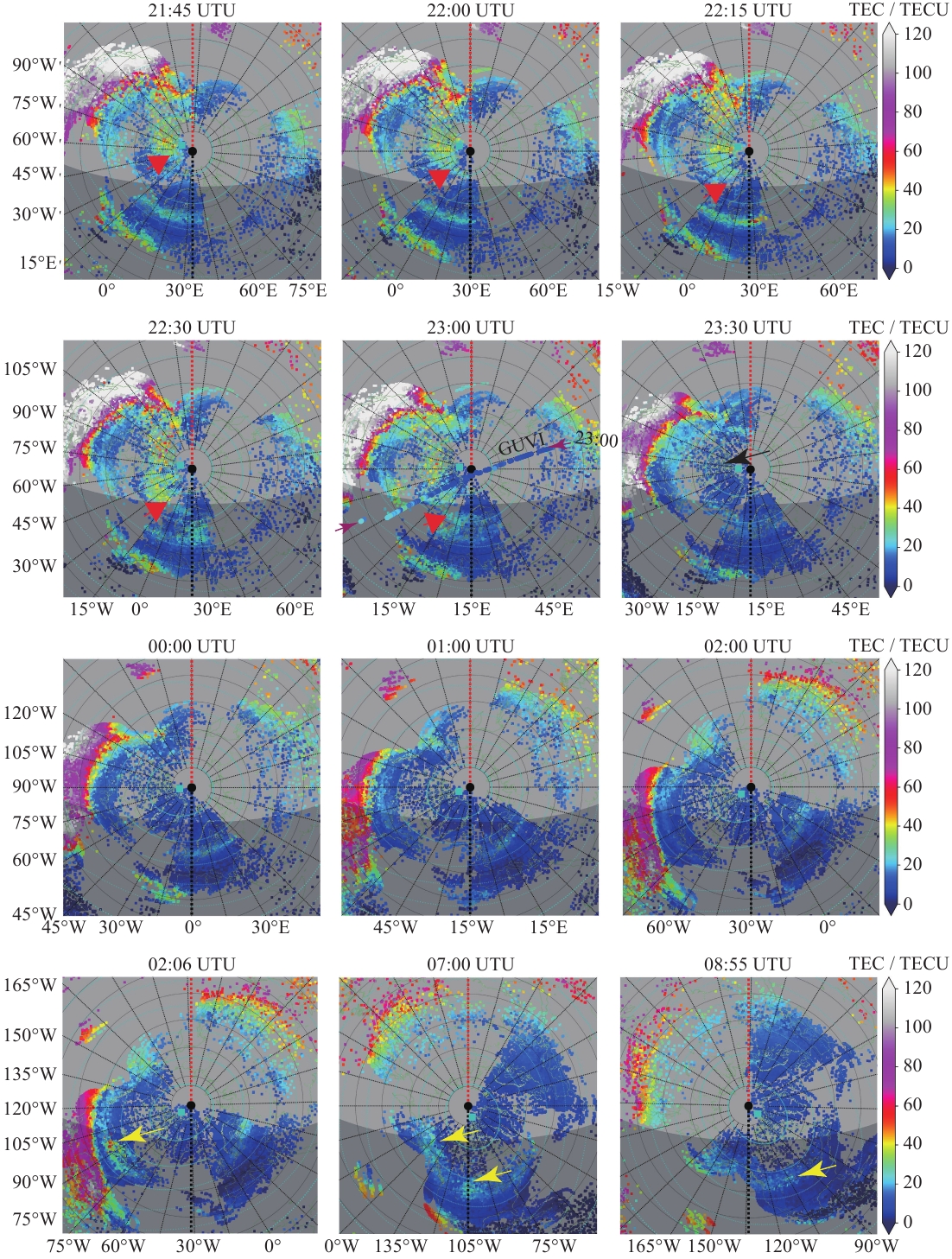
Figure 6. Same as Figure 5 but for snapshots at 21:45–08:55 UT (10–11 May 2024). Yellow arrows mark the area of enhanced TEC due to auroral particle precipitation
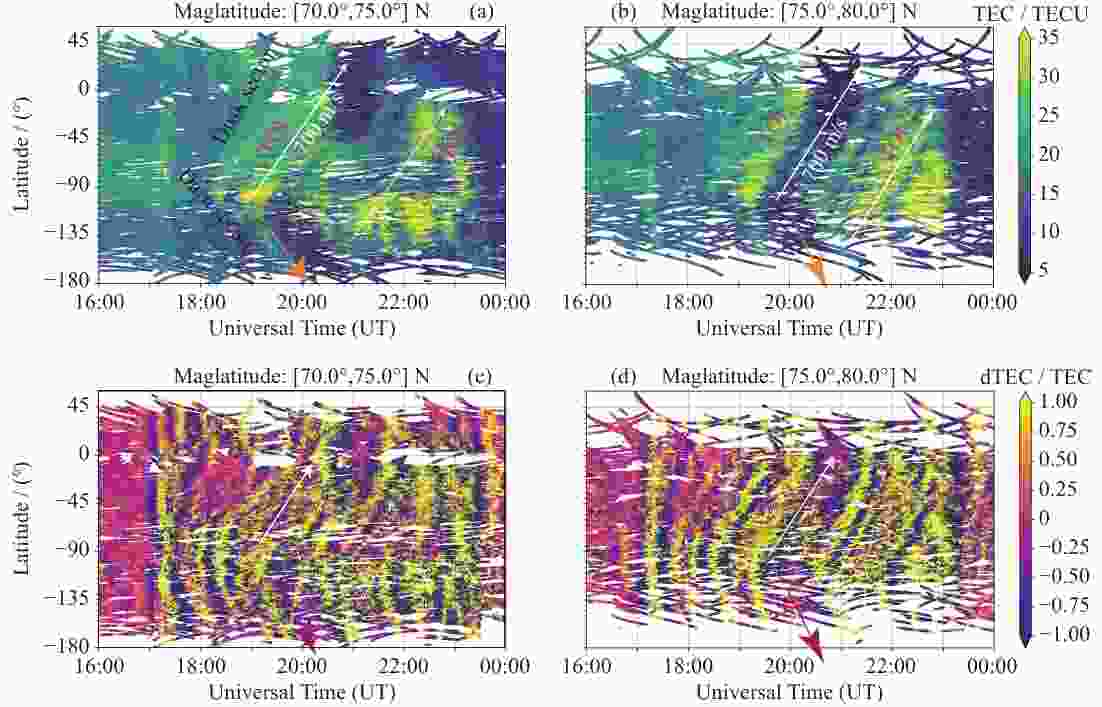
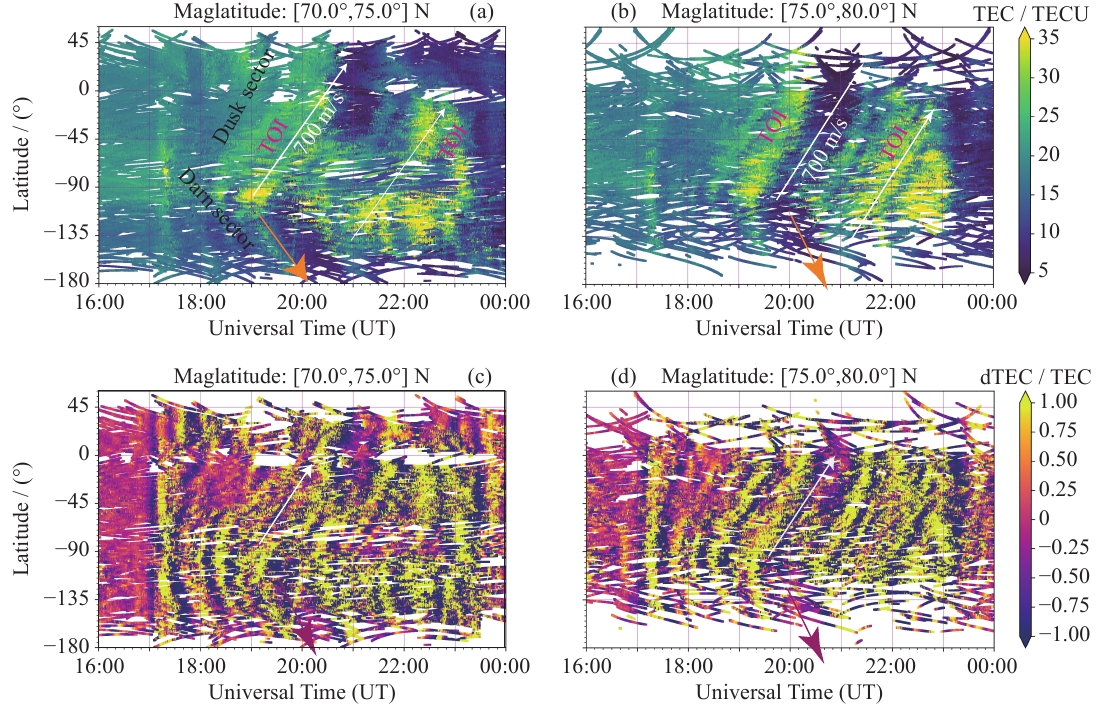
Figure 7. Longitudinal propagation inside the polar cap of density structures in TOI and patches (a and b), and dTEC fluctuations (c and d) over two apex latitude bins of 70°N–75°N (left) and 75°N–80°N (right) on 10 May 2024
-
[1] FOSTER J C, COSTER A J, ERICKSON P J, et al. Multiradar observations of the polar tongue of ionization[J]. Journal of Geophysical Research: Space Physics, 2005, 110(A9): A09S31 [2] HOSOKAWA K, TSUGAWA T, SHIOKAWA, K. et al. Dynamic temporal evolution of polar cap tongue of ionization during magnetic storm[J]. Journal of Geophysical Research: Space Physics, 2010, 115: A12333 doi: 10.1029/2010ja015848 [3] THOMAS E G, BAKER J B H, RUOHONIEMI J M, et al. Direct observations of the role of convection electric field in the formation of a polar tongue of ionization from storm enhanced density[J]. Journal of Geophysical Research: Space Physics, 2013, 118(3): 1180-1189 doi: 10.1002/jgra.50116 [4] LIU J, WANG W B, BURNS A, et al. Relative importance of horizontal and vertical transports to the formation of ionospheric storm-enhanced density and polar tongue of ionization[J]. Journal of Geophysical Research: Space Physics, 2016, 121(8): 8121-8133 doi: 10.1002/2016JA022882 [5] ZOU S, RIDLEY A J, MOLDWIN M B, et al. Multi-instrument observations of SED during 24-25 October 2011 storm: implications for SED formation processes[J]. Journal of Geophysical Research: Space Physics, 2013, 118(12): 7798-7809 doi: 10.1002/2013JA018860 [6] ZOU S, MOLDWIN M B, RIDLEY A J, et al. On the generation/decay of the storm-enhanced density plumes: role of the convection flow and field-aligned ion flow[J]. Journal of Geophysical Research: Space Physics, 2014, 119(10): 8543-8559 doi: 10.1002/2014JA020408 [7] Yuan, Z G, DENG X H, ZHANG S R, et al. F region behavior in the SED plume during a geomagnetic superstorm: A case study[J]. Journal of Geophysical Research: Space Physics, 2009, 114: A08303 doi: 10.1029/2008ja013841 [8] ZHANG S R, ERICKSON P J, COSTER A J, et al. Subauroral and polar traveling ionospheric disturbances during the 7-9 September 2017 storms. Space Weather, 2019, 17(1): 1748-1764 [9] FOSTER J C, BURKE W J. SAPS: a new categorization for sub-auroral electric fields[J]. Eos, Transactions American Geophysical Union, 2002, 83(36): 393-394 doi: 10.1029/2002eo000289 [10] FOSTER J C, VO H B. Average characteristics and activity dependence of the subauroral polarization stream[J]. Journal of Geophysical Research: Space Physics, 2002, 107(A12): 1475 doi: 10.1029/2002ja009409 [11] AA E, ERICKSON P J, ZHANG S R, et al. A statistical study of the subauroral polarization stream over north American sector using the millstone hill incoherent scatter radar 1979-2019 measurements[J]. Journal of Geophysical Research: Space Physics, 2020, 125(10): e2020JA028584 doi: 10.1029/2020JA028584 [12] VALLADARES C E, BASU S, BUCHAU J, et al. Experimental evidence for the formation and entry of patches into the polar cap[J]. Radio Science, 1994, 29(1): 167-194 doi: 10.1029/93RS01579 [13] VAN-DER-MEEREN C, OKSAVIK K, LORENTZEN D, et al. GPS scintillation and irregularities at the front of an ionization tongue in the nightside polar ionosphere[J]. Journal of Geophysical Research: Space Physics, 2014, 119(10): 8624-8636 doi: 10.1002/2014JA020114 [14] –ZHANG S R, ERICKSON P J, ZHANG Y L, et al. Observations of ion-neutral coupling associated with strong electrodynamic disturbances during the 2015 St. Patrick’s day storm[J]. Journal of Geophysical Research: Space Physics, 2017, 122(1): 1314-1337 doi: 10.1002/2016JA023307 [15] AA E, ZHANG S R, WANG W B, et al. Multiple longitude sector storm-enhanced density (SED) and long-lasting subauroral polarization stream (SAPS) during the 26-28 February 2023 geomagnetic storm[J]. Journal of Geophysical Research: Space Physics, 2023, 128(9): e2023JA031815 doi: 10.1029/2023JA031815 [16] AA E, ZHANG S R, LEI J H, et al. Significant midlatitude plasma density peaks and dual-hemisphere SED during the 10-11 May 2024 super geomagnetic storm[J]. Journal of Geophysical Research: Space Physics, 2024, 129(11): e2024JA033360 doi: 10.1029/2024JA033360 [17] DENG Y, RIDLEY A J. Role of vertical ion convection in the high-latitude ionospheric plasma distribution[J]. Journal of Geophysical Research: Space Physics, 2006, 111(A9): A09314 doi: 10.1029/2006ja011637 [18] HUBA J D, SAZYKIN S, COSTER A. SAMI3-RCM simulation of the 17 March 2015 geomagnetic storm[J]. Journal of Geophysical Research: Space Physics, 2017, 122(1): 1246-1257 doi: 10.1002/2016JA023341 [19] DANG T, LEI J H, WANG W B, et al. Formation of double tongues of ionization during the 17 March 2013 geomagnetic storm[J]. Journal of Geophysical Research: Space Physics, 2019, 124(12): 10619-10630 doi: 10.1029/2019JA027268 [20] LU G, ZAKHARENKOVA I, CHERNIAK I, et al. Large-scale ionospheric disturbances during the 17 March 2015 storm: a model-data comparative study[J]. Journal of Geophysical Research: Space Physics, 2020, 125(5): e2019JA027726 doi: 10.1029/2019JA027726 [21] ZHANG Q H, ZHANG B C, LOCKWOOD M, et al. Direct observations of the evolution of polar cap ionization patches[J]. Science, 2013, 339(6127): 1597-1600 doi: 10.1126/science.1231487 [22] ZHANG Q H, LOCKWOOD M, FOSTER J C, et al. Direct observations of the full Dungey convection cycle in the polar ionosphere for southward interplanetary magnetic field conditions[J]. Journal of Geophysical Research: Space Physics, 2015, 120(6): 4519-4530 doi: 10.1002/2015JA021172 [23] WEBER E J, KLOBUCHAR J A, BUCHAU J, et al. Polar cap F layer patches: structure and dynamics[J]. Journal of Geophysical Research: Space Physics, 1986, 91(A11): 12121-12129 doi: 10.1029/JA091iA11p12121 [24] LOCKWOOD M, CARLSON JR H C. Production of polar cap electron density patches by transient magnetopause reconnection[J]. Geophysical Research Letters, 1992, 19(17): 1731-1734 doi: 10.1029/92GL01993 [25] ZHANG Q H, ZHANG B C, LIU R Y, et al. On the importance of interplanetary magnetic field | By| on polar cap patch formation[J]. Journal of Geophysical Research: Space Physics, 2011, 116(A5): A05308 [26] REN J, ZOU S, GILLIES R G, et al. Statistical characteristics of polar cap patches observed by RISR-C[J]. Journal of Geophysical Research: Space Physics, 2018, 123(8): 6981-6995 doi: 10.1029/2018JA025621 [27] NISHIMURA Y, KELLY T, JAYACHANDRAN P T, et al. Nightside high-latitude phase and amplitude scintillation during a substorm using 1-second scintillation Indices[J]. Journal of Geophysical Research: Space Physics, 2023, 128(8): e2023JA031402 doi: 10.1029/2023JA031402 [28] WANG Y, JAYACHANDRAN P T, ZHANG Q H, et al. Morphological comparison of standard scintillation indices at the Canadian arctic during a strong geomagnetic storm: a case study[J]. Journal of Geophysical Research: Space Physics, 2025, 130(11): e2025JA034211 doi: 10.1029/2025JA034211 [29] BURNS A G, KILLEEN T L, WANG W, et al. A “tongue” of neutral composition[J]. Journal of Atmospheric and Solar-Terrestrial Physics, 2004, 66(15-16): 1457-1468 doi: 10.1016/j.jastp.2004.04.009 [30] CAI X G, BURNS A G, WANG W B, et al. Investigation of a neutral “tongue” observed by GOLD during the geomagnetic storm on May 11, 2019[J]. Journal of Geophysical Research: Space Physics, 2021, 126(6): e2020JA028817 doi: 10.1029/2020JA028817 [31] PRÖLSS G W. Ionospheric F-region Storms[M]//VOLLAND H. Handbook of Atmospheric Electrodynamics (1995). Florida: CRC Press, 2017 [32] BRINTON H C, GREBOWSKY J M, BRACE L H. The high-latitude winter F region at 300 km: thermal plasma observations from AE-C[J]. Journal of Geophysical Research: Space Physics, 1978, 83(A10): 4767-4776 doi: 10.1029/JA083iA10p04767 [33] JENNER L A, WOOD A G, DORRIAN G D, et al. Plasma density gradients at the edge of polar ionospheric holes: the absence of phase scintillation[J]. Annales Geophysicae, 2020, 38(2): 575-590 doi: 10.5194/angeo-38-575-2020 [34] ZHANG S R, AA E. Ionospheric electron density large gradients at midlatitudes[M]//NISHIMURA Y, VERKHOGLYADOVA O, DENG Y, et al. Cross-Scale Coupling and Energy Transfer in the Magnetosphere-Ionosphere-Thermosphere System, Amsterdam: Elsevier, 2021. [35] SPOGLI L, ALFONSI L, DE FRANCESCHI G, et al. Climatology of GPS ionospheric scintillations over high and mid-latitude European regions[J]. Annales Geophysicae, 2009, 27: 3429-3437 doi: 10.5194/angeo-27-3429-2009 [36] THEMENS D R, ELVIDGE S, MCCAFFREY A, et al. The high latitude ionospheric response to the major May 2024 geomagnetic storm: a synoptic view[J]. Geophysical Research Letters, 2024, 51(19): e2024GL111677 doi: 10.1029/2024GL111677 [37] RIDEOUT W, COSTER A. Automated GPS processing for global total electron content data[J]. GPS Solutions, 2006, 10: 219-228 doi: 10.1007/s10291-006-0029-5 [38] VIERINEN J, COSTER A J, RIDEOUT W C, et al. Statistical framework for estimating GNSS bias[J]. Atmospheric Measurement Techniques, 2016, 9(3): 1303-1312 doi: 10.5194/amt-9-1303-2016 [39] ZHANG S R, LIU J, COSTER A J, et al. Global GNSS observation of mesoscale ionospheric irregularities (2006-2024)[J]. Journal of Geophysical Research: Space Physics, 2026, 131(3): e2025JA034951 doi: 10.1029/2025JA034951 [40] PRIKRYL P, GHODDOUSI-FARD R, SPOGLI L, et al. GPS phase scintillation at high latitudes during geomagnetic storms of 7-17 March 2012-Part 2: interhemispheric comparison[J]. Annales Geophysicae, 2015, 33(6): 657-670 doi: 10.5194/angeo-33-657-2015 [41] SAITO A, FUKAO S, MIYAZAKI S. High resolution mapping of TEC perturbations with the GSI GPS network over Japan[J]. Geophysical Research Letters, 1998, 25(16): 3079-3082 doi: 10.1029/98GL52361 [42] TSUGAWA T, SAITO A, OTSUKA Y. A statistical study of large-scale traveling ionospheric disturbances using the GPS network in Japan[J]. Journal of Geophysical Research: Space Physics, 2004, 109(A6): A06302 [43] DING F, WAN W, LIU L, et al. A statistical study of large-scale traveling ionospheric disturbances observed by GPS TEC during major magnetic storms over the years 2003-2005[J]. Journal of Geophysical Research: Space Physics, 2008, 113(A3): A00A01 doi: 10.1029/2008ja013037 [44] ZAKHARENKOVA I, ASTAFYEVA E, CHERNIAK I. GPS and GLONASS observations of large-scale traveling ionospheric disturbances during the 2015 St. Patrick’s day storm[J]. Journal of Geophysical Research: Space Physics, 2016, 121(12): 12138-12156 doi: 10.1002/2016ja023332 [45] ZHANG S R, ERICKSON P J, GONCHARENKO L P, et al. Ionospheric bow waves and perturbations induced by the 21 August 2017 solar eclipse[J]. Geophysical Research Letters, 2017, 44(24): 12067-12073 doi: 10.1002/2017gl076054 [46] SAVITZKY A, GOLAY M J E. Smoothing and differentiation of data by simplified least squares procedures[J]. Analytical Chemistry, 1964, 36(8): 1627-1639 doi: 10.1021/ac60214a047 [47] COSTER A J, GONCHARENKO L, ZHANG S R, et al. GNSS observations of ionospheric variations during the 21 August 2017 solar eclipse[J]. Geophysical Research Letters, 2017, 44(24): 12041-12048 [48] ZHANG S R, COSTER A J, ERICKSON P J, et al. Traveling ionospheric disturbances and ionospheric perturbations associated with solar flares in September 2017[J]. Journal of Geophysical Research: Space Physics, 2019, 124(7): 5894-5917 doi: 10.1029/2019JA026585 [49] ZHANG S R, NISHIMURA Y, ERICKSON P J, et al. Traveling ionospheric disturbances in the vicinity of storm-enhanced density at midlatitudes[J]. Journal of Geophysical Research: Space Physics, 2022, 127(8): e2022JA030429 doi: 10.1029/2022JA030429 [50] ZHANG S R, VIERINEN J, AA E, et al. 2022 Tonga volcanic eruption induced global propagation of ionospheric disturbances via lamb waves[J]. Frontiers in Astronomy and Space Sciences, 2022, 9: 871275 doi: 10.3389/fspas.2022.871275 [51] CHRISTENSEN A B, PAXTON L J, AVERY S, et al. Initial observations with the global ultraviolet imager (GUVI) in the NASA TIMED satellite mission[J]. Journal of Geophysical Research: Space Physics, 2003, 108(A12): 1451 doi: 10.1029/2003ja009918 [52] STRICKLAND D J, MEIER R R, WALTERSCHEID R L, et al. Quiet-time seasonal behavior of the thermosphere seen in the far ultraviolet dayglow[J]. Journal of Geophysical Research: Space Physics, 2004, 109(A1): A01302 doi: 10.1029/2003ja010220 [53] ZHANG Y, PAXTON L J, MORRISON D, et al. O/N2 changes during 1-4 October 2002 storms: IMAGE SI-13 and TIMED/GUVI observations[J]. Journal of Geophysical Research: Space Physics, 2004, 109(A10): A10308 doi: 10.1029/2004ja010441 [54] ZHANG S R, NISHIMURA Y, VIERINEN J, et al. Simultaneous global ionospheric disturbances associated with penetration electric fields during intense and minor solar and geomagnetic disturbances[J]. Geophysical Research Letters, 2023, 50(19): e2023GL104250 doi: 10.1029/2023GL104250 [55] HUANG F Q, LEI J H, YUE X N, et al. Interplay of gravity waves and disturbance electric fields to the abnormal ionospheric variations during the 11 May 2024 superstorm[J]. AGU Advances, 2025, 6(1): e2024AV001379 doi: 10.1029/2024AV001379 [56] CHEN Y H, AA E, YUAN T J, et al. The extreme depletion of ionospheric electron density and its hemispheric asymmetry during the May 2024 storm[J]. National Science Review, 2025, 12(10): nwaf307 doi: 10.1093/nsr/nwaf307 [57] HUANG F Q, LEI J H, –ZHANG S R, et al. Peculiar nighttime ionospheric enhancements over the Asian sector during the May 2024 superstorm[J]. Journal of Geophysical Research: Space Physics, 2024, 129(11): e2024JA033350 doi: 10.1029/2024JA033350 [58] SUN W j, LI G Z, ZHAO B Q, et al. Midlatitude plasma blob-like structures along with super equatorial plasma bubbles during the May 2024 great geomagnetic storm[J]. Geophysical Research Letters, 2024, 51(21): e2024GL111638 doi: 10.1029/2024GL111638 [59] ZHANG S R, COSTER A J, ERICKSON P J, et al. Mesoscale ionospheric irregularity oval at high latitudes observed by global GNSS networks (2010-2024)[J]. Journal of Astronomy and Space Sciences, 2025, 42(4): 119-134 doi: 10.5140/JASS.2025.42.4.119 [60] FORSYTHE V V, KUNDURI B, ZOU S. Multi-instrument investigation of the polar holes[J]. Journal of Geophysical Research: Space Physics, 2021, 126(12): e2021JA029795 doi: 10.1029/2021JA029795 -
-

 下载:
下载:

计量
- 文章访问数: 697
- HTML全文浏览量: 82
- PDF下载量: 73
-
被引次数:
0(来源:Crossref)
0(来源:其他)

