


赤道等离子体泡形态学特征与闪烁效应研究进展
doi: 10.11728/cjss2026.05.2026-0068 cstr: 32142.14.cjss.2026-0068
-
 郑宇豪 男, 1996年8月24日生出生, 博士, 现为武汉大学地球与空间信息科学技术学院博士后, 主要研究方向为电离层闪烁分析及建模. E-mail: zhengyuhao@whu.edu.cn
 -
 熊超 男, 现为武汉大学地球与空间信息科学技术学院教授, 博士生导师, 主要研究方向为电离层物理、星载磁场与等离子体探测、空间天气效应等. E-mail: xiongchao@whu.edu.cn
作者简介:
通讯作者:
Research Progress on Morphological Characteristics and Scintillation Effects of Equatorial Plasma Bubbles
-
摘要: 基于CHAMP, GRACE, Swarm等低轨卫星近20年的长期观测资料, 结合COSMIC掩星、地基GNSS(Global Navigation Satellite System)接收机网络和全天空成像仪等多源探测结果, 系统综述了EPBs形态学特征与闪烁效应的研究进展. 从太阳活动、地磁活动、高度、经度、季节和地方时等多个维度, 分析了赤道等离子体泡发生率的统计特征及其主要控制因素; 综述其空间尺度与三维形态特征, 包括东西向尺度、场向尺度、内部精细结构及其演化过程, 指出赤道等离子体泡是具有明显层级性和场向延展特征的多尺度三维不规则体结构; 归纳赤道等离子体泡相关磁场扰动的主要观测特征及其可能物理机制, 讨论了抗磁效应、场向电流和阿尔芬波扰动在理解其电磁响应中的作用; 进而, 系统评述了赤道等离子体泡引起的L波段信号闪烁、幅度衰减和GPS(Global Positioning System)信号中断等现象的统计规律、传播机制以及相关建模与应用研究进展.Abstract: Equatorial Plasma Bubbles (EPBs) are among the most prominent plasma irregularities in the low-latitude ionosphere. Their multiscale morphological evolution and modulation of trans-ionospheric radio-wave propagation represent major scientific and practical concerns in space weather research. This review aims to summarize recent advances in the morphology, magnetic signatures, and scintillation effects of EPBs, and to identify key issues that require further investigation. Long-term in situ observations from low-Earth-orbit satellites, including CHAMP, GRACE, and Swarm, are reviewed together with complementary measurements from COSMIC radio occultation, ground-based Global Navigation Satellite System (GNSS) receiver networks, and all-sky airglow imagers. The occurrence characteristics of EPBs are first examined in relation to solar activity, geomagnetic activity, longitude, season, altitude, and local time. Previous observations demonstrate that EPB occurrence exhibits pronounced longitudinal and seasonal variability and is strongly controlled by the prereversal enhancement of the eastward electric field, background ionospheric conditions, and lower-atmospheric forcing. The spatial scales and three-dimensional morphology of EPBs are then discussed. EPBs are characterized by strong field-aligned extension, considerable zonal variability, and hierarchical structures ranging from large-scale plasma depletions to kilometer- and subkilometer-scale irregularities. Their morphology may evolve through upward growth, bifurcation, merging, and secondary instability development. Magnetic perturbations associated with EPBs are also reviewed. Available measurements suggest that their electromagnetic signatures may result from plasma diamagnetic effects, field-aligned currents, polarization electric fields, and Alfvénic perturbations. However, the relative contributions of these processes remain uncertain and require coordinated plasma and magnetic-field observations. Finally, the effects of EPBs on L-band signals are assessed, including amplitude and phase scintillation, signal fading, loss of lock, and positioning degradation. These effects depend not only on the large-scale geometry of plasma depletions, but also on the intensity and spectral distribution of embedded small-scale irregularities. Overall, EPBs should be regarded as multiscale, three-dimensional, and electrodynamically coupled ionospheric structures. Future progress will rely on coordinated multisource observations, improved three-dimensional reconstruction, and physics-based modeling. Such efforts are essential for understanding EPB evolution and improving the reliability of satellite communication, navigation, and positioning systems in equatorial and low-latitude regions.
-
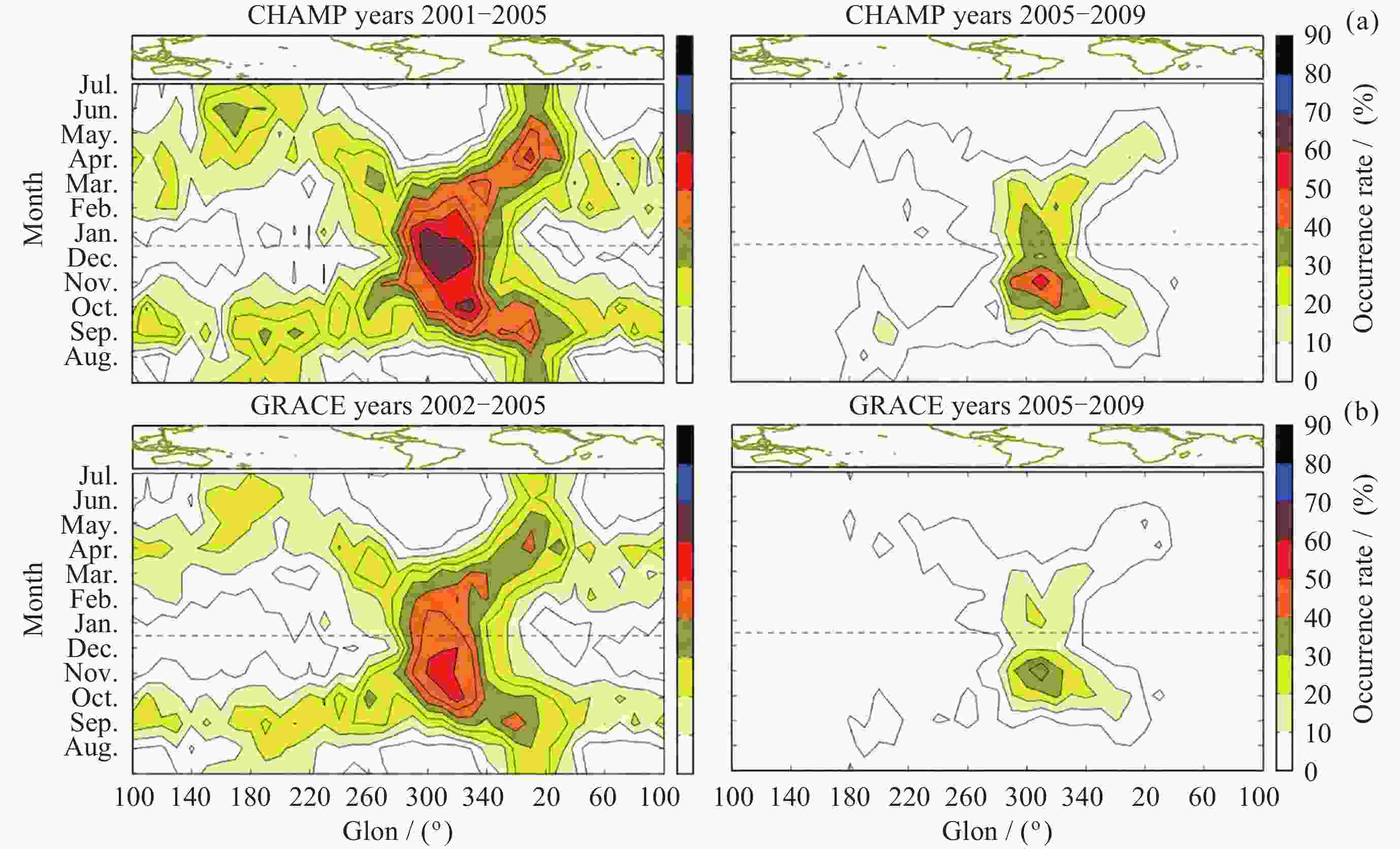
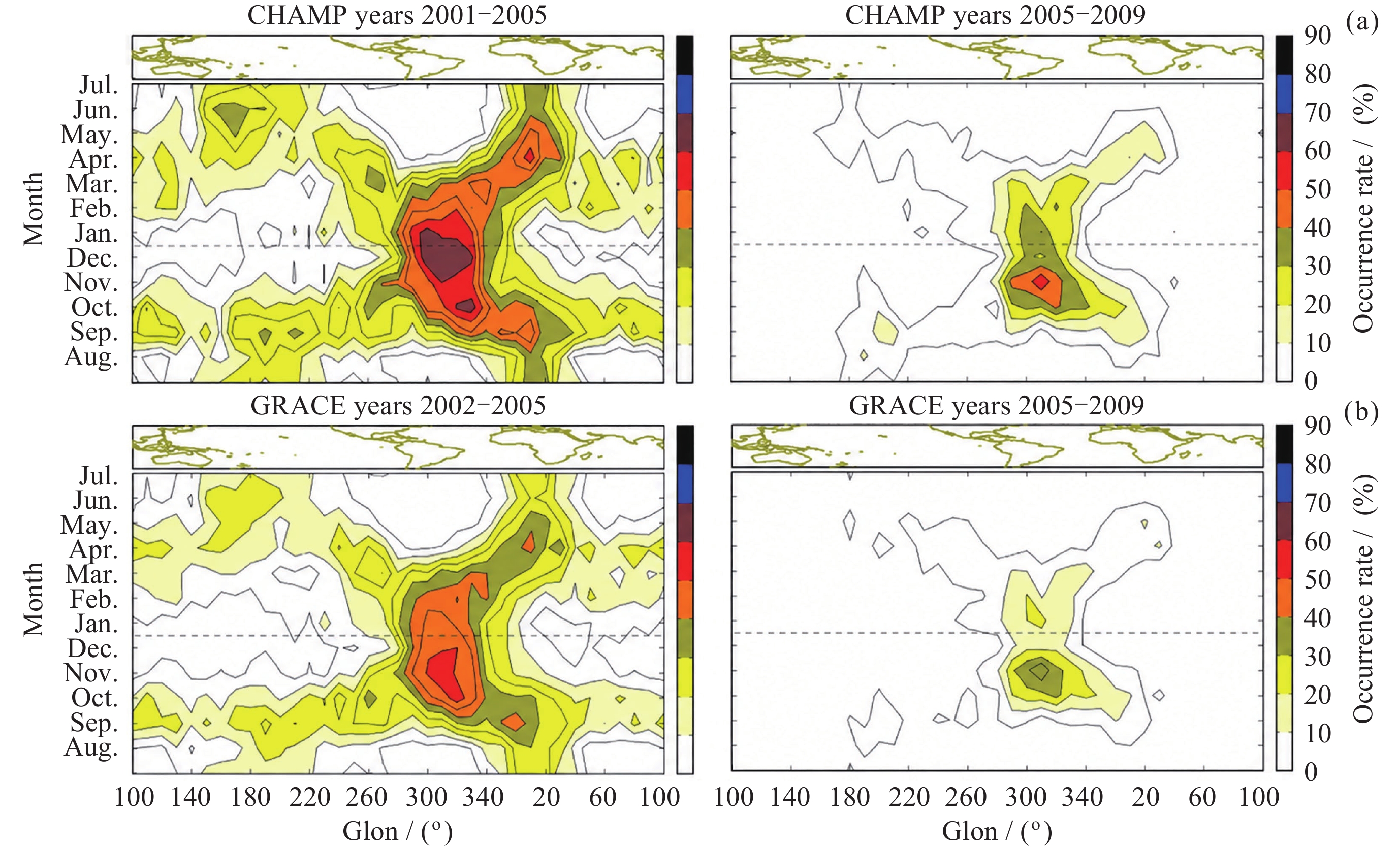
图 1 高太阳活动年期间与低太阳活动年期间观测到的EPB发生率的季节/经度分布[19]. (a) CHAMP卫星等离子体探测器观测结果, (b) GRACE卫星K波段测距系统观测结果
Figure 1. Seasonal-longitudinal distributions of EPB occurrence rates during periods of higher and lower solar activity. (a) Observations from the CHAMP Planar Langmuir Probe, (b) observations from the GRACE K-Band Ranging system[19]
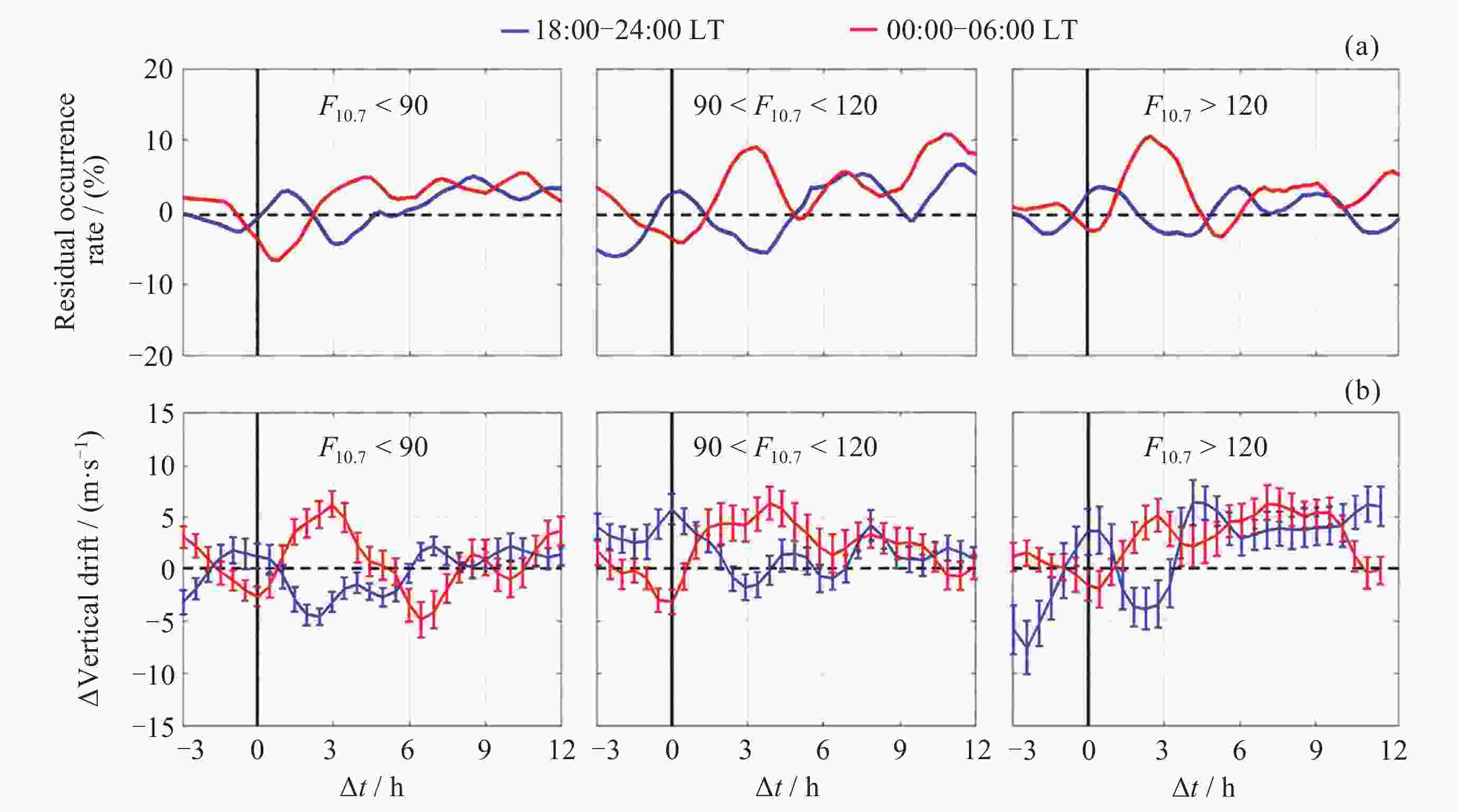
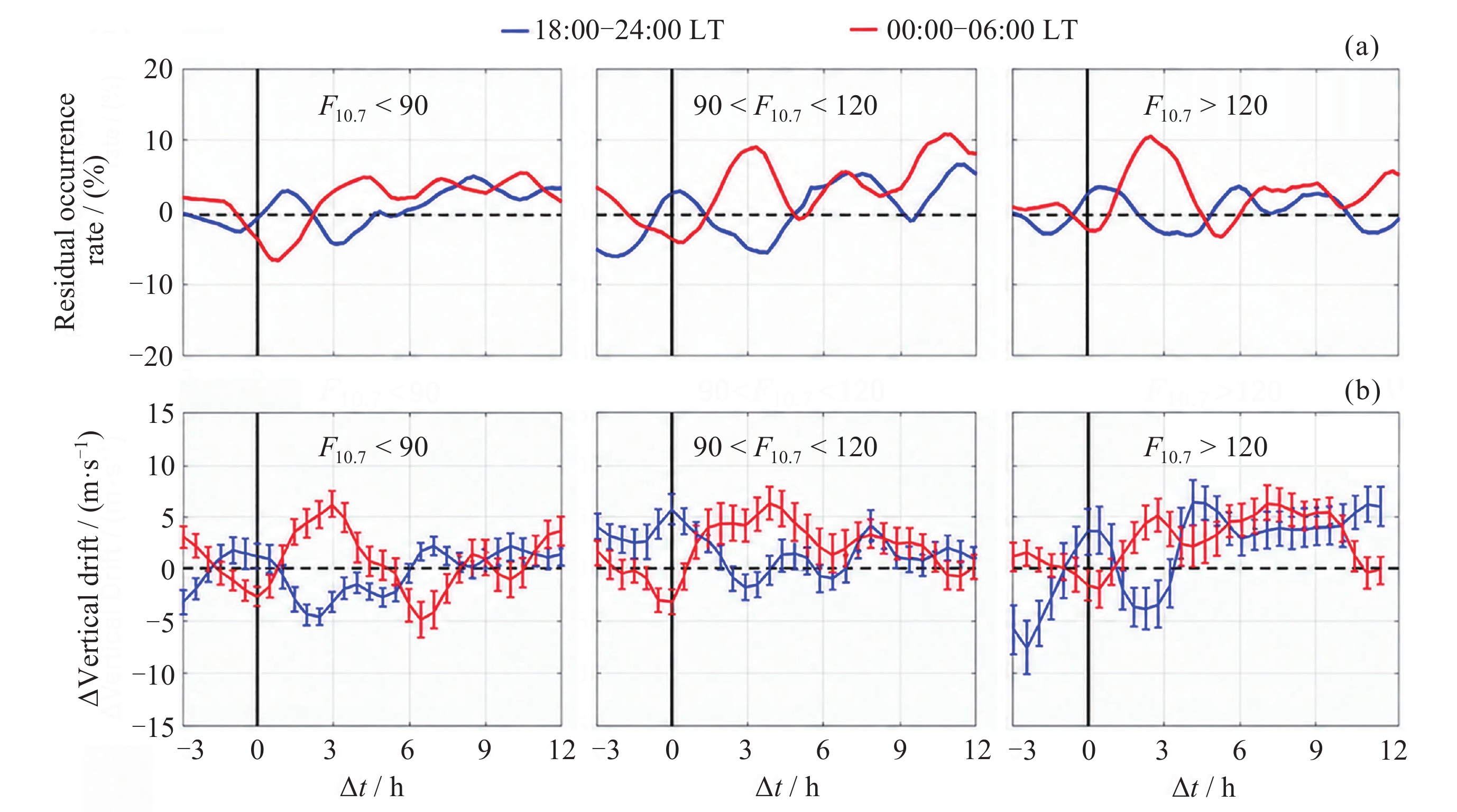
图 2 亚暴扰动的叠加历元分析结果. (a) ESF发生率相对于平静期背景值的残差, (b)等离子体垂直漂移速度相对于平静期背景值的残差
Figure 2. Superposed epoch analysis of substorm-related disturbances. (a) Residual ESF occurrence rate relative to the quiet-time background, (b) residual vertical plasma drift relative to the quiet-time background
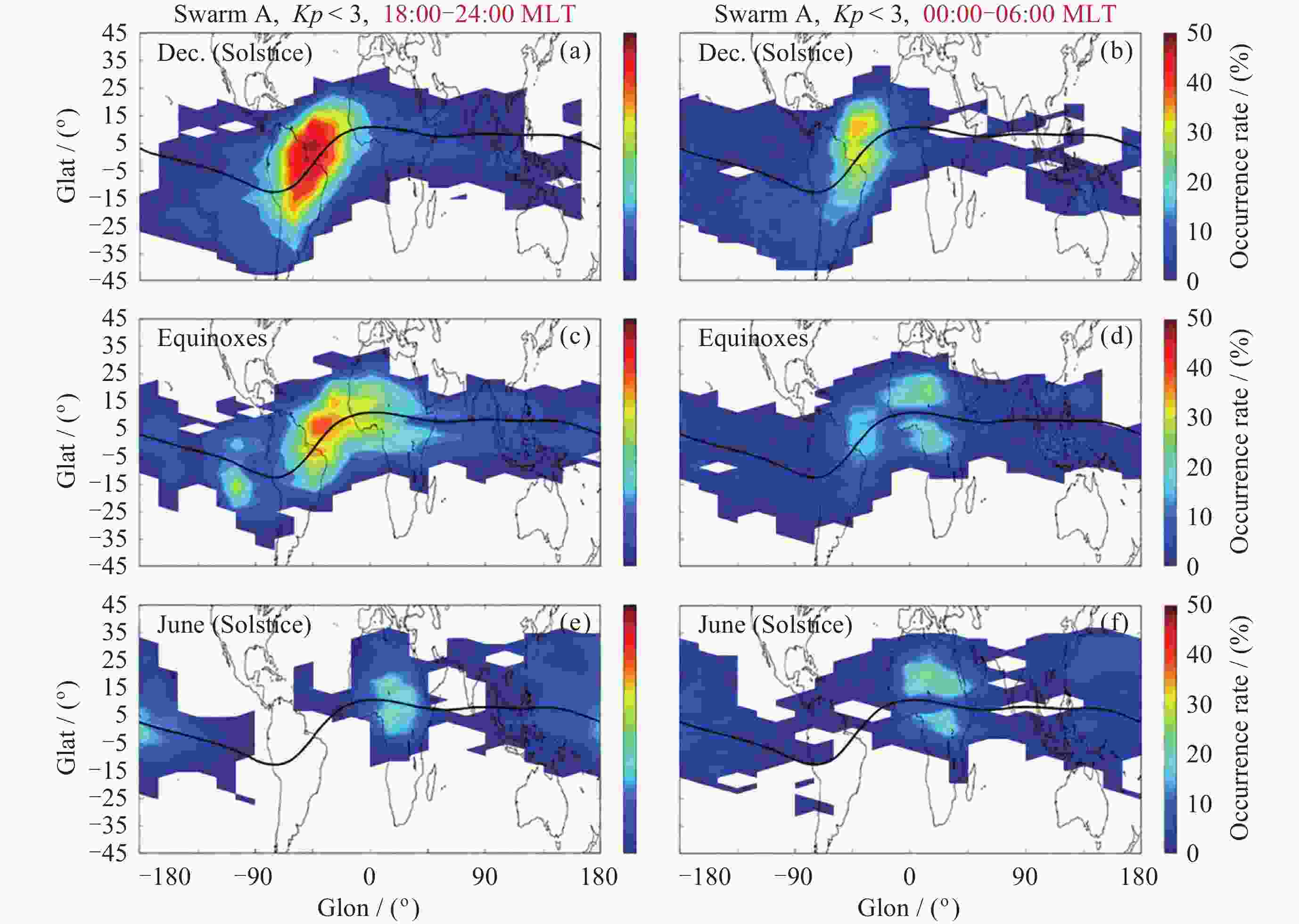
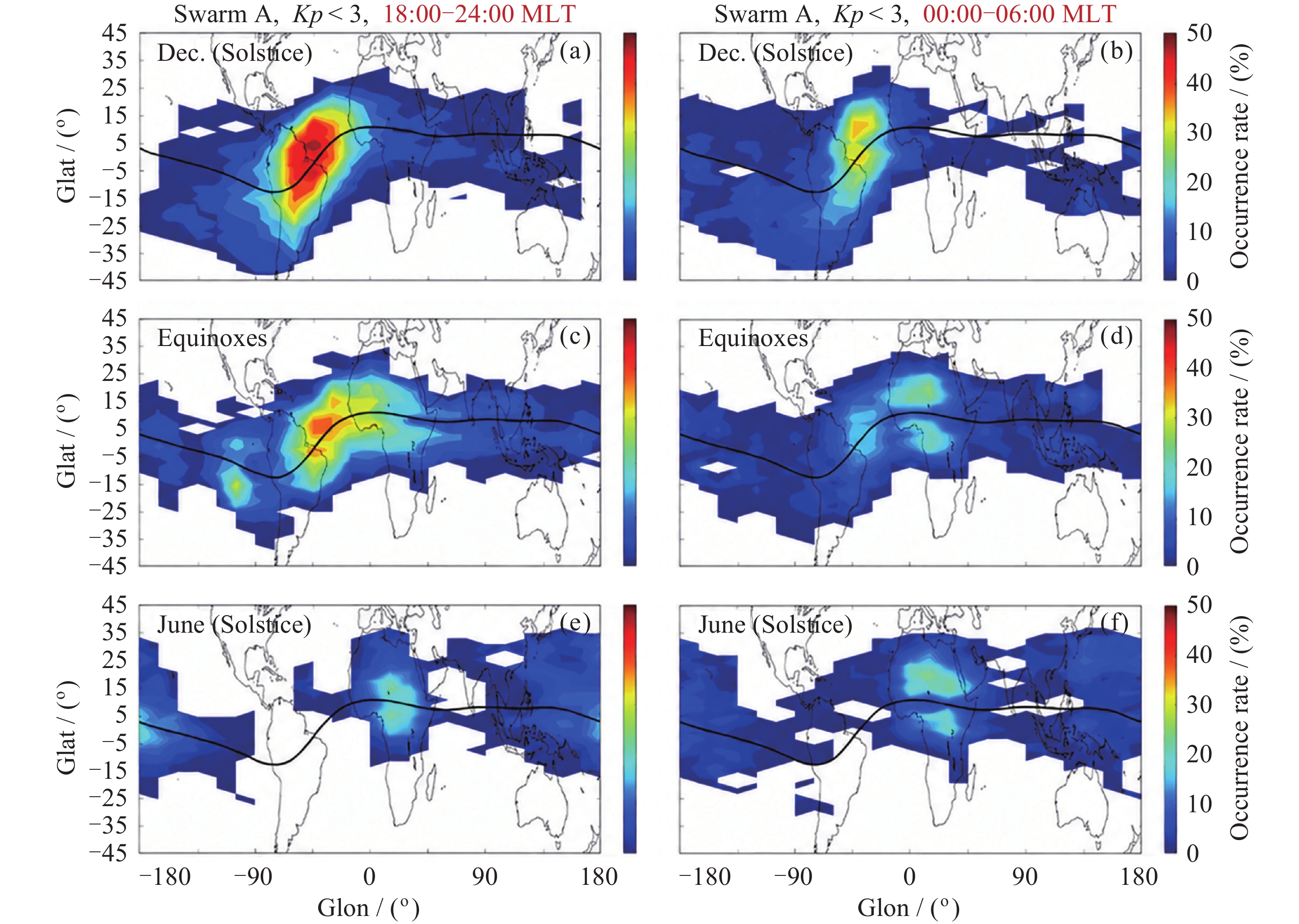
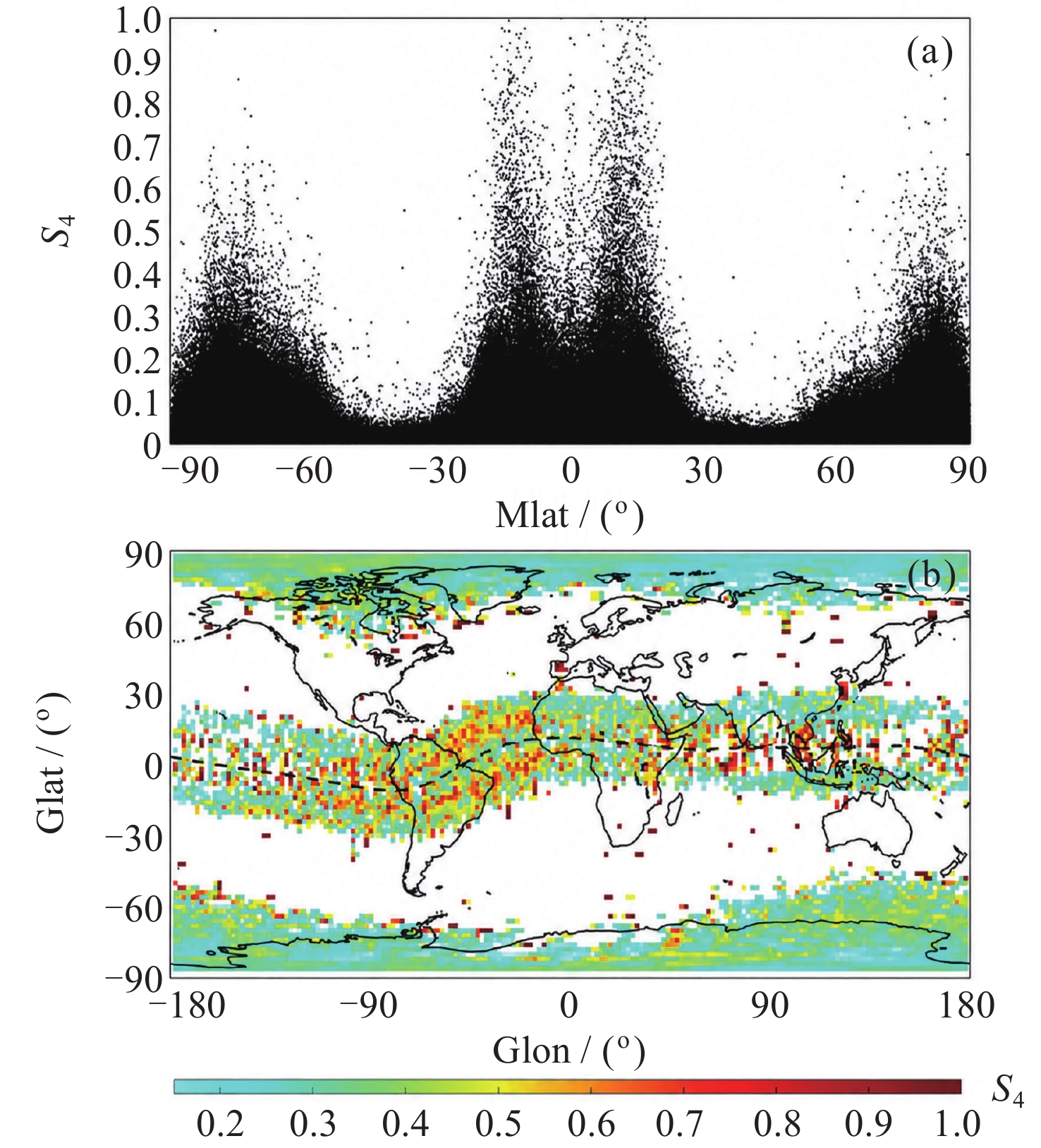
图 3 Swarm A卫星观测的赤道等离子体耗空发生率在地理纬度–经度平面内的分布
Figure 3. Geographic latitude-longitude distributions of equatorial plasma depletion occurrence rates observed by Swarm A
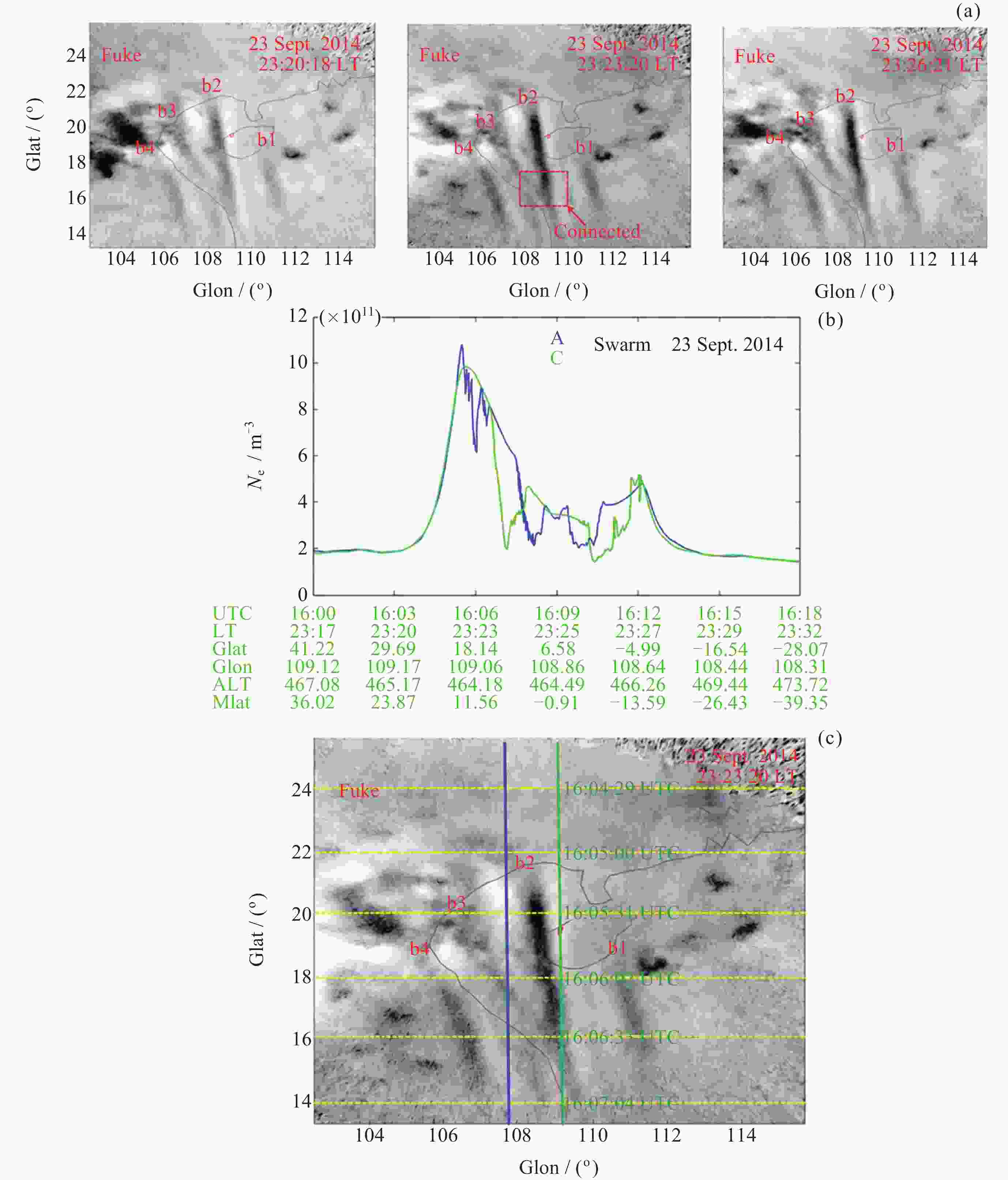
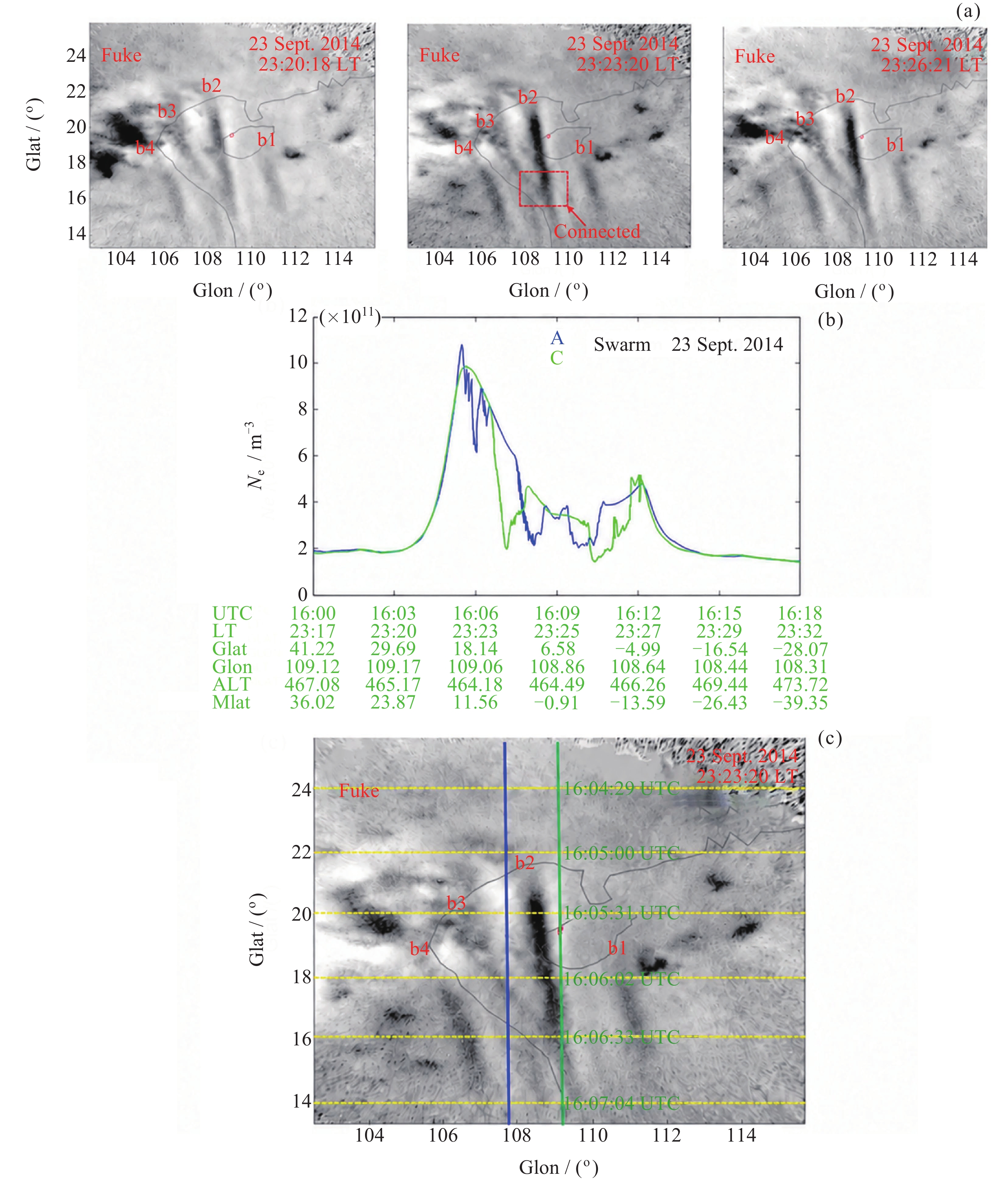
图 5 2014年9月23日Fuke台站气辉观测与Swarm卫星原位电子密度观测的联合分析. (a) 23:20:18-23:26:21 LT期间获取的三幅连续气辉图像, (b) Swarm A(蓝色)和Swarm C(绿色)观测的原位电子密度时间序列, (c) Swarm A(蓝色)和Swarm C(绿色)的飞行轨迹叠加在23:23:20 LT的气辉图像上[27]
Figure 5. Coordinated airglow imaging and in situ electron density observations by the Swarm satellites over the Fuke station on 23 September 2014. (a) Three consecutive airglow images acquired between 23:20:18 and 23:26:21 LT, (b) time series of in situ electron density measured by Swarm A (blue) and Swarm C (green), (c) trajectories of Swarm A (blue) and Swarm C (green) superimposed on the airglow image acquired at 23:23:20 LT [27]
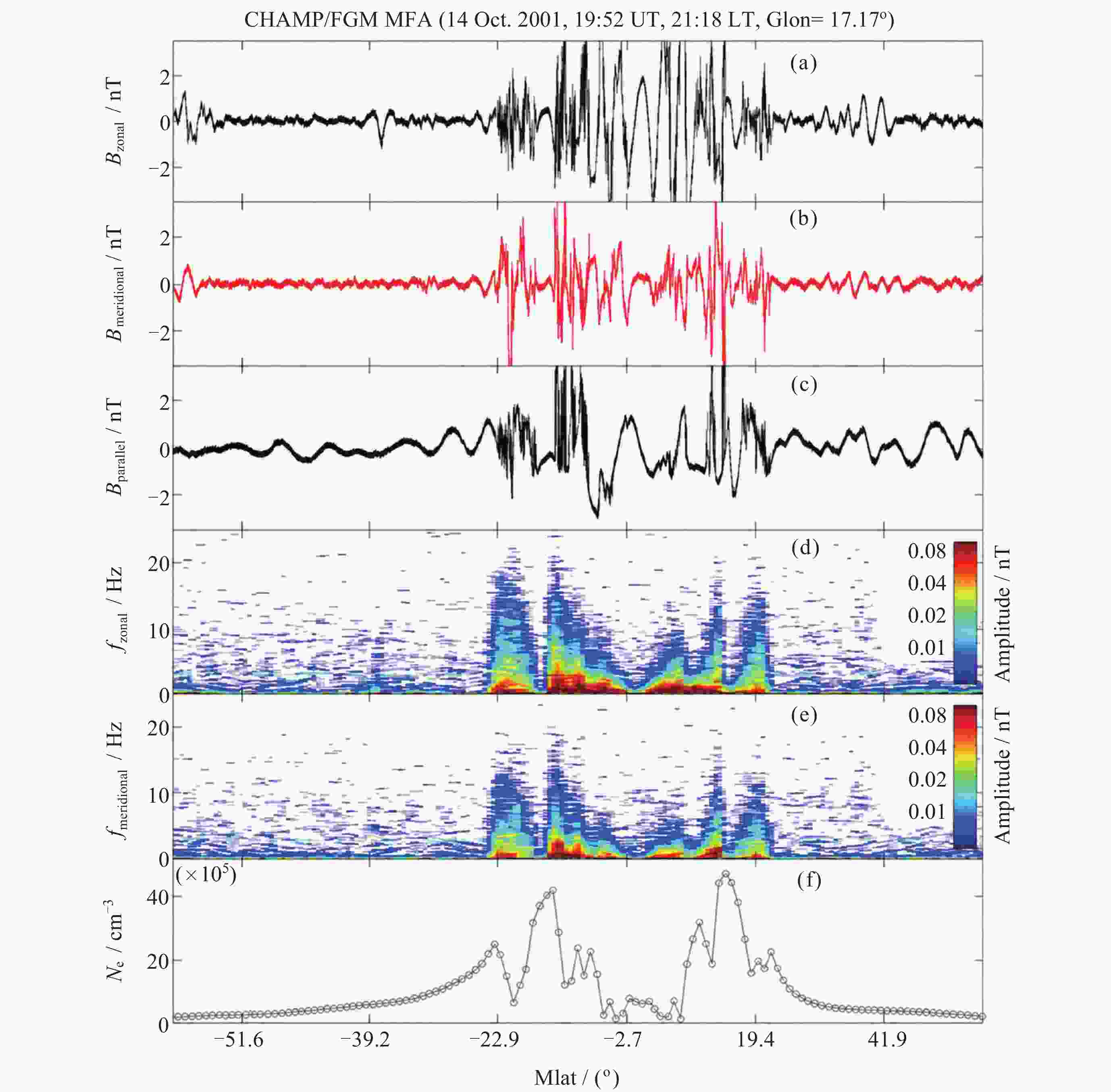
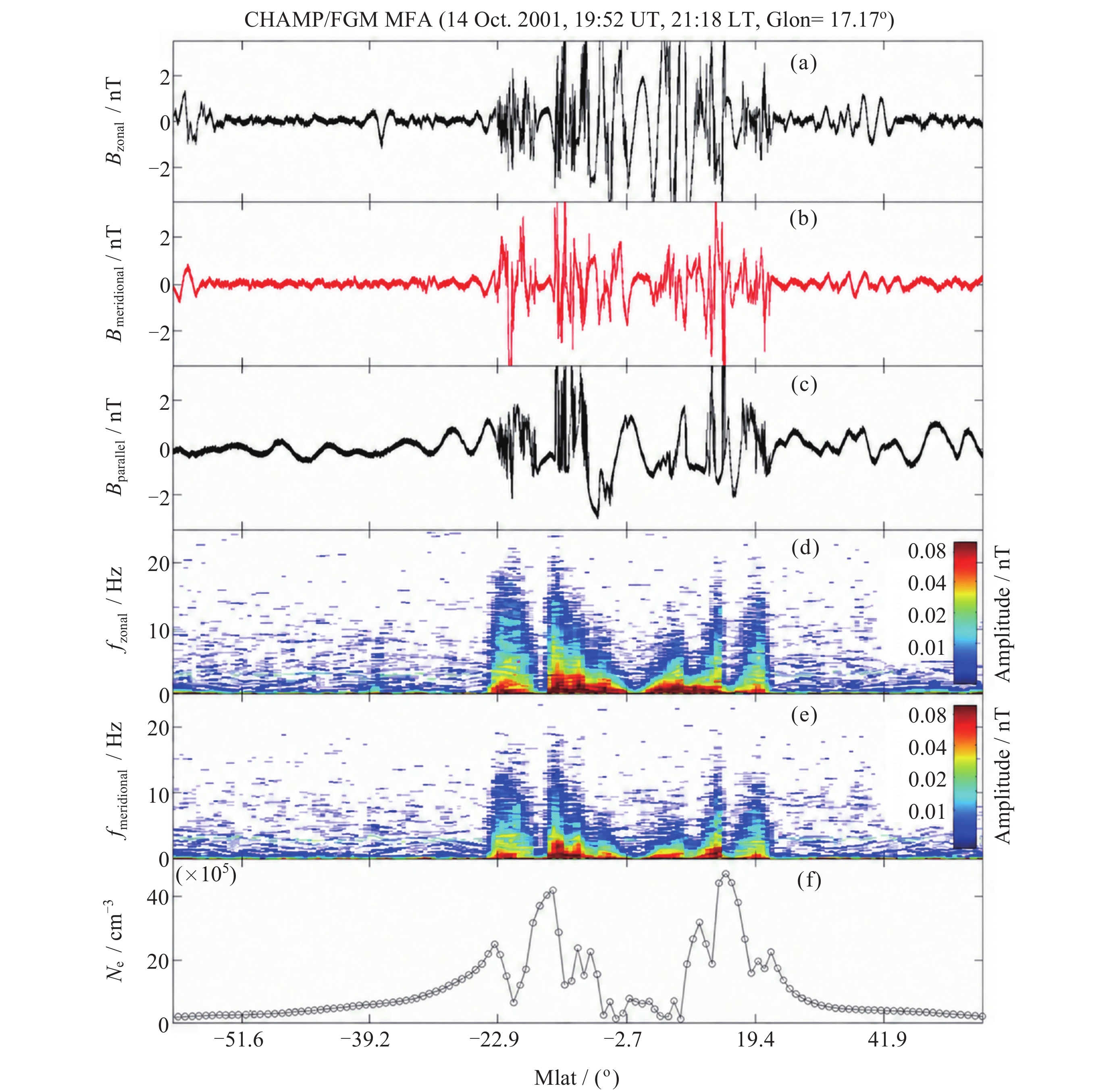
图 7 CHAMP卫星于2001年10月14日观测到的赤道等离子体泡相关阿尔芬波特征. (a)~(c)分别为磁场对齐坐标系中的东西向、南北向和平行磁场扰动分量, (d)和(e)分别为东西向和南北向磁场扰动的动态频谱, (f)为同期原位电子密度剖面[26]
Figure 7. Alfvénic wave signatures associated with equatorial plasma bubbles observed by CHAMP on 14 October 2001. (a)~(c)Magnetic perturbation components in the zonal, meridional and field-aligned dircetions under the magnetic field-aligned coordinate system, (d) and (e) dynamic spectra of the zonal and meridional magnetic perturbations, respectively, (f) corresponding in-situ electron density profile[26].
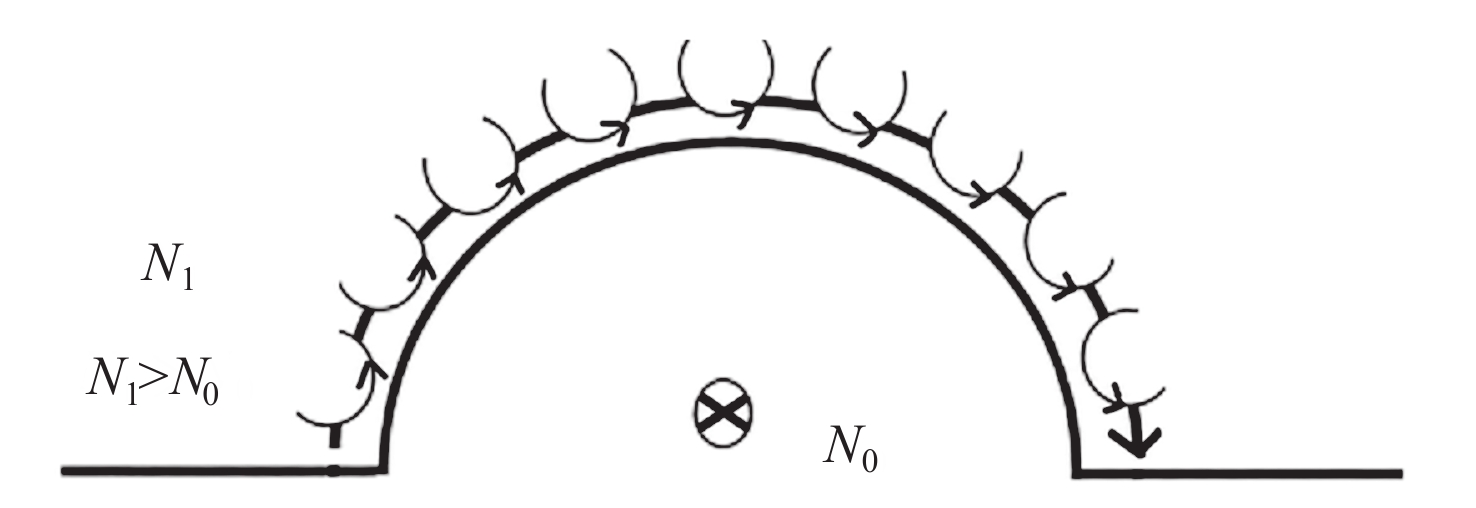
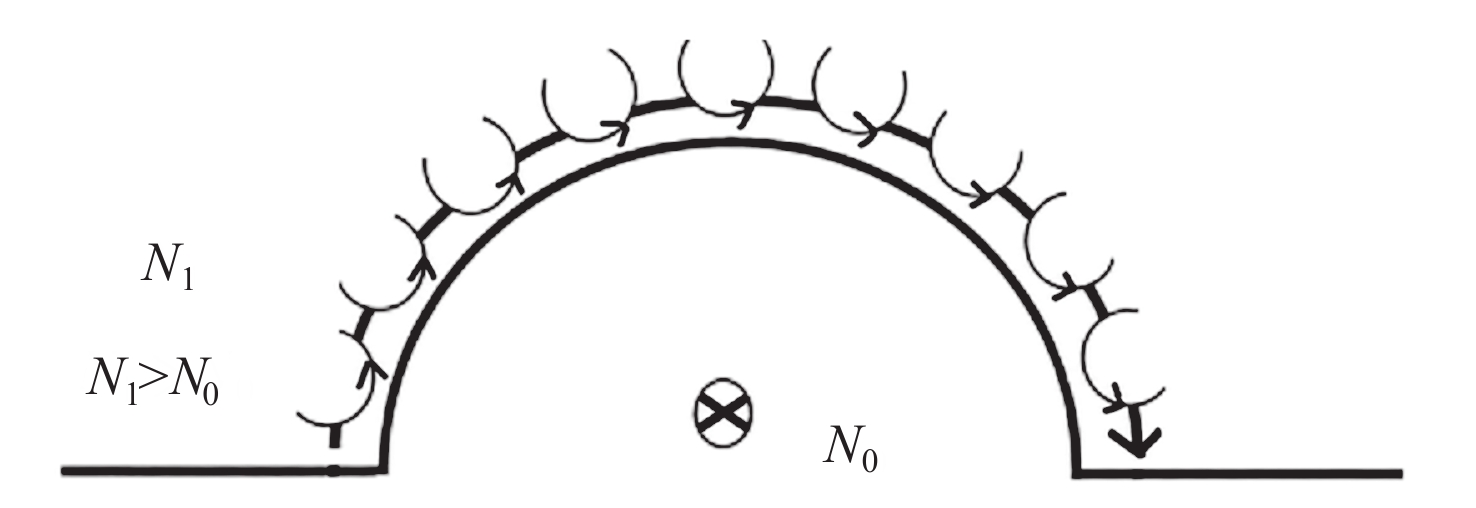
图 8 等离子体抗磁效应在等离子体密度分界面处产生的电流
Figure 8. Schematic illustration of the current generated at a plasma density boundary by the plasma diamagnetic effect
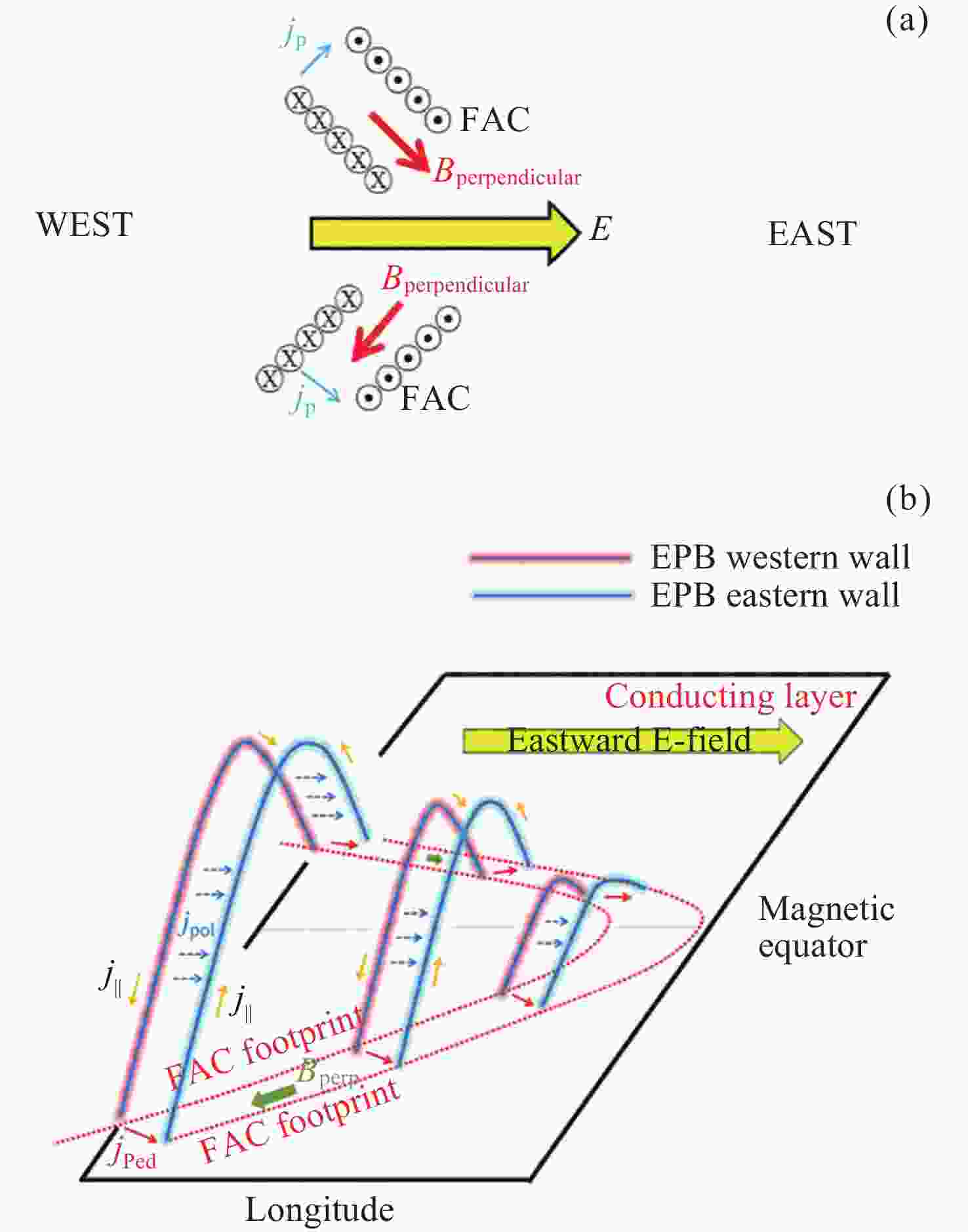
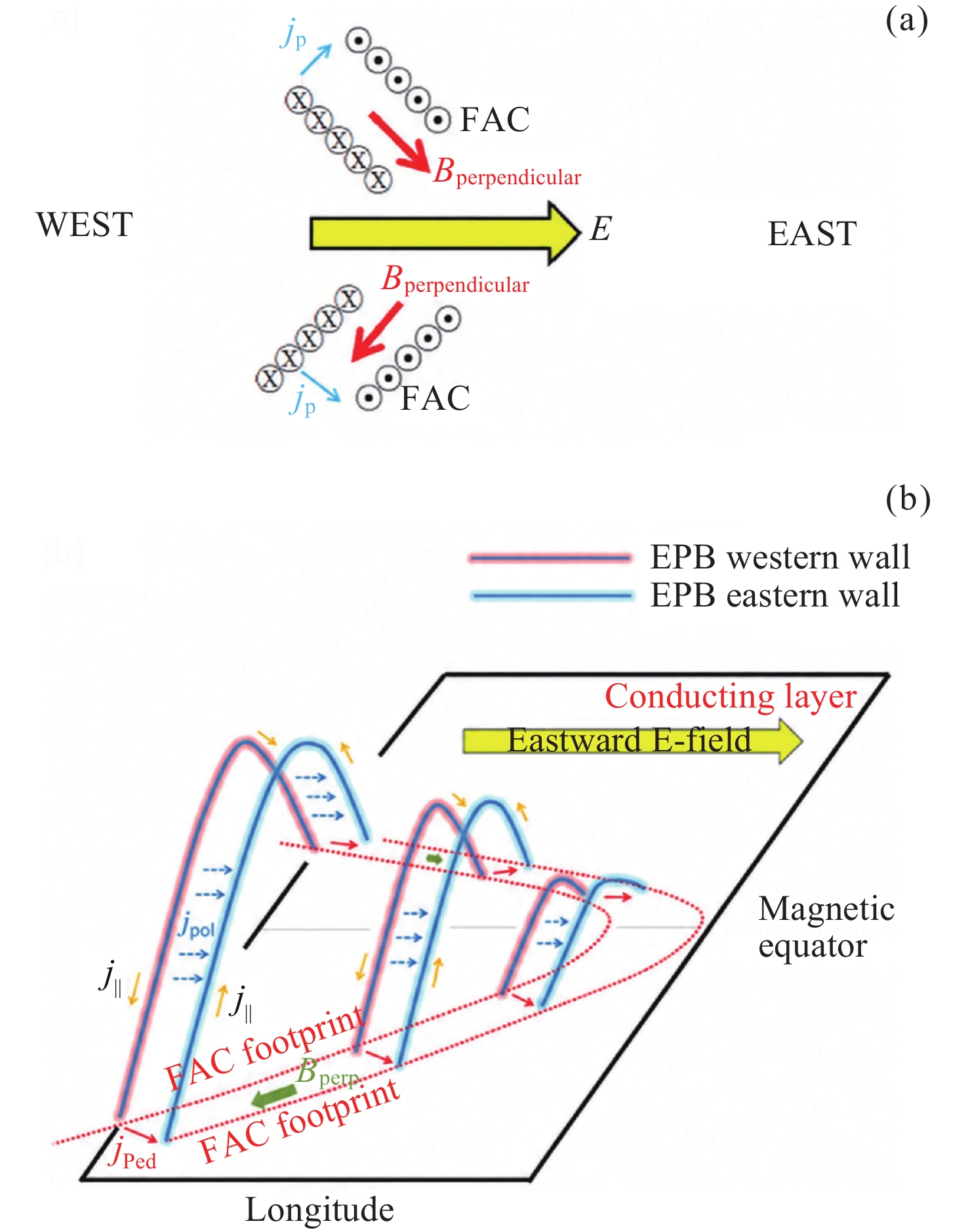
图 9 赤道等离子体泡空间结构及其相关电流系统. (a) EPB东西两侧边界附近的等离子体压力梯度电流、垂直磁场扰动和场向电流分布, (b) EPB沿磁力线延伸的三维结构, 以及极化电流、场向电流和电导层内Pedersen电流之间的闭合回路[56]
Figure 9. Schematic illustration of the spatial structure of an equatorial plasma bubble and its associated current system. (a) Distributions of the plasma pressure-gradient current, perpendicular magnetic perturbation, and field-aligned currents near the western and eastern walls of the EPB, (b) t hree-dimensional field-aligned structure of the EPB and the current closure involving polarization currents, field-aligned currents, and Pedersen currents in the conducting layer[56].
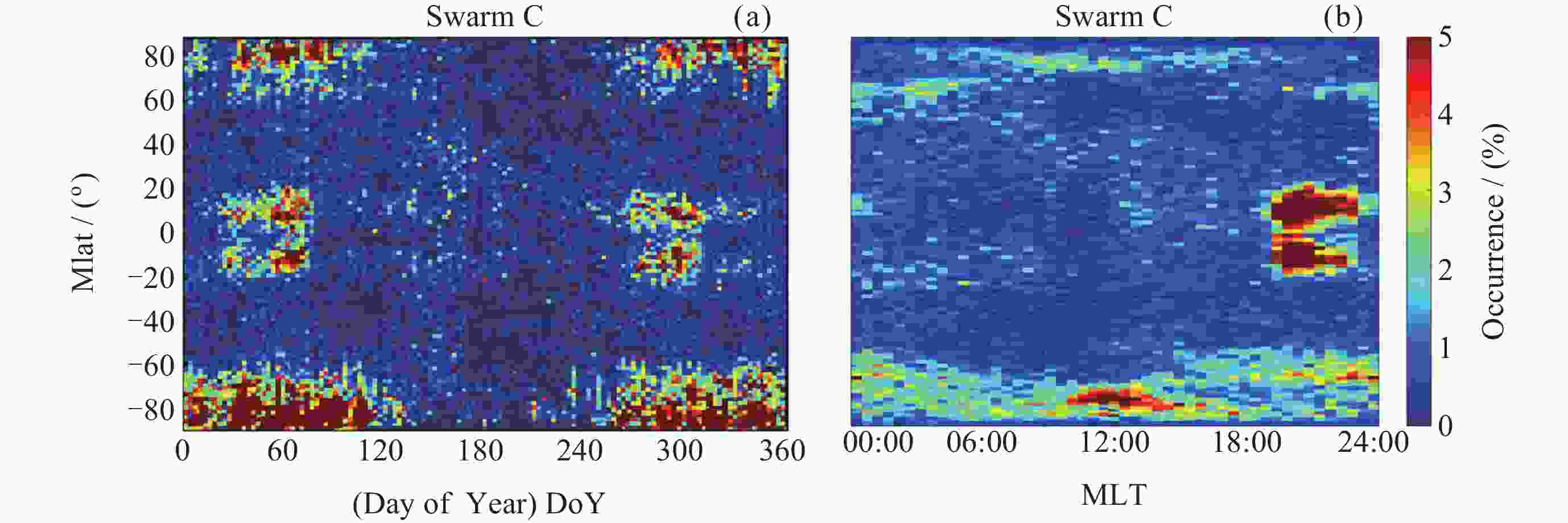
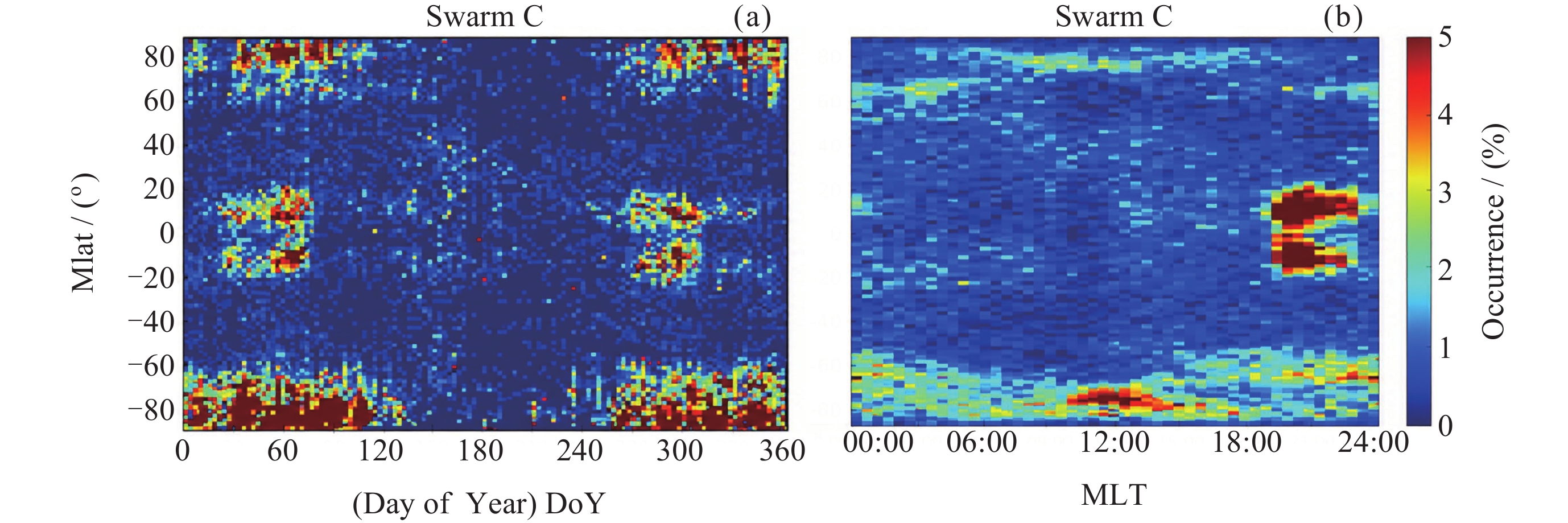
图 10 Swarm C卫星GPS接收机信号失锁事件发生率随磁纬度和时间的分布. (a) 2013年12月1日至2016年6月23日期间, 失锁事件发生率随DoY和磁纬度的变化, (b) 2013年12月-2016年11月期间, 失锁事件发生率随MLT和磁纬的变化[35]
Figure 10. Distributions of the occurrence rate of GPS signal loss-of-lock events onboard Swarm C as functions of magnetic latitude and time. (a) Variation in the occurrence rate with DoY and magnetic latitude from 1 December 2013 to 23 June 2016, (b) variation in the occurrence rate with MLT and magnetic latitude from December 2013 to November 2016[35]
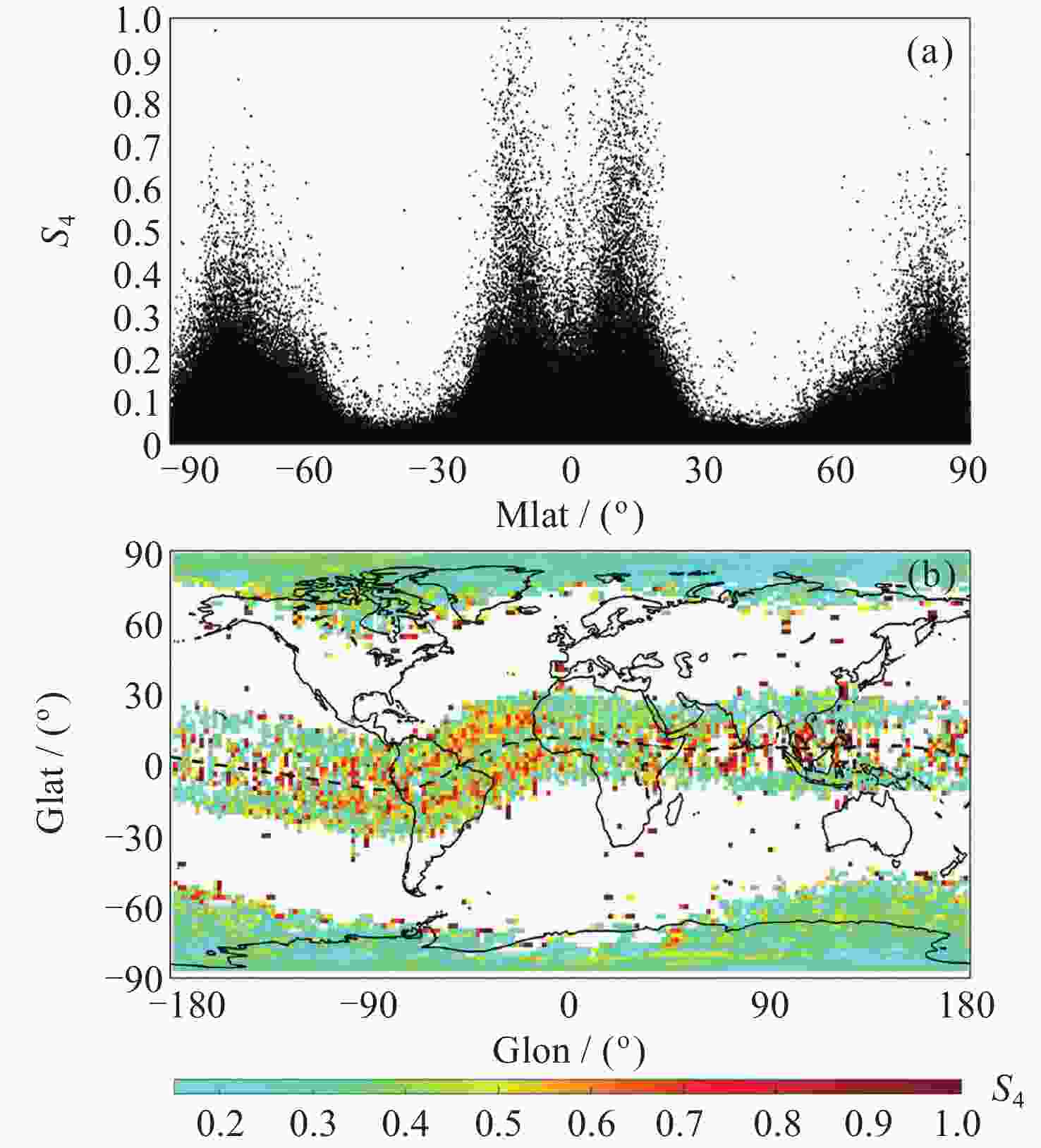
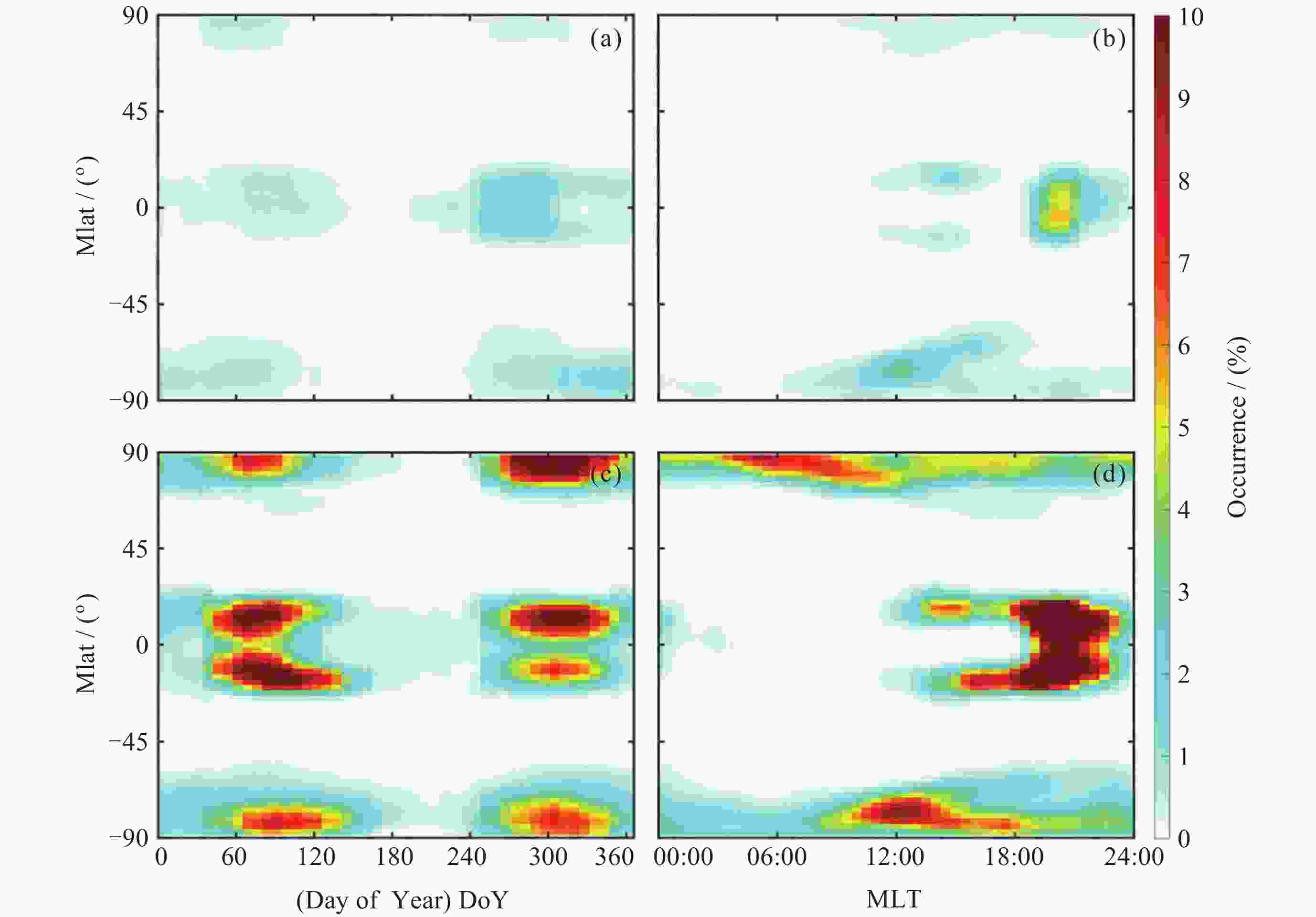
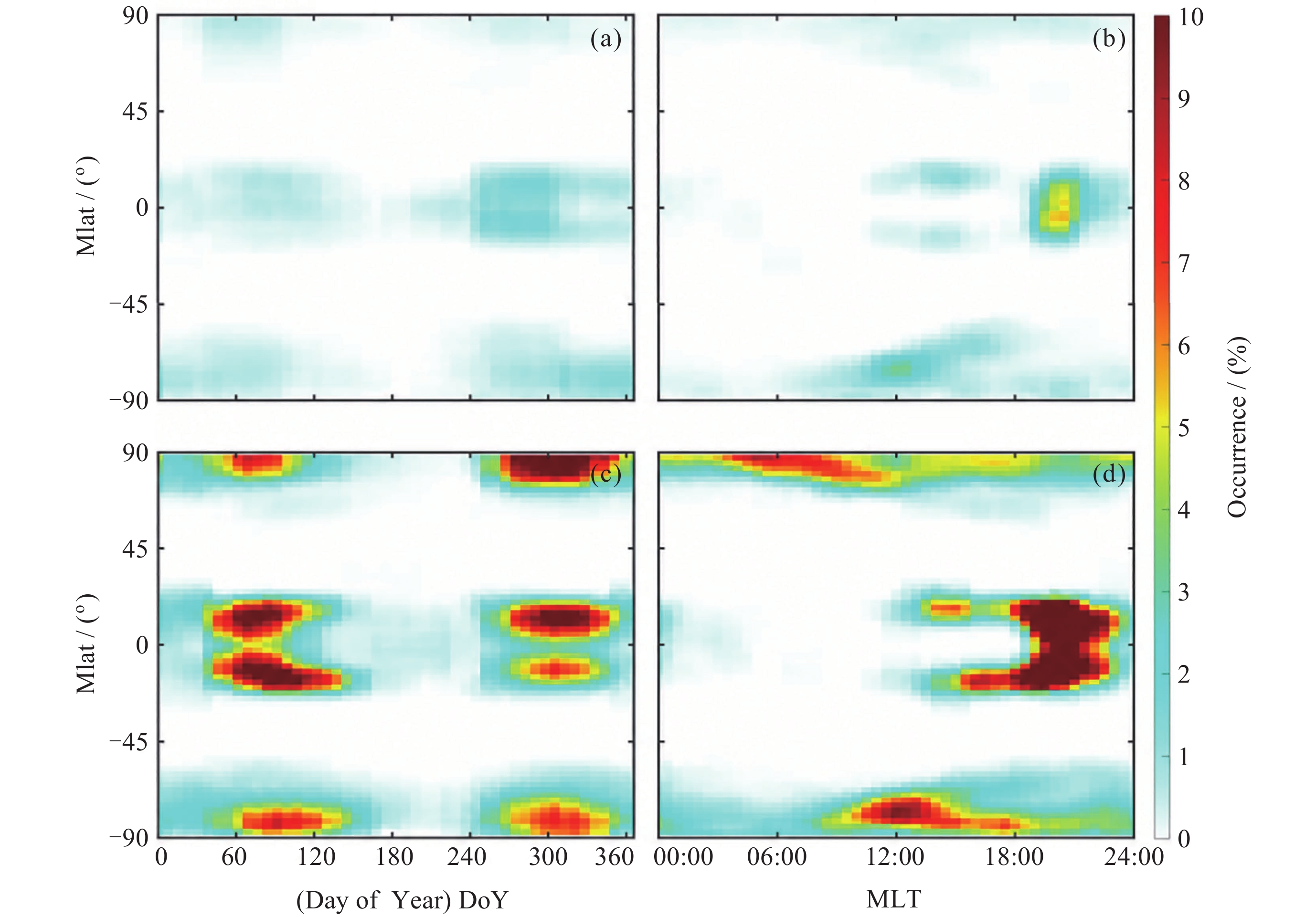
图 12 不同磁纬度下闪烁发生率随DoY和MLT的变化分布. (a)和(b)分别为F10.7<100条件下闪烁发生率随DoY和MLT的变化, (c)和(d)分别为F10.7>100条件下闪烁发生率随DoY和MLT的变化[37]
Figure 12. Distributions of scintillation occurrence rate as functions of DoY and MLT at different magnetic latitudes. Occurrence rates as functions of DoY (a) and MLT (b), respectively, for F10.7 < 100, (c) and (d) are corresponding results for F10.7 > 100 [37]
-
[1] BOOKER H G, WELLS H W. Scattering of radio waves by the F-region of the ionosphere[J]. Terrestrial Magnetism and Atmospheric Electricity, 1938, 43(3): 249-256 doi: 10.1029/TE043i003p00249 [2] WOODMAN R F, LA HOZ C. Radar observations of F region equatorial irregularities[J]. Journal of Geophysical Research, 1976, 81(31): 5447-5466 doi: 10.1029/JA081i031p05447 [3] KELLEY M C, MCCLURE J P. Equatorial spread-F: A review of recent experimental results[J]. Journal of Atmospheric and Terrestrial Physics, 1981, 43(5/6): 427-435 [4] OSSAKOW S L. Spread-F theories—A review[J]. Journal of Atmospheric and Terrestrial Physics, 1981, 43(5/6): 437-452 [5] DUNGEY J W. Convective diffusion in the equatorial F region[J]. Journal of Atmospheric and Terrestrial Physics, 1956, 9(5/6): 304-310 doi: 10.1016/0021-9169(56)90148-9 [6] BASU S, KELLEY M C. A review of recent observations of equatorial scintillations and their relationship to current theories of F region irregularity generation[J]. Radio Science, 1979, 14(3): 471-485 doi: 10.1029/RS014i003p00471 [7] FEJER B G, KELLEY M C. Ionospheric irregularities[J]. Reviews of Geophysics, 1980, 18(2): 401-454 doi: 10.1029/RG018i002p00401 [8] SULTAN P J. Linear theory and modeling of the Rayleigh-Taylor instability leading to the occurrence of equatorial spread F[J]. Journal of Geophysical Research: Space Physics, 1996, 101(A12): 26875-26891 doi: 10.1029/96JA00682 [9] HANSON W B, SANATANI S. Large Ni gradients below the equatorial F peak[J]. Journal of Geophysical Research, 1973, 78(7): 1167-1173 doi: 10.1029/JA078i007p01167 [10] MCCLURE J P, HANSON W B, HOFFMAN J H. Plasma bubbles and irregularities in the equatorial ionosphere[J]. Journal of Geophysical Research, 1977, 82(19): 2650-2656 doi: 10.1029/JA082i019p02650 [11] TSUNODA R T. Magnetic-field-aligned characteristics of plasma bubbles in the nighttime equatorial ionosphere[J]. Journal of Atmospheric and Terrestrial Physics, 1980, 42(8): 743-752 doi: 10.1016/0021-9169(80)90057-4 [12] FEJER B G, FARLEY D T, WOODMAN R F, et al. Dependence of equatorial F region vertical drifts on season and solar cycle[J]. Journal of Geophysical Research: Space Physics, 1979, 84(A10): 5792-5796 doi: 10.1029/JA084iA10p05792 [13] TSUNODA R T. Control of the seasonal and longitudinal occurrence of equatorial scintillations by the longitudinal gradient in integrated E region Pedersen conductivity[J]. Journal of Geophysical Research: Space Physics, 1985, 90(A1): 447-456 doi: 10.1029/JA090iA01p00447 [14] AARONS J. The longitudinal morphology of equatorial F-layer irregularities relevant to their occurrence[J]. Space Science Reviews, 1993, 63(3/4): 209-243 doi: 10.1007/bf00750769 [15] ABDU M A. Outstanding problems in the equatorial ionosphere-thermosphere electrodynamics relevant to spread F[J]. Journal of Atmospheric and Solar-Terrestrial Physics, 2001, 63(9): 869-884 doi: 10.1016/S1364-6826(00)00201-7 [16] BURKE W J, GENTILE L C, HUANG C Y, et al. Longitudinal variability of equatorial plasma bubbles observed by DMSP and ROCSAT-1[J]. Journal of Geophysical Research: Space Physics, 2004, 109(A12): 2004JA010583 doi: 10.1029/2004JA010583 [17] SU S Y, LIU C H, HO H H, et al. Distribution characteristics of topside ionospheric density irregularities: Equatorial versus midlatitude regions[J]. Journal of Geophysical Research: Space Physics, 2006, 111(A6): 2005JA011330 doi: 10.1029/2005JA011330 [18] STOLLE C, LÜHR H, ROTHER M, et al. Magnetic signatures of equatorial spread F as observed by the CHAMP satellite[J]. Journal of Geophysical Research: Space Physics, 2006, 111(A2): 2005JA011184 doi: 10.1029/2005JA011184 [19] XIONG C, PARK J, LÜHR H, et al. Comparing plasma bubble occurrence rates at CHAMP and GRACE altitudes during high and low solar activity[J]. Annales Geophysicae, 2010, 28(9): 1647-1658 doi: 10.5194/angeo-28-1647-2010 [20] HUANG C S, DE LA BEAUJARDIERE O, RODDY P A, et al. Occurrence probability and amplitude of equatorial ionospheric irregularities associated with plasma bubbles during low and moderate solar activities (2008-2012)[J]. Journal of Geophysical Research: Space Physics, 2014, 119(2): 1186-1199 doi: 10.1002/2013JA019212 [21] XIONG C, STOLLE C, LÜHR H, et al. Scale analysis of equatorial plasma irregularities derived from Swarm constellation[J]. Earth, Planets and Space, 2016, 68(1): 121 doi: 10.1186/s40623-016-0502-5 [22] WAN X, XIONG C, RODRIGUEZ-ZULUAGA J, et al. Climatology of the occurrence rate and amplitudes of local time distinguished equatorial plasma depletions observed by Swarm satellite[J]. Journal of Geophysical Research: Space Physics, 2018, 123(4): 3014-3026 doi: 10.1002/2017JA025072 [23] XIONG C, LÜHR H. Field-aligned scale length of depleted structures associated with post-sunset equatorial plasma bubbles[J]. Journal of Space Weather and Space Climate, 2023, 13: 3 doi: 10.1051/swsc/2023002 [24] STOLLE C, LÜHR H, FEJER B G. Relation between the occurrence rate of ESF and the equatorial vertical plasma drift velocity at sunset derived from global observations[J]. Annales Geophysicae, 2008, 26(12): 3979-3988 doi: 10.5194/angeo-26-3979-2008 [25] LÜHR H, XIONG C, PARK J, et al. Systematic study of intermediate-scale structures of equatorial plasma irregularities in the ionosphere based on CHAMP observations[J]. Frontiers in Physics, 2014, 2: 15 doi: 10.3389/fphy.2014.00015 [26] LÜHR H, PARK J, XIONG C, et al. Alfvén wave characteristics of equatorial plasma irregularities in the ionosphere derived from CHAMP observations[J]. Frontiers in Physics, 2014, 2: 47 doi: 10.3389/fphy.2014.00047 [27] XIONG C, XU J Y, WU K, et al. Longitudinal thin structure of equatorial plasma depletions coincidently observed by Swarm constellation and all-sky imager[J]. Journal of Geophysical Research: Space Physics, 2018, 123(2): 1593-1602 doi: 10.1002/2017JA025091 [28] XIONG C, XU J S, STOLLE C, et al. On the occurrence of GPS signal amplitude degradation for receivers on board LEO satellites[J]. Space Weather, 2020, 18(2): e2019SW002398 doi: 10.1029/2019SW002398 [29] KELLEY M C. The Earth's Ionosphere: Plasma Physics and Electrodynamics[M]. San Diego: Academic Press, 1989 [30] TSUNODA R T, WHITE B R. On the generation and growth of equatorial backscatter plumes 1. Wave structure in the bottomside F layer[J]. Journal of Geophysical Research: Space Physics, 1981, 86(A5): 3610-3616 doi: 10.1029/JA086iA05p03610 [31] HYSELL D L. An overview and synthesis of plasma irregularities in equatorial spread F[J]. Journal of Atmospheric and Solar-Terrestrial Physics, 2000, 62(12): 1037-1056 doi: 10.1016/S1364-6826(00)00095-X [32] XIONG C, LÜHR H, MA S Y, et al. Features of highly structured equatorial plasma irregularities deduced from CHAMP observations[J]. Annales Geophysicae, 2012, 30(8): 1259-1269 doi: 10.5194/angeo-30-1259-2012 [33] LUO X M, XIONG C, GU S F, et al. Geomagnetically conjugate observations of equatorial plasma irregularities from Swarm constellation and ground-based GPS stations[J]. Journal of Geophysical Research: Space Physics, 2019, 124(5): 3650-3665 doi: 10.1029/2019JA026515 [34] LÜHR H, ROTHER M, MAUS S, et al. The diamagnetic effect of the equatorial Appleton anomaly: its characteristics and impact on geomagnetic field modeling[J]. Geophysical Research Letters, 2003, 30(17): 2003GL017407 doi: 10.1029/2003GL017407 [35] XIONG C, STOLLE C, PARK J. Climatology of GPS signal loss observed by Swarm satellites[J]. Annales Geophysicae, 2018, 36(2): 679-693 doi: 10.5194/angeo-36-679-2018 [36] ZHENG Y H, XIONG C, JIN Y Q, et al. The refractive and diffractive contributions to GPS signal scintillation at high latitudes during the geomagnetic storm on 7-8 September 2017[J]. Journal of Space Weather and Space Climate, 2022, 12: 40 doi: 10.1051/swsc/2022036 [37] ZHENG Y H, XIONG C, SPOGLI L, et al. Global ionospheric scintillation estimation based on phase screen modeling from one-dimensional satellite data[J]. Space Weather, 2025, 23(1): e2024SW004103 doi: 10.1029/2024SW004103 [38] PARK J, LÜHR H, MIN K W. Neutral density depletions associated with equatorial plasma bubbles as observed by the CHAMP satellite[J]. Journal of Atmospheric and Solar-Terrestrial Physics, 2010, 72(2/3): 157-163 doi: 10.1016/j.jastp.2009.11.003 [39] (胡洋, 熊超, 尹凡, 等. Swarm卫星星载接收机GPS信号中断统计特征分析[J]. 地球物理学报, 2023, 66(11): 4464-4477 doi: 10.6038/cjg2023Q0983HU Yang, XIONG Chao, YIN Fan, et al. Distribution of the GPS signal interruption for the spacebore receiver on board Swarm satellites[J]. Chinese Journal of Geophysics, 2023, 66(11): 4464-4477 doi: 10.6038/cjg2023Q0983 [40] FEJER B G, SCHERLIESS L, DE PAULA E R. Effects of the vertical plasma drift velocity on the generation and evolution of equatorial spread F[J]. Journal of Geophysical Research: Space Physics, 1999, 104(A9): 19859-19869 doi: 10.1029/1999JA900271 [41] CARTER B A, YIZENGAW E, RETTERER J M, et al. Global equatorial plasma bubble occurrence during the 2015 St. Patrick's Day storm[J]. Journal of Geophysical Research: Space Physics, 2016, 121(1): 894-905 doi: 10.1002/2015JA022194 [42] WAN X, XIONG C, GAO S Z, et al. The nighttime ionospheric response and occurrence of equatorial plasma irregularities during geomagnetic storms: a case study[J]. Satellite Navigation, 2021, 2(1): 23 doi: 10.1186/s43020-021-00055-x [43] ZHOU Y L, LÜHR H, XIONG C, et al. Ionospheric storm effects and equatorial plasma irregularities during the 17-18 March 2015 event[J]. Journal of Geophysical Research: Space Physics, 2016, 121(9): 9146-9163 doi: 10.1002/2016JA023122 [44] GAO S Z, CAI H T, ZHAN W J, et al. Characterization of local time dependence of equatorial spread F responses to substorms in the American sector[J]. Journal of Space Weather and Space Climate, 2023, 13: 2 doi: 10.1051/swsc/2022039 [45] (杨璐冰, 蔡红涛, 熊超, 等. 基于Swarm数据的全球中低纬等离子不规则体统计分析[J]. 地球物理学报, 2025, 68(10): 3675-3691 doi: 10.6038/cjg2024S0620YANG Lubing, CAI Hongtao, XIONG Chao, et al. A global statistical analysis of plasma irregularities at mid- and low- latitudes based on Swarm data[J]. Chinese Journal of Geophysics, 2025, 68(10): 3675-3691 doi: 10.6038/cjg2024S0620 [46] LUO W H, LI H, XIONG C, et al. Linkage of equatorial ionization anomaly with the day-to-day occurrence of postsunset irregularities and scintillation in low-latitude region around 110°E[J]. Space Weather, 2022, 20(10): e2022SW003192 doi: 10.1029/2022SW003192 [47] GAO S Z, XIONG C, CAI H T, et al. Predicting equatorial spread F at JICAMARCA sector via supervised machine learning[J]. Space Weather, 2025, 23(3): e2024SW004214 doi: 10.1029/2024SW004214 [48] KIL H. The morphology of equatorial plasma bubbles - a review[J]. Journal of Astronomy and Space Sciences, 2015, 32(1): 13-19 doi: 10.5140/JASS.2015.32.1.13 [49] ABDU M A. Day-to-day and short-term variabilities in the equatorial plasma bubble/spread F irregularity seeding and development[J]. Progress in Earth and Planetary Science, 2019, 6(1): 11 doi: 10.1186/s40645-019-0258-1 [50] FEJER B G, LARANJA S R, CONDOR P. Multi-process driven unusually large equatorial perturbation electric fields during the April 2023 geomagnetic storm[J]. Frontiers in Astronomy and Space Sciences, 2024, 11: 1351735 doi: 10.3389/fspas.2024.1351735 [51] ZHENG Y H, XIONG C, RANG X Y, et al. Merging and dissipation of intense equatorial plasma bubbles with large-scale mid-latitude low electron density regions during the 23-24 April 2023 geomagnetic storm[J]. Journal of Geophysical Research: Space Physics, 2026, 131(1): e2025JA033744 doi: 10.1029/2025JA033744 [52] SUN L C, XU J Y, ZHU Y J, et al. Interaction between an EMSTID and an EPB in the EIA crest region over China[J]. Journal of Geophysical Research: Space Physics, 2021, 126(8): e2020JA029005 doi: 10.1029/2020JA029005 [53] WU K, XU J Y, YUE X N, et al. Equatorial plasma bubbles developing around sunrise observed by an all-sky imager and global navigation satellite system network during storm time[J]. Annales Geophysicae, 2020, 38(1): 163-177 doi: 10.5194/angeo-38-163-2020 [54] LÜHR H, KLÖCKER N. AMPTE-IRM observations of magnetic cavities near the magnetopause[J]. Geophysical Research Letters, 1987, 14(3): 186-189 doi: 10.1029/GL014i003p00186 [55] LÜHR H, KLÖCKER N, ACUÑA M H. The diamagnetic effect during AMPTE’s tail releases: Initial results[J]. Advances in Space Research, 1988, 8(1): 11-14 doi: 10.1016/0273-1177(88)90336-5 [56] PARK J, LÜHR H, STOLLE C, et al. The characteristics of field-aligned currents associated with equatorial plasma bubbles as observed by the CHAMP satellite[J]. Annales Geophysicae, 2009, 27(7): 2685-2697 doi: 10.5194/angeo-27-2685-2009 [57] XIONG C, STOLLE C, LÜHR H. The Swarm satellite loss of GPS signal and its relation to ionospheric plasma irregularities[J]. Space Weather, 2016, 14(8): 563-577 doi: 10.1002/2016SW001439 [58] MARQUES H A, MARQUES H A S, AQUINO M, et al. Accuracy assessment of Precise Point Positioning with multi-constellation GNSS data under ionospheric scintillation effects[J]. Journal of Space Weather and Space Climate, 2018, 8: A15 doi: 10.1051/swsc/2017043 [59] LUO X M, DU J F, MONICO J F G, et al. ROTI-based stochastic model to improve GNSS Precise Point Positioning under severe geomagnetic storm activity[J]. Space Weather, 2022, 20(7): e2022SW003114 doi: 10.1029/2022SW003114 [60] TANG L, ZHANG F K, LI P, et al. Effects of equatorial plasma bubble-induced ionospheric gradients on GNSS PPP-RTK[J]. GPS Solutions, 2024, 28(3): 124 doi: 10.1007/s10291-024-01664-0 [61] AA E, ZHANG S R, ZOU S S, et al. Significant midlatitude Bubble-Like Ionospheric Super-depletion Structure (BLISS) and dynamic variation of storm-enhanced density plume during the 23 April 2023 geomagnetic storm[J]. Space Weather, 2024, 22(3): e2023SW003704 doi: 10.1029/2023SW003704 [62] JIN Y Q, KOTOVA D, XIONG C, et al. Ionospheric plasma IRregularities - IPIR - Data product based on data from the Swarm satellites[J]. Journal of Geophysical Research: Space Physics, 2022, 127(4): e2021JA030183 doi: 10.1029/2021JA030183 -
-

 下载:
下载:

计量
- 文章访问数: 381
- HTML全文浏览量: 44
- PDF下载量: 31
-
被引次数:
0(来源:Crossref)
0(来源:其他)

