


基于夸父二号卫星地球凌日观测的科学研究展望
doi: 10.11728/cjss2026.05.2025-0237 cstr: 32142.14.cjss.2025-0237
-
 李昊 男, 1986年10月出生于吉林省长春市, 中国科学院国家空间科学中心研究员, 主要从事原子谱线偏振、太阳大气磁场反演等方面的研究. E-mail: lihao01@nssc.ac.cn
 -
 田晖 男, 1982年8月出生于湖北省蕲春市, 北京大学地球与空间科学学院教授, 博士生导师, 主要从事太阳物理、恒星磁活动、空间极紫外探测等方面的研究. E-mail: huitian@pku.edu.cn
作者简介:
通讯作者:
Prospects for Scientific Research Based on Transit Observations of Earth by the Solar Polar-orbit Observatory
-
摘要: 夸父二号科学卫星在利用木星引力改变轨道倾角飞出黄道面之前, 将在黄道面环日飞行, 有望在可见光和极紫外多个波段完整观测地球凌日过程. 本文主要围绕夸父二号未来将开展的地球凌日观测, 预先分析其可开展的相关科学研究内容. 一方面, 利用极紫外波段地球大气遮掩太阳的观测, 可反演地球热层氧原子数密度及其垂直分布. 基于地球经验大气模型, 对极紫外波段地球大气吸收进行了正演模拟, 反演测试表明, 可有效反演地球热层250~600 km范围内的氧原子数密度分布;另一方面, 基于地球凌日过程中在极紫外与可见光波段表现出的光变曲线特征, 可预估未来极紫外波段开展系外行星凌星探测的典型光变信号. 模拟分析了行星凌星过程中极紫外波段的光变曲线特征. 由于行星大气对极紫外辐射具有显著吸收作用, 光变曲线将呈现出不同于可见光波段的变化特征. 上述结果不仅对理解地球大气热层的性质具有重要意义, 而且能为探测系外行星高层大气的特性提供重要启示.Abstract: The Solar Polar-orbit Observatory (SPO) mission will employ a gravity assist of Jupiter to change its orbital inclination, enabling the spacecraft to leave the ecliptic plane and conduct direct imaging observations of the Sun’s poles. Before performing the gravity assist maneuver at Jupiter, SPO will orbit the Sun near the ecliptic plane, during which it will have the opportunity to observe the transit of the Earth across the solar disk in visible and Extreme-ultraviolet (EUV) bands. This paper focuses on the prospective Earth’s transit observations by SPO in the future and presents a preliminary assessment of the potential scientific investigations that could be carried out. First, the absorption of EUV radiation by the Earth’s atmosphere during transit can be used to retrieve the atomic oxygen number density in the thermosphere and its variation with altitude, thereby obtaining the vertical distribution of oxygen atoms. Using an empirical atmospheric model of Earth, we perform forward modeling of the absorption of EUV radiation by the Earth’s atmosphere. Inversion tests demonstrate that the absorption in these EUV wavelengths can be used to infer the distribution of atomic oxygen number density in the thermosphere within an altitude range of 250-600 km. Second, based on the characteristics of light curves in both the EUV and visible bands, obtained during the Earth’s transit, we can investigate the typical transit photometric signatures that may arise in future exoplanet transit detections in EUV bands. We simulate the light-curve characteristics during planetary transits in the EUV band. Due to the significant absorption of EUV radiation by planetary atmospheres, the resulting light curves exhibit characteristics that differ from those observed in the visible band. These results will provide important guidance and theoretical support for future EUV-based exoplanet detection missions.
-
Key words:
- Planetary Atmosphere /
- Transit /
- Occultation /
- Extreme ultraviolet
-
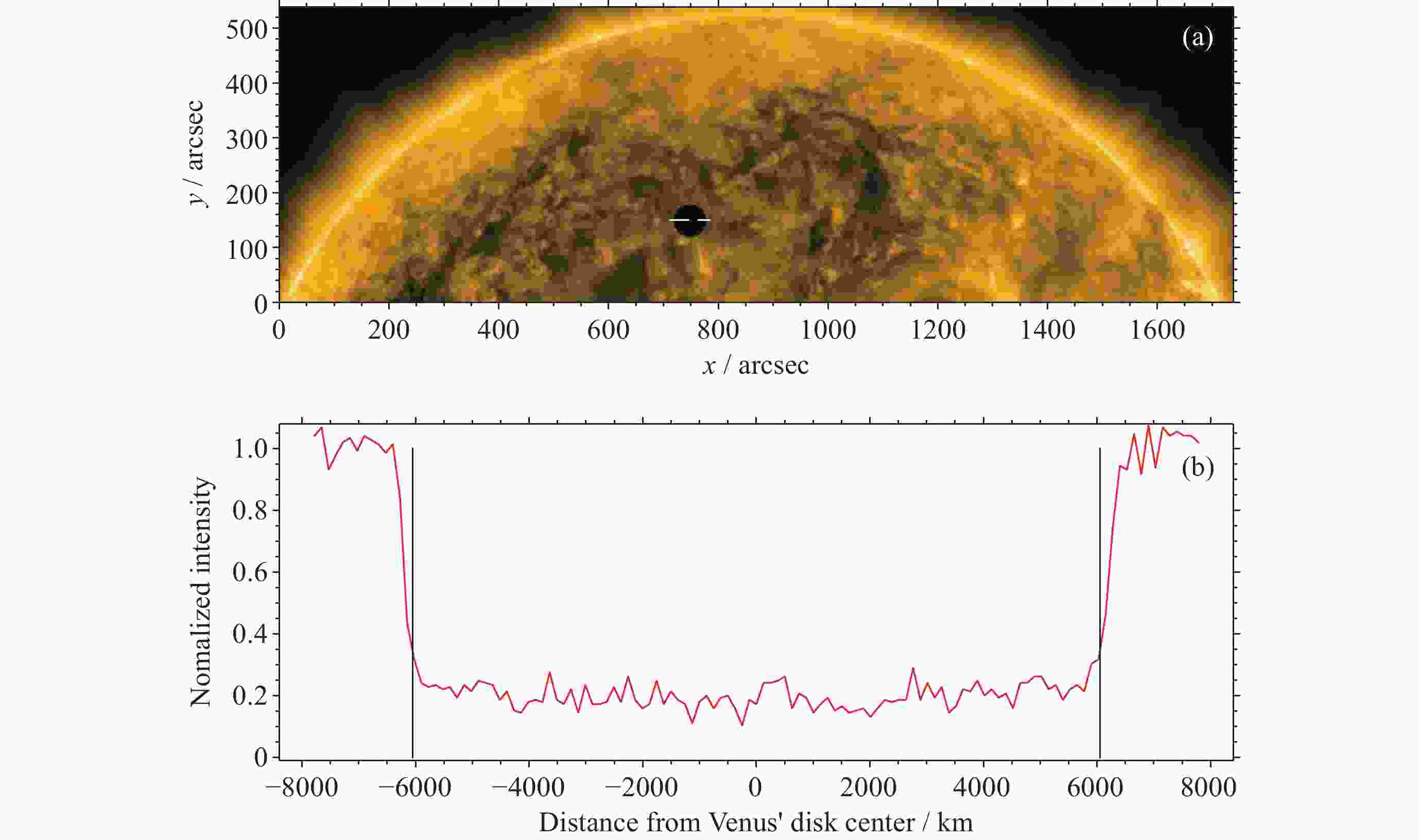
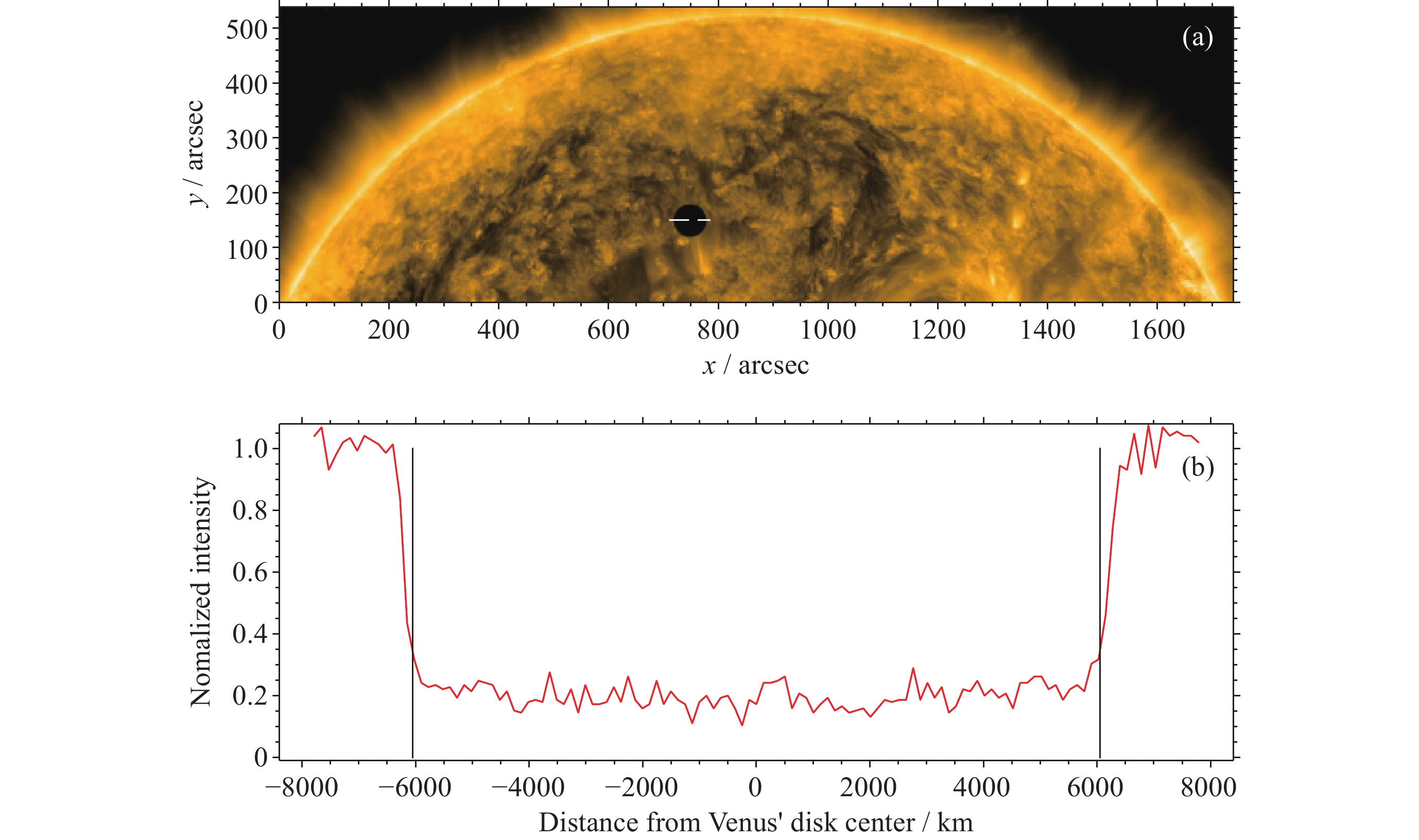
图 1 SDO/AIA在171 Å波段观测的金星凌日. (a)金星凌日原始图像, (b)沿(a)中白色虚线的归一化光强变化曲线
Figure 1. Transit of Venus observed by SDO/AIA in the 171 Å band. (a) Image of the Venus transit. (b) Normalized intensity curve along the white dashed line in panel (a)
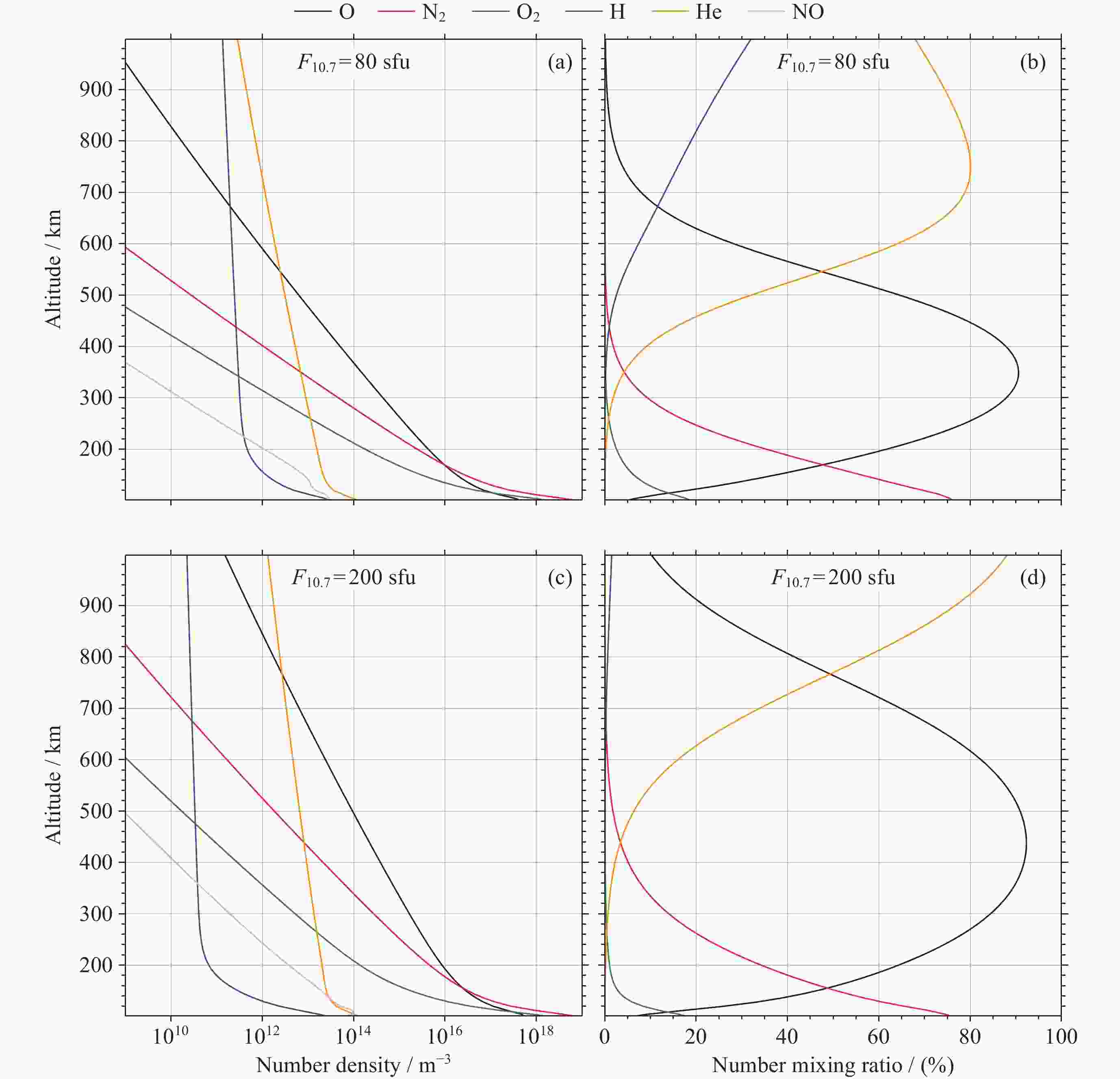
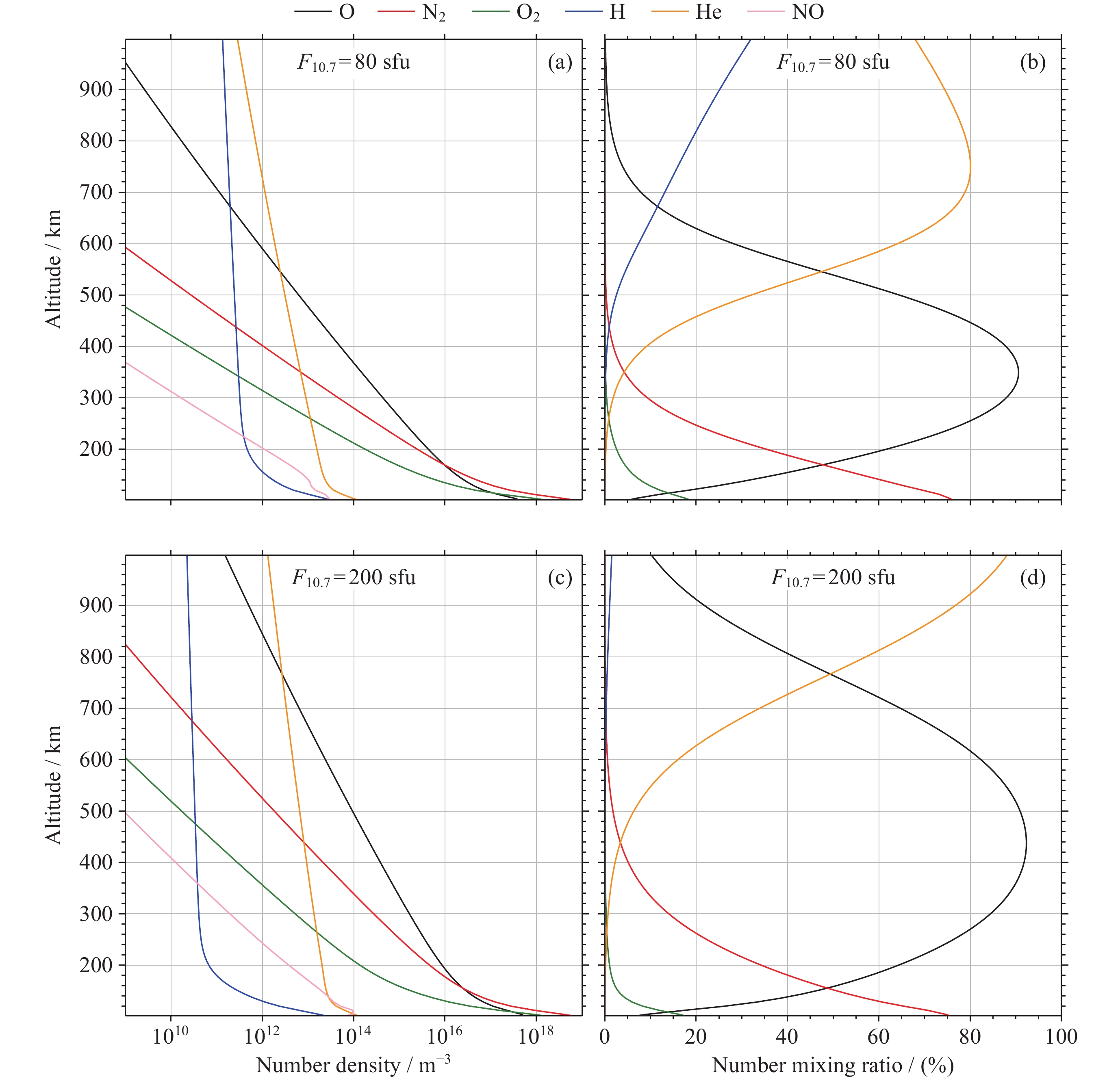
图 3 NRLMSIS2.1经验大气模型在赤道附近冬季06:00 LT条件下的垂直廓线. (a)(c)为氧分子、氮分子、氧原子、氢原子、氦原子以及一氧化氮分子的数密度随高度的变化廓线, (b)(d)给出了这些原子和分子的数混合比随高度的分布, (a)(b)对应F10.7 = 80 sfu的情况, (c)(d)对应F10.7 = 200 sfu的情况
Figure 3. Vertical profiles from the NRLMSIS2.1 empirical atmosphere model for equatorial regions at 06:00 LT in winter. (a)(c) show the number-density profiles of atomic oxygen, molecular nitrogen, molecular oxygen, atomic hydrogen, atomic helium, and nitric oxide. (b)(d) present the corresponding number mixing ratios. (a)(b) correspond to low solar activity (F10.7 = 80 sfu), while (c)(d) correspond to high solar activity (F10.7 = 200 sfu)
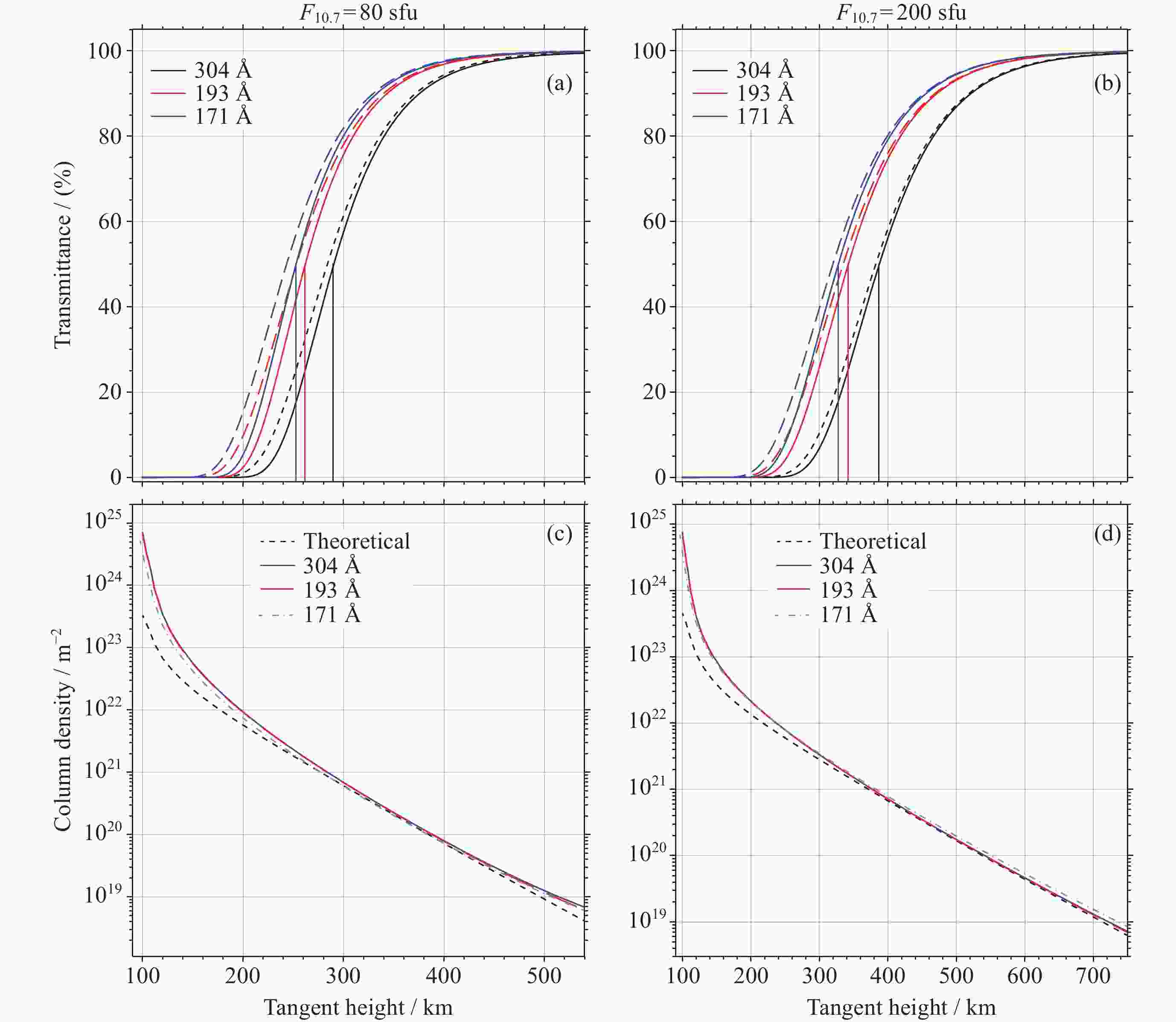
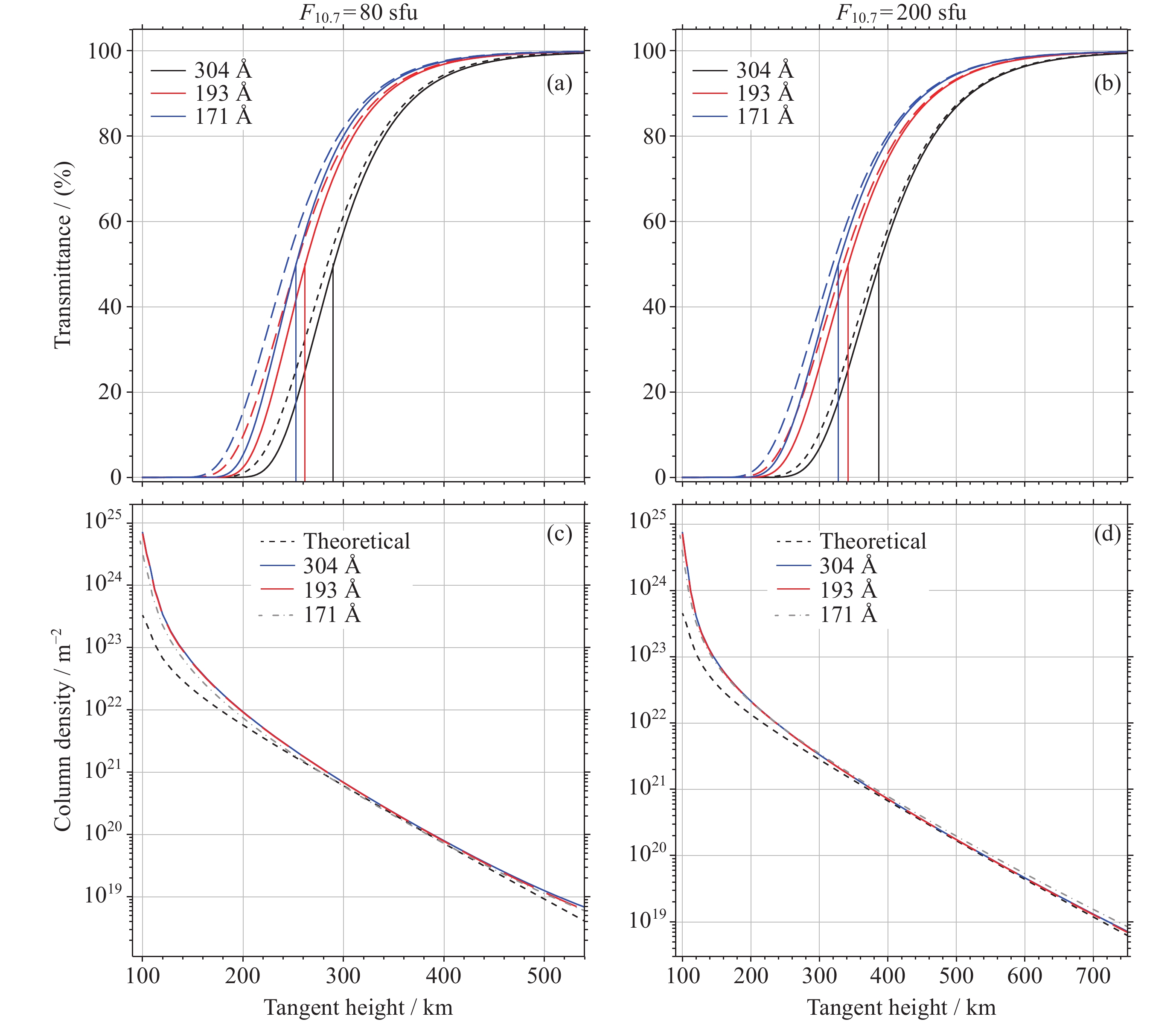
图 4 地球大气对极紫外辐射的正演透过率与反演柱密度. (a)(b)在F10.7 = 80 sfu和200 sfu的条件下, 正演计算得到的极紫外171, 193, 304 Å三个波段的辐射透过率, (c)(d)基于上述透过率反演得到的氧原子柱密度随高度的分布
Figure 4. Forward modeling of EUV transmittance of the Earth’s atmosphere and the retrieved column densities of atomic oxygen. (a)(b) show the synthesized transmittance at 171 Å, 193 Å, and 304 Å for the cases of F10.7 = 80 sfu and 200 sfu, respectively. (c)(d) present the inverted column densities of atomic oxygen derived from the synthesized transmittance
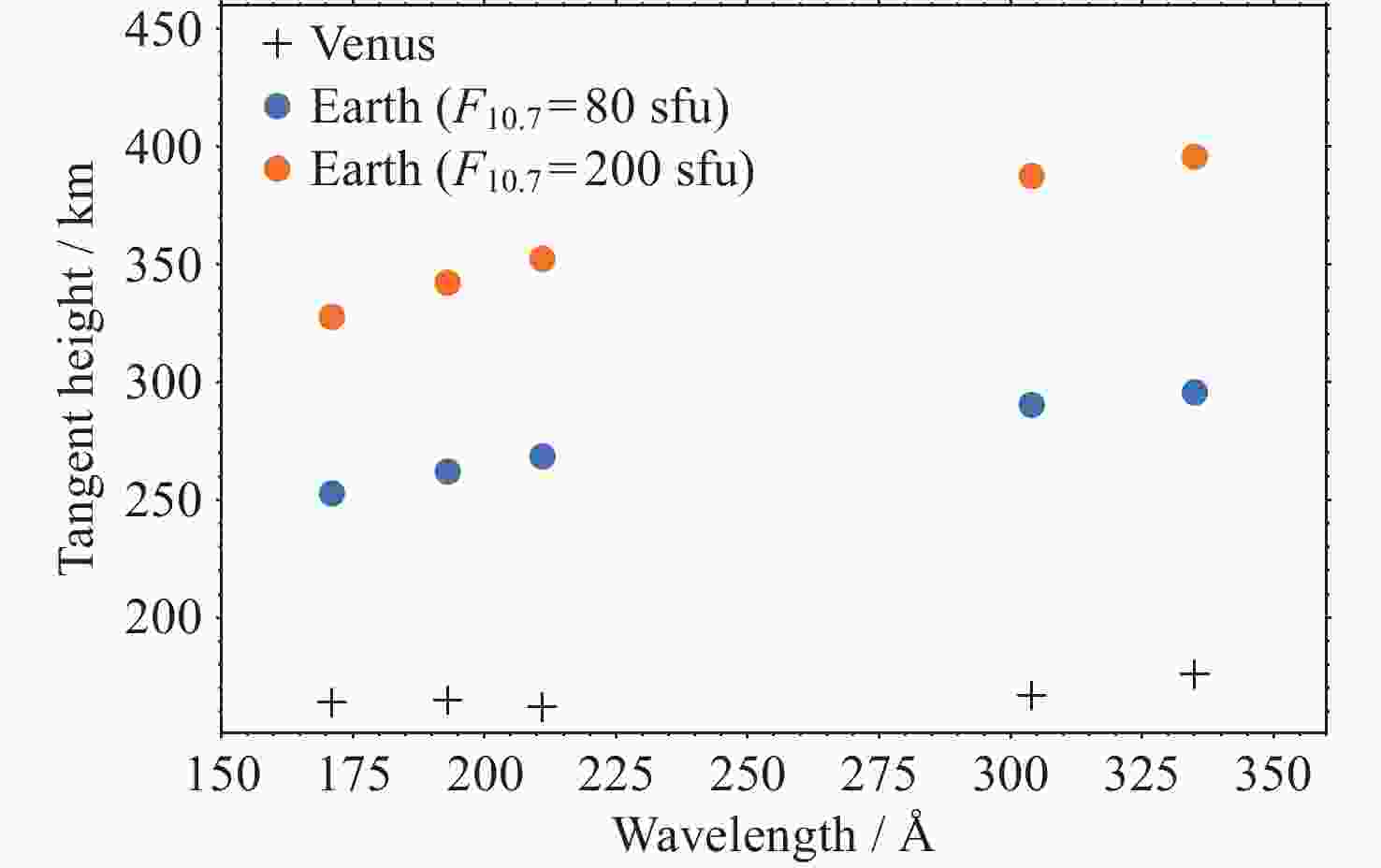
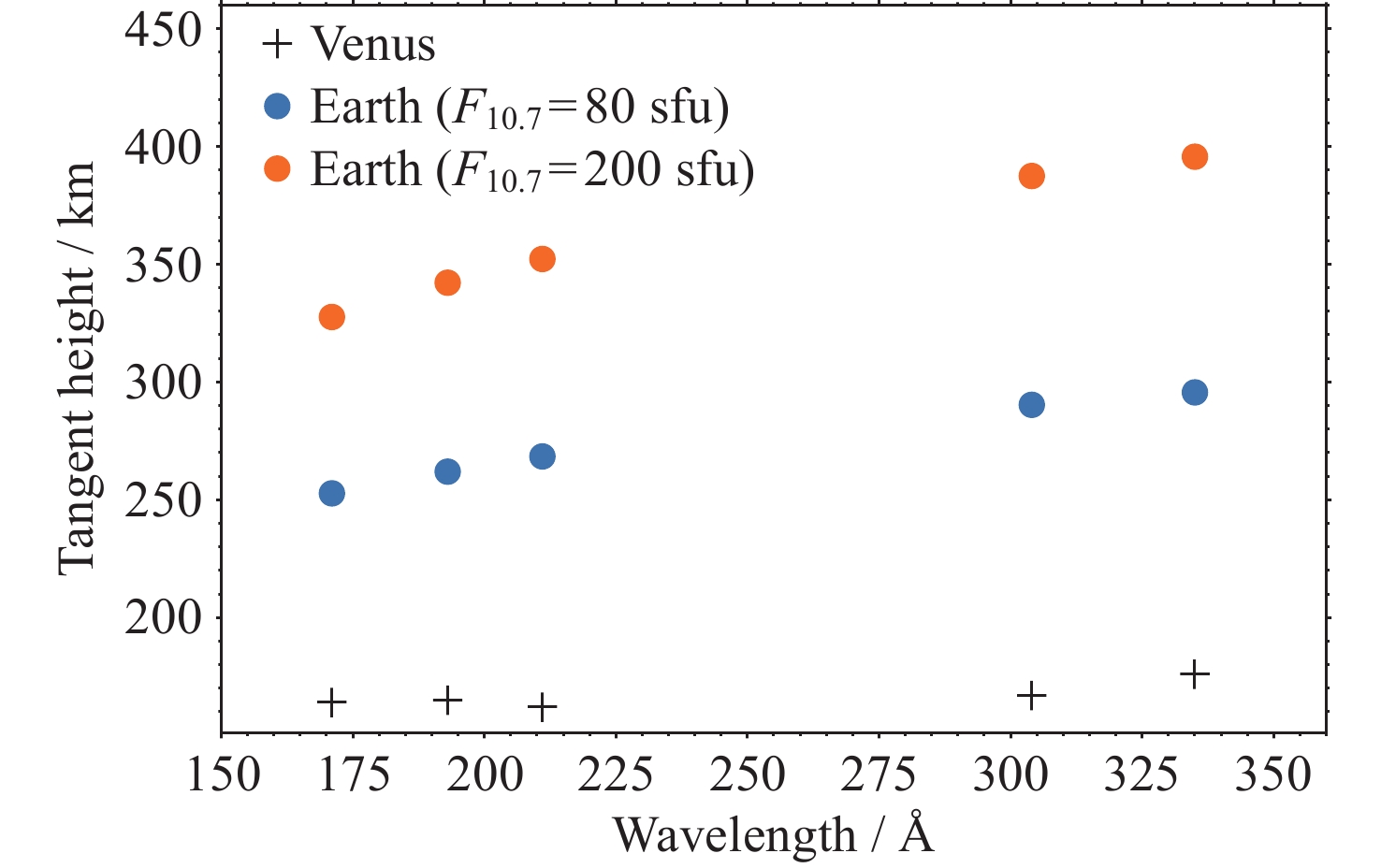
图 5 金星和地球掩日观测时在171, 193, 211, 304和335 Å波段的大气遮挡高度(透过率为50%时的切向高度).
Figure 5. Occultation heights of Venus and Earth’s atmosphere at the wavelengths of 171, 193, 211, 304, and 335 Å (The tangent height where the transmittance is 50%)
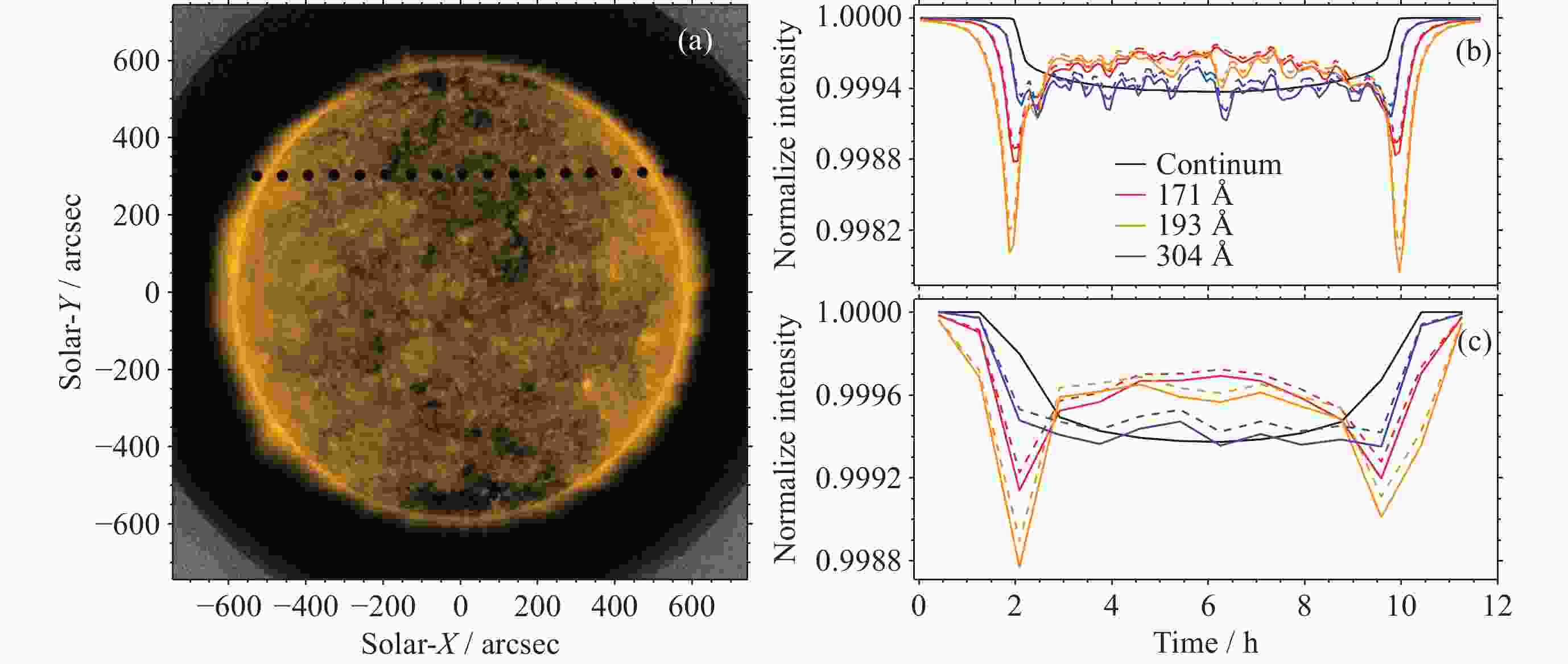
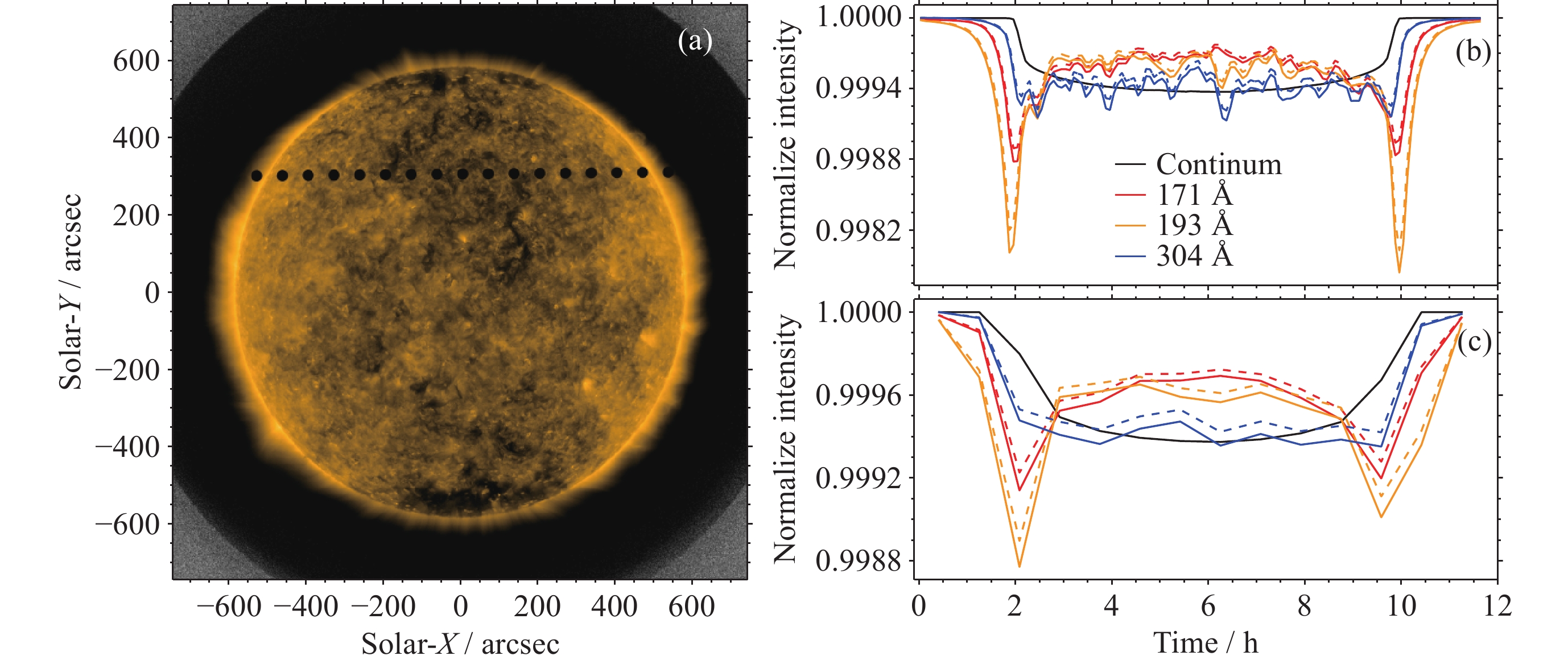
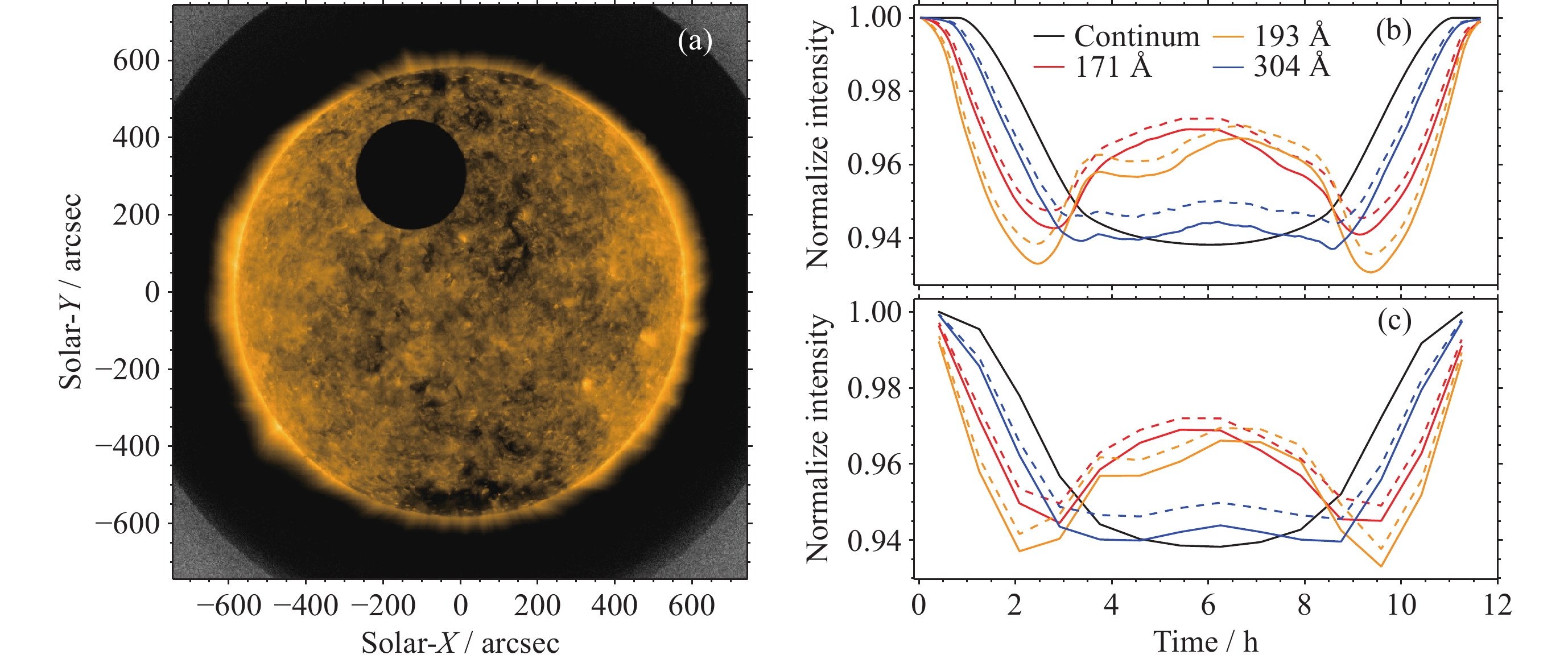
图 6 夸父二号观测地球凌日过程的模拟结果. (a)根据卫星轨道计算得到的地球凌日过程中投影到太阳表面的位置及投影半径, (b)凌日过程中极紫外171, 193 和 304 Å及可见光波段的光变曲线, (c)曝光时间提高至50 min时得到的光变曲线
Figure 6. Simulation of the Earth’s transit observed by SPO. (a) Projected position and radius of Earth on the solar disk during the transit, calculated based on the orbit of SPO. (b) Light curves in the EUV 171, 193 and 304 Å and visible bands. (c) Light curves obtained by increasing the exposure time to 50 minutes
-
[1] WINN J N, FABRYCKY D C. The occurrence and architecture of exoplanetary systems[J]. Annual Review of Astronomy and Astrophysics, 2015, 53(1): 409-447 doi: 10.1146/annurev-astro-082214-122246 [2] NASA. NASA Exoplanet Archive [EB/OL]. (2025-12-31)[2025-12-31]. https://exoplanetarchive.ipac.caltech.edu/ [3] LISSAUER J J, FABRYCKY D C, FORD E B, et al. A closely packed system of low-mass, low-density planets transiting Kepler-11[J]. Nature, 2011, 470(7332): 53-58 doi: 10.1038/nature09760 [4] BORUCKI W J, KOCH D, BASRI G, et al. Kepler planet-detection mission: introduction and first results[J]. Science, 2010, 327(5968): 977-980 doi: 10.1126/science.1185402 [5] KOCH D G, BORUCKI W J, BASRI G, et al. Kepler mission design, realized photometric performance, and early science[J]. The Astrophysical Journal Letters, 2010, 713(2): L79-L86 doi: 10.1088/2041-8205/713/2/L79 [6] SEAGER S, DEMING D. Exoplanet atmospheres[J]. Annual Review of Astronomy and Astrophysics, 2010, 48(1): 631-672 doi: 10.1146/annurev-astro-081309-130837 [7] MADHUSUDHAN N, AGÚNDEZ M, MOSES J I, et al. Exoplanetary atmospheres—chemistry, formation conditions, and habitability[J]. Space Science Reviews, 2016, 205(1/2/3/4): 285-348 doi: 10.1007/s11214-016-0254-3 [8] MADHUSUDHAN N. Exoplanetary atmospheres: key insights, challenges, and prospects[J]. Annual Review of Astronomy and Astrophysics, 2019, 57: 617-663 doi: 10.1146/annurev-astro-081817-051846 [9] BYCHKOV V, GOLUBKOV G, NIKITIN A, et al. The Atmosphere and Ionosphere: Elementary Processes, Discharges and Plasmoids[M]. Dordrecht: Springer, 2013. DOI: 10.1007/978-94-007-2914-8 [10] THOMAS G E, STAMNES K. Radiative Transfer in the Atmosphere and Ocean[M]. Cambridge: Cambridge University Press, 2002 [11] LECAVELIER DES ETANGS A, EHRENREICH D, VIDAL-MADJAR A, et al. Evaporation of the planet HD 189733b observed in H I Lyman-α[J]. Astronomy and Astrophysics, 2010, 514(10): A72 doi: 10.1051/0004-6361/200913347 [12] LECAVELIER DES ETANGS A, BOURRIER V, WHEATLEY P J, et al. Temporal variations in the evaporating atmosphere of the exoplanet HD 189733b[J]. Astronomy and Astrophysics, 2012, 543(4): L4 doi: 10.1051/0004-6361/201219363 [13] POPPENHAEGER K, SCHMITT J H M M, WOLK S J. Transit observations of the hot Jupiter hd 189733b at X-ray wavelengths[J]. The Astrophysical Journal, 2013, 773(1): 62 doi: 10.1088/0004-637X/773/1/62 [14] 田晖, 白先勇, 邓元勇, 等. 晚型恒星极紫外和X射线探测的科学目标与初步方案[J]. 中国科学: 物理学 力学 天文学, 2022, 52(11): 119511 doi: 10.1360/SSPMA-2022-0023TIAN Hui, BAI Xianyong, DENG Yuanyong, et al. Scientific objectives and preliminary plans for EUV and X-ray observations of late-type stars[J]. Scientia Sinica Physica, Mechanica & Astronomica, 2022, 52(11): 119511 doi: 10.1360/SSPMA-2022-0023 [15] 田晖, 白先勇, 封莉, 等. 空间天气探源计划(探冕计划)[J]. 空间科学学报, 2025, 45(4): 881-898 doi: 10.11728/cjss2025.04.2025-0060TIAN Hui, BAI Xianyong, FENG Li, et al. Coronal explorer for the sun and nearby stars[J]. Chinese Journal of Space Science, 2025, 45(4): 881-898 doi: 10.11728/cjss2025.04.2025-0060 [16] 王赤, 汪毓明, 田晖, 等. 空间物理学科发展战略研究[J]. 空间科学学报, 2023, 43(1): 9-42 doi: 10.11728/cjss2023.01.yg01WANG Chi, WANG Yuming, TIAN Hui, et al. Strategic study for the development of space physics[J]. Chinese Journal of Space Science, 2023, 43(1): 9-42 doi: 10.11728/cjss2023.01.yg01 [17] 颜毅华, 邓元勇, 甘为群, 等. 空间太阳物理学科发展战略研究[J]. 空间科学学报, 2023, 43(2): 199-211 doi: 10.11728/cjss2023.02.yg04YAN Yihua, DENG Yuanyong, GAN Weiqun, et al. Strategic study for the development of solar physics in space[J]. Chinese Journal of Space Science, 2023, 43(2): 199-211 doi: 10.11728/cjss2023.02.yg04 [18] DENG Yuanyong, TIAN Hui, JIANG Jie, et al. Probing solar polar regions[J]. Chinese Journal of Space Science, 2025, 45(4): 913-942 doi: 10.11728/cjss2025.04.2025-0054 [19] PESNELL W D, THOMPSON B J, CHAMBERLIN P C. The Solar Dynamics Observatory (SDO)[J]. Solar Physics, 2012, 275(1/2): 3-15 doi: 10.1007/s11207-011-9841-3 [20] REALE F, GAMBINO A F, MICELA G, et al. Using the transit of Venus to probe the upper planetary atmosphere[J]. Nature Communications, 2015, 6(1): 7563 doi: 10.1038/ncomms8563 [21] LEMEN J R, TITLE A M, AKIN D J, et al. The Atmospheric Imaging Assembly (AIA) on the Solar Dynamics Observatory (SDO)[J]. Solar Physics, 2012, 275(1/2): 17-40 doi: 10.1007/s11207-011-9776-8 [22] PÄTZOLD M, HÄUSLER B, BIRD M K, et al. The structure of Venus’ middle atmosphere and ionosphere[J]. Nature, 2007, 450(7170): 657-660 doi: 10.1038/nature06239 [23] FOX J L. The post-terminator ionosphere of Venus[J]. Icarus, 2011, 216(2): 625-639 doi: 10.1016/j.icarus.2011.09.020 [24] FOX J L, SUNG K Y. Solar activity variations of the Venus thermosphere/ionosphere[J]. Journal of Geophysical Research: Space Physics, 2001, 106(A10): 21305-21335 doi: 10.1029/2001JA000069 [25] TANGA P, WIDEMANN T, SICARDY B, et al. Sunlight refraction in the mesosphere of Venus during the transit on June 8th, 2004[J]. Icarus, 2012, 218(1): 207-219 doi: 10.1016/j.icarus.2011.12.004 [26] PERE C, TANGA P, WIDEMANN T, et al. Multilayer modeling of the aureole photometry during the Venus transit: comparison between SDO/HMI and VEx/SOIR data[J]. Astronomy & Astrophysics, 2016, 595(9): A115 doi: 10.1051/0004-6361/201628528 [27] BRANCO A, MACHADO P, DEMANGEON O, et al. Transmission spectroscopy along the transit of Venus: a proxy for exoplanets atmospheric characterization[J]. Atmosphere, 2024, 15(12): 1431 doi: 10.3390/atmos15121431 [28] AHRER E M, STEVENSON K B, MANSFIELD M, et al. Early release science of the exoplanet WASP-39b with JWST NIRCam[J]. Nature, 2023, 614(7949): 653-658 doi: 10.1038/s41586-022-05590-4 [29] EMMERT J T. Thermospheric mass density: a review[J]. Advances in Space Research, 2015, 56(5): 773-824 doi: 10.1016/j.asr.2015.05.038 [30] MEIER R R, PICONE J M, DROB D, et al. Remote sensing of earth’s limb by TIMED/GUVI: retrieval of thermospheric composition and temperature[J]. Earth and Space Science, 2015, 2(1): 1-37 doi: 10.1002/2014EA000035 [31] STEPHAN A W, MEIER R R, ENGLAND S L, et al. Daytime O/N2 retrieval algorithm for the Ionospheric Connection explorer (ICON)[J]. Space Science Reviews, 2018, 214(1): 42 doi: 10.1007/s11214-018-0477-6 [32] SHEESE P E, MCDADE I C, GATTINGER R L, et al. Atomic oxygen densities retrieved from optical spectrograph and infrared imaging system observations of O2 a-band airglow emission in the mesosphere and lower thermosphere[J]. Journal of Geophysical Research: Atmospheres, 2011, 116(D1): D01303 doi: 10.1029/2010JD014640 [33] TUMINELLO R M, ENGLAND S L, SIRK M M, et al. Neutral composition information in ICON EUV dayglow observations[J]. Journal of Geophysical Research: Space Physics, 2022, 127(8): e2022JA030592 doi: 10.1029/2022JA030592 [34] TUMINELLO R M, STEPHAN A W, ENGLAND S L. Retrieval of thermospheric O and N2 densities from ICON EUV[J]. Journal of Geophysical Research: Space Physics, 2024, 129(2): e2023JA032100 doi: 10.1029/2023JA032100 [35] HAYS P B, ROBLE R G. Stellar spectra and atmospheric composition[J]. Journal of the Atmospheric Sciences, 1968, 25(6): 1141-1153 doi: 10.1175/1520-0469(1968)025<1141:SSAAC>2.0.CO;2 [36] HAYS P B, ROBLE R G. Atmospheric properties from the inversion of planetary occultation data[J]. Planetary and Space Science, 1968, 16(9): 1197-1198 doi: 10.1016/0032-0633(68)90131-1 [37] HAYS P B, ROBLE R G, SHAH A N. Terrestrial atmospheric composition from stellar occultations[J]. Science, 1972, 176(4036): 793-794 doi: 10.1126/science.176.4036.793 [38] HAYS P B, ROBLE R G. Stellar occultation measurements of molecular oxygen in the lower thermosphere[J]. Planetary and Space Science, 1973, 21(3): 339-348 doi: 10.1016/0032-0633(73)90032-9 [39] ROBLE R G, HAYS P B. The nighttime distribution of ozone in the low-latitude mesosphere[J]. Pure and Applied Geophysics, 1973, 106(1): 1281-1289 doi: 10.1007/BF00881080 [40] ROBLE R G, HAYS P B. On determining the ozone number density distribution from OAO-2 stellar occultation measurements[J]. Planetary and Space Science, 1974, 22(9): 1337-1340 doi: 10.1016/0032-0633(74)90054-3 [41] CHANDRASEKHAR S. Radiative Transfer[M]. New York: Dover Publications, 1960. [42] LI Z, WU X C, TU C, et al. Oxygen and air density retrieval method for single-band stellar occultation measurement[J]. Remote Sensing, 2024, 16(11): 2006 doi: 10.3390/rs16112006 [43] ROBLE R G, HAYS P B. A technique for recovering the vertical number density profile of atmospheric gases from planetary occultation data[J]. Planetary and Space Science, 1972, 20(10): 1727-1744 doi: 10.1016/0032-0633(72)90194-8 [44] LEWIS B R, GIBSON S T, HAWES F T, et al. A new model for the Schumann-Runge bands of O2[J]. Physics and Chemistry of the Earth, Part C: Solar, Terrestrial & Planetary Science, 2001, 26(7): 519-526 doi: 10.1016/S1464-1917(01)00040-X [45] CHU W P, MCCORMICK M P, LENOBLE J, et al. SAGE II inversion algorithm[J]. Journal of Geophysical Research: Atmospheres, 1989, 94(D6): 8339-8351 doi: 10.1029/JD094iD06p08339 [46] LUMPE J D, BEVILACQUA R M, HOPPEL K W, et al. POAM II retrieval algorithm and error analysis[J]. Journal of Geophysical Research: Atmospheres, 1997, 102(D19): 23593-23614 doi: 10.1029/97JD00906 [47] LUMPE J D, BEVILACQUA R M, HOPPEL K W, et al. POAM III retrieval algorithm and error analysis[J]. Journal of Geophysical Research: Atmospheres, 2002, 107(D21): 4575 doi: 10.1029/2002JD002137 [48] KYRÖLÄ E, TAMMINEN J, LEPPELMEIER G W, et al. GOMOS on Envisat: an overview[J]. Advances in Space Research, 2004, 33(7): 1020-1028 doi: 10.1016/S0273-1177(03)00590-8 [49] LUMPE J D, FLOYD L E, HERRING L C, et al. Measurements of thermospheric molecular oxygen from the Solar Ultraviolet Spectral Irradiance Monitor[J]. Journal of Geophysical Research: Atmospheres, 2007, 112(D16): D16308 doi: 10.1029/2006JD008076 [50] LUMPE J D, MCCLINTOCK W E, EVANS J S, et al. A new data set of thermospheric molecular oxygen from the Global-scale Observations of the Limb and Disk (GOLD) mission[J]. Journal of Geophysical Research: Space Physics, 2020, 125(4): e2020JA027812 doi: 10.1029/2020JA027812 [51] 张斯敏, 吴小成, 孙明晨, 等. 星光掩星剥洋葱法反演臭氧密度[J]. 光谱学与光谱分析, 2022, 42(1): 203-209 doi: 10.3964/j.issn.1000-0593(2022)01-0203-07ZHANG Simin, WU Xiaocheng, SUN Mingchen, et al. Using onion-peeling method to inverse ozone density based on the stellar occultation technology in the near space region[J]. Spectroscopy and Spectral Analysis, 2022, 42(1): 203-209 doi: 10.3964/j.issn.1000-0593(2022)01-0203-07 [52] 李政, 吴小成, 胡雄, 等. 恒星掩星方法在大气氧气密度探测中的应用与进展[J]. 空间科学学报, 2025, 45(5): 1358-1375 doi: 10.11728/cjss2025.05.2025-0083LI Zheng, WU Xiaocheng, HU Xiong, et al. Applications and advances of stellar occultation technique in atmospheric oxygen density measurement[J]. Chinese Journal of Space Science, 2025, 45(5): 1358-1375 doi: 10.11728/cjss2025.05.2025-0083 [53] 李政, 吴小成, 胡雄, 等. 恒星掩星方法在大气氧气密度探测中的应用与进展[J]. 空间科学学报, 2025, 45(5): 1358-1375 doi: 10.11728/cjss2025.05.2025-0083LI Zheng, WU Xiaocheng, HU Xiong, et al. Applications and advances of stellar occultation technique in atmospheric oxygen density measurement[J]. Chinese Journal of Space Science, 2025, 45(5): 1358-1375 doi: 10.11728/cjss2025.05.2025-0083 [54] SEWELL R H A, THIEMANN E M B, LAFYATIS J, et al. Thermospheric density, composition, and temperature from GOES-R/SUVI solar occultations[J]. Space Weather, 2025, 23(9): e2024SW004234 doi: 10.1029/2024SW004234 [55] EMMERT J T, JONES JR M, SISKIND D E, et al. NRLMSIS 2.1: an empirical model of nitric oxide incorporated into MSIS[J]. Journal of Geophysical Research: Space Physics, 2022, 127(10): e2022JA030896 doi: 10.1029/2022JA030896 [56] VERNER D A, FERLAND G J, KORISTA K T, et al. Atomic data for astrophysics. II. New analytic FITS for photoionization cross sections of atoms and ions[J]. The Astrophysical Journal, 1996, 465: 487 doi: 10.1086/177435 [57] CONWAY R R. Photoabsorption and Photoionization Cross Sections of O, O2, and N2 for Photoelectron Production Calculations: A Compilation of Recent Laboratory Measurements[R]. Washington D C: Naval Research Laboratory, 1988 [58] THOMPSON M A, KRISSANSEN-TOTTON J, WOGAN N, et al. The case and context for atmospheric methane as an exoplanet biosignature[J]. Proceedings of the National Academy of Sciences of the United States of America, 2022, 119(14): e2117933119 doi: 10.1073/pnas.2117933119 [59] BÉZARD B, CHARNAY B, BLAIN D. Methane as a dominant absorber in the habitable-zone sub-Neptune K2-18 b[J]. Nature Astronomy, 2022, 6(5): 537-540 doi: 10.1038/s41550-022-01678-z [60] STEVENSON K B, BEAN J L, SEIFAHRT A, et al. Transmission spectroscopy of the hot Jupiter wasp-12b FROM 0.7 TO 5 μm[J]. The Astronomical Journal, 2014, 147(6): 161 doi: 10.1088/0004-6256/147/6/161 [61] RIEKE M J, KELLY D M, HORNER S D. Overview of James Webb space telescope and NIRCam’s role[C]//Proceedings of SPIE 5904, Cryogenic Optical Systems and Instruments XI. San Diego: SPIE, 2005: 590401. DOI: 10.1117/12.615554 [62] TURNER J D, PEARSON K A, BIDDLE L I, et al. Ground-based near-UV observations of 15 transiting exoplanets: constraints on their atmospheres and no evidence for asymmetrical transits[J]. Monthly Notices of the Royal Astronomical Society, 2016, 459(1): 789-819 doi: 10.1093/mnras/stw574 [63] Toriumi S, Airapetian V S, Hudson H S, et al. Sun-as-a-star spectral irradiance observations of transiting active regions[J]. The Astrophysical Journal, 2020, 902(1): 36 doi: 10.3847/1538-4357/abadf9 [64] XU Y, TIAN H, HOU Z Y, et al. Sun-as-a-star spectroscopic observations of the line-of-sight velocity of a solar eruption on 2021 October 28[J]. The Astrophysical Journal, 2022, 931(2): 76 doi: 10.3847/1538-4357/ac69d5 [65] XU Y, TIAN H, VERONIG A M, et al. Sun-as-a-star observations of obscuration dimmings caused by filament eruptions[J]. The Astrophysical Journal, 2024, 970(1): 60 doi: 10.3847/1538-4357/ad500b [66] YANG Z H, TIAN H, ZHU Y J, et al. Is it possible to detect coronal mass ejections on solar-type stars through extreme-ultraviolet spectral observations?[J] The Astrophysical Journal, 2024, 966(1): 24. DOI: 10.3847/1538-4357/ad2a44 [67] LIU X F, HOU Y J, LI Y, et al. Sun-as-a-star analysis of the solar eruption source region using Hα spectroscopic observations of CHASE[J]. The Astrophysical Journal, 2025, 993(1): 126 doi: 10.3847/1538-4357/ae0743 [68] LLAMA J, SHKOLNIK E L. Transiting the sun: the impact of stellar activity on X-ray and ultraviolet transits[J]. The Astrophysical Journal, 2015, 802(1): 41 doi: 10.1088/0004-637X/802/1/41 [69] LLAMA J, SHKOLNIK E L. Transiting the sun. II. the impact of stellar activity on Lyα transits[J]. The Astrophysical Journal, 2016, 817(1): 81 doi: 10.3847/0004-637X/817/1/81 [70] LLAMA J, SHKOLNIK E L. High energy exoplanet transits[C]//Proceedings of the International Astronomical Union. Cambridge: Cambridge University Press, 2016: 356-362. DOI: 10.1017/S1743921317004379 [71] QU Y, HOU Y, Yang S, et al. Probing Solar/Stellar Atmosphere through Planet Transit Ultraviolet Photometry. In preparation, 2026. -
-

 下载:
下载:

计量
- 文章访问数: 1149
- HTML全文浏览量: 140
- PDF下载量: 192
-
被引次数:
0(来源:Crossref)
0(来源:其他)

