


低纬度电离层电子浓度午夜塌陷研究进展
doi: 10.11728/cjss2026.05.2026-0027 cstr: 32142.14.cjss.2026-0027
-
 龚韵 男, 1983年12月出生于湖北省武汉市, 现为武汉大学地球与空间科学技术学院教授、博士生导师, 主要从事中高层大气与电离层耦合机理、无线电雷达自主研制及应用研究. E-mail: yun.gong@whu.edu.cn
-
 张绍东 男, 1972年10月出生于湖北省黄石市, 现为贵州师范大学校长, 武汉大学地球与空间科学技术学院教授、博士生导师, 主要从事中高层大气探测技术、实验观测和数值模拟研究. E-mail: zsd@whu.edu.cn
通讯作者:
Recent Rresearch Progress in Low-latitude Ionospheric Midnight Collapse of Electron Density
-
摘要: 低纬度电离层午夜塌陷是夜间电离层电子浓度演变中一种典型的结构性变化, 表征了夜间电离层离子垂直输运及其动力学调制作用. 自该现象被观测以来, 围绕其形态特征与物理机制开展了大量研究, 相关工作采用地基雷达观测、卫星观测资料以及数值模拟等多种研究方法. 本文系统回顾了数十年来低纬度电离层午夜塌陷的研究进展, 重点总结其在不同季节、不同地磁活动水平下的主要形态特征; 围绕其物理机制, 着重讨论离子垂直漂移速度在午夜塌陷形成与演化中的主导作用, 并进一步分析影响离子垂直漂移变化的关键因素. 在此基础上, 结合当前观测与理论研究进展, 对午夜塌陷及相关夜间电离层动力学过程的未来研究方向进行展望.
-
关键词:
- 低纬度电离层午夜塌陷 /
- 非相干散射雷达 /
- 电子浓度峰值高度 /
- 离子垂直漂移
Abstract: The low-latitude ionospheric midnight collapse is a typical structural variation in the nighttime evolution of electron density, reflecting vertical ion transport and its dynamical modulation in the nighttime ionosphere. Since the phenomenon was first observed, extensive studies have been conducted by the international scientific community to investigate its morphological characteristics and underlying physical mechanisms, using a variety of approaches including ground-based radar observations, satellite measurements, and numerical model simulations. This paper systematically reviews several decades of research progress on the low-latitude midnight collapse, with particular emphasis on its principal morphological features under different seasonal conditions and levels of geomagnetic activity. Focusing on the physical mechanisms, we highlight the dominant role of vertical ion drift in the formation and evolution of the midnight collapse and further analyze the key factors controlling variations in vertical ion drift. On this basis, future research directions for the midnight collapse and related nighttime ionospheric dynamical processes are discussed in light of recent observational and theoretical advances. -
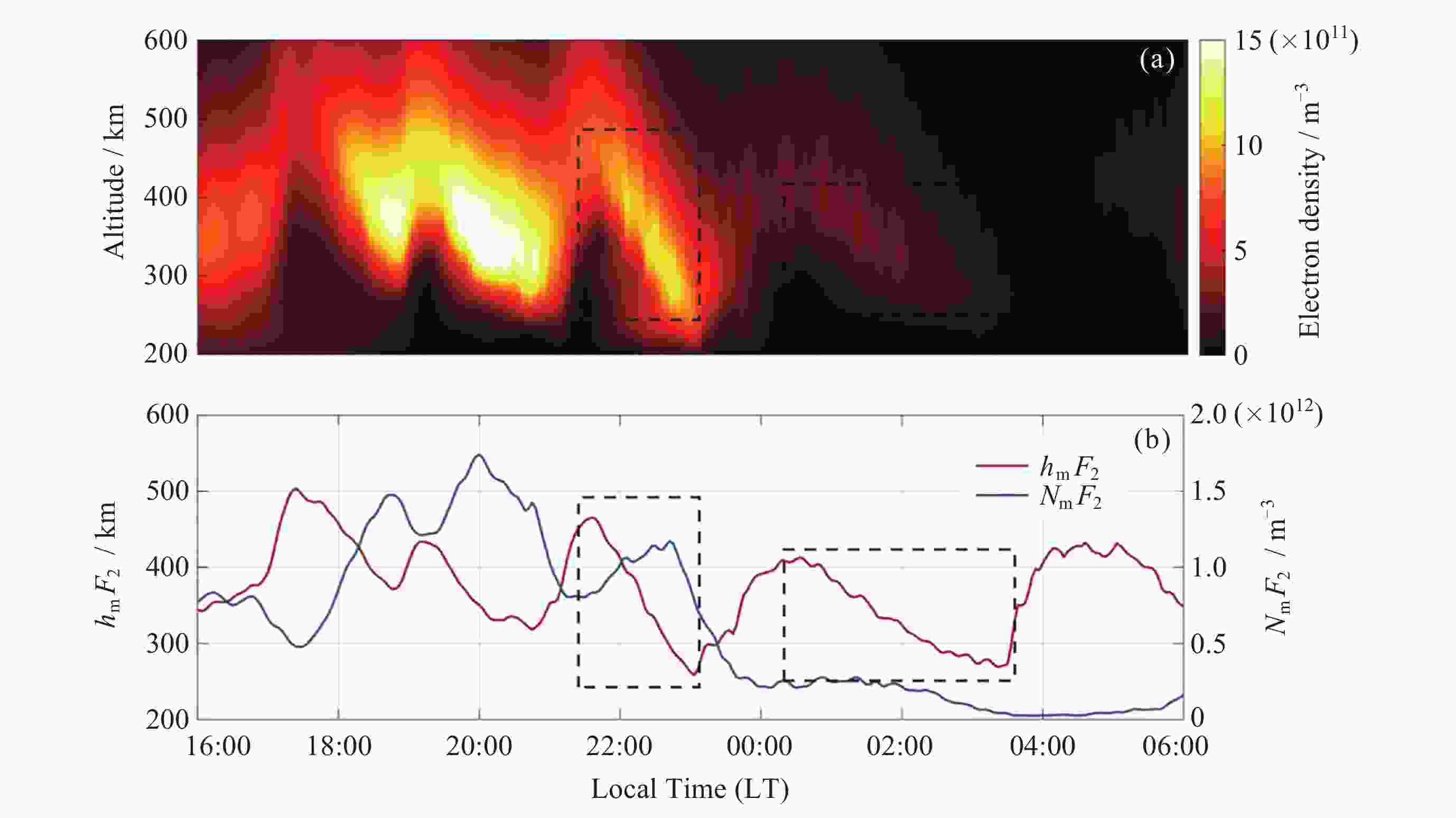
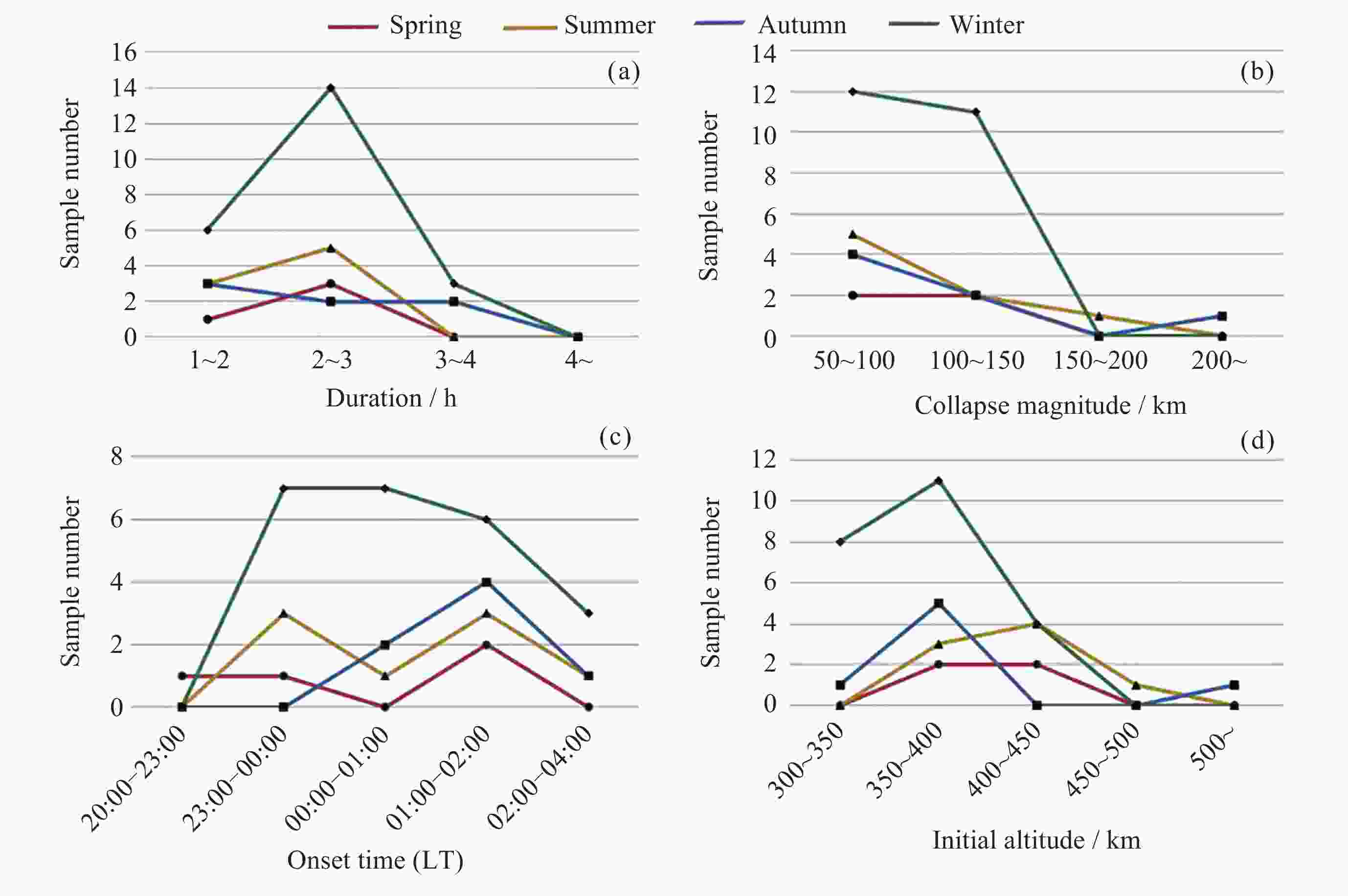
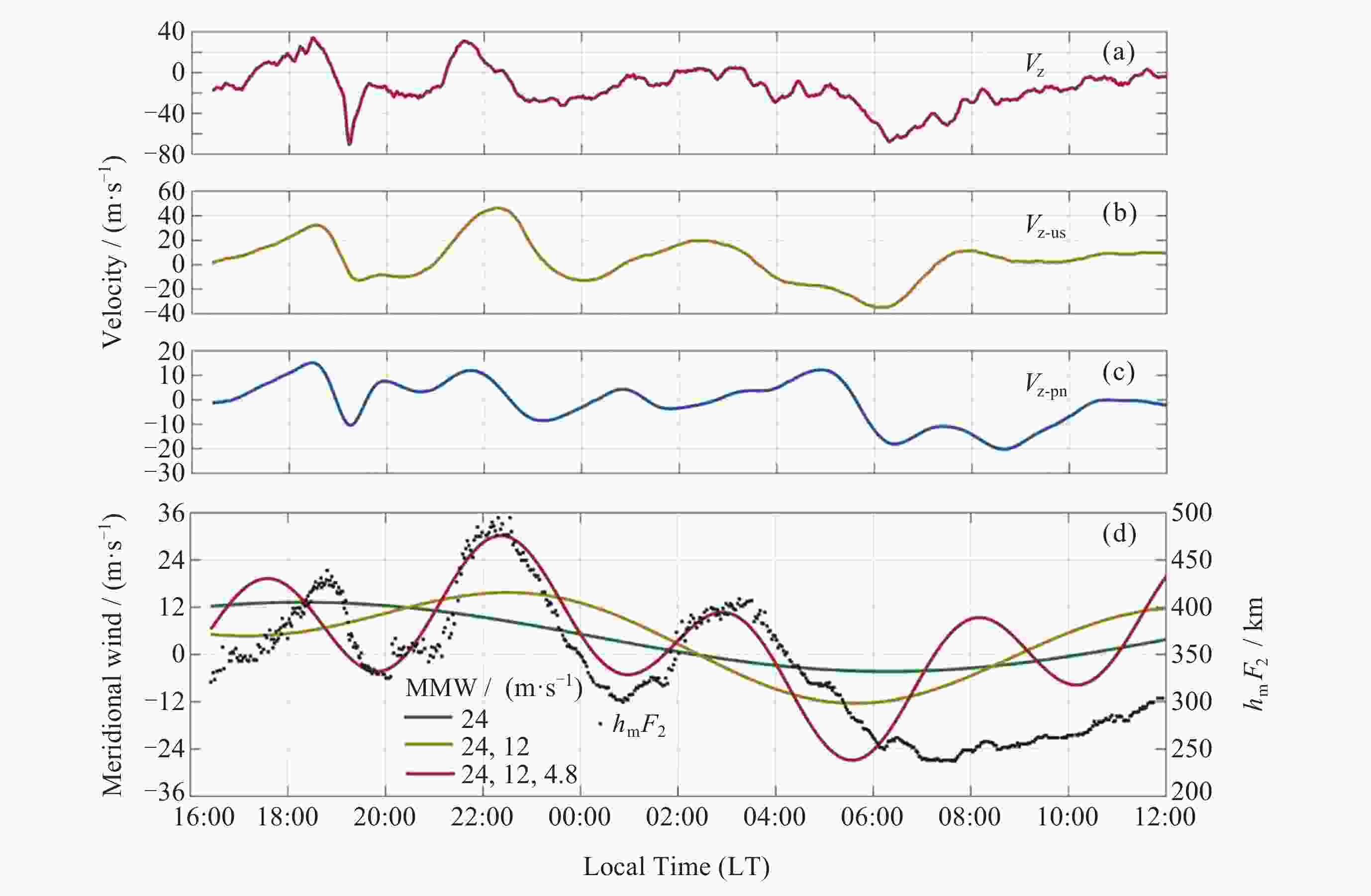
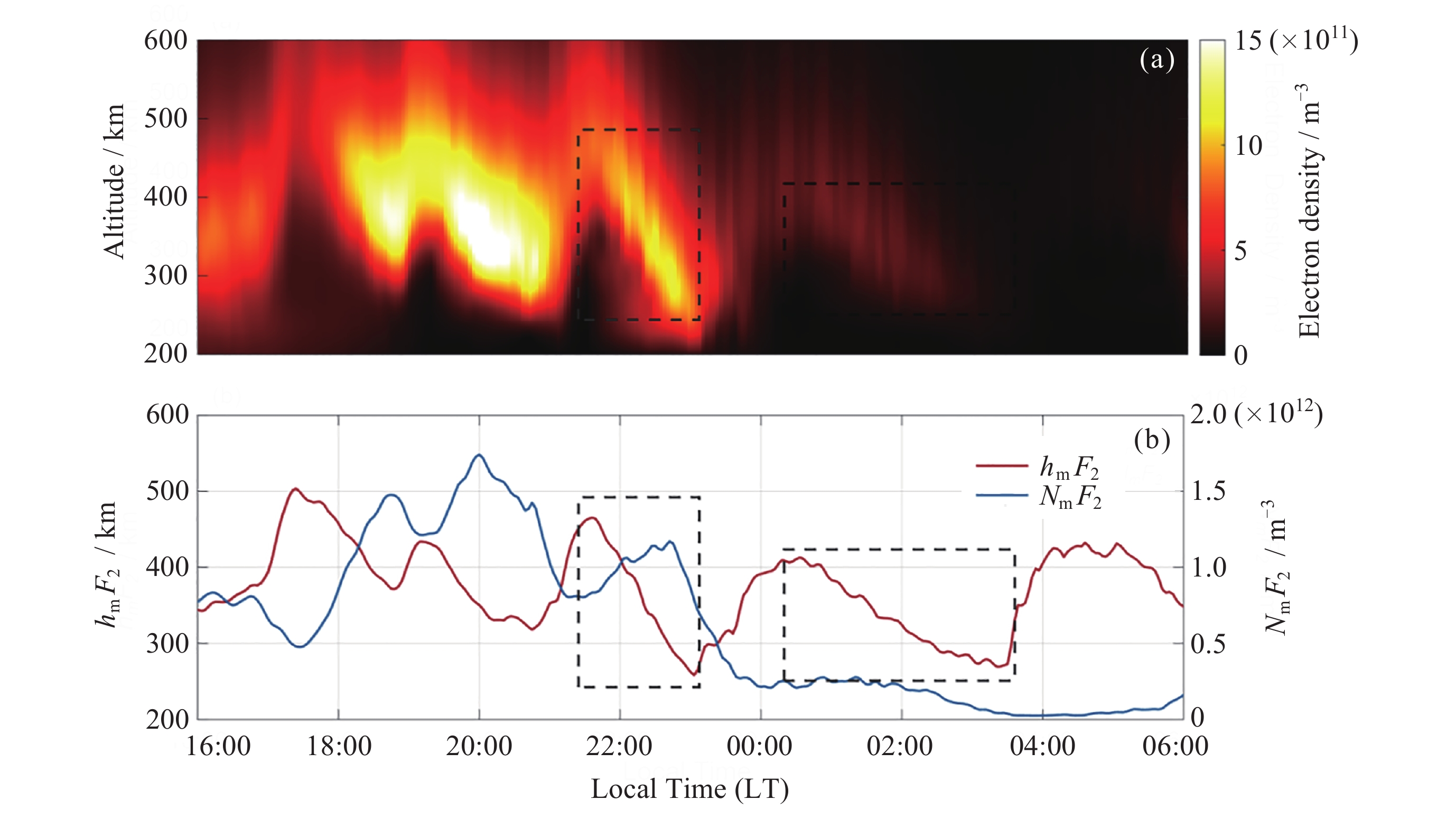
图 1 (a) 2011年8月16日16:00 LT至8月17日06:00 LT期间阿雷西博非相干散射雷达观测到的电子密度的高度–时间分布, 虚线框标示夜间出现的两次典型午夜塌陷过程. (b) 同一时段F区峰值电子密度(NmF2)及其对应峰值高度(hmF2)的时间演变, 用虚线框标出与(a)中对应的午夜塌陷阶段 (修改自文献[2])
Figure 1. (a) Height-time distribution of electron density observed by the Arecibo incoherent scatter radar from 16:00 LT on 16 August to 06:00 LT on 17 August 2011, illustrating two representative midnight collapse events highlighted by dashed boxes. (b) Temporal evolution of the F-region peak electron density (NmF2) and the corresponding peak height (hmF2) during the same interval, with dashed boxes indicating the corresponding collapse phases shown in panel (a) (modified from Ref. [2])
-
[1] NELSON G J, COGGER L L. Dynamical behaviour of the nighttime ionosphere at Arecibo[J]. Journal of Atmospheric and Terrestrial Physics, 1971, 33(11): 1711-1726 doi: 10.1016/0021-9169(71)90219-4 [2] GONG Y, CHEN X K, MA Z, et al. Statistical analysis of ionospheric midnight collapse events observed by Arecibo incoherent scatter radar[J]. Remote Sensing, 2025, 17(16): 2897 doi: 10.3390/rs17162897 [3] HYSELL D L, LARSEN M F, SULZER M P. High time and height resolution neutral wind profile measurements across the mesosphere/Lower thermosphere region using the Arecibo incoherent scatter radar[J]. Journal of Geophysical Research: Space Physics, 2014, 119(3): 2345-2358 doi: 10.1002/2013JA019621 [4] HARPER R M. A semidiurnal tide in the meridional wind at F region heights at low latitudes[J]. Journal of Geophysical Research: Space Physics, 1979, 84(A2): 411-415 doi: 10.1029/JA084iA02p00411 [5] BASU S, BASU S, GANGULY S, et al. Generation of kilometer scale irregularities during the midnight collapse at Arecibo[J]. Journal of Geophysical Research: Space Physics, 1981, 86(A9): 7607-7616 doi: 10.1029/JA086iA09p07607 [6] APONTE N, BRUM C G M, SULZER M P, et al. Measurements of the O+ to H+ transition height and ion temperatures in the lower topside ionosphere over Arecibo for equinox conditions during the 2008-2009 extreme solar minimum[J]. Journal of Geophysical Research: Space Physics, 2013, 118(7): 4465-4470 doi: 10.1002/jgra.50416 [7] YUE X N, CAI Y H, WANG J Y, et al. Ionospheric pre‐sunrise uplift: comparison of Sanya incoherent scatter radar observations and numerical simulations[J]. Journal of Geophysical Research: Space Physics, 2023, 128(2): e2022JA031119 doi: 10.1029/2022JA031119 [8] SEKER I, LIVNEH D J, MATHEWS J D. A 3‐D empirical model of F region medium‐scale traveling ionospheric disturbance bands using incoherent scatter radar and all‐sky imaging at Arecibo[J]. Journal of Geophysical Research: Space Physics, 2009, 114(A6): A06302 doi: 10.1029/2008ja014019 [9] GONG Y, ZHOU Q, ZHANG S, et al. Midnight ionosphere collapse at Arecibo and its relationship to the neutral wind, electric field, and ambipolar diffusion[J]. Journal of Geophysical Research: Space Physics, 2012, 117(A8): A08332 doi: 10.1029/2012ja017530 [10] BURNSIDE R G, BEHNKE R A, WALKER J C G. Meridional neutral winds in the thermosphere at Arecibo: simultaneous incoherent scatter and airglow observations[J]. Journal of Geophysical Research: Space Physics, 1983, 88(A4): 3181-3189 doi: 10.1029/JA088iA04p03181 [11] BEHNKE R A, HARPER R M. Vector measurements of F region ion transport at Arecibo[J]. Journal of Geophysical Research, 1973, 78(34): 8222-8234 doi: 10.1029/JA078i034p08222 [12] MACPHERSON B, GONZÁLEZ S A, BAILEY G J, et al. The effects of meridional neutral winds on the O+‐H+ transition altitude over Arecibo[J]. Journal of Geophysical Research: Space Physics, 1998, 103(A12): 29183-29198 doi: 10.1029/98JA02660 [13] VLASOV M N, NICOLLS M J, KELLEY M C, et al. Modeling of airglow and ionospheric parameters at Arecibo during quiet and disturbed periods in October 2002[J]. Journal of Geophysical Research: Space Physics, 2005, 110(A7): A07303 doi: 10.1029/2005ja011074 [14] HERRERO F A, MERIWETHER JR J W. 6300‐Å airglow meridional intensity gradients[J]. Journal of Geophysical Research: Space Physics, 1980, 85(A8): 4191-4204 doi: 10.1029/JA085iA08p04191 [15] HERRERO F A, SPENCER N W, MAYR H G. Thermosphere and F-region plasma dynamics in the equatorial region[J]. Advances in Space Research, 1993, 13(1): 201-220 doi: 10.1016/0273-1177(93)90019-8 [16] OTSUKA Y, KADOTA T, SHIOKAWA K, et al. Optical and radio measurements of a 630‐nm airglow enhancement over Japan on 9 September 1999[J]. Journal of Geophysical Research: Space Physics, 2003, 108(A6): 1252 doi: 10.1029/2002ja009594 [17] SOBRAL J H A, CARLSON H C, FARLEY D T, et al. Nighttime dynamics of the F region near Arecibo as mapped by airglow features[J]. Journal of Geophysical Research: Space Physics, 1978, 83(A6): 2561-2566 doi: 10.1029/JA083iA06p02561 [18] FOPPIANO A J, CID L, JARA V. Ionospheric long-term trends for South American mid-latitudes[J]. Journal of Atmospheric and Solar-Terrestrial Physics, 1999, 61(9): 717-723 doi: 10.1016/S1364-6826(99)00025-5 [19] KALITA B R, BHUYAN P K, YOSHIKAWA A. NmF2 and hmF2 measurements at 95° E and 127° E around the EIA northern crest during 2010-2014[J]. Earth, Planets and Space, 2015, 67(1): 186 doi: 10.1186/s40623-015-0355-3 [20] MORO J, XU J, DENARDINI C M, et al. On the sources of the ionospheric variability in the South American magnetic anomaly during solar minimum[J]. Journal of Geophysical Research: Space Physics, 2019, 124(9): 7638-7653 doi: 10.1029/2019JA026780 [21] JIANG C H, TIAN R, LIU T X, et al. Observations of strong range spread f and nighttime ionospheric enhancement in the mid‐latitude region under geomagnetically quiet conditions[J]. Journal of Geophysical Research: Space Physics, 2024, 129(11): e2024JA033106 doi: 10.1029/2024JA033106 [22] JAKOWSKI N, JUNGSTAND A, LOIS L, et al. Night-time enhancements of the F2-layer ionization over Havana, Cuba[J]. Journal of Atmospheric and Terrestrial Physics, 1991, 53(11/12): 1131-1138 doi: 10.1016/0021-9169(91)90062-c [23] DANDENAULT P B, RICHARDS P G. The collapse of the midnight ionosphere and behavior of meridional neutral winds at townsville over a full solar cycle[J]. Journal of Geophysical Research: Space Physics, 2015, 120(11): 9826-9838 doi: 10.1002/2015JA021842 [24] CRARY D J, FORBES J M. The dynamic ionosphere over Arecibo: a theoretical investigation[J]. Journal of Geophysical Research: Space Physics, 1986, 91(A1): 249-258 doi: 10.1029/JA091iA01p00249 [25] LEI J H, LIU L B, WAN W X, et al. Modeling the behavior of ionosphere above Millstone Hill during the September 21-27, 1998 storm[J]. Journal of Atmospheric and Solar-Terrestrial Physics, 2004, 66(12): 1093-1102 doi: 10.1016/j.jastp.2004.04.004 [26] GORDON W E. Incoherent scattering of radio waves by free electrons with applications to space exploration by radar[J]. Proceedings of the IRE, 1958, 46(11): 1824-1829 doi: 10.1109/JRPROC.1958.286852 [27] SULZER M P. A phase modulation technique for a sevenfold statistical improvement in incoherent scatter data‐taking[J]. Radio Science, 1986, 21(4): 737-744 doi: 10.1029/RS021i004p00737 [28] SULZER M P. A radar technique for high range resolution incoherent scatter autocorrelation function measurements utilizing the full average power of klystron radars[J]. Radio Science, 1986, 21(6): 1033-1040 doi: 10.1029/RS021i006p01033 [29] ZHOU Q H, SULZER M P. Incoherent scatter radar observations of the F-region ionosphere at Arecibo during January 1993[J]. Journal of Atmospheric and Solar-Terrestrial Physics, 1997, 59(17): 2213-2229 doi: 10.1016/S1364-6826(97)00040-0 [30] LI Y L, ZHOU Q H. Measurements of F1‐ region ionosphere state variables at Arecibo through quasi height‐independent exhaustive fittings of the incoherent scatter ion‐line spectra[J]. Journal of Geophysical Research: Space Physics, 2024, 129(11): e2024JA032620 doi: 10.1029/2024JA032620 [31] GONG Y, ZHANG S D, ZHOU Q H, et al. First observation of a strong thermospheric 4. 8‐hour tide and its impact on the ionosphere over Arecibo[J]. Geophysical Research Letters, 2025, 52(15): e2025GL115315 [32] GONG Y, CHEN X, MA Z, et al. Storm-time modulation of ionospheric midnight collapses over Arecibo: role of ion drift components and thermospheric tides[J]. Journal of Geophysical Research: Space Physics, 2026, 131: e2025JA035011. doi: 10.1029/2025JA035011 [33] GOSLING J T. The solar flare myth[J]. Journal of Geophysical Research: Space Physics, 1993, 98(A11): 18937-18949 doi: 10.1029/93JA01896 [34] BUONSANTO M J. Ionospheric storms-a review[J]. Space Science Reviews, 1999, 88(3/4): 563-601 [35] IMMEL T J, MANNUCCI A J. Ionospheric redistribution during geomagnetic storms[J]. Journal of Geophysical Research: Space Physics, 2013, 118(12): 7928-7939 doi: 10.1002/2013JA018919 [36] EVANS J S, CORREIRA J, LUMPE J D, et al. GOLD observations of the thermospheric response to the 10-12 may 2024 Gannon superstorm[J]. Geophysical Research Letters, 2024, 51(16): e2024GL110506 doi: 10.1029/2024GL110506 [37] FULLER‐ROWELL T J, CODRESCU M V, MOFFETT R J, et al. Response of the thermosphere and ionosphere to geomagnetic storms[J]. Journal of Geophysical Research: Space Physics, 1994, 99(A3): 3893-3914 doi: 10.1029/93JA02015 [38] GONG Y, ZHOU Q H. Incoherent scatter radar study of the terdiurnal tide in the E‐ and F‐region heights at Arecibo[J]. Geophysical Research Letters, 2011, 38(15): L15101 doi: 10.1029/2011gl048318 [39] IMMEL T J, SAGAWA E, ENGLAND S L, et al. Control of equatorial ionospheric morphology by atmospheric tides[J]. Geophysical Research Letters, 2006, 33(15): L15108 doi: 10.1029/2006gl026161 [40] FORBES J M, BRUINSMA S L, ZHANG X L, et al. Surface‐exosphere coupling due to thermal tides[J]. Geophysical Research Letters, 2009, 36(15): L15812 doi: 10.1029/2009gl038748 [41] OBERHEIDE J, FORBES J M, HÄUSLER K, et al. Tropospheric tides from 80 to 400 km: propagation, interannual variability, and solar cycle effects[J]. Journal of Geophysical Research: Atmospheres, 2009, 114(D1): D00I05 doi: 10.1029/2009jd012388 [42] GONG Y, MA Z, LV X D, et al. A study on the quarterdiurnal tide in the thermosphere at Arecibo during the February 2016 sudden stratospheric warming event[J]. Geophysical Research Letters, 2018, 45(23): 13142-13149 doi: 10.1029/2018gl080422 -
-

 下载:
下载:

计量
- 文章访问数: 755
- HTML全文浏览量: 76
- PDF下载量: 101
-
被引次数:
0(来源:Crossref)
0(来源:其他)

