| Citation: | XIONG Shaolin. Overview of GECAM Observations from 2024 to 2026. Chinese Journal of Space Science, 2026, 46(4): 918-922 doi: 10.11728/cjss2026.04.2026-yg19

|

| [1] |
ABBOTT B P, ABBOTT R, ABBOTT T D, et al. Gravitational waves and gamma-rays from a binary neutron star merger: GW170817 and GRB 170817A[J]. The Astrophysical Journal Letters, 2017, 848(2): L13 doi: 10.3847/2041-8213/aa920c
|
| [2] |
GOLDSTEIN A, VERES P, BURNS E, et al. An ordinary short gamma-ray burst with extraordinary implications: Fermi-GBM Detection of GRB 170817A[J]. The Astrophysical Journal Letters, 2017, 848(2): L14 doi: 10.3847/2041-8213/aa8f41
|
| [3] |
LIU J C, ZHANG Y Q, XIONG S L, et al. GRB 221009A: HEBS detection[J/OL]. GRB Coordinates Network, (2022-10-14). https://ui.adsabs.harvard.edu/abs/2022GCN.32751..1L/abstract
|
| [4] |
AN Z H, ANTIER S, BI X Z, et al. Insight-HXMT and GECAM-C observations of the brightest-of-all-time GRB 221009A[OL]. arXiv preprint, arXiv: 2303.01203, 2023
|
| [5] |
ZHENG C, ZHANG Y Q, XIONG S L, et al. Observation of GRB 221009A early afterglow in X-ray/gamma-ray energy bands[J]. The Astrophysical Journal Letters, 2024, 962(1): L2 doi: 10.3847/2041-8213/ad2073
|
| [6] |
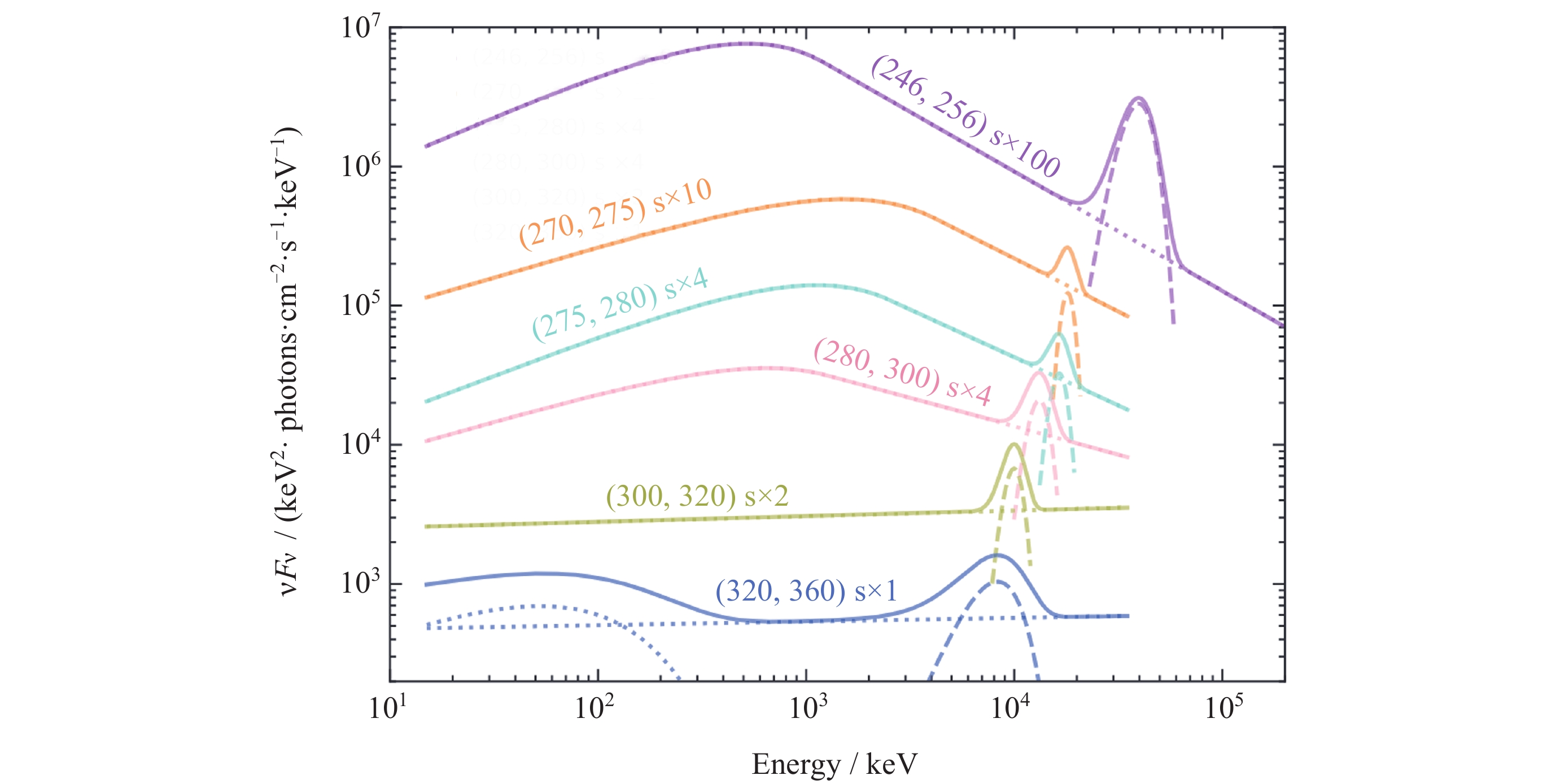
ZHANG Y Q, XIONG S L, MAO J R, et al. Observation of spectral lines in the exceptional GRB 221009A[J]. Science China Physics, Mechanics & Astronomy, 2024, 67(8): 289511
|
| [7] |
LIU J Y, MAO J R, XIONG S L, et al. The production mechanism of the high-energy emission line in the brightest cosmic burst[OL]. arXiv preprint arXiv: 2509.14715, 2025
|
| [8] |
YU Z H, WANG C W, XIONG S L, et al. Brightest gamma-ray-burst flare observed in GRB 221009A: bridging the last gap between the prompt emission and flare in gamma-ray bursts[J]. The Astrophysical Journal Letters, 2026, 998(1): L21 doi: 10.3847/2041-8213/ae33be
|
| [9] |
SUN H, WANG C W, YANG J, et al. Magnetar emergence in a peculiar gamma-ray burst from a compact star merger[J]. National Science Review, 2025, 12(3): nwae401 doi: 10.1093/nsr/nwae401
|
| [10] |
YI S X, WANG C W, SHAO X, et al. Evidence of minijet emission in a large emission zone from a magnetically dominated gamma-ray burst jet[J]. The Astrophysical Journal, 2025, 985(2): 239 doi: 10.3847/1538-4357/adcf98
|
| [11] |
MACCARY R, GUIDORZI C, MAISTRELLO M, et al. A set of distinctive properties ruling the prompt emission of GRB 230307A and other long γ-ray bursts from compact object mergers[J]. Journal of High Energy Astrophysics, 2026, 49: 100456 doi: 10.1016/j.jheap.2025.100456
|
| [12] |
CHEN R C, ZHANG B B, WANG C W, et al. Evidence for a brief appearance of gamma-ray periodicity after a compact star merger[J]. Nature Astronomy, 2025, 9(11): 1701-1713 doi: 10.1038/s41550-025-02649-w
|
| [13] |
ZHANG Y Q, XUE W C, ZHANG J P, et al. Multi-instrument search for gamma-ray counterpart of X-ray transients detected by EP/WXT[J]. The Astrophysical Journal Letters, 2025, 987(2): L38 doi: 10.3847/2041-8213/ade0aa
|
| [14] |
CAI C, XIONG S L, ZHANG Y Q, et al. Extending the short gamma-ray burst population from subthreshold triggers in Fermi/GBM and GECAM data and its implications[J]. The Astrophysical Journal Letters, 2025, 989(2): L21 doi: 10.3847/2041-8213/adf722
|
| [15] |
ZHANG J P, WANG C W, YU Z H, et al. On the ultralong gamma-ray transient GRB 250702B/EP 250702a[J]. The Astrophysical Journal Letters, 2026, 997(2): L45 doi: 10.3847/2041-8213/ae31e7
|
| [16] |
XIE S L, CAI C, YU Y W, et al. GECAM observations of the galactic magnetar SGR J1935+2154 during the 2021 and 2022 burst active episodes. I. burst catalog[J]. The Astrophysical Journal Supplement Series, 2025, 277(1): 5 doi: 10.3847/1538-4365/ada6a9
|
| [17] |
XIAO S, TUO Y L, ZHANG S N, et al. Discovery of the linear energy dependence of the spectral lag of X-ray bursts from SGR J1935+2154[J]. Monthly Notices of the Royal Astronomical Society, 2023, 521(4): 5308-5333 doi: 10.1093/mnras/stad885
|
| [18] |
XIAO S, YANG J J, LUO X H, et al. The minimum variation timescales of X-ray bursts from SGR J1935+2154[J]. The Astrophysical Journal Supplement Series, 2023, 268(1): 5 doi: 10.3847/1538-4365/ace77c
|
| [19] |
XIAO S, LI X B, XUE W C, et al. Individual and averaged power density spectra of X-ray bursts from SGR J1935+2154: quasi-periodic oscillation search and slopes[J]. Monthly Notices of the Royal Astronomical Society, 2024, 527(4): 11915-11924
|
| [20] |
XIAO S, ZHANG S N, XIONG S L, et al. The self-organized criticality behaviours of two new parameters in SGR J1935+2154[J]. Monthly Notices of the Royal Astronomical Society, 2024, 528(2): 1388-1392 doi: 10.1093/mnras/stae142
|
| [21] |
WANG C W, XIONG S L, WANG Y, et al. GECAM discovery of the second FRB-associated magnetar X-ray burst from SGR J1935+2154[J]. Monthly Notices of the Royal Astronomical Society, 2026, 546(4): stag312 doi: 10.1093/mnras/stag312
|
| [22] |
TAN W J, WANG Y, WANG C W, et al. GECAM discovery of a peculiar magnetar X-ray burst (MXB 221120) from SGR J1935+2154 associated with a fast radio burst[J]. Astronomy & Astrophysics, 2026, 707: A289 doi: 10.1051/0004-6361/202658841
|
| [23] |
WANG Y, WANG C W, XIONG S L, et al. Unveil a peculiar light-curve pattern of magnetar burst with GECAM observations of SGR J1935+2154[J]. The Astrophysical Journal, 2025, 993(1): 24 doi: 10.3847/1538-4357/ae0cbe
|
| [24] |
XIE S L, CHEN A M, YU Y W, et al. Eclipsed X-ray bursts from magnetar SGR J1935+2154 and the fireball measurements[J]. The Astrophysical Journal, 2026, 999(2): 159 doi: 10.3847/1538-4357/ae433d
|
| [25] |
ZHAO Y, LIU J C, XIONG S L, et al. The first GECAM observation results on terrestrial gamma-ray flashes and terrestrial electron beams[J]. Geophysical Research Letters, 2023, 50(14): e2022GL102325 doi: 10.1029/2022GL102325
|
| [26] |
WANG C W, XIONG S L, ZHAO Y, et al. GECAM discovery of peculiar oscillating particle precipitation events[J]. Science China Physics, Mechanics & Astronomy, 2026, 69(2): 229513
|
| [27] |
WANG C W, XIONG S L, XUE H B, et al. Pitch angle measurement method based on detector counts distribution. -I. Basic conception[J]. Experimental Astronomy, 2025, 60(3): 25
|
| [28] |
REN Y Z, ZHU F R, XIONG S L, et al. Systematic study of the simultaneous events detected by GECAM[J]. Astronomy & Astrophysics, 2026, 707: A318 doi: 10.1051/0004-6361/202558377
|
Figures(1)
Journal Introduction
ISSN 2097-7689 CN 11-1783/V
Copyright © Editorial Office of Chinese Journal of Space Science. 京ICP备08100722号
Supported by: Beijing Renhe Information Technology Co., Ltd.



 DownLoad: